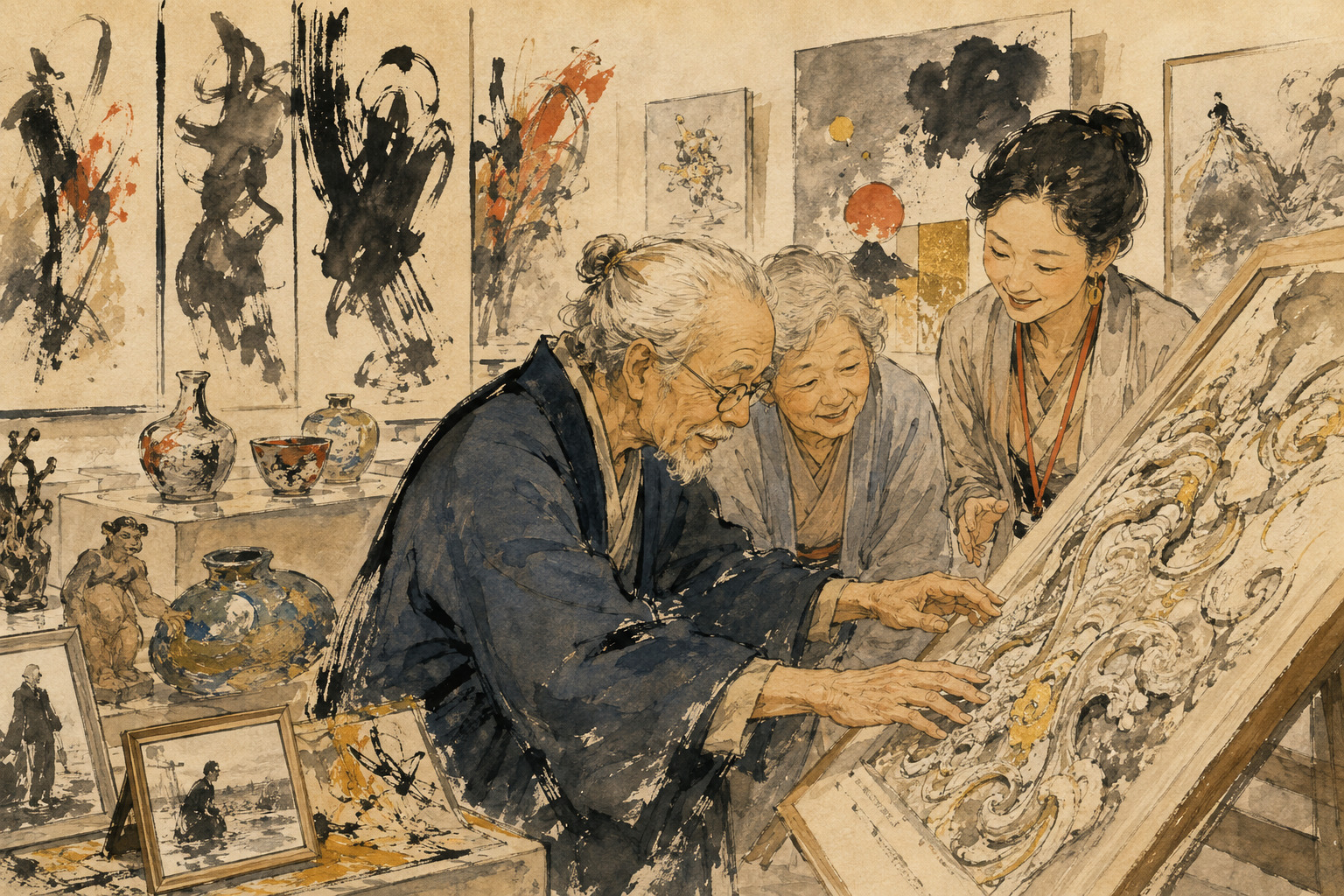
A gallery’s most familiar command is so deeply learned that it can be delivered without words: step close, look carefully, keep your hands back. In Yokohama this week, one part of an exhibition begins with the opposite invitation. Some works made by residents of senior homes may be experienced by touch. A visitor can approach not only through color and outline but through texture, pressure, warmth and the slow movement of fingers across a surface.
That reversal is only half the story. The other boundary being crossed is the wall—physical and social—around residential care. Benesse Style Care’s Tsumugu Art Exhibition 2026 Summer, whose name suggests weaving or joining lives together, runs through Sunday at Art Forum Azamino in Yokohama’s Aoba Ward. Paintings, ceramics, photographs and calligraphy made before and after residents entered care are shown in a public cultural venue. Their makers are not present only as people receiving a service. Their imaginations, choices and accumulated biographies face the city.
Benesse’s July announcement describes about 100 works. Art Forum Azamino’s own calendar lists 31 participating fee-based senior homes and about 120 items, including handicrafts. The sources do not explain the 20-work difference; they may be counting different categories or a later installation list. The honest description is therefore approximate, not exact. Nor does either listing say that every work can be handled. The new tactile component applies to works deliberately presented for touch.
What is on view—and what the public record does not tell us
The exhibition occupies the full first-floor exhibition area at Art Forum Azamino. Admission is free and no reservation is required. It is open from 10 a.m. to 5 p.m., with last admission at 4:30; on Sunday it closes at 2 p.m., with last admission at 1:30. Benesse says its dialogic-viewing session is offered from 2:30 to 3:30 p.m. each day from Wednesday through Saturday, with visitors asking staff on the day.
| What is confirmed | What remains unclear in the public material |
|---|---|
| Residents’ painting, ceramics, photography, calligraphy and other work are displayed. | No full catalogue, artist list or work-by-work provenance had been published before this article. |
| Works made both before and after moving into a Benesse home are included. | The organizer does not break down how many works come from each period or each home. |
| Selected resident-made art is intended for direct tactile viewing for the first time in the series. | The announcement does not specify the number, materials, handling protocol, tactile labels, audio description or whether blind and low-vision advisers co-designed the presentation. |
| BASN dialogic viewing invites a group to look, think, speak and listen with a facilitator. | No independent evaluation of this exhibition’s effect on residents or visitors has been released. |
Those gaps do not cancel the event. They define how carefully it should be reported. “Touchable” is a real design decision, but it is not a synonym for “fully accessible.” “About 100 works” is a large exhibition, but it does not mean 100 artists. “Quality of life” is the organizer’s objective, not a measured result reported in a peer-reviewed study of these residents.
A life does not begin at the care-home door
The most consequential curatorial choice may be quieter than touch. Benesse says it is showing work residents made before entering a home alongside work made after the move. That decision refuses an institutional habit: recording a person primarily from the date of admission forward.
A painting carried into residential care can be evidence of a self assembled across decades—a place once visited, a technique practiced, a friendship maintained, a problem returned to. A ceramic vessel may have been made before the artist needed daily assistance. A photograph can preserve not only what stood before a lens, but where the photographer chose to stand. When such work is stored as a personal belonging, only a few people may see it. When it receives a label, spacing, light and a public audience, it becomes testimony.
The distinction matters in a country where 36.24 million people, 29.3 percent of the population, were 65 or older in the Statistics Bureau’s October 2024 estimate. Demography can turn older people into a policy mass: pension recipients, patients, household types, care levels, budget pressure. Those categories are necessary for planning. They are inadequate for describing a person.
The gallery performs a change of grammar. A “resident’s activity” becomes an artist’s work. A private possession becomes public culture. A person spoken about by a care organization becomes someone whose decisions other people must interpret.
That shift should not be romanticized. Entry into a public exhibition does not erase dependence, loneliness, illness or the limits of residential life. It also does not guarantee equal curatorial power. The organizer still selects, frames and describes the work. But moving art outward changes who can respond to it. A neighbor, child or stranger is no longer visiting a care institution to be charitable. The visitor is receiving something made by a resident.
From “do not touch” to a museum of many senses
The prohibition on touching art has sound reasons. Skin leaves oil, salt and moisture. Repeated contact abrades a surface. A bronze, textile, paper object or painted layer can be permanently changed by thousands of careful hands. Museums hold objects for viewers who are not yet born, and conservation distributes access across time.
But the rule also distributes access unequally in the present. If the approved path to an object is exclusively visual, a visitor who cannot see it clearly receives less of the work. A written label can describe shape; it cannot reproduce weight, edge, grain, concavity or the way a hand learns a volume by moving around it.
Museums have been challenging that inequality for at least half a century. New York’s Museum of Modern Art introduced touch tours in 1972, enabling blind and low-vision visitors to encounter sculpture with trained guides. The program did not abolish conservation. It identified objects and procedures through which touch could become an authorized method of looking.
In Japan, the National Museum of Ethnology in Osaka gave tactile culture a major public platform in 2021 with Universal Museum—Exploring the New Field of Tactile Sensation. The exhibition and its later touring versions did not treat touch merely as compensation for sight. They asked sighted visitors, too, to discover how much modern exhibition culture loses when vision dominates every other sense. Workshops used blindfolds, clay and textured objects to make touch an active form of inquiry.
1972 — MoMA introduces guided touch tours for blind and low-vision visitors.
2006 — The United Nations adopts the Convention on the Rights of Persons with Disabilities; Article 30 protects equal participation in cultural life and the use of artistic potential for society’s enrichment.
2014 — Japan ratifies the convention.
2018 — Japan enacts a law promoting cultural and artistic activity by persons with disabilities.
2021 — Osaka’s National Museum of Ethnology opens its large tactile “Universal Museum” exhibition.
2024 — Reasonable accommodation by private businesses becomes a legal obligation in Japan.
2026 — Tsumugu adds resident-made tactile art to its fifth public exhibition.
Yokohama’s exhibition sits inside this wider history, though Benesse does not present it as a disability-specific show. Its contribution is smaller and more local: it makes touch part of an encounter between people living in senior homes and people arriving from the surrounding community. That social direction matters. Access is not only a technique for delivering information to an individual. It can reorganize who is permitted to participate in a cultural exchange.
Touch is a beginning, not an accessibility certificate
A work designed to be handled must answer questions that ordinary wall display can postpone. Which surface carries meaning? From what height and angle can it be reached? Can it withstand repeated contact? Does a visitor know where to begin? Is guidance offered without taking control of the person’s hand? Can someone decline physical contact and still understand the work?
Meaningful access also extends beyond touch: step-free routes, places to rest, large print, strong contrast, plain-language text, Braille where useful, audio description, captioning and staff able to adjust an encounter. The best combination depends on the work and on consultation with the people expected to use it. No single feature makes a gallery universal.
Japan’s policy landscape has moved toward that understanding. The disability-rights convention’s Article 30 covers access to cultural materials and places, but it goes further: people with disabilities must have opportunities to develop and use their creative, artistic and intellectual potential not only for themselves but for society. Japan’s 2018 cultural-arts law similarly joins creation, enjoyment and social participation. Since April 2024, businesses have been legally required to provide reasonable accommodation, subject to the circumstances of a request and undue burden.
The important word is not “special.” It is “equal.” A tactile replica offered in a corridor while the original experience remains socially or intellectually closed can still isolate. By contrast, an object intentionally made for many hands can give sighted and non-sighted visitors a common starting point. People may notice different features, but they inhabit the same cultural event.
Looking together without an answer key
The exhibition’s second experiment is conversational. BASN dialogic viewing, developed through Benesse Art Site Naoshima, gathers people with a facilitator to look, think and put discoveries or feelings into words. Participants hear how other people construct meaning from the same object. The point is not to guess the curator’s answer.
Benesse Style Care says it began holding these sessions twice a month in participating homes in fiscal 2024. Nursery-school children joined, and after-school club children followed in fiscal 2025. The company says the gatherings have also been used in dementia cafés, creating repeated points of contact with the community. At the Yokohama exhibition, residents who choose to participate and employee facilitators bring that method into the gallery.
The practice can change the relationship between care worker and resident. In an ordinary service interaction, the staff member often knows the schedule, the safety procedure and the desired outcome. In front of an ambiguous artwork, expertise is redistributed. A resident’s association or interpretation may be the thing no one else can supply.
Still, “dialogue” is not automatically equal. A facilitator can steer too hard, reward some answers, rush silence or turn personal memory into clinical data. Ethical practice requires consent, the freedom not to disclose and respect for speech that arrives slowly or nonverbally. An artwork should open a person’s world, not authorize an institution to claim it.
How a home activity became a public series
Tsumugu began in fiscal 2023 with 30 Benesse homes centered on Kawasaki, Yokohama and Machida. The purpose, in the company’s description, was to give residents a celebratory public occasion for individual expression and the achievement of making work together. It started at the same Azamino venue to which it has now returned.
The format widened by one circle each year. In fiscal 2024, residents made joint work with children from Benesse nursery schools. In August 2025, visitors added masking tape to a participatory piece that changed across the exhibition’s run; attendance reached 745. The fourth edition moved to Takatsu Civic Hall in Kawasaki in March 2026, added children from after-school clubs and drew a series record of 932 visitors.
That spring display included torn-paper pictures inspired by ukiyo-e, pipe-cleaner bouquets, art assembled from recycled bottle caps, masking-tape collaborations and a two-meter map joining Kawasaki landmarks with features of homes and nurseries. Individual work remained important: the organizer said showing pieces from any period of a resident’s life could renew confidence and motivation.
The current fifth edition returns attention to individual practice while adding the senses. It also returns to a civic gallery at a moment when other exhibitions occupy the same building. Senior-home art is not presented in a sealed care-sector conference. It enters Yokohama’s ordinary exhibition calendar.
- Fiscal 2023: 30 homes launch the exhibition around individual and group expression.
- Fiscal 2024: nursery-school children join collaborative making; regular dialogic viewing develops in homes.
- August 2025: visitors help build participatory art; attendance reaches 745.
- March 2026: the show moves to Kawasaki, includes after-school clubs and receives a record 932 visitors.
- August 2026: the fifth exhibition presents roughly 100 works and introduces art intended to be touched.
What research can say—and what it cannot
Arts participation and health have become a substantial research field. A 2019 World Health Organization evidence review mapped more than 3,000 studies and found roles for the arts in health promotion, prevention and the management of illness across the lifespan. The range was wide, from small pilots and case studies to longitudinal cohorts and randomized trials. That breadth is encouraging; it is also a warning against turning “art is good for you” into one simple causal promise.
A Japanese cross-sectional study of 522 community-dwelling adults aged 60 and older found that more frequent active arts engagement—activities such as music and painting—was associated with higher scores across positive emotion, engagement, relationships, meaning and accomplishment. A later comparison using longitudinal data from Japan and England found that participation in arts and cultural groups was associated in the Japanese cohort with higher odds of life satisfaction and greater social support.
Those findings support continued access to culture. They do not prove that this five-day exhibition improves cognition, treats dementia or raises every resident’s quality of life. People who join arts activities may differ in health, income, mobility, education or social support from those who do not. Even carefully adjusted observational research cannot erase every such difference.
There is also a moral risk in requiring art by older people to justify itself medically. No one asks a younger painter to lower health costs before granting wall space. Residents may create because a color is beautiful, because clay answers the hand, because a photograph settles a memory, because finishing is satisfying, or because the result is strange and funny. Art can support health and still be worth making when no clinical outcome changes.
The most respectful claim is also the strongest one: older people do not need a therapeutic excuse to enter public culture. Their work can be valuable because it asks something of the rest of us.
The provider is also the narrator
Benesse Style Care organizes the exhibition, provides many of the facilitators and operates the homes whose residents supply the art. Its corporate philosophy invokes Benesse, “living well,” and the company explicitly presents the program as evidence of personalized care and efforts to improve quality of life.
That alignment can fund sustained work. It also creates a marketing interest. The organizer’s releases naturally emphasize confidence, possibility, connection and staff insight. Public material available before publication did not include residents’ critical accounts, independent visitor research, selection criteria, refusal rates, copyright terms, artist compensation or a formal access audit.
These are not hostile questions. They are how a promising activity matures into accountable cultural practice. Who decides that an old work leaves a resident’s room? Is consent renewed for publicity and photography? Does the artist approve the label? Can a resident choose anonymity or withdraw? Are works insured? Are residents able to attend the public venue, and if not, how do responses return to them? Are artist names used wherever residents want them used?
At its best, “person-centered” care should make those choices visible. A person is not centered when an institution tells a moving story on their behalf without transferring control. The same principle that makes touch ethical—permission, guidance and choice—makes exhibition ethical too.
The hand meets a history
A hand moving across a deliberately touchable artwork encounters more than a texture. It meets the decisions of another hand: where to press, build, score, join, smooth or leave rough. That exchange can cross age, sight, institutional status and the distance between a private room and a public gallery.
Tsumugu’s fifth edition is modest beside a national museum or a disability-rights law. It does not solve the access of every work or the social isolation of residential care. Its importance lies in the direction of travel. Art comes out of the home. Visitors go beyond passive looking. Conversation replaces the answer key. Work made decades ago is allowed to speak in the present tense.
The conventional museum instruction protects an object by controlling the visitor: do not touch. Yokohama’s more interesting instruction asks everyone to accept a different responsibility. Touch only what has been offered. Listen to what another person notices. Treat the maker not as a diagnosis, an age or a corporate case study, but as the source of an encounter.
A public exhibition cannot give anyone back an earlier life. It can refuse to act as though that life disappeared. On the gallery wall, on a plinth and under a visitor’s fingertips, the residents’ histories remain active—still capable of changing the room.
- Benesse Style Care Group — official July 16 announcement, exhibition dates, approximately 100 works, tactile art and BASN dialogic viewing
- PR TIMES release syndicated by TRAICY — hours, admission, viewing sessions and development of the exhibition
- Art Forum Azamino — venue listing, 31 homes and approximately 120 items
- Benesse Style Care Group — spring 2026 exhibition history, 30-home origin, collaborative works and dialogic practice
- Benesse Art Site Naoshima — dialogic-viewing forum and facilitation beyond the museum
- Museum of Modern Art — history of touch tours and access programs beginning in 1972
- National Museum of Ethnology — 2021 Universal Museum tactile exhibition
- United Nations — Convention on the Rights of Persons with Disabilities, Article 30
- Ministry of Foreign Affairs — Japan’s 2014 ratification of the disability-rights convention
- Agency for Cultural Affairs — 2018 law promoting cultural and artistic activities by persons with disabilities
- Cabinet Office — mandatory reasonable accommodation by private businesses from April 2024
- World Health Organization — 2019 scoping review of more than 3,000 studies on arts, health and well-being
- Statistics Bureau — 2024 population estimate by age
- Public Health journal study — arts engagement and psychological well-being among older adults in Japan
- BMJ Public Health study — longitudinal arts-group participation, well-being and social support in Japan and England
Editorial note: This article uses public records and published research; it contains no independent interviews or on-site observations. Benesse’s “about 100 works” and quality-of-life language are organizer statements. The venue separately lists about 120 items from 31 homes, a difference the sources do not reconcile. The article therefore avoids an exact count. It does not assume that residents are disabled or that the tactile element was designed specifically for blind and low-vision visitors. Program details were checked during the exhibition and may be changed by the organizer. The exchange-rate strip is an editorial reference unrelated to the exhibition.