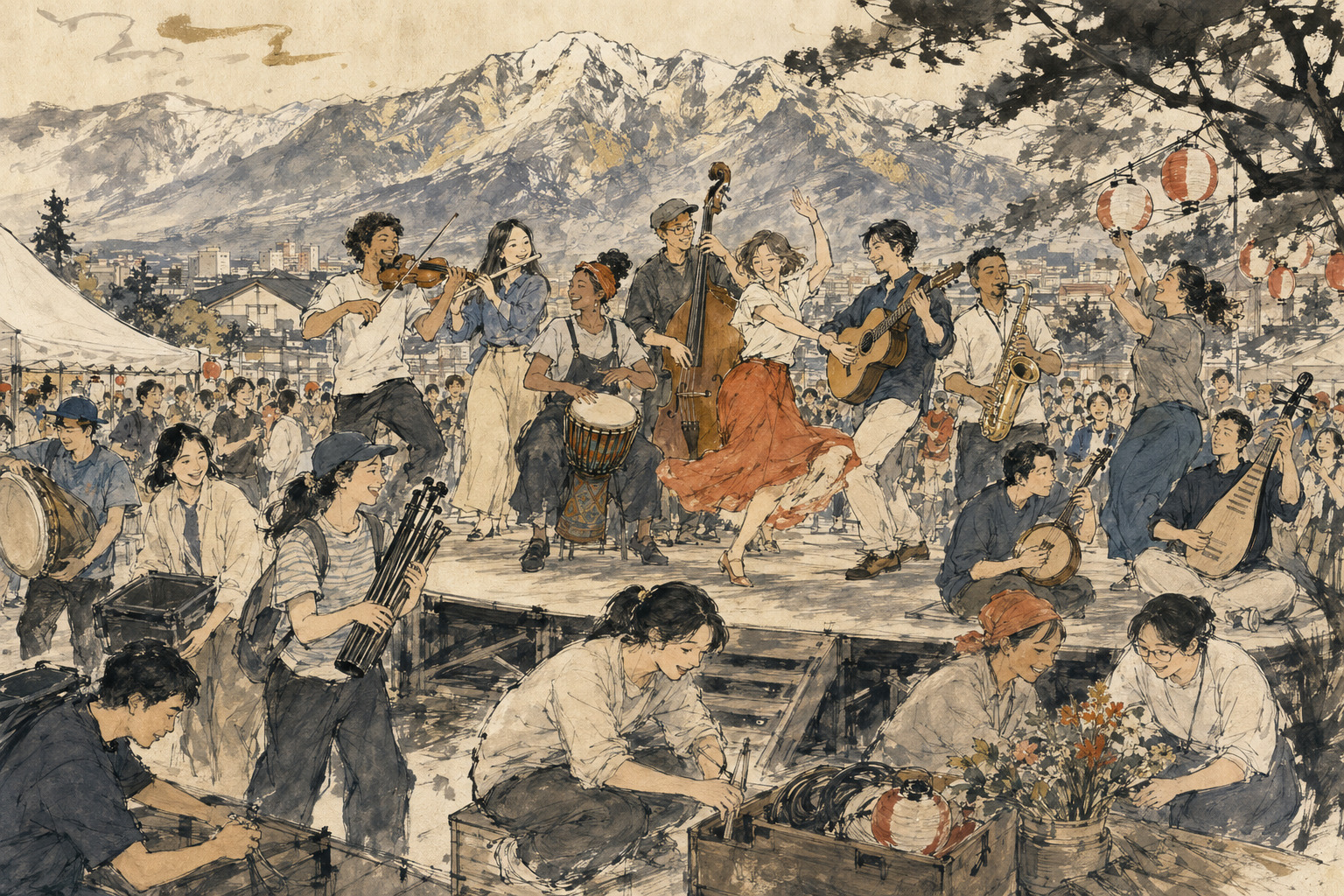
Before the first guitar note reaches the evening air in Nanto, someone has already found a bed for the guitarist. Someone else has counted meals, checked the artists’ route, carried equipment from storage, hung signs, tested a stage, decorated a café, marked a parade course and learned which wristband opens which door. At Sukiyaki Meets the World, the audience sees a music festival. Behind it, a small city rehearses the art of receiving strangers.
The 35th edition opens Friday, August 21, with a free outdoor program performed by residents and visiting artists. On Saturday and Sunday, the circular Helios theater and an outdoor garden stage will host music from South Africa, Guinea, Malawi, the Russian republic of Tuva, Réunion Island and Japan. There will be workshops, children’s activities, food and craft markets, DJs, a parade and a finale. The event describes itself as one of Japan’s largest world-music festivals.
Its most important statistic is not a fee or a stage time. The organizer says more than 200 volunteers, from elementary-school children to long-serving veterans, plan and operate the festival. Some work for months. Some join only during the event. Together they perform the many jobs that a commercial production would distribute across paid departments.
The work hidden inside a weekend
The volunteer system is not an undifferentiated call for extra hands. It is an organization chart. The 2026 recruitment page assigns participants to specialist teams, each with different shifts and responsibilities. Meetings run from spring through August. Volunteers can help select artists, shape programs and settle the site plan before the public ever sees a schedule.
| Volunteer team | What it actually does |
|---|---|
| Helios and garden stages | Build audience areas, check admission, guide and protect visitors, decorate the outdoor site, run stage flow and care for performers. |
| Technical | Assist professional stage managers with construction, changeovers and technical work at the indoor and outdoor stages. |
| Workshops and children | Plan and operate workshops, exhibitions and Sukiyakids activities; recruit participants, handle reception, sound and instructors. |
| Parade | Design the procession, decorate the route, guide performers, manage traffic and publicize the event. |
| Artist care | Move performers between locations, set up dressing rooms and plan accommodation. |
| Staff and security | Write manuals, register volunteers, plan security and respond to problems during the festival. |
| Catering | Build and run meal stations, count portions and prepare backstage hospitality. |
| Café, markets and information | Buy materials, serve the festival café, manage vendors, sell tickets and merchandise, prepare signs and answer visitors’ questions. |
The calendar makes the depth clearer. Project and team meetings begin in April. Two all-staff sessions introduce the year’s program and settle detailed assignments. On August 16, equipment and building materials come out of storage and decoration begins. August 17 through 20 are final preparation days. After the last public program on Sunday, the equipment goes back; on Monday, volunteers see off the artists, inspect the grounds and clean the places where guests and staff stayed.
This is not merely unpaid ushering at the edge of a professionally made product. Residents participate upstream, where artistic and logistical choices are made. The organization asks registrants to identify useful languages, licenses and experience. A person who can drive a large vehicle, interpret, design a menu or handle a stage change is not asked to become generic labor. The skill becomes part of the festival.
The festival’s deepest cultural act may be the transfer of authority: residents are not invited only to consume international culture. They are trusted to produce the encounter.
Five youth groups, one new theater, one invited act
The origin story belongs to another administrative map. Nanto City did not exist in 1991. The festival began in Fukuno, one of the eight towns and villages that would merge to form Nanto in November 2004. That April, five local youth organizations that had been working separately joined to form the Sukiyaki Network. Fukuno’s municipal cultural center, Helios, had opened the previous month. The network and the center built the first Sukiyaki Meets the World together in August.
According to the Suntory Foundation’s account, the first edition could invite only one overseas act. Its objective was already ambitious: use music from Asia, Africa and Latin America to create contact with lives and cultures that a rural Japanese town rarely encountered directly. Visiting artists stayed in the community. Concerts were joined by workshops and conversation about food, background and everyday culture.
The model learned by traveling as well as hosting. From 1992, festival staff exchanged with Musiques Métisses in Angoulême, France, sending two organizers each year and receiving staff in Fukuno. By the time Sukiyaki received the Suntory Community Cultural Award in 2002, it was inviting close to 10 groups a year, had presented musicians from more than 17 countries and was supported by roughly 80 volunteers. Residents trained for a month with visiting teachers in Trinidadian steel pan and African djembe; the resulting ensembles continued to perform after the guests went home.
Recognition followed the growth: a Kita-Nippon Shimbun community award in 1996, the Suntory prize in 2002, the Japan Foundation Prize for Global Citizenship in 2009, and later regional-revitalization and local-government honors. Awards do not prove artistic vitality. They do show what outsiders found unusual: an annual event had become continuing civic education.
1991 — Five youth groups form the Sukiyaki Network; the first festival opens with Helios.
1992 — Organizer exchange begins with Musiques Métisses in Angoulême.
2002 — The festival receives the Suntory Community Cultural Award; about 80 volunteers are involved.
2004 — Fukuno and seven neighboring municipalities merge as Nanto City. The festival is already 13 years old.
2009 — The Japan Foundation recognizes the committee for sustained intercultural work.
2010 — The Sukiyaki Residence program begins creating multinational ensembles in Nanto.
2026 — The 35th edition is supported by a volunteer body the organizer describes as more than 200 people.
“World music” is not one kind of music
The festival’s title arrived at a revealing moment. Four years before Sukiyaki’s first edition, independent labels and promoters met in London and popularized “world music” as a retail category. It solved a practical problem: record stores needed a shelf for music that did not fit the Anglo-American pop bins. It also created a conceptual one. An immense range of traditions, popular styles and experimental hybrids could now be treated as one exotic elsewhere.
That tension has never vanished. Oxford scholarship describes world music as a deliberately vague market category, large enough to contain traditional forms, newly composed roots music and contemporary popular music. A festival can repeat the flattening—flags, costumes, a taste of everywhere—or it can restore names, histories and relationships.
Sukiyaki’s stronger work happens when it takes the second path. ODUCHU is not simply “music from Russia,” but a Tuvan duo using throat singing, folk melody, guitar and electronics to update a specific inheritance. Sibusile Xaba arrives from South Africa’s adventurous jazz landscape, shaped by mentors such as Madala Kunene and Philip Tabane but unwilling to stay inside jazz. Guinean singer Sia Tolno performs with Japan’s JariBu Afrobeat Arkestra, a collaboration organized around a living repertoire and political voice rather than nationality as decoration.
On Sunday, OKI DUB AINU BAND brings the tonkori and Ainu musical identity into dub and amplified ensemble music. Madalitso Band arrives from Malawi. The Réunion group Lindigo Family joins Amami singer and sanshin player Anna Sato. These artists do not share a genre. They share a platform that asks the audience to hear difference without requiring it to become distance.
The 2026 program: a festival with open edges
Friday’s opening is a compact statement of method. From 7 p.m., the outdoor stage belongs to community groups whose members have trained in workshops, appearing alongside Xaba, ODUCHU and Madalitso Band. Admission is free. The first night does not introduce residents to the finished product; it places their performance inside it.
Saturday expands across the free garden stage and paid Helios theater. The indoor program begins with the Sukiyaki Steel Orchestra joined by Candice and Emmanuel of Trinidad and Tobago’s Renegades. Xaba follows, then Sia Tolno with JariBu, and the Japanese group Sai. Outdoors, ODUCHU and Japanese acts perform without a ticket. The parade moves from 5:30 to 6:30 p.m., while DJs extend the outdoor program into the evening.
Sunday places Amami and Réunion’s joint project on the garden stage and CHAPPO, OKI DUB AINU BAND and Madalitso Band inside Helios. The public finale begins at 5:30 p.m. Workshops travel through Amami island song, the Malawian band’s path from street performance to international stages, and the homeland of Tuvan throat singing. Children can try instruments and make objects through Sukiyakids.
- Friday’s opening stage, the garden stage, parade, workshops and most programs outside Helios are free.
- Helios opens at 2:30 p.m. Saturday and 12:30 p.m. Sunday.
- A two-day Helios pass is ¥10,000; one-day tickets are ¥6,000 in advance or ¥7,000 at the door.
- Admission to Helios is free for high-school students and younger.
- The venue is about a 10-minute walk from Fukuno Station on the JR Jōhana Line.
The pricing design matters. A festival can praise accessibility while placing its meaningful encounters behind a single expensive gate. Sukiyaki preserves a paid theater program but surrounds it with free performances, a parade, workshops and markets. A family can encounter much of the festival before deciding whether to buy a ticket. Young people can enter Helios free.
The parade is the argument
Saturday’s procession may explain Sukiyaki better than any mission statement. The published running order places a Fukuno Yotaka lantern, a Munakata Shikō-inspired nebuta, African percussion, elementary-school steel pans, local wind ensembles, high-school baseball players, taikagura drumming, Brazilian maracatu performers and the festival’s giant puppets inside the same moving line.
The local is not the opposite of the international there. Fukuno’s lantern tradition is not pushed aside to make space for something “global,” and visiting forms are not sealed on a distant concert stage. They occupy the road together. School clubs see that culture is something they can carry. Foreign artists meet a place that already has rhythms, paper, wood, festival craft and memory of its own.
This is the most convincing answer to the old problem inside the phrase “world music.” The parade does not pretend every tradition is interchangeable. It creates coordination without sameness. Each group must keep its own pulse while moving at the speed of the whole procession.
Not booking, but making
The festival’s residence projects extend that principle beyond presentation. Since 2010, visiting artists have lived together in Nanto, exchanged cultural knowledge and created work that did not exist before their arrival. The organizer describes the aim as moving beyond a superficial “mix” toward music made by sharing.
The 2026 festival carries two strong examples. Lindigo Family and Anna Sato first developed music together during the 2025 residency, joining Réunion’s maloya with Amami island song. The project then toured Africa and France before returning to the place where it was assembled. Nanto was not merely one date purchased on an existing tour. It became a point of origin.
Earlier this year, the CASCA project brought Brazilian artists Maria Cau Levy and Ana Frango Elétrico together with Izumi Ishimoto of Gokayama Washi no Sato. They researched and made work through the processes of Gokayama paper, exhibited in Nanto and later at the Brazilian Embassy in Tokyo. That is a music festival acting as a cultural office across seasons and disciplines—connecting contemporary Brazilian practice to a local craft without asking either to become a souvenir.
A civic institution in a shrinking city
Nanto’s population at the end of June was 44,634. When the city was created in 2004, it had 59,230 residents. The loss of 14,596 people is nearly one quarter in less than 22 years. In a large city, 200 festival volunteers might be a recruitment metric. In a geographically broad rural city managing population decline, it is civic capacity made visible.
That does not mean a festival reverses demography. A weekend cannot replace health care, transport, schools, housing or stable employment. Nor should volunteer devotion become an excuse to underfund culture. The work has costs even when it has no wage: evenings surrendered after a job, family schedules rearranged, physical strain during setup and the risk that a small group of experienced people becomes indispensable.
The published volunteer terms show some practical support. Staff receive access to performances and workshops. Five meals are available during the festival with advance registration, and low-cost shared lodging is arranged for a limited number of participants. Work is divided into shifts, and people may watch concerts in their free time. Those provisions do not turn volunteering into employment. They recognize that hospitality must extend to the people supplying it.
The intergenerational design may be equally important. Children, parents, students and veterans can register; people under 18 stop work by 9 p.m. A young volunteer can enter through crafts or reception, meet a stage technician, hear a language never studied at school and return years later with a different skill. Institutional memory is renewed through participation rather than stored only in an office.
What lasts after the finale
At 5:30 Sunday evening, the formal finale will begin. The public ending will have music and bodies gathered in front of a stage. The operational ending will be quieter: equipment counted, rooms cleaned, signs removed, artists driven away, keys returned. That second ending reveals what has been built.
The festival’s strongest legacy is not that Nanto can briefly imitate a cosmopolitan capital. It is that Nanto has spent 35 years creating its own form of internationalism. It begins with a cultural center and five youth groups, passes through local cooks and drivers, school ensembles and visiting masters, and returns as music that sometimes tours beyond Japan. The city does not wait for the world to arrive fully packaged. It prepares a room, enters the workshop and helps make what happens next.
More than 200 volunteers will keep the visible weekend moving. Their greater accomplishment is less visible: they make repeated contact possible. A song from a distant place becomes a rehearsal on a weekday. A visiting musician becomes a collaborator. A child in the audience becomes a player, then perhaps a stagehand or committee member. At Sukiyaki Meets the World, “meeting” is not a slogan between two nouns. It is the work.
- Sukiyaki Meets the World — official 2026 outline, dates, venue and principal artists
- Official 2026 timetable — stages, parade, workshops, markets and finale
- Official volunteer page — teams, responsibilities, schedule, meals and accommodation
- Official festival history — civic model, residence program and awards
- Official ticket page — Helios prices, times and youth admission
- Suntory Foundation — 2002 Community Cultural Award history of the festival’s founding and growth
- Japan Foundation — 2008 Prize for Global Citizenship profile
- Arts Council Tokyo — institutional history, citizen leadership and national network
- Nanto City — population at the end of June 2026 and change since the city’s creation
- Festival workshop program — 2026 instructors and civic training
- Sukiyaki Residence — Lindigo Family with Anna Sato
- CASCA — Brazilian artists and Gokayama washi collaboration
- Festival artist profile — Sibusile Xaba
- Festival artist profile — ODUCHU
- Festival artist profile — Sia Tolno with JariBu Afrobeat Arkestra
- Oxford University Press — history and ambiguity of “world music” as an industry category
Editorial note: This article is based on the cited public records and contains no independent interviews. “More than 200” and “one of Japan’s largest” are the festival organizer’s descriptions. The volunteer total includes participants of different ages and may include people from outside Nanto; it should not be read as 200 city residents. Program times and artists were checked against the official timetable available before opening and remain subject to organizer changes. Population is from Nanto’s resident registry at June 30, 2026. The exchange-rate strip is an editorial reference unrelated to the festival.