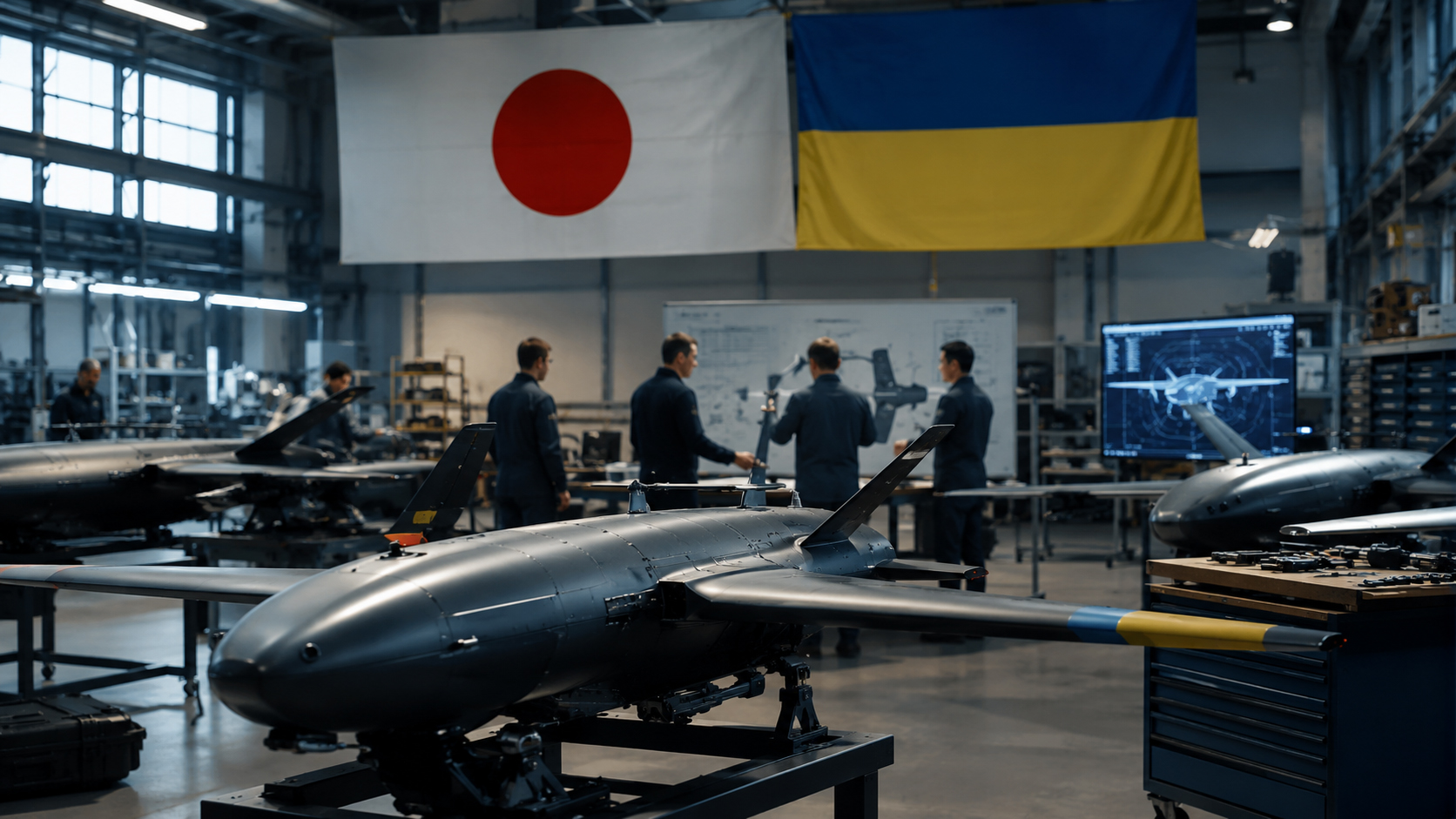
Japan’s drone issue ends in Ukraine.
A drone story can begin in a rice field. It can begin with a mountain village that no longer has enough delivery drivers, a dark industrial tunnel where humans should not go, a wildfire burning at night, or an aging port that needs eyes in the sky. But in 2026 Japan, every serious drone story eventually reaches defense. The small flying machine has become a meeting place for industrial policy, economic security, Taiwan anxiety, lessons from Ukraine, and the awkward rebirth of Japan’s defense technology base.
At the center of that story is Ukraine’s wartime drone knowledge and the growing interest of Japanese companies, officials, and investors. Reuters reported on June 19, 2026 that Ukrainian drone makers including UFORCE, Skyeton, and General Cherry are pushing into Asia, especially Japan and Taiwan, as regional tensions rise around Taiwan. Reuters also reported that Japan has allocated nearly $2 billion to support drone systems in this year’s defense budget.
This is not simply an export story. Ukraine has become the world’s fastest drone laboratory because it had no choice. Ideas are tested in weeks, pushed to operators, improved under pressure, or discarded. That is not Japan’s usual rhythm. Japan likes reliability, quality, certification, long-term maintenance, and careful supply chains. Ukraine’s wartime drone culture is faster, rougher, cheaper, and far more brutal. The collision between those two cultures may shape Japan’s next drone decade.
The door Terra Drone opened
One date matters: March 31, 2026. That was when Terra Drone announced a strategic investment in Amazing Drones, a Ukraine-based interceptor drone company, along with the launch of the Terra A1 interceptor project. Terra Drone had already built a global identity in surveying, infrastructure inspection, UTM, oil-and-gas inspection, and industrial drone services. It was not known primarily as a battlefield company. It was a field-work company.
That is why the announcement mattered. A company associated with industrial inspection and drone operations was investing in Ukrainian interceptor drone technology. The old wall between industrial drones and defense drones started to look much thinner. Cameras, communications, navigation, flight control, sensors, mission software, and operational discipline all cross the boundary. Technology developed for civilian worksites can matter in defense. Lessons from defense — speed, cost, mass production, repairability, jamming resistance — can come back into civilian drone design.
On April 17, Terra Drone said the Terra A1 had entered operational deployment in Ukraine through Amazing Drones, with further expansion to depend on real-world evaluation. On April 28, it announced a second strategic investment in Ukraine’s WinnyLab, a fixed-wing interceptor drone company. Japan’s drone sector had moved from watching the war to participating in the technology lessons created by it.
Why interceptor drones matter
An interceptor drone sounds like science fiction until the economics are understood. Cheap attack drones, loitering munitions, and one-way systems are forcing defenders to spend expensive missiles against relatively inexpensive threats. If a defender uses a very costly air-defense missile to stop a much cheaper drone, the attacker can win by exhausting the defender’s budget and stockpiles.
That is why countries are searching for cheaper, faster, more numerous counter-drone tools: radar, optical detection, jamming, AI classification, net systems, lasers, and drones designed to stop other drones. Reuters reported on June 18 that drone attacks beyond traditional battlefields are pushing rapid demand for counter-drone systems to protect civilian infrastructure, including airports, oil fields, ports, and data centers.
Japan is a hard country for this problem. It is dense, urban, coastal, and infrastructure-rich. Airports, ports, nuclear plants, energy facilities, data centers, communications sites, and Self-Defense Force bases sit close to civilian life. “Shoot it down” is not a sufficient policy. Falling debris, jamming restrictions, airspace law, police authority, fire response, civil aviation safety, and the chain of command all matter. Counter-drone defense is not only an engineering problem. It is a legal and institutional problem.
Ukraine’s advantage is fast failure
The most valuable thing Ukrainian drone companies bring to Japan may not be a specific aircraft. It may be learning speed. Ukraine has lived through jammed communications, GPS-denied operations, night missions, low-altitude attacks, swarm behavior, cheap repairs, field modifications, and the terrifying reality that a good idea can become obsolete in months.
Those lessons do not fit neatly into a brochure. But they matter. Which sensor fails in smoke? Which communications link survives interference? Which design can be repaired by tired operators near the front? Which airframe is too clever for its own maintenance burden? In Ukraine, the expiration date on drone technology is short.
Business Insider recently reported that Ukraine sees value even in some of its older drone-war technologies for friendly countries facing threats such as Shahed-style attacks. That concept is important for Japan. Japanese procurement culture often seeks the carefully specified ideal. Drone war rewards the useful, available, repairable, and scalable. Ukraine’s lesson is uncomfortable but valuable: do not wait for the perfect document while the sky changes above you.
The Taiwan shadow
Japan’s interest in Ukrainian drone technology is not only about Europe’s war. It is also about a much closer body of water. Reuters framed Ukraine’s Asia push in the context of Taiwan tensions. In Japan, the phrase “Taiwan contingency” is still handled carefully. Geography is less careful. The Southwest Islands, Okinawa, the Sakishima chain, the East China Sea, and the Taiwan Strait are not abstract places on a white paper. They are the map Japan has to live with.
In a future crisis around Taiwan, drones could matter for reconnaissance, communications relay, electronic warfare, logistics, port protection, base defense, maritime monitoring, and counter-drone operations. Treating drones only as convenient civilian machines would be dangerously slow.
At the same time, Japan carries its postwar political culture, arms-export caution, and self-image as a peaceful country. That makes drone-defense cooperation awkward. Is it defensive technology to protect civilians and infrastructure? Is it an arms business? Is it economic security? Is it militarization? The line is not easy to draw. That tension is exactly why the story matters.
How Japanese companies enter defense
Money is also changing. Reuters reported in May that Japan’s defense minister urged financial institutions to invest in defense companies after the state-backed Development Bank of Japan lifted some restrictions on investing in weapons-related companies, excluding weapons banned by international treaties. This is not a loud change, but it is a significant one. Technology cannot move from prototype to production without capital.
Drones sit at the front of that shift because they pull in many kinds of companies: software firms, sensor makers, communications specialists, battery suppliers, materials companies, mapping firms, AI developers, logistics operators, and aircraft manufacturers. Defense is no longer entered only through the door marked “fighter jet” or “warship.” It can be entered through inspection drones, airspace management software, disaster robotics, agricultural autonomy, and communications resilience.
That makes transparency essential. Japanese society will not accept defense technology that hides behind euphemisms. But it can have a serious discussion about protecting ports, airports, power plants, islands, data centers, and disaster zones. If drone companies move into defense, they should explain what they are protecting, who they serve, and where the civilian-defense boundary lies.
The supply-chain question
Drone security is also component security. Motors, cameras, communications modules, GNSS, batteries, flight controllers, semiconductors, and software stacks all matter. The small-drone industry has long depended deeply on Chinese supply chains because Chinese components were cheap, available, and effective. That dependency helped grow the industry. It also created strategic risk.
Ukraine is trying to reduce dependence on Chinese components. Taiwan has become a quiet player in electronics, navigation, batteries, and manufacturing. The Guardian reported in May that Taiwan has emerged as a quiet player as Ukraine seeks to edge China out of its drone supply chain. Japan faces the same question: how Japanese is a “Japanese drone” if critical components come from a supply chain that may be politically vulnerable?
The beauty of civil technology, the reality of defense
The other articles in this drone issue have focused on agriculture, logistics, disaster response, industrial inspection, and heavy-lift platforms. Those are social technologies. They help farmers, villages, inspectors, firefighters, and infrastructure operators. But the same sensors, aircraft, communications, and AI also enter defense. Pretending otherwise would be childish.
That does not mean Japan should treat every drone as a weapon. It means Japan should use honest language. Drones can deliver medicine to a mountain village, map a wildfire at night, inspect a dangerous chimney, and stop an incoming drone. The tool is not morally simple. Neither is the world around it.
Japan.co.jp’s view is not that defense is automatically wrong. A country with Japan’s geography and neighbors cannot afford fantasy pacifism. But the reverse is also true: “security” should not become a magic word that excuses everything. Japan needs open debate, careful regulation, clear procurement rules, and honest boundaries.
What to watch next
| Issue | Why it matters |
|---|---|
| Terra A1 field evaluation | The question is whether operational lessons from Ukraine feed back into Japanese design, production, and doctrine. |
| Japan’s drone budget | Nearly $2 billion can disappear into prototypes unless it supports production, training, maintenance, and real operations. |
| Counter-drone law | Airports and urban infrastructure may need detection, identification, and authority rules before kinetic interception. |
| Supply chains | Reducing dependence on Chinese components may become the real test of economic security. |
| Public accountability | Defense drone work should be explained plainly: what is being protected, by whom, and under what rules. |
The small aircraft that shows the shape of a country
Drones are small. What they reveal is large: Japan’s shrinking workforce, rural logistics problem, disaster risk, aging infrastructure, defense budget, Taiwan anxiety, Ukrainian battlefield learning, and the remaking of supply chains. A small propeller now reflects the outline of a nation.
Ukraine-Japan drone cooperation is still early: investments, demonstrations, meetings, prototypes, cautious statements, and battlefield feedback loops. But the direction is clear. Drones have become a junction between Japan’s industrial policy and defense policy.
What Japan needs now is not only patriotic slogans. It needs the ability to build cheap aircraft quickly, test them honestly, operate them safely, regulate them intelligently, and avoid swallowing every civilian technology into the defense machine without public discussion. It also needs the humility to learn from Ukraine’s bitter experience.
Agricultural drones look at rice fields. Inspection drones look into pipes. Disaster drones look at fire. Defense drones look at something less comfortable: what a country fears, what it protects, and how much it is willing to change.
- Ukrainian drone firms are looking for Asian partners, including in Japan and Taiwan.
- Terra Drone’s Amazing Drones and WinnyLab moves brought a Japanese drone company into interceptor-drone development connected to Ukraine.
- Japan’s drone defense spending and financing environment are changing quickly.
- Counter-drone systems are becoming relevant not only for bases, but for airports, ports, energy facilities, and data centers.
- The hard questions are not only technical: they are regulatory, ethical, financial, and political.
Sources and references
This article is based on Reuters reporting on Ukrainian drone makers targeting Asia, Terra Drone’s Amazing Drones and WinnyLab announcements, Terra A1 deployment materials, Defense News reporting on Japan’s interceptor-drone push, Reuters reporting on counter-drone markets and defense finance in Japan, and Business Insider / The Guardian reporting on Ukrainian drone technology and supply chains.
- Reuters: Ukrainian drone makers target Asia as Taiwan tensions spur demand
- Terra Drone: Strategic investment in Amazing Drones and Terra A1
- Terra Drone: Terra A1 operational deployment in Ukraine
- Terra Drone: Investment in WinnyLab
- Defense News: Japan joins the interceptor-drone race
- Reuters: Counter-drone market expands beyond battlefields
- Reuters: Japan urges banks to fund defense companies
- Business Insider: Ukraine says older drone-war tech can still help allies
- The Guardian: Taiwan and Ukraine’s drone supply chain