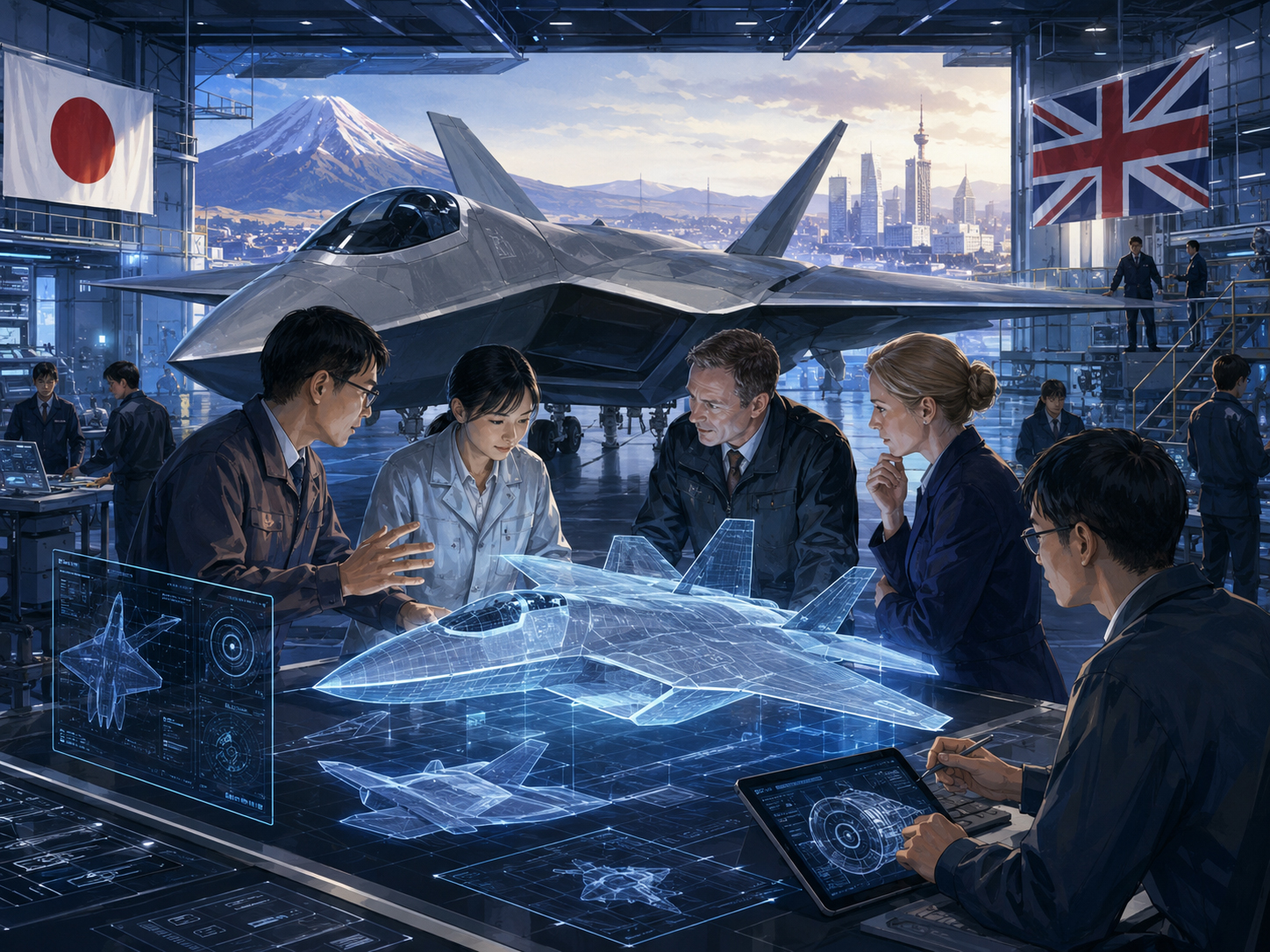
When Britain and Japan announced a new technology and defense partnership in June 2026, the most important word was not fighter. It was trust. The Global Combat Air Programme, or GCAP, is often described as a plan to build a next-generation combat aircraft by 2035. But for Japan, the United Kingdom and Italy, it is also a test of whether three advanced industrial democracies can share technology, divide work, protect secrets, control exports and still move fast enough to matter.
Reuters reported that Prime Minister Keir Starmer and Prime Minister Sanae Takaichi agreed a broad package covering technology, defense, AI, space, quantum, cyber, manufacturing and infrastructure, while also vowing progress on GCAP. The news peg was immediate: the next international contract stage for the fighter programme was expected by the end of the month. The deeper story is older. Japan is trying to preserve a domestic fighter-industrial base, reduce overdependence on any single partner, and enter a defense-production world in which software, sensors and unmanned systems matter as much as the airframe.
GCAP is a fighter programme, but it is also an industrial treaty, a technology-sharing experiment and a political argument about Japan’s future role in security.
What GCAP is
The Global Combat Air Programme was announced by the leaders of Japan, the United Kingdom and Italy in December 2022. Its goal is to deliver a next-generation combat aircraft around 2035. For Japan, the aircraft is tied to the successor of the F-2. For Britain and Italy, it sits in the line of succession after the Eurofighter Typhoon. But the “fighter” label is too narrow. A sixth-generation aircraft is expected to operate as part of a wider combat system: crewed aircraft, uncrewed adjuncts, advanced sensors, electronic warfare, cyber protection, space-based support and secure data links.
Japan’s Ministry of Defense frames air superiority as fundamental to national defense operations. It also says Japan must maintain a domestic manufacturing base for fighter aircraft. That is why GCAP matters beyond procurement. It is a way to keep Japanese engineers, factories and system integrators inside the most advanced part of aerospace development.
Why Britain?
Japan’s postwar fighter history has largely been shaped by the United States: imports, licensed production and joint development. The F-2, derived from the F-16, preserved important Japanese industrial capabilities but also showed the limits of a framework in which the United States held much of the technology leverage. GCAP is different. It is Japan’s first major fighter partnership without the United States at the center.
Britain brings BAE Systems, Rolls-Royce, sensors, systems integration and the legacy of the Tempest future-air programme. Italy brings Leonardo and a major aerospace-defense industrial base. Japan brings Mitsubishi Heavy Industries, IHI, Mitsubishi Electric and a national need to replace the F-2 while keeping production know-how at home. Together, the three countries are trying to create a combat-air ecosystem that spans Europe and the Indo-Pacific.
The industrial face: Edgewing
In 2025, BAE Systems, Leonardo and Japan Aircraft Industrial Enhancement Co. launched Edgewing as the joint venture designed to lead delivery of GCAP. Leonardo described the company as accountable for the design and development of the next-generation combat aircraft and as the design authority for the life of the product. That phrase matters. In aerospace, design authority is not a ceremonial title. It determines who understands the aircraft deeply enough to modify it, certify it, upgrade it and sustain it decades later.
For Japan, the key question is whether participation means real authority or just workshare. Will Japanese industry own major parts of the mission system, sensors, structures, engine interfaces or software architecture? Will Japanese suppliers be central to upgrades after 2040? Will the programme educate a new generation of engineers? GCAP’s success will be measured not only in aircraft delivered but in know-how retained.
2035The target service-entry timeframe for the next-generation fighter.
Three nationsJapan, the United Kingdom and Italy are the founding partners.
EdgewingThe industry joint venture formed by BAE, Leonardo and JAIEC.
Beyond the jetThe aircraft sits inside a system of sensors, drones, AI and data links.
Arms exports and Japan’s political line
GCAP also belongs to a much longer Japanese debate: how far can a country with a pacifist postwar identity go in building and exporting advanced weapons? For decades, Japan maintained strict limits on arms exports. Since the 2010s, those rules have been gradually revised to allow more international cooperation and equipment transfers. Reuters has described this as Japan’s decade-long march toward arms exports.
A fighter programme pushes that debate to its hardest edge. Modern combat aircraft are too expensive if produced only in small national batches. Export customers, future partners or broader participation may become important for cost and scale. Yet every export raises political questions: who will use the aircraft, under what rules, in what conflict, and with what Japanese responsibility?
Europe, the Indo-Pacific and the same aircraft
GCAP is unusual because it ties together two strategic theaters that were once treated separately. Britain and Italy look at Russia, NATO and Europe’s need to keep high-end defense industry alive. Japan looks at China, North Korea, Russia’s Far East presence, Taiwan contingencies and the reliability of U.S. support. The aircraft is therefore asked to do diplomatic work before it even flies: it must connect European security to Indo-Pacific security in hardware, software and factories.
That is why the June 2026 UK-Japan partnership matters. It placed GCAP inside a wider technology relationship that includes AI, space, quantum and cybersecurity. Future combat aircraft will be flying data centers as much as machines of speed. They will depend on secure chips, resilient networks, AI-assisted decision tools, satellite links and electronic warfare. A defense partnership that stops at metalwork would already be obsolete.
The hard parts ahead
Joint development always sounds cleaner in communiqués than it feels in engineering rooms. Costs rise. Schedules slip. National industries fight for workshare. Governments change. Export-control rules collide. Classified technologies do not always move easily across borders. Italy has previously complained about technology-sharing barriers inside the programme. Britain’s defense budget pressures and Europe’s rival fighter plans add further uncertainty.
Still, the logic behind GCAP remains powerful. Japan needs an advanced fighter and a domestic aerospace base. Britain needs a future combat-air industry and Indo-Pacific relevance. Italy needs a long-term aerospace anchor. All three need partners who can share cost and capability in a more dangerous strategic environment.
A mirror of Japan’s future
By 2035, if GCAP succeeds, commentators will ask whether the aircraft is stealthy enough, fast enough and digitally advanced enough. Japan should ask a second set of questions. Did the programme keep Japanese fighter design alive? Did it train engineers? Did it create export choices without losing political control? Did it give Tokyo options beyond dependence on a single alliance channel?
GCAP has not yet delivered a fighter. But it has already revealed the shape of a new Japan: more industrially assertive, more willing to share security burdens, and more exposed to the compromises that come with becoming a maker rather than only a buyer.