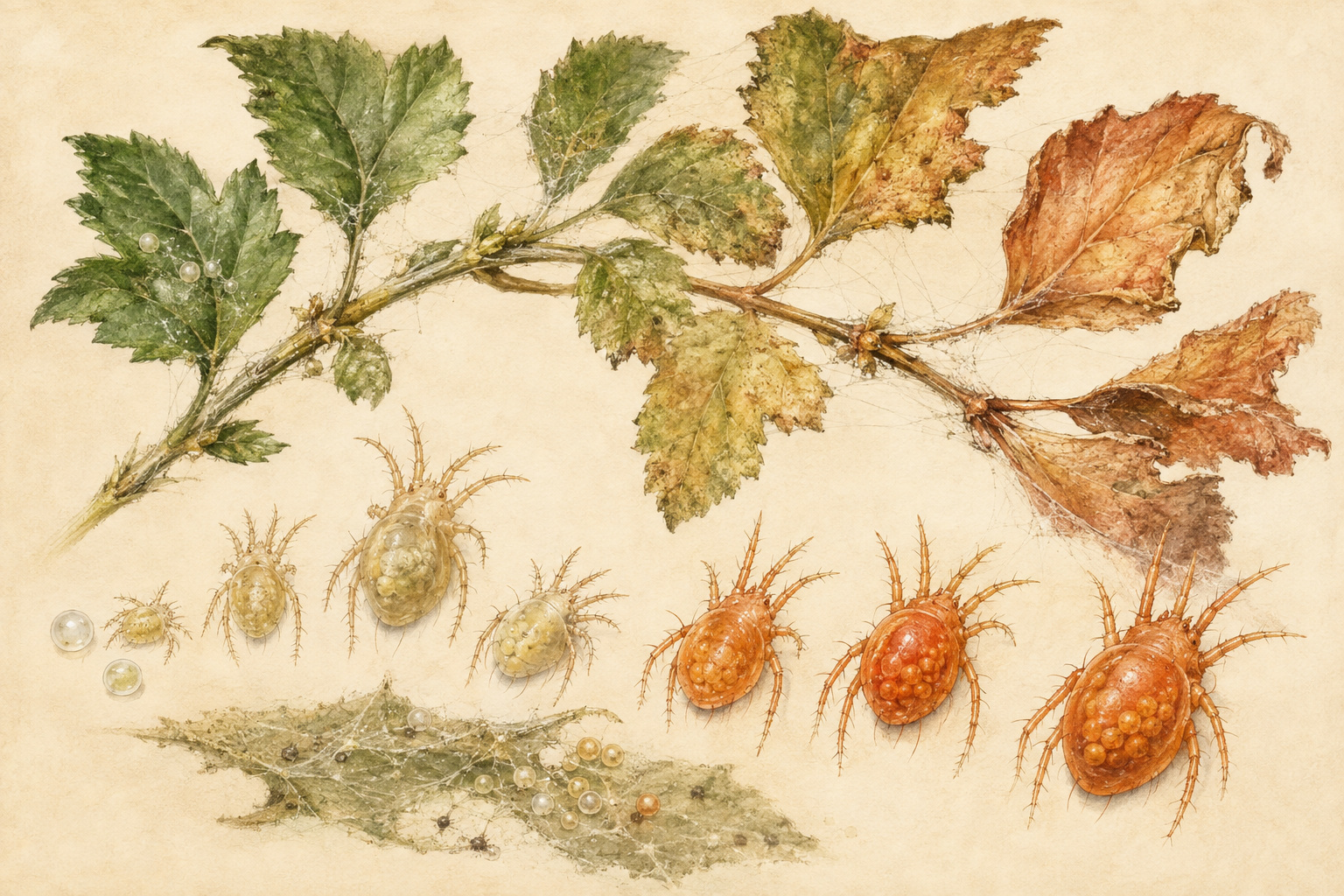
ORANGE is not decoration on a two-spotted spider mite. It is the visible edge of a seasonal reallocation. As winter approaches, the female stops feeding and laying eggs, accumulates carotenoid pigment and enters diapause. The color records a physiological decision made inside a creature roughly half a millimeter long.
Rismayani, a doctoral student in the Graduate School of Bio-Applications and Systems Engineering at Tokyo University of Agriculture and Technology, worked with Kanae Sai and Tomohiro Ohsako, who were graduate students there during the research, and TUAT Professor Takeshi Suzuki. The team collaborated with Professor Rika Umemiya-Shirafuji at Obihiro University of Agriculture and Veterinary Medicine. Ohsako is now affiliated with Osaka University's Graduate School of Science and is a Japan Society for the Promotion of Science research fellow.
Their paper, “A single PLAT domain protein couples reproductive arrest and carotenoid pigmentation during diapause in the two-spotted spider mite, Tetranychus urticae Koch,” was published online in Insect Biochemistry and Molecular Biology on July 27, 2026. Its DOI is 10.1016/j.ibmb.2026.104644.
A Global Pest That Is Not an Insect
The two-spotted spider mite, Tetranychus urticae, is closer to spiders and scorpions than to insects. It feeds on crops and ornamental plants across the world. TUAT says its host range exceeds 1,100 plant species, and its ability to develop pesticide resistance has helped earn it the description “superpest.”
During favorable seasons, females feed and reproduce rapidly. When conditions turn unfavorable, diapause suspends feeding and reproduction so the mite can survive winter. Diapause is not the same as temporary inactivity caused by cold. It is an anticipatory physiological program that does not end immediately when favorable conditions return.
The cue is photoperiodism: reading seasonal time from changes in day and night length. Juvenile females exposed repeatedly to long nights enter diapause as adults. Reproduction stops, the body changes color and the animal waits through the season that would otherwise threaten it.
Why Winter Diapause Is Orange
The pigment is astaxanthin, a carotenoid also associated with the red color of salmon and shrimp. Its strong antioxidant activity may help the mite tolerate stresses during overwintering, making the color shift part of winter preparation rather than a cosmetic byproduct.
Most animals cannot synthesize carotenoids and must obtain them from food. Spider mites and some insects are unusual: they acquired fungal carotenoid-synthesis genes through horizontal gene transfer. The mite can make beta-carotene and convert it into astaxanthin.
Much of the astaxanthin is stored as esters bound to fatty acids. Eggs also require lipids. That shared demand suggested a resource-allocation problem: in summer, lipids support egg production; in winter, they may be redirected toward carotenoid storage and protection.
- Juvenile females experience repeated long nights.
- Diapause appears in adult females and TuPLAT10 rises.
- In the team's model, lipid allocation shifts from eggs toward pigment.
- Egg laying stops while astaxanthin-related lipids accumulate.
- The mite changes from yellow-green to vivid orange for winter.
Proteomics Finds a One-Domain Candidate
The researchers raised female mites under long-night conditions that induce diapause and short-night conditions that favor reproduction. They then used liquid chromatography-tandem mass spectrometry, or LC-MS/MS, to compare proteins expressed in adult females.
TuPLAT10 stood out among proteins that increased under diapause-inducing conditions. A PLAT domain is a region involved in binding lipids and other proteins. PLAT-containing proteins commonly pair that region with a catalytic domain that drives a chemical reaction.
TuPLAT10 carries a single PLAT domain and no catalytic domain. That architecture led the team to suspect a binding or allocation role rather than enzymatic conversion. It might help determine where lipid resources go without chemically transforming them itself.
RNA Interference Separates Color From Reproduction
Expression alone cannot show that a protein connects two processes. The team used RNA interference, introducing double-stranded RNA corresponding to the target gene to suppress TuPLAT10 activity.
Females raised under long-night, diapause-inducing conditions began laying eggs when TuPLAT10 was suppressed. Many also failed to turn orange. The same intervention disrupted both reproductive arrest and pigmentation.
A comparison sharpened the result. Suppressing carotenoid-synthesis enzymes could prevent orange coloration, but egg laying remained arrested. Blocking pigment alone did not release reproduction. Suppressing TuPLAT10 affected both, supporting the conclusion that it is one factor coupling the two seasonal changes.
| Question | What the study establishes | What remains unknown |
|---|---|---|
| Expression | TuPLAT10 rose strongly under diapause-inducing conditions. | How a long-night signal reaches and regulates the protein. |
| Reproduction | Suppressing the gene restored egg laying under diapause conditions. | Long-term survival and population effects in natural environments. |
| Color | Many suppressed mites did not become orange. | Why responses varied among individuals. |
| Lipids | Protein structure and knockdown results support an allocation role. | The direct binding partner, destination and metabolic route. |
| Control | The protein is a possible target affecting diapause and reproduction. | A deliverable treatment, field performance and non-target safety. |
The Lipid Switch Is an Evidence-Based Model
The team's interpretation is economical. During short spring and summer nights, lower TuPLAT10 leaves more lipid available for eggs. During long autumn and winter nights, increased TuPLAT10 redirects lipid toward fatty acids that esterify astaxanthin. Reproduction pauses as orange pigment accumulates.
That model explains two conspicuous traits with one resource decision. But “switch” is functional shorthand, not a complete molecular diagram. The study has not yet shown whether TuPLAT10 acts as a transporter, a scaffold, a regulator of another protein or part of a larger complex.
The researchers nominate phosphatidic acid as a possible lipid received by TuPLAT10. Phosphatidic acid contributes to cell membranes, serves as a branch point for other lipids and participates in cellular signaling. Its binding, destination and conversion into egg or pigment pathways remain to be traced.
A Pest-Control Target, Not Yet a Pest-Control Product
Diapause allows mites to survive winter and seed the next spring's outbreak. Interfering with overwintering could reduce later populations. Because eggs also depend on lipids, disrupting allocation might create a second route to suppress reproduction. That combination makes TuPLAT10 an attractive research target.
The distance to application is substantial. The study did not produce a spray, commercial RNA pesticide or field protocol. Researchers would need a practical delivery method, evidence of effectiveness outside controlled conditions, resistance monitoring and safety testing for crops, beneficial mites and other non-target organisms.
Restored egg laying under a diapause signal also does not automatically mean poorer winter survival. Survival, fecundity and population growth must be followed over time before the agricultural value of manipulating TuPLAT10 can be judged.
LONG NIGHTS Juvenile females detect seasonal change through photoperiodism.
DIAPAUSE Adult females increase TuPLAT10 and suspend egg laying.
ORANGE COLOR Astaxanthin-related lipids accumulate for overwintering.
RNA INTERFERENCE Suppressing TuPLAT10 disrupts reproductive arrest and color change.
JULY 27, 2026 The peer-reviewed paper is published online.
NEXT TESTS Trace the signal, lipid binding, transport, metabolism and control potential.
What the Color Has Revealed
Suzuki's interest began with the dramatic orange transformation itself. In TUAT's Japanese release, he recalls being captivated when he first saw the phenomenon as a student and entering research because of it. The connection to lipid allocation answered one old question while creating several new ones, he said.
The immediate questions are molecular. Which receptor and signaling pathway carry information about night length to TuPLAT10? Which lipids and partner proteins bind it? Where do those lipids travel, and where does metabolism divide between astaxanthin storage and egg formation?
The orange mite is therefore more than a seasonal curiosity. Its color exposes a biological budget changing from reproduction to survival. TuPLAT10 gives researchers a way to enter that budget at the molecular level. It may eventually reveal a weakness in a costly crop pest, but its first achievement is more fundamental: joining color, fat and reproductive timing in a single testable mechanism.
- Tokyo University of Agriculture and Technology — Japanese research release, August 28, 2026
- Obihiro University of Agriculture and Veterinary Medicine — Joint Japanese news release, August 28, 2026
- Tokyo University of Agriculture and Technology — Official Takeshi Suzuki researcher profile
- Rismayani et al. — “A single PLAT domain protein couples reproductive arrest and carotenoid pigmentation during diapause in the two-spotted spider mite,” Insect Biochemistry and Molecular Biology
This report was written independently from Japanese primary university material and the published paper record available through August 29, 2026. Researcher names, affiliations, titles, the paper title, journal, DOI and specialist terminology follow official records; English author forms follow the paper's published author list. The lipid-allocation switch and pest-control potential are the research team's interpretation and prospective application. No pesticide product, field trial, delivery method or non-target safety result was reported.