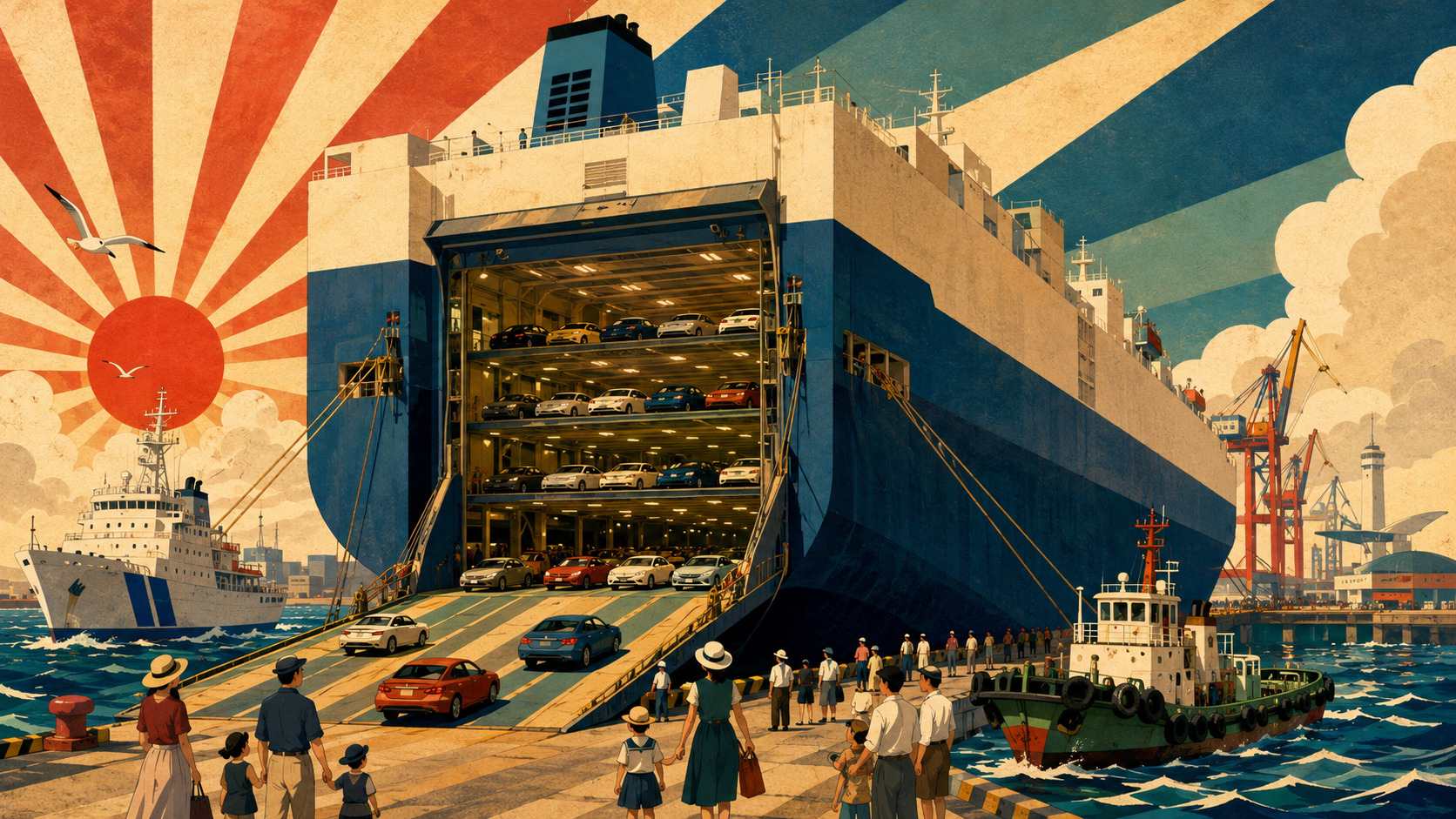
The afternoon door in a ship the size of a building
At 1 p.m., the most unusual door in Aichi opens—not at the quay, but through a controlled shuttle route from the Port Information Center Kamomeria to Shin Kurushima Toyohashi Shipbuilding. Beyond it is a form most residents know only from across Mikawa Bay: a high-sided vehicle carrier, nearly 200 meters from bow to stern, built to hold about 7,000 automobiles.
The visit is the festival’s first public interior tour of a car carrier. It is free, requires no advance application and will accept roughly 2,000 people in arrival order. That last point corrects an easy misunderstanding. The separate port-factory bus tour required an application, and its June 22 deadline has passed. The car-carrier tour itself remains a same-day, first-come event.
Visitors assemble outside Kamomeria’s main entrance at 3-29 Jinnōfutō-chō. Dedicated buses make the round trip to the shipyard; private vehicles must not go directly to Shin Kurushima Toyohashi Shipbuilding. Toyohashi City estimates about 30 minutes of transport and 30 to 60 minutes aboard. The flyer summarizes the experience as about an hour including travel, but families should allow closer to 60–90 minutes and leave space for queues.
The rules are a diagram of the ship
Toyohashi’s safety instructions explain the interior before anyone boards. Visitors need sneakers or similarly secure walking shoes. The decks contain many circular openings about five centimeters across, so high heels and walking canes are not permitted. Numerous steps and level changes mean the route is not barrier-free; wheelchairs and strollers cannot enter. Those are consequential restrictions, and families should decide before joining the line whether every member can safely complete the route.
Photography inside the ship and photography of the vessel’s name are prohibited. The city said one authorized photo point was planned. That rule also explains why responsible preview coverage should not guess the ship’s identity from construction schedules or silhouettes. The public facts are its approximate scale, capacity, location and visiting arrangement; the name is deliberately outside the published visitor story.
The city does not identify the engineering purpose of the five-centimeter openings in its visitor notice, so they should not be assigned one from a distance. What they safely reveal is an industrial walking surface unlike a passenger deck. The many level changes likewise belong to a structure organized around vehicle ramps, cargo spaces and ship systems—not a passenger terminal. The restrictions are therefore not small print attached to the experience. They are a readable cross-section of whom the ship was designed to carry: vehicles and trained crews.
A floating multistory garage—and a hard planning problem
Pure car and truck carriers, usually abbreviated PCCs or PCTCs, use roll-on/roll-off loading. Vehicles drive aboard through large stern or side ramps, then climb internal ramps to assigned decks. A ship can resemble a multistory parking structure, but the comparison understates the difficulty: every vehicle must be delivered to the right port without trapping cargo scheduled to leave earlier, while safe clearances, weight, stability and access routes are preserved.
NYK describes a representative 7,000-car carrier with 12 decks, more than 60 vehicle types and calls at more than ten ports. The possible loading patterns can exceed 10 to the 2,000th power. That is a generic industry example, not the disclosed specification of Toyohashi’s open ship. It shows why the rows visitors see are the physical result of a sophisticated stowage plan rather than an oversized parking exercise.
| What visitors may recognize | What it does in a typical PCTC | What not to assume |
|---|---|---|
| Wide stern or side ramp | Connects the quay to a principal vehicle deck for roll-on/roll-off cargo. | The festival has not published which ramp or route the public will use. |
| Internal inclined ramps | Move vehicles between deck levels; some designs use movable ramps. | Not every carrier has the same arrangement. |
| Long, low deck spaces | Maximize standard-car capacity; selected deck heights may adjust for trucks or machinery. | “7,000 cars” is a standard-car equivalent, not 7,000 of every vehicle type. |
| Ventilation, alarms and cameras | Support safe operations in large enclosed vehicle spaces. | Public access does not reveal or certify every installed safety system. |
From cranes and car-bulkers to dedicated carriers
Before roll-on/roll-off ships, automobiles were lifted aboard general cargo vessels one at a time. Crane handling was slow and risked damaging finished paintwork. As Japanese auto exports accelerated in the 1960s, ships added ramps and multiple vehicle decks. Early “car-bulkers” carried automobiles outward and returned with grain, coal or ore. The combination saved an empty return voyage, but dust and residue threatened the cars and mismatched schedules created delays.
Japan’s first oceangoing pure car carrier entered service in 1970. Dedicated hulls grew from a little over 1,000 vehicles to 6,000 and then 7,000-class ships. They also evolved into PCTCs able to carry trucks, construction machinery, railway cars and other rolling cargo, sometimes on roll trailers. The great blank sides visible from shore are therefore the outer wall of a highly flexible cargo system.
Toyohashi is not merely a port of call for that system. It is a place where the ships are built. Shin Kurushima Toyohashi Shipbuilding says its car-carrier construction record is among the world’s leading. Its parent group describes the 7,000-class type as about 200 meters long, 38 meters wide and 38 meters deep. Publicly listed Toyohashi-built ships include the 7,000-car Plumeria Leader, 7,100-car Sakura Leader and 7,200-car Blanco Ace. Those examples establish the yard’s expertise; they do not identify the vessel open on July 20.
How Mikawa became an automobile port
Mikawa Port began in 1962 when the separate ports of Nishiura, Gamagori, Toyohashi and Tahara were brought under one prefectural port administration. It was designated an Important Port in 1964, when eastern Mikawa was being developed as an industrial region. Large reclamation projects followed, particularly between 1970 and 1974. Toyohashi’s own port opened to international trade in May 1972.
The cargo story changed in stages. Finished-vehicle exports began at the Gamagori district in 1978. Imports began at Jinnō in 1988. By 1993, Mikawa had become Japan’s leading automobile-import port by both units and value, a position it has now held for 33 consecutive years. The port’s history is not a straight line from “export port” to “import port.” It became a two-way automotive gateway embedded in a manufacturing region.
The 2025 customs figures give the scale: 184,079 imported finished vehicles, first in Japan, and 837,666 exported finished vehicles, second only to Nagoya. On July 6, 2026—two weeks before the festival—Tesla began full-scale imports of Model 3 and Model Y vehicles at Jinnō Wharf No. 7. Together with Kia’s April arrival, that brought the number of automobile brands using Mikawa for import or export to 28.
What one car’s journey requires
A finished vehicle arriving at Mikawa does not simply roll off a ship and into a showroom. It moves through a sequence of berth scheduling, stevedoring, customs, inspection, temporary storage in a motor pool and onward distribution. An exported car travels the chain in reverse. Thousands of units make land use and timing as important as the ship itself.
Aichi’s long-term port plan identifies the pressures: motor-pool land is tight; finished cars, containers and general cargo compete for space; winter northwesterly winds can disrupt safe cargo handling; and general traffic mixes with port trucks on congested National Route 23. The plan calls for terminal reorganization, digital logistics, stronger transport connections, calmer berths and greater resilience.
That is why the festival’s industrial booths and port bus tour belong in the same story as the giant carrier. The tour route turns scale into sensation; the booths explain the chain. The bus tour of port factories and the container terminal was advance-registration only and is closed. It should not be confused with the open, first-come car-carrier visit.
Three working ships tell the rest of the port story
From 4 to 7 p.m., Jinnō Wharf No. 3 is scheduled to open three very different vessels. Final reception is at 6:30 p.m. The lineup shifts the festival’s question from “How are cars moved?” to “What keeps a bay, a workforce and a sea lane functioning?”
| Vessel | Published role and scale | Why it matters |
|---|---|---|
| Japan Coast Guard patrol vessel Isuzu | 56 m, 335 gross tons, more than 35 knots; assigned to the Toba Coast Guard Office. | Search and rescue, law enforcement and maritime safety. Operational demands and weather can supersede a public opening. |
| Miya Fisheries High School training ship Aichi Maru | 48.60 m, 581 gross tons, 56-person capacity; completed in May 2025 for coastal and international voyages. | Teaches navigation, engineering, communications and fisheries while supporting drone, underwater-robot and pollution research. |
| MLIT marine-environment vessel Hakuryu | 33.5 m, 198 gross tons; works across Ise and Mikawa bays. | Collects floating debris and spilled oil and monitors the marine environment so ships and fishing vessels can navigate safely. |
The new Aichi Maru is itself a 2026 first-season story. Aichi Prefecture plans more than 200 training days a year, including pole-and-line fishing, engine practice, ship communications, aerial environmental surveys by drone and underwater observation by robot. Hakuryu, meanwhile, can show visitors the bridge and deck of a less glamorous but indispensable ship: a vessel designed to remove the driftwood, refuse and oil that can close a route or damage a bay.
At 5 p.m., the Toyohashi Fire Department’s special water-rescue unit is scheduled to demonstrate its work. The marine stage also includes Sea Scouts’ semaphore, the appointment of a one-day port master, fire-band music and local drumming. The result is not one ship opening but a compact map of maritime occupations.
Vehicle decks enter a new safety era
Car carriers concentrate large numbers of vehicles in long enclosed spaces. Fire detection, ventilation, patrols, fixed extinguishing systems and access planning have always been central design issues. On January 1, 2026, new International Maritime Organization amendments entered into force for vehicle, special-category and ro-ro spaces, adding or strengthening requirements including fixed fire detection and alarm, effective video monitoring and fire patrols in relevant spaces. Exact application depends on ship type and construction date.
The timing is significant for Mikawa. New battery-electric models are now part of the port’s import mix, while the ships themselves are changing fuel. Shin Kurushima says dual-fuel LNG has become a mainstream direction for new PCC designs and points toward ammonia, methanol and hydrogen; the group received approval in principle for an ammonia-fueled PCC design in 2021. The challenge is double: carry a changing vehicle fleet safely while reducing the carrier’s own emissions.
Visitors should not treat a glimpse of pipes, detectors or cameras as a safety audit. The more useful lesson is conceptual. A car carrier is a tightly managed environment in which cargo planning, fire protection, ventilation, stability and human movement are inseparable.
Marine Day returns to July 20
In 2026, the third Monday of July happens to fall on July 20, returning Marine Day to its original calendar date. The observance traces its history to July 20, 1876, when Emperor Meiji reached Yokohama aboard the lighthouse tender Meiji Maru after a northern tour. The holiday was enacted in 1995, first observed in 1996 and moved to the third Monday under the Happy Monday system in 2003.
The Toyohashi Chamber of Commerce says the festival is held every Marine Day so the public can become familiar with the port and understand its importance, functions and development. The 2026 program gives that mission unusual clarity. The morning and early afternoon reveal the cargo machine. The late afternoon introduces the people and vessels that protect, teach and clean. The evening fair—food trucks, port booths, a refrigerated-truck subzero experience, games, EV-bike trials and esports—keeps the waterfront open after industrial access closes.
How to visit without missing the ship
For the car carrier, arrive at Kamomeria before the 1 p.m. start and expect a first-come queue. Use closed, stable footwear and carry as little as possible so both hands remain free. Do not bring a stroller or rely on a cane for this route; the city’s published restrictions make the tour unsuitable in those circumstances. Follow staff instructions on photography and do not seek the shipyard independently.
Parking is centered on Lifeport Toyohashi, with second, third and temporary lots when directed. Free shuttles run from Toyohashi Station’s east exit to the event area, and another shuttle links the temporary Jinnō-nishi motor-pool lot with Kamomeria at roughly ten-minute intervals. Early tour buses returning before 3:30 p.m. discharge near Lifeport, where esports begins at 2; returns after 3:30 discharge near Kamomeria as the main festival begins.
| Time | Best use | Registration |
|---|---|---|
| 13:00–16:00 | Car-carrier interior tour from Kamomeria by dedicated shuttle. | No advance booking. Free, first-come, about 2,000 people. |
| 14:00–20:30 | Taiko no Tatsujin and Puyo Puyo esports at Lifeport. | Open event; follow on-site capacity controls. |
| 16:00–19:00 | Isuzu, Aichi Maru and Hakuryu; EV-bike trial and stage. | Public opening; vessel reception closes 18:30. Subject to change. |
| 16:00–21:00 | Main Kamomeria festival, booths, food and waterfront fair. | General access; some activities may charge. |
| Closed | Port-factory and container-terminal bus tour. | Advance applications ended June 22. |
A port that lets the public see the whole chain
Most people meet automotive trade at the end of the chain: a vehicle in a showroom, a delivery truck on a road, an export figure in a report. Toyohashi’s one-day opening works in the opposite direction. It begins inside the vast steel volume that moves the cars, then steps outward to the shipyard, berth, motor pool, customs, roads and institutions of the bay.
The carrier will attract the largest queue because its scale is immediate. But the deeper portrait emerges at Jinnō Wharf No. 3. A patrol ship stands for safety. A fisheries school ship stands for the next generation of mariners. A cleanup vessel stands for the environmental labor that commerce depends upon. Together they make a more honest definition of an automobile port: not a wall of parked cars, but a public system of manufacturing, navigation, law, education and care.
From four ports to 28 brands: a timeline
| Year | Development | Meaning in 2026 |
|---|---|---|
| 1962 | Nishiura, Gamagori, Toyohashi and Tahara are unified administratively as Mikawa Port. | The modern port begins as a bay-wide system, not one quay. |
| 1964 | Mikawa is designated an Important Port; major industrial reclamation follows. | Port and manufacturing land develop together. |
| 1972 | Toyohashi Port opens to international trade. | The city gains a direct overseas cargo gateway. |
| 1978 | Finished-vehicle exports begin in the Gamagori district. | Automotive shipping becomes a core port business. |
| 1988 | Finished-vehicle imports begin in the Jinnō district. | The gateway becomes two-way. |
| 1993 | Mikawa begins its continuing run as Japan’s No. 1 auto-import port by units and value. | The 2026 festival marks the 33rd consecutive year. |
| 2025 | New Aichi Maru completed; port handles 184,079 imported and 837,666 exported vehicles. | Education and trade both renew their hardware. |
| 2026 | Kia and Tesla begin imports; Toyohashi holds its first car-carrier interior tour. | Twenty-eight brands and one day of rare public access show a port still changing. |
Principal sources and further reading
- Toyohashi City, first car-carrier interior tour: date, time, free first-come admission, capacity, shuttle route, ship scale, footwear, accessibility and photography rules.
- Toyohashi City, Toyohashi Port Festival 2026: overall program, parking and station shuttles, waterfront activities and the closed factory-tour application.
- Toyohashi Chamber of Commerce, official festival page: purpose, venue hours and the three ships scheduled for public opening.
- Toyohashi Port Festival official two-page flyer: site plan, stage program, vessel reception, shuttle timetable and change notice.
- Japan Maritime Public Relations Center, 38-page national Marine Day guide: Toyohashi’s listing in the nationwide 2026 program.
- Aichi Prefecture, Tesla imports at Mikawa Port: July 6 start, 28-brand total and 2025 import/export counts.
- Aichi Prefecture, Mikawa Port historical materials: 1962 unification, 1964 designation, reclamation, container terminal and port milestones.
- Toyohashi City history, 1966–1975: May 1972 opening of Toyohashi Port to international trade.
- Aichi Prefecture, Mikawa Port long-term concept: 1978 export and 1988 import starts, motor-pool, wind, road, digitalization and decarbonization issues.
- Shin Kurushima Toyohashi Shipbuilding: the Toyohashi yard’s specialist car-carrier construction role.
- Shin Kurushima Dockyard, pure car carrier profile: 7,000-class dimensions, design demands, alternative fuels and named Toyohashi-built ships.
- NYK, history and structure of PCTCs: ramps, decks, car-bulkers, the first Japanese oceangoing PCC and representative modern layouts.
- NYK and Fujitsu, car-carrier stowage planning: 7,000-car, 12-deck planning complexity and digital optimization.
- Aichi Prefecture, new Aichi Maru: dimensions, 2025 completion, training, research, environmental and disaster-response functions.
- MLIT Chubu Regional Development Bureau, 2026 Hakuryu opening: exact public hours and the vessel’s debris, oil and monitoring role.
- Toba Coast Guard Office, Isuzu profile: assignment, dimensions, tonnage, speed and operational cancellation caution.
- International Maritime Organization, rules in force from January 1, 2026: updated fire-safety requirements for vehicle and ro-ro spaces.
- Japan Coast Guard, history of Marine Day: Meiji Maru, enactment and the move to the third Monday.
Editor’s note: Program information was checked on July 18, 2026, Japan time. The festival and vessel openings remain subject to weather, safety and operational changes. This is a pre-event guide; it does not report that a scheduled activity has already occurred. The open car carrier’s name has not been published for visitors, and this article does not infer it. The hero is an editorial illustration, not a photograph of the vessel or tour.