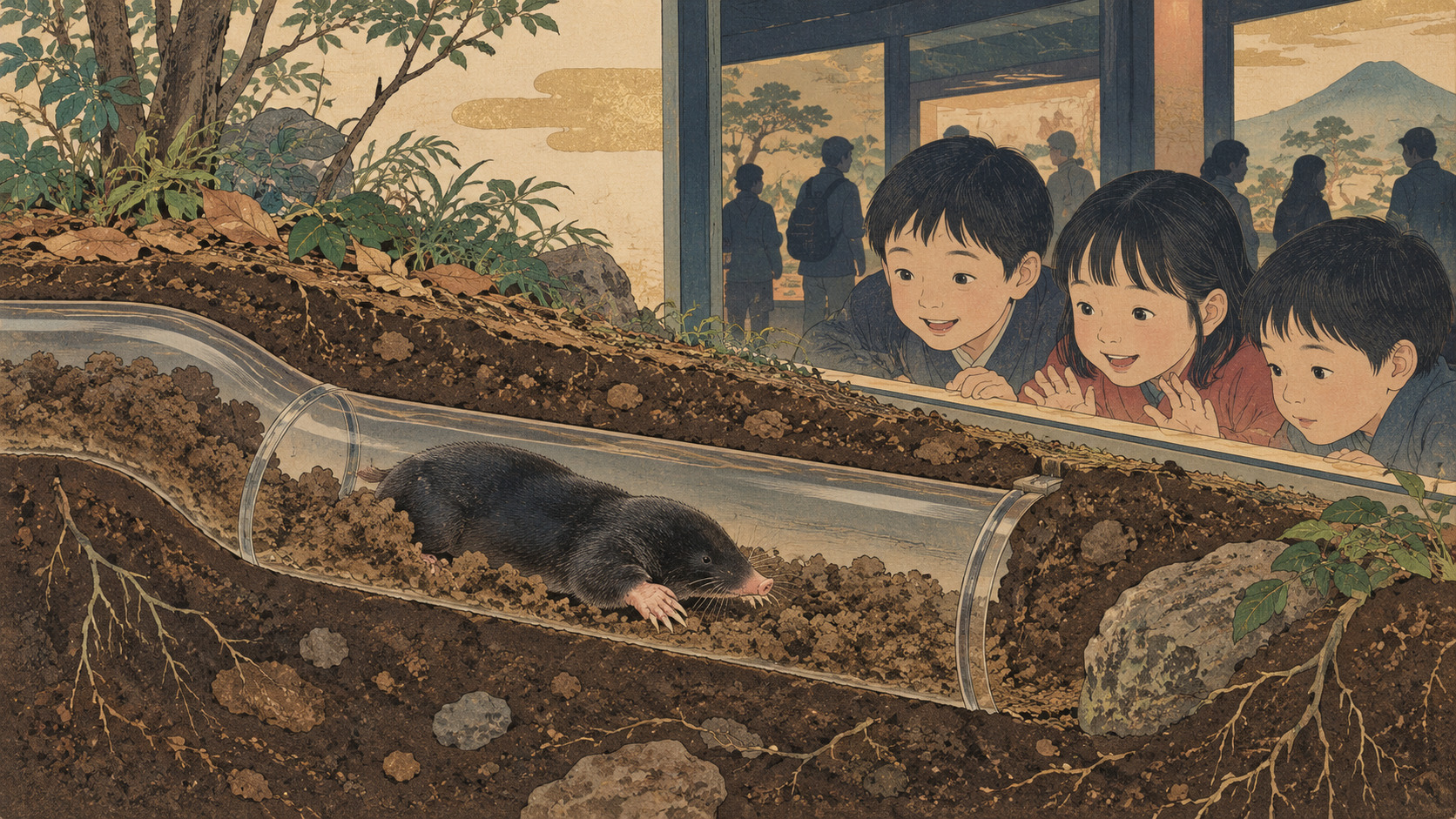
A mole gives its audience only seconds. A pink snout tests the air, soil shifts, and broad forefeet work against the wall of a transparent tube. Then the animal is gone and the tunnel becomes empty evidence again.
Toyohashi Zoo and Botanical Park—known as Nonhoi Park—opened Mogu-room on September 3 near the exit of its Nocturnal Animal House. The permanent husbandry and research display holds Japanese moles, Mogera wogura. Local television reported that the three animals on view had been captured within the park.
Clear tubes link container habitats. An endoscopic camera looks inside; a replica skeleton gives visitors an anatomical reference; prototype trapping and measuring devices make the research process part of the display. Mogu-room is designed not merely to reveal an elusive animal, but to show how much effort is required to know it responsibly.
Reading “western Japan’s only” correctly
The park says that, before Mogu-room opened, only two members of the Japanese Association of Zoos and Aquariums permanently displayed animals in the mole family: Tama Zoological Park in Tokyo and Aquamarine Fukushima. Nonhoi became the third nationally and the only one in western Japan. The comparison was current at the end of July.
That is a specific institutional claim, not proof that no temporary display, non-member facility or private research colony exists anywhere west of the dividing line. It depends on three conditions—JAZA membership, animals in the family Talpidae, and permanent public display. The distinction turns a catchy superlative into information a reader can evaluate.
The park also warns that animals may be taken off display according to their condition. This is not a minor disclaimer. Moles are difficult to capture and maintain, and outward signs can be hard to read. A credible research exhibit must allow the animal’s welfare to override a visitor’s expectation of guaranteed visibility.
The animal behind the familiar silhouette
The Japanese mole is endemic to Japan. Yamaguchi Museum records its range across western Honshu, Shikoku, Kyushu and nearby islands, and lists earthworms, insects and myriapods among its prey. Tama Zoological Park gives a head-and-body length of 125 to 185 millimetres and a weight range of 48.5 to 175 grams, across grassland, farmland and mountain forest.
Its outward-turned forelimbs function like digging tools; dense fur suits movement through a confined passage. It is not literally eyeless. The useful comparison is not with an allegedly incomplete surface animal, but with a mammal highly specialised for a world organised by soil pressure, vibration, smell and touch.
Taxonomy carries its own history. Older Japanese references may place moles in Insectivora or use other legacy order names. Toyohashi’s 2026 release uses Eulipotyphla—shin-mumōchō-moku in current Japanese—and the family Talpidae. The official English common name used by Tama is Japanese mole.
- Visitors see: posture in a tunnel, movement of snout and forefeet, and brief passages between chambers.
- Researchers measure: prototypes aim to record body weight and time without routine capture.
- Traps communicate: an IoT sensor sends an immediate alert so a live-caught animal can be recovered sooner.
- Questions remain: field behaviour, population patterns, long-term health and breeding are still difficult to document.
From a local question to a research network
According to the Higashi Aichi newspaper, Nonhoi began focused mole research about four years ago. Researchers sharing the problem subsequently joined, producing a network said to include seven organisations by 2026. Public sources examined for this article did not provide a complete, consistent list of all seven and their roles, so no full roster is asserted.
One core project is publicly documented. “Elucidating the Ecology of Subterranean Small Mammals Using a Biological Monitoring System” received support from the MUFG Biodiversity Conservation Research Fund in 2025. Nonhoi is the lead institution, working with Gifu University, the National Institute of Advanced Industrial Science and Technology, and Sojo University. Gifu lists the research period as August 2025 through March 2028.
The team is developing film sensors based on microelectromechanical systems and scales optimised for small animals. The stated aim is to collect biological data non-invasively in captivity, improve husbandry and breeding, and eventually adapt monitoring tools for wildlife and biodiversity conservation.
Making faster capture a welfare tool
Studying an underground mammal begins with the difficult act of detecting a live capture. Gifu University’s Wildlife Resource Laboratory explains that delayed discovery in a live trap increases the burden on the animal. Speed is therefore not just an efficiency metric; it is part of humane field practice.
The laboratory adapted its HuntBot remote-capture technology into a mole trap with an IoT motion sensor. Entry triggers an alert on a smartphone, allowing staff to respond without waiting for the next routine inspection. A 3D-printed body can be adjusted for tunnel size, target species and field conditions.
Sojo University reports that an improved version was placed in the field in 2026, while Gifu records a confirmed live-capture test. Those are promising development steps, not a completed validation. The public evidence does not yet establish the size of any reduction in holding time or a final capture-success rate.
A scale embedded in ordinary movement
Body weight is basic health information, but obtaining it can require catching and moving a small, sensitive animal. The collaboration is instead developing a tunnel that records weight when a mole passes through on its own.
Tokai Television reported that the Mogu-room system weighs a mole in real time as it crosses the tube. Sojo University, however, describes the small-animal scale and film sensors as under development. The most accurate reading is therefore that visitors are seeing a research instrument in progress, not a finished diagnostic product.
If the measurements become stable, the result is richer than an occasional weigh-in. Time-stamped series could reveal changes associated with feeding, rest, season or illness. The same voluntary passage would become both a visitor’s glimpse and a data point, limiting the need to handle the animal solely for measurement.
The precedent of Tama’s Mole House
Japan has a longer history of designing around this problem. Tama Zoological Park opened its Mole House in August 2003 with eastern moles. It drew on earlier husbandry experience to connect a shallow soil-filled frame—sealed with clear acrylic—to pipes extending into the off-view holding area.
The engineering compromise was exacting. Too much depth hid the tunnel from visitors; too much soil left insufficient room to dig. The display had to balance a natural substrate, animal choice and human visibility. Nonhoi’s containers, clear pipe and internal camera add digital measurement to the same fundamental negotiation.
The rarity of permanent displays should not be confused with rarity in the wild. The Japanese mole is widespread in western Japan and is listed as Least Concern by the IUCN. Its challenge is the opposite: it is ordinary but concealed, locally present but difficult to capture, keep and observe over time.
A zoo that shows unfinished knowledge
Traditional exhibits can make scientific knowledge appear complete: the animal is present, the label states the facts, and the visitor moves on. Mogu-room exposes uncertainty. Prototype devices remain prototypes. Important behaviour is unknown. The animal may choose not to appear, or may be withdrawn for health reasons.
Transparency also creates responsibility. A clear passage improves observation, but whether its use is comfortable must be checked through time budgets, avoidance, weight and health. A facility built to gather biological data should give equal status to data about the welfare of its displayed animals.
The opening guide on September 5 has ended; the permanent display remains. Its success should eventually be assessed by more than attendance or sightings. Did alerts shorten trap waits? Did the scale produce reliable measurements? Did data change husbandry, field methods or conservation practice? Publishing those answers would allow a research display to return knowledge to the public that supports it.
Learning to wait for an unseen neighbour
The mole is not an exotic animal imported from a remote wilderness. It is beneath Toyohashi’s park, fields and grasslands. People fail to see it because their lives occupy a different layer.
Mogu-room uses tubes, a camera and sensors to bridge those layers. Yet the goal should not be to force the animal onto a human timetable. The better design accepts that nothing may appear, then records quietly when the animal chooses to pass.
For a few seconds, one mole moves through the soil. A child sees a snout. A scientist sees a timestamp and a weight. A keeper watches for change. The darkness beneath the ground was never empty. Opening a window into it requires more than light; it requires the technology—and the patience—to wait.
- Nonhoi Park, “Mogu-room” opening notice — official name, opening time, location, species, JAZA-member comparison and welfare caveat.
- Toyohashi City release — camera, replica skeleton, research display and four-year preparation.
- Tokai Television/FNN — opening-day reporting, three animals and real-time weighing.
- Gifu University Wildlife Resource Laboratory — collaboration, alerting live trap, 3D printing and animal burden.
- Sojo University monitoring-project notice — partner institutions, MEMS, weighing and research goals.
- Sojo University trap-development update — 2026 field testing and iteration.
- Gifu University research overview — project period.
- Yamaguchi Museum, Japanese mole — scientific name, endemic status, range and diet.
- Tama Zoological Park species account — English name, range, measurements, habitat and conservation status.
- Tokyo Zoological Park Society, Mole House opening — 2003 design and husbandry precedent.
- Japanese Association of Zoos and Aquariums member list — Nonhoi Park membership.