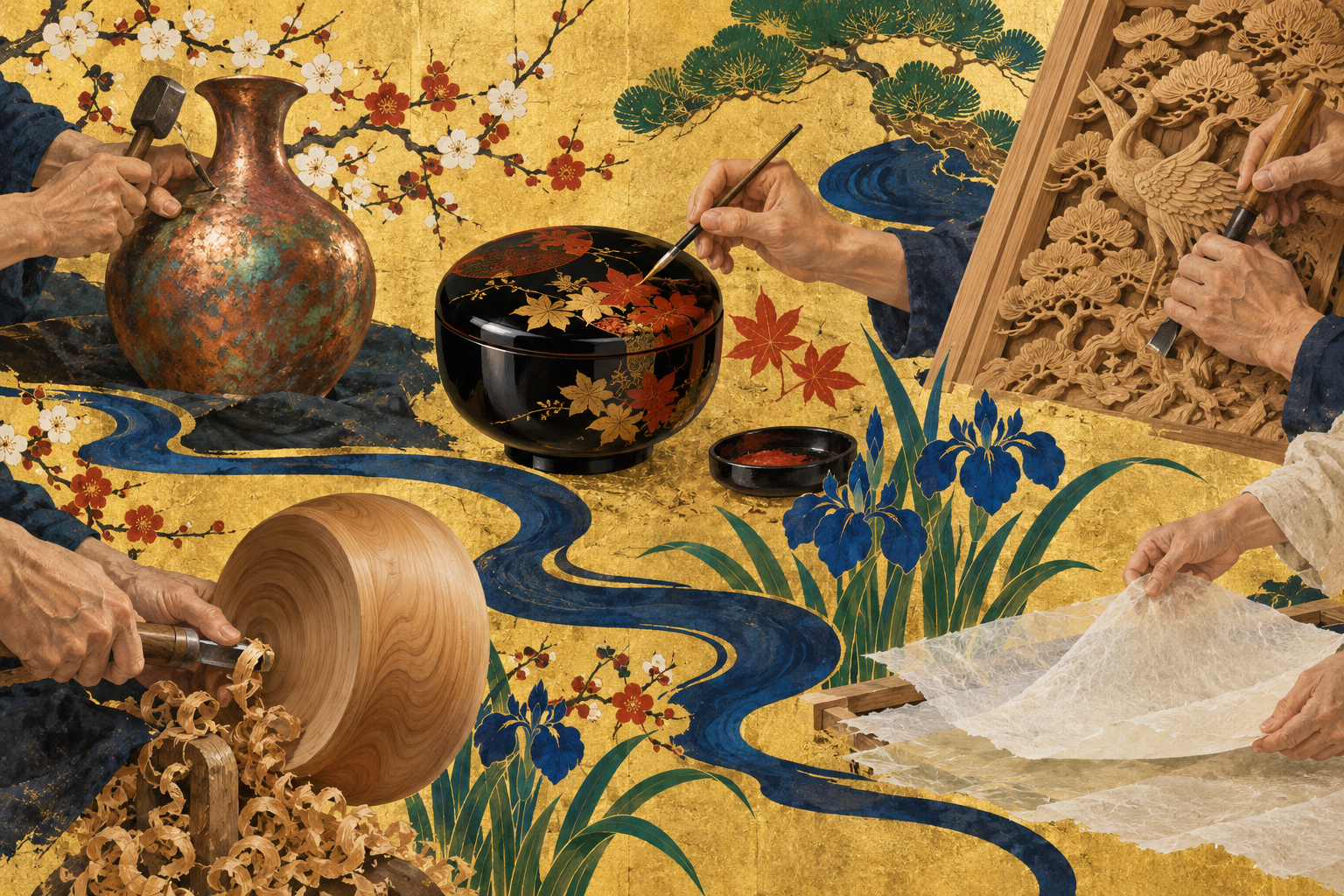
A polished object can hide the work that made it. The wood beneath a lacquered surface, the preparation beneath an iridescent shell pattern and the decisions behind a carved opening may be easy to overlook. An exhibition opening at Nihonbashi Toyama-kan on September 11 invites visitors to look at those layers—and to try a small part of the work themselves.
The 29th Toyama Prefecture Traditional Craftspeople Exhibition brings together Takaoka copperware, Takaoka lacquerware, Inami wood carving, Shogawa turned wood and Etchu washi. Display and sales continue through September 24, with the final day ending at 6 p.m. Workshops take place on selected dates, rather than every day. [1]
The title recognises people as well as objects
The Japanese exhibition title, 第29回 富山県伝統工芸士展 ~継承される技術・技法~, puts certified craftspeople at its centre. Dentō kōgeishi is a title awarded by the Association for the Promotion of Traditional Craft Industries. Its published requirements include at least 12 years of production experience in the relevant craft region and practical, knowledge and interview examinations. [12]
That certification concerns a person's skills. It is distinct from the designation of a craft category. Shogawa turned wood introduces another useful distinction: the association specifically identifies it as a designated traditional craft material. The expertise involved in creating a wooden foundation deserves attention alongside the finished article. [11]
Seen this way, “traditional” becomes an invitation to ask who does which part of the work, and how the knowledge passes on. Age alone tells only part of an object's story.
Takaoka copperware: beyond the silhouette
The association traces Takaoka copperware to the early Edo period, when the Kaga Maeda domain brought in seven casting craftspeople. The tradition combines forming copper alloys in moulds with work such as engraving and colouring. Its account describes an interconnected production structure, from models and casting to finishing and decoration. [9]
The September 20 workshop focuses on a different material and a limited operation: participants pattern a tin sheet using a tagane, a metalworking chisel, to make a coaster. It is an encounter with skills from the copperware region, not a session pouring molten copper. [4]
That distinction offers a way to view the exhibition too. Look separately at the outline of a metal object and its surface. Form, pattern and colour can represent different decisions and different specialisms.
Takaoka lacquerware: the work below the shine
Takaoka lacquerware also has roots in the early Edo-period castle town. The association's history describes production of armour, chests and dining trays, followed by the development of varied decorative methods. Representative techniques include carved lacquer decoration, Yusuke-nuri and shell-based aogai-nuri. [7]
In the latter, shell contributes its shifting colour to a design. Preparing the wood, building the ground, placing shell, coating and polishing all contribute to the final surface. What catches the eye is supported by operations that may be difficult to see. [7]
On September 22, participants attach pre-cut abalone-shell pieces to a miniature panel. The activity takes about 20 minutes, but the finished object will not leave with them that day: the organiser says it will be mailed three weeks later after finishing, with postage included in the fee. [6]
The difference between participation time and completion time is part of the story. A brief workshop offers access to one stage of a longer process.
Inami carving: shaping the spaces within wood
According to the association's account, Inami carving began when a sculptor from Kyoto passed skills to local carpenters during the rebuilding of a temple hall lost to fire in the mid-18th century. Temple work initially predominated. During the Meiji period, carving became a specialised occupation and expanded into products such as transom panels for homes. [8]
A carved transom asks the maker to consider what remains and what is removed. Openings, depth and the passage of light are part of its effect. Carving can therefore be understood as an organisation of space as well as a treatment of wood.
The September 19 session brings the task down to the scale of a coaster. Participants carve a pattern into wood that has already been cut and planed, using tools including rounded and V-shaped carving blades. [3]
Shogawa: the foundation has a maker
Shogawa turned wood grew against the background of timber transported and gathered along the Shogawa River. The association dates the beginnings of commercial lathe-work there to craftspeople drawn by the timber supply in the second half of the 19th century. Drying, rough turning and finishing turn wood into a usable form. [11]
For the September 12 pincushion workshop, a craftsperson has already turned the round wooden base. Participants choose fabric and sew to create the cushion. The advertised experience does not include operating a lathe. [2]
The base may be less conspicuous than the fabric placed above it, yet it carries its own expertise. Giving that work a separate place in the exhibition helps make an often-overlooked contribution visible.
Etchu washi: a history of practical uses
Etchu washi encompasses regional histories in Yatsuo, Gokayama and Birudan. The association points to references to paper from Etchu in Nara-period Shōsōin documents. It also describes later practical uses: paper associated with medicines in Yatsuo and supplies for the Kaga domain from Gokayama. [10]
Those early references establish a long regional history; they should not be treated as proof that every present-day product uses an unchanged ancient method. The material's significance also lies in the different needs it has served.
On September 21, visitors will colour two existing washi postcards with dyes through cut-out stencils. This is a paper-decoration session, rather than papermaking from fibre. [5]
Choose the date for the craft you want to try
| Date | Activity | Fee and duration |
|---|---|---|
| September 12, Saturday | Shogawa: one pincushion[2] | ¥2,000 / about 30 minutes |
| September 19, Saturday | Inami: one carved wood coaster[3] | ¥1,100 / about 40 minutes |
| September 20, Sunday | Takaoka: one tin-sheet coaster[4] | ¥4,000 / about 50 minutes |
| September 21, Monday | Etchu washi: two dyed postcards[5] | ¥1,100 / about 40 minutes |
| September 22, Tuesday | Takaoka: one shell-decorated mini panel[6] | ¥3,500 / about 20 minutes |
Each session is listed for four participants. Preschool children need an accompanying guardian for carving; the tin workshop is for ages 10 and above, and postcard dyeing is for elementary-school age and older. No age restriction is listed for the pincushion or shell panel. Consult the individual official pages for session times and application forms. The shell activity also advertises entry as seats become free during its 11 a.m.–5:30 p.m. reception period. [2][3][4][5][6]
The venue is the exchange space at Nihonbashi Toyama-kan, on the first floor of Nihonbashi Daiei Building, 1-2-6 Nihonbashi Muromachi, Chuo-ku, Tokyo. The facility lists shop-floor hours of 10:30 a.m.–7 p.m.; the exhibition closes at 6 p.m. on its final day. Its access page places it a one-minute walk from Mitsukoshimae Station's B5 exit. Event enquiries: 03-6262-2723. [1][13]
Japan.co.jp analysis: learning to be a more attentive user
A short workshop cannot compress years of apprenticeship into an afternoon. It can, however, change the questions a visitor asks of a finished object. Which stage takes time? Who completes it? What care will it need after purchase?
That is the opportunity in placing participation beside display and sales. Makers carry skills forward, while people who understand, choose and continue using their work form another part of the relationship. A visit to Nihonbashi could leave someone with more than a souvenir: a reason to keep learning about the work being done in Toyama.
- Nihonbashi Toyama-kan, 29th traditional craftspeople exhibition
- Nihonbashi Toyama-kan, pincushion workshop
- Nihonbashi Toyama-kan, wood-carving workshop
- Nihonbashi Toyama-kan, tin-sheet coaster workshop
- Nihonbashi Toyama-kan, washi postcard dyeing
- Nihonbashi Toyama-kan, shell-decorated panel workshop
- Association for the Promotion of Traditional Craft Industries: Takaoka lacquerware
- Association for the Promotion of Traditional Craft Industries: Inami wood carving
- Association for the Promotion of Traditional Craft Industries: Takaoka copperware
- Association for the Promotion of Traditional Craft Industries: Etchu washi
- Association for the Promotion of Traditional Craft Industries: Shogawa turned wood
- Official traditional craftspeople directory: certification
- Nihonbashi Toyama-kan, access and opening hours