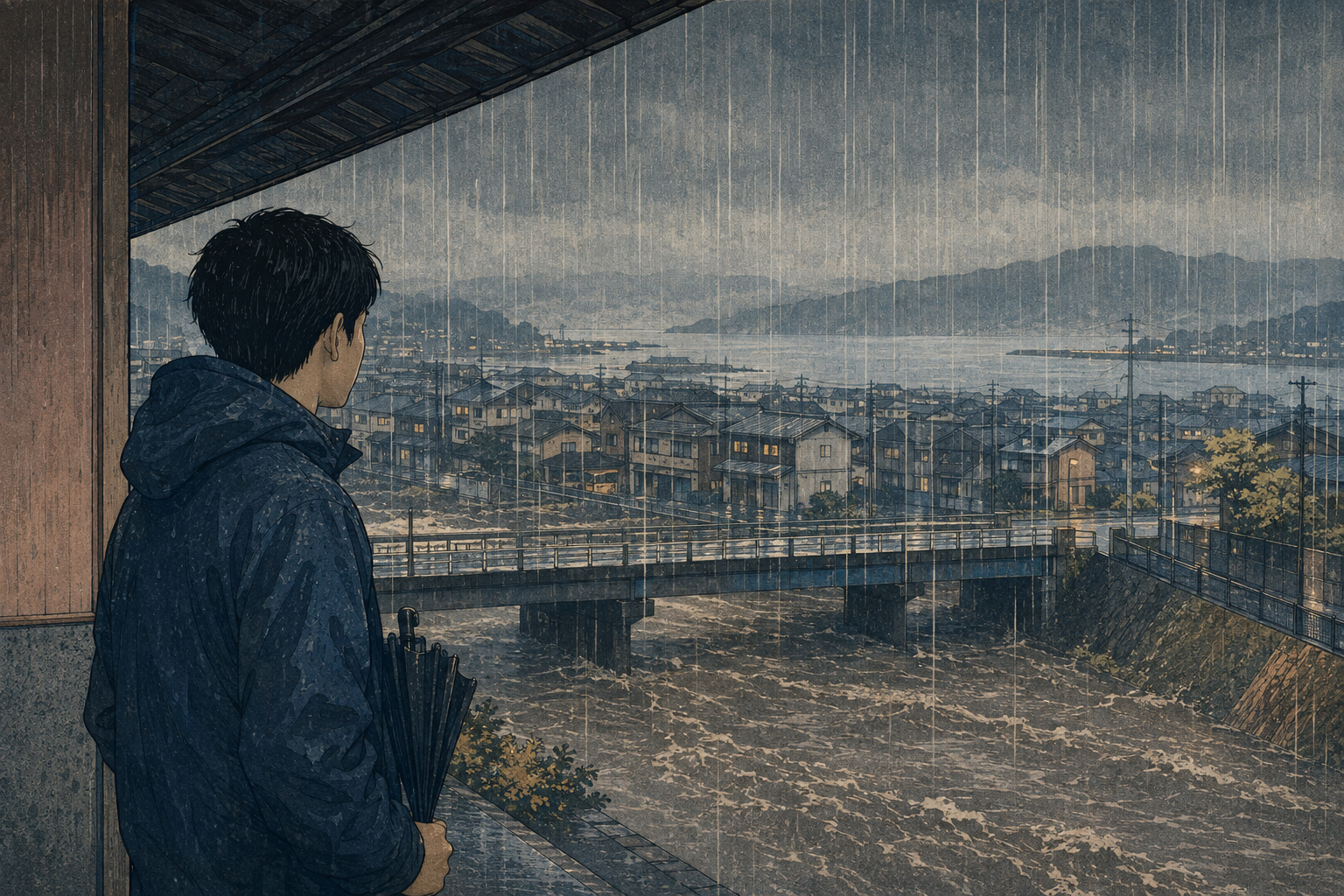
The black Level 5 color vanished from the warning screen Thursday afternoon. The disaster did not vanish with it. Japan’s weather and transport authorities had issued a Level 5 Heavy Rain Emergency for Himi at 6:20 a.m. By 4:00 p.m., they said it was being replaced by a Level 3 warning, while stressing that landslides, inundation and river flooding remained serious threats.
The terminology is new. JMA reorganized Japan’s hazard information on May 29, 2026, attaching level numbers to the names of heavy-rain, landslide, flood and storm-surge warnings. A Level 5 Heavy Rain Emergency is weather information corresponding to the highest alert level: a major disaster may be imminent or already occurring. It is distinct from an evacuation order issued by a municipality. Residents must read JMA risk information together with local evacuation instructions.
Himi’s rainfall reached 358.0 mm in the 24 hours through 2:30 p.m., the station’s highest figure on record. That replaced the morning report’s early snapshot of 252.0 mm in 12 hours. In a 10:00 a.m. river update, MLIT said inundation had been confirmed along the Ao, Unami and Kamishō rivers in Himi.
Four communities isolated; homes and roads damaged
Himi’s 3:00 p.m. damage report said parts of the Kumanashi, Tokonabe, Yoshitaki and Ajikawa communities had been isolated by landslides or fallen trees. The number of households and residents was still being established, but the city said it had confirmed that everyone was safe.
The same report listed 24 incidents on municipal roads—including 20 landslides and four fallen trees—and 33 incidents on prefectural roads involving damage, flooding, soil or trees. Five steep-slope failures were confirmed in Hinata, Nakanouchi, Yabuta, Ao and Yokawa.
Forty apartments in the municipal Ōno housing complex had water above floor level; two units in the Ōura complex had water below floor level. A broken water supply left about 38 households in Busshōji and Hinata without service. About 880 customers in Yabuta, Goishi, Yatsushiro, Hayakawa, Yokawa and nearby districts remained without electricity at the report’s cutoff.
The fire service received 77 calls. Himi said rescue or other response work had been completed in all cases by 3:00 p.m.; one case involved emergency transport. The city did not identify the cause or seriousness of that transport, so this article does not convert it into a confirmed injury count. At the same cutoff, 125 people were in 11 designated shelters and 50 were in five voluntary shelters.
A reopened highway does not reconnect every road
The Nōetsu Expressway was closed between Himi and Nanao-Ōdomari interchanges at 2:00 p.m. after soil and debris were found. The Toyama road office later announced the closure had been lifted. That did not restore the many municipal and prefectural roads still affected inside Himi.
JR West continued to warn of suspended service or major delays on sections of the Himi Line and other routes affected by heavy rain. Friday-morning service can change with overnight rainfall and safety inspections; the operating company’s live information, not Thursday’s timetable, is decisive.
The downgrade is not the end of the emergency
JMA said the front would move slowly south and remain across Japan through Friday night. Areas where rain had eased could receive warning-level rainfall again. The agency forecast as much as 180 mm across Toyama Prefecture in the 24 hours through 6:00 p.m. Friday. Because the ground was already saturated, less additional rain than usual could trigger slope failure, inundation or rising rivers.
Himi’s mayor urged residents to stay away from slopes, flooded roads, rivers and irrigation channels even after the special warning was lifted. The city’s message captured the central fact of this update: a lower number describes the current warning category, not the repair of a road, the draining of a home or the stabilization of a soaked hillside.
Toyama applied the Disaster Relief Act to Takaoka, Himi, Oyabe and Imizu and held a second disaster-headquarters meeting at 4:30 p.m. A third meeting is scheduled for 10:00 a.m. Friday to reassess damage and the next phase of the response.
- JMA and MLIT — Level 5 Heavy Rain Emergency issued for Ishikawa and Toyama, August 27, 2026
- JMA and MLIT — warning downgrade and renewed heavy-rain outlook, 4:00 p.m.
- Japan Meteorological Agency — current warnings
- Japan Meteorological Agency — real-time hazard risk maps
- Japan Meteorological Agency — 2026 hazard-information terminology
- Toyama Prefectural Government — Disaster Relief Act applied to four cities
- Toyama Prefectural Government — official heavy-rain information hub
- Himi City — August 2026 heavy-rain information hub
- Himi City — damage report as of 3:00 p.m., August 27
- Himi mayor — public safety message
- Toyama Office of River and National Highway — emergency river and road information
- JR West — Hokuriku operating information
Update policy: This report reflects official information checked through 9:25 p.m. JST on August 27, 2026. Each figure retains its own cutoff: Himi’s damage report was current at 3:00 p.m., while the city’s shelter page was updated at 4:40 p.m. We do not infer a casualty count from the single emergency transport. The lead image is an AI-generated editorial illustration, not documentary photography.