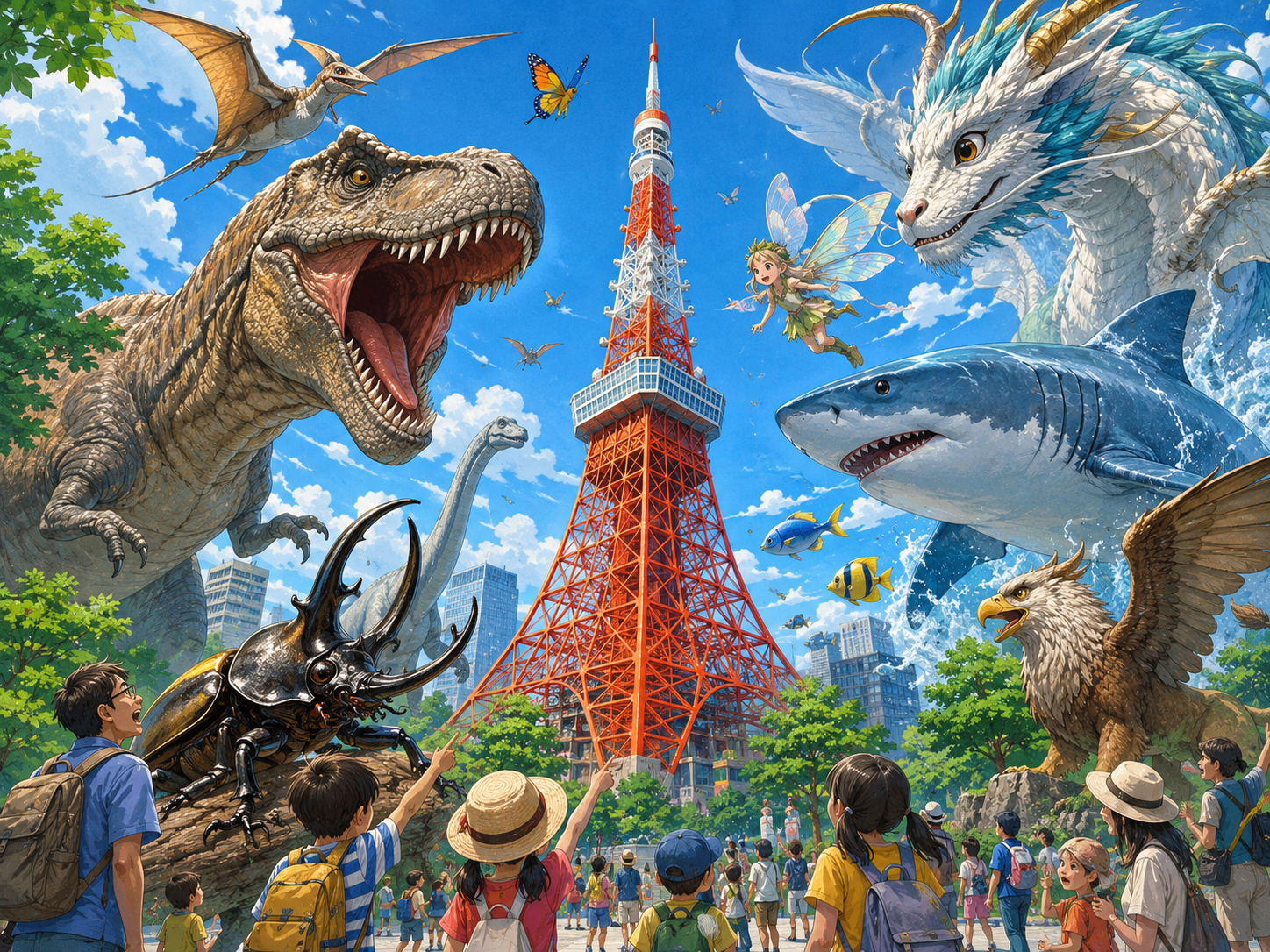
When dinosaurs come to Tokyo Tower, children close the encyclopedia and run
An encyclopedia is usually quiet. A child opens a page, reads a name, compares body lengths, studies horns, fangs, wings, and claws. Dinosaurs, insects, sharks, beasts, extinct animals, imaginary monsters. Children stage battles on paper and, almost without noticing, begin to learn classification and observation.
That encyclopedia is becoming three-dimensional at the foot of Tokyo Tower. From July 18 to September 27, 2026, Saikyo-Oh Zukan Festival in Tokyo Tower 2026 will be held at Tower Hall A and other areas in Tokyo Tower FootTown. The event, which drew more than 40,000 visitors in 2025, returns to Tokyo for summer vacation.
The venue recreates Saikyo Island, the setting of the anime Sai-Kyo-Oh Zukan: The Ultimate Tournament. Visitors become researchers of a sort, taking on missions and attractions, including a dinosaur live show, digital paper sumo, 3D racing, puzzle quizzes, a 3D battle theater, photo spots, and screenings of selected anime episodes.
This is not merely a character event. It is a meeting point for Japanese children’s culture, encyclopedia culture, summer family tourism, Tokyo Tower as a Showa-era landmark, digital play, and parent-child learning.
What is Saikyo-Oh Zukan?
Saikyo-Oh Zukan is a children’s encyclopedia series from Gakken. It presents dinosaurs, animals, insects, extinct creatures, mythical beasts, yokai, robots, and even space characters through the question: What if they fought, and who would be the strongest?
That idea is powerful for children. An encyclopedia organizes knowledge. Saikyo-Oh Zukan adds competition to knowledge. Tyrannosaurus versus lion. Mammoth versus Triceratops. Beetle versus scorpion. Creatures from different eras and environments are placed into an imaginary ring.
Adults may say that such battles are not real. But children use the imagined matchups to learn size, weapons, weaknesses, habitats, evolution, diet, and abilities. Comparing strength becomes a gateway to observation.
The series has surpassed 6.6 million copies in circulation and has also been adapted into television anime. From paper encyclopedia to animation, from animation to event — knowledge leaves the page.
Why Tokyo Tower fits an event like this
Tokyo Tower opened in 1958. At 333 meters tall, it rose as Japan moved from postwar recovery into high-speed growth. Television spread, appliances entered homes, and Tokyo transformed into a modern city. Tokyo Tower was a broadcast tower, tourist site, and symbol of the future.
It echoed the Eiffel Tower while carrying Japan’s postwar hope. School trips, family trips, films, dramas, monster movies, anime, dates, and night views all made Tokyo Tower a memory collector as much as a transmitter.
When Tokyo Skytree opened in the 21st century, Tokyo Tower lost its role as the main broadcasting tower. But its appeal did not disappear. It gained a new role as a landmark connecting Showa nostalgia with contemporary experience. Night views, events, anime collaborations, esports facilities, illuminations, and seasonal programs turned the tower into a venue for layered experiences.
Saikyo-Oh Zukan Festival fits that evolution. A Reiwa-era digital encyclopedia and dinosaur show enter a Showa-era tower. That time layering feels very Tokyo.
Encyclopedias have long shaped Japanese learning
In Japanese children’s culture, encyclopedias occupy a special place: insect encyclopedias, animal encyclopedias, plant encyclopedias, dinosaur books, space encyclopedias, vehicle encyclopedias. Heavy, large-format books once sat on family shelves and in school libraries.
Since the Meiji period, Japan has absorbed modern science through naming, classification, specimen collection, museums, zoos, botanical gardens, school education, and nature study. Encyclopedias helped children organize the world.
But encyclopedias change with the times. Older encyclopedias centered on accurate illustrations and explanations. Today’s encyclopedias connect to photography, CG, manga, quizzes, rankings, battles, video, apps, and events. Knowledge is not only read; it is played with.
Saikyo-Oh Zukan is a modern encyclopedia. It gamifies learning, compares creatures, and turns information into story. That may invite debate. But if children open books, learn about animals, then become interested in fossils and museums, the encyclopedia has succeeded in a new way.
Why dinosaurs keep capturing children
Dinosaurs are strange creatures. They no longer live on Earth, yet in children’s worlds they are always alive: Tyrannosaurus, Triceratops, Spinosaurus, Velociraptor. The names are difficult, but children learn them quickly.
Dinosaurs have three forms of power. They are huge. They are extinct. And they stand between science and imagination. Fossils are real, reconstructions are research-based, but movement, sound, and combat include imagination. Children play freely in that gap.
The festival includes a collaboration with DINO-A-LIVE, known for realistic dinosaur live shows. DINO-A-LIVE is not simply a costume or a static model; it is designed as an experience of a living dinosaur. A Tyrannosaurus seen on an encyclopedia page moves in front of the child. Knowledge enters the body.
Read in a book, watch in anime, feel surprised at the venue — this is the flow of modern children’s learning entertainment.
What digital paper sumo and 3D racing reveal
The 2026 event also includes digital attractions in collaboration with Little Planet, a next-generation children’s theme park. Saikyo-Oh Zukan creatures appear in attractions such as drawing-based 3D racing and digital paper sumo.
This shows a major shift in learning. Children are not satisfied with passively watching screens. They want to draw, touch, move, compete, take pictures, and show parents. Digital play is becoming interactive experience rather than passive video.
Paper sumo is an old Japanese game: make paper wrestlers, tap the ring, and watch them move. When it becomes digital, Showa-era play connects with Reiwa-era technology. The idea of Saikyo-Oh Zukan creatures entering digital paper sumo is very Japanese: old play is not discarded, but moved to a new screen.
At Tokyo Tower, a Showa landmark, children play a digital version of paper sumo. It is time travel through Japanese childhood.
A strong summer-vacation structure
The event runs from July 18 to September 27, with September planned for weekends and holidays only. The schedule is clearly aimed at summer family tourism.
Japanese summer vacation brings independent study projects, museums, dinosaur exhibits, insect exhibits, science centers, stamp rallies, movies, pools, and festivals. For parents, it is also the season of finding places to take children. As heat becomes more severe, indoor events are especially valuable.
Tokyo Tower is easy to understand as a destination. Families from outside Tokyo, inbound tourists, parents and children in the Tokyo area, and grandparents with grandchildren all know what it means to go to Tokyo Tower. The tower alone can justify a day out.
Add dinosaurs, encyclopedias, anime, digital play, photo spots, and a shop, and the structure becomes strong. Parents have the excuse of learning. Children have the truth of play.


Tokyo is turning anime and education into tourism
In Tokyo, anime, manga, games, and character events have become tourism resources. Ikebukuro, Akihabara, Shibuya, Shinjuku, Tokyo Big Sight, Tokyo Dome City, and Tokyo Tower all host the worlds of fictional works for limited periods.
The Tokyo Metropolitan Government also treats animation and content industries as part of the city’s international identity, supporting festivals such as Tokyo Anime Award Festival from cultural and industrial angles.
Saikyo-Oh Zukan Festival is an anime event, but also an educational event: creatures, dinosaurs, fossils, quizzes, and the researcher framing. It shows how Tokyo’s content tourism is moving beyond merchandise and photo ops toward learning and experience.
Children’s events cultivate future fans. Today’s dinosaur child may become tomorrow’s museum visitor, science-center user, anime fan, or even researcher or creator.
The danger and delight of comparing strength
At the center of Saikyo-Oh Zukan is the idea of comparing strength. Who is strongest? Which creature would win? For children, that is exciting and easy to understand.
Nature, however, is not a simple tournament. A lion is weak in the ocean. A shark cannot fight on land. Insects are small but astonishingly strong relative to body weight. Many dinosaurs did not live at the same time. Strength depends on environment, conditions, and opponent.
That is why Saikyo-Oh Zukan is really an entrance to comparison. Why is something strong? Where is it weak? What are its weapons? How does it defend itself? Speed, weight, poison, intelligence, groups, habitat — when a child asks “which is stronger?” there is a seed of science inside.
The adult role is not to dismiss the question, but to add conditions. What if it were underwater? What if it were night? What if one had a group? What if they were the same size? Play becomes thinking.
Between real fossils and CG
The event’s appeal is not only digital. The 2025 event also combined experiences such as touching real fossils, 3D visuals, and dinosaur shows, and the 2026 version is again planned as a multi-sensory experience of the encyclopedia world.
For children, distinguishing real from artificial is important. Moving between them is also important. A fossil is real past. CG is imagined motion. A show is a dinosaur felt through the body. None of these alone fully captures the appeal.
Modern learning events are good at combining specimens, models, video, sound, games, photos, and goods. Knowledge enters through eyes, ears, hands, and body, not only the head.
Saikyo Island inside Tokyo Tower is an encyclopedia turned into a large playground.
Tokyo Tower for parents, Saikyo Island for children
For parents, Tokyo Tower may be nostalgic. A school trip. A date. A place seen in dramas or films. A memory of Showa or Heisei Tokyo.
For children, Tokyo Tower may not feel nostalgic yet. It is a big red tower, a photo spot, a place with elevators, and a place with events. When Saikyo-Oh Zukan enters, it becomes the child’s destination.
That generational gap gives the event strength. Parents have a reason to go to Tokyo Tower. Children have a reason to see dinosaurs and strongest creatures. Grandparents can join easily. Three generations of memory overlap in one place.
Tokyo Tower can accept new events precisely because it is old.
Tourist landmarks survive by borrowing stories
A landmark becomes old if it only stands there. It must renew the reasons people visit. Tokyo Tower remains strong because it can borrow stories.
Seasonal illuminations, anime collaborations, esports facilities, observation decks, food, shops, and events have changed Tokyo Tower from a broadcast tower into a container for experiences. The tower itself stays the same; the stories inside it change.
Saikyo-Oh Zukan Festival is one of those stories. By borrowing dinosaurs, creatures, anime, and encyclopedia culture, Tokyo Tower becomes a summer family event. In return, Saikyo-Oh Zukan borrows Tokyo Tower’s symbolic power and becomes a memory beyond paper and screen.
Tourism and content now lend place and story to each other.
The future of encyclopedias is outside the page
What happens next to encyclopedias? Paper books will not disappear. They remain powerful precisely because they are physical: turn pages, compare entries, go back, add sticky notes, read again. Encyclopedias continue to help children organize the world at their own pace.
But around the book, there will be more anime, games, events, AR, video, and digital attractions. Children learn from the book, watch video, experience the event, then return home and open the book again. Learning no longer ends on the page.
Saikyo-Oh Zukan Festival in Tokyo Tower 2026 shows that future clearly. An encyclopedia becomes a family day out inside a city landmark.
Dinosaurs come to Tokyo Tower. Children are amazed. Parents take photos. On the way home, a child may ask: If a Tyrannosaurus and a beetle were the same size, which would be stronger?
If that question appears, the event has already worked.
- Saikyo-Oh Zukan Festival in Tokyo Tower 2026 is scheduled from July 18 to September 27.
- The 2025 event drew more than 40,000 visitors; the 2026 version adds dinosaur shows, digital paper sumo, 3D theater, and more.
- Saikyo-Oh Zukan is a Gakken encyclopedia series with more than 6.6 million copies in circulation.
- Tokyo Tower opened in 1958 as a Showa landmark and now functions as a venue for family experiences.
- Encyclopedias, anime, digital play, and tourism are combining as learning moves outside the page.
Sources and references
This feature is based on public information from the Saikyo-Oh Zukan festival, PR TIMES, Tokyo Tower, the anime’s official site, and Tokyo culture and tourism sources.