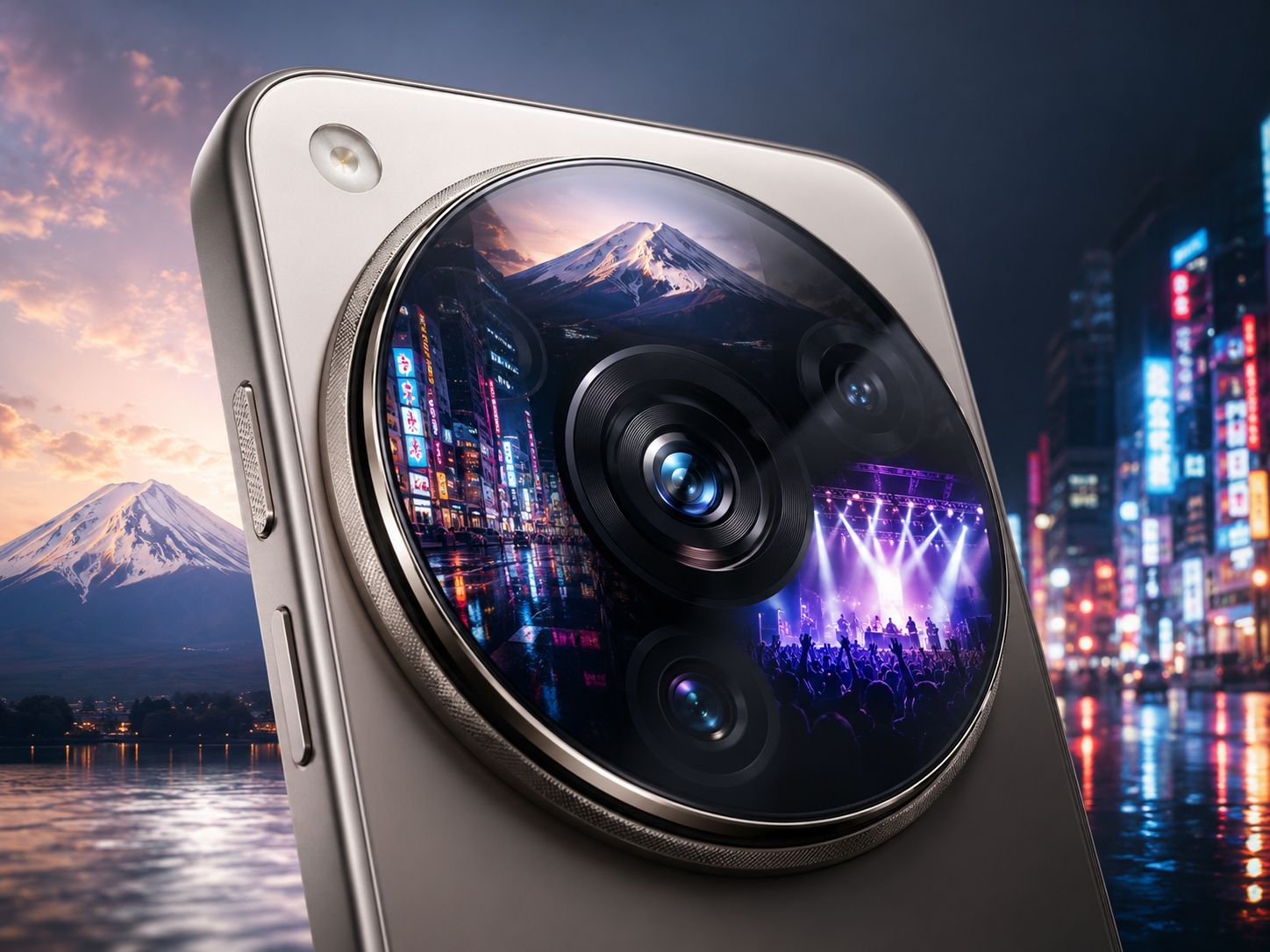
Japan’s travel memory is changing through the telephoto lens in your pocket
Mount Fuji is beautiful because it is far away. Tokyo Tower feels special because it suddenly appears between city buildings. Kyoto rooftops, Shibuya Crossing, sunlight through shrine trees, a concert stage, a fox in Hokkaido, neon in Shinjuku at night — Japanese scenery mixes what is close and what must be watched from a distance.
That distance once required a camera: an SLR, telephoto lens, tripod, interchangeable lenses, film, or memory cards. Travelers carried cameras around their necks. Photography enthusiasts carried heavy bags. Smartphones were convenient, but distant subjects were difficult.
The OPPO Find X9 Ultra pushes that boundary further. OPPO positions the model as “Your Next Camera,” emphasizing its Hasselblad co-developed camera system, dual 200MP cameras, 50MP 10x optical telephoto, and 8K video. Seen alongside the Hasselblad imaging push in the Find X9 series, it is not just another smartphone story. It is a story about how tourism, memory, concerts, food, family photos, and social media are now shaped through pocket cameras.
Japan is one of the countries where smartphone cameras matter most. Tourist sites are crowded. Cities are dense with detail. Food is beautiful. Seasons pass quickly. The smartphone camera is a tool for memory, a tool for finding shops, a tool for posting to social media, and sometimes a work tool too.
Camera phones became lifestyle culture in Japan
No history of smartphone cameras can leave Japan out. In 2000, J-Phone released a camera-equipped mobile phone and helped spread the sha-mail culture of taking and sending photos. It anticipated much of the later smartphone era.
Before that, photos were taken with cameras. They were developed, printed, and placed in albums. Even when digital cameras spread, photos were often transferred to computers. Camera phones created a new habit: take a picture and send it immediately.
Japanese mobile-phone culture absorbed many features early: cameras, mobile email, emoji, ringtones, mobile payments, QR codes, one-seg TV, games, horoscopes, and news. The so-called galapagos phone ecosystem looked closed, but it also contained many functions smartphones later made global.
Today’s smartphone-camera culture sits on that foundation. Photography moved from special act to daily reflex. Photograph before eating. Photograph before meeting. Photograph before buying. Photograph when lost. Photograph as evidence. Photograph as memory. The smartphone became modern life’s second eye.
The weight of the Hasselblad name
OPPO’s partnership with Hasselblad means more than branding. Hasselblad is a prestigious Swedish camera maker, famous in part for the cameras used by astronauts on the Moon. For photographers, the name suggests medium-format cameras, color, tonal range, and a professional shooting experience.
In recent years, smartphone makers have increasingly partnered with classic camera brands such as Leica, Zeiss, and Hasselblad. As small sensors and thin bodies became harder to differentiate, companies began talking about optics, color science, portraits, lens rendering, and shooting experience.
A logo alone does not make a better photo. What matters is color rendering, exposure, tonal gradation, consistency between lenses, skin tones, night processing, and camera-app feel. Hasselblad’s name signals that OPPO wants to sell not only resolution, but photographic taste and experience.
That story fits Japan well. Japanese users are demanding about cameras. Many grew up with compact digital cameras, mirrorless cameras, and DSLRs. Even on phones, they notice color, stabilization, night scenes, telephoto quality, and how food looks.
Telephoto changes how Japan is photographed
The Find X9 Ultra’s headline feature is its Hasselblad telephoto camera claiming 10x optical zoom. Telephoto has long been a smartphone weakness. Digital zoom could enlarge images, but outlines broke down, night shots became rough, and moving subjects were difficult.
Telephoto suits Japanese tourism. Photograph Fuji from a distance. Capture details on temple roofs. Get expressions at zoos and aquariums. Frame a concert stage. Photograph baseball players. Catch distant trains on Shinkansen platforms. Cut out city patterns from an observation deck.
When strong telephoto enters the phone, travelers can capture distant expressions without a camera bag. This is more than convenience. It changes the way travel memory is made. Wide-angle shots say, “I was there.” Telephoto shots say, “This is what I noticed.”
Telephoto is not magic, however. Moving subjects, dark conditions, hand shake, subject distance, and AI processing all matter. Some reviews praise the X9 Ultra’s zoom ambition, while others note challenges with consistency and motion. Smartphone cameras have advanced, but physics has not disappeared.
Smartphone cameras have changed how Japan gets crowded
Smartphone cameras have changed tourism crowding. Travel photos were once mainly for family and friends. Now taking the photo can become the purpose of travel. People go to shoot, queue to film, and search for the right angle to post.
Kyoto’s bamboo groves, convenience stores with Fuji views, Shibuya Crossing, Sensoji Temple, Nara Park, teamLab installations, cafe parfaits, ekiben, ramen, and shrine gates have all become not only places to see, but places to photograph.
There is a positive side. Small local shops and landscapes can be discovered through social media. Foreign visitors record Japanese details, share them with friends, and inspire the next travelers. Photos become free tourism advertising.
But there are problems too: manners, trespassing, crowding, private property, obstructed sidewalks, and resident life. The better cameras become, the more people want to photograph everything near and far. Tourist sites must now operate with photography culture in mind.
Food is the smartphone camera’s strongest subject
In Japanese smartphone-camera culture, food holds a special place. Sushi, ramen, tempura, wagashi, parfaits, ekiben, izakaya small plates, and convenience-store sweets are photographed before they are eaten. Taking the picture has become part of the meal.
Food photography is difficult. Interiors are dark. Lighting is yellow. Steam rises. Bowls and plates reflect light. Rice and sashimi can blow out. Ramen oil reflects sharply. Smartphone cameras tune color, brightness, sharpness, and blur to make food look appealing.
This is one reason Hasselblad color rendering matters. Not just loud color, but natural depth: white plates, wooden counters, red tuna, green matcha, golden tempura. Japanese food is remembered through subtle color.
For tourists, food photos are proof of travel and guidance for future travelers. Smartphone cameras now support the restaurant-review economy.


Concerts, sports, festivals: catching heat from far away
Telephoto value is not limited to tourism. It matters for concerts, sports, and festivals: summer festivals, fireworks, baseball stadiums, soccer matches, idol concerts, anime events, theater, and traditional performance. People try to bring faraway stages, players, and floats closer through the screen in their hand.
These moments once required a compact digital camera or telephoto lens. Now people use phones. Photos and videos are shared immediately: concert impressions, oshi memories, fireworks clips, match highlights. The smartphone becomes an extension of the event.
Venue rules still matter. Many performances prohibit photography. Phones can block sightlines. As smartphone telephoto improves, etiquette and rules become more important.
Technology increases what people can do. Society must decide how it should be used.
8K video and the cinematic tourist
The Find X9 Ultra also emphasizes 8K video and high-quality 4K capabilities. Smartphone video may be changing tourism even more than photography. Short videos, vertical clips, travel vlogs, restaurant introductions, hotel reviews, and walking videos have turned travelers into storytellers.
Japan is video-friendly. Train departure melodies, shopping-street sound, festival chants, ramen steam, snow, coastal wind, and nighttime neon carry atmosphere that still images cannot fully capture.
A high-end smartphone makes one person a small production crew. Gimbals, external lenses, ND filters, cooling accessories, and editing apps all support this shift. OPPO’s mention of professional filmmaking accessories shows how the phone is becoming a camera system rather than only a handset.
Video consumes battery and storage. That is why large batteries matter. A camera phone is really a small production device.
Smartphones did not swallow camera companies entirely
As smartphone cameras improve, people ask whether dedicated cameras are obsolete. The answer is not simple. Professional work, long shoots, larger sensors, interchangeable lenses, control, file management, flash systems, and durability still give dedicated cameras strong territory.
But for travelers, smartphones are overwhelming. They are always present. You can shoot and review immediately. You can share. The same device holds maps, translation, payments, train tickets, and hotel reservations. It supports the entire journey, not only the photograph.
So smartphones did not simply replace cameras. They widened the entrance to photography. People who never carried cameras now take photos every day. People who never owned telephoto lenses now try to capture distant subjects.
Photography expanded from a specialized hobby to a universal habit.
OPPO faces a difficult Japanese market
Building presence in Japan is not easy for OPPO. The Japanese smartphone market is heavily shaped by the iPhone, carrier sales, brand trust, operating-system familiarity, accessories, and family ecosystem compatibility. Android makers must differentiate through price, cameras, batteries, design, and AI features.
OPPO has entered Japan through the Reno and Find series. OPPO Japan’s official site promotes the Find X series with Hasselblad color rendering, multispectral imaging, and high-end chips such as Dimensity 9500.
The Find X9 Ultra has strong global visibility as a camera flagship, but domestic sales form and timing should be discussed carefully. This article therefore reads the device in a Japanese context: does OPPO’s camera-phone strategy fit Japan’s tourism, SNS, and photography culture?
The important question is not only what the spec sheet says. It is what kind of photographic life the phone creates.
AI photography makes memory beautiful — and a little uneasy
Smartphone camera progress is not only optical. AI processing is central. It brightens dark scenes, stabilizes shake, smooths skin, deepens skies, restores distant detail, removes distractions, and makes food look more appetizing. A photo is both a record and a computed image.
That is convenient and beautiful. It is also a little unsettling. In travel photos, where does the seen landscape end and the AI-created memory begin? Fuji becomes a little bluer. Night scenes become brighter. Food becomes more vivid. The moon becomes larger. Photography moves from truth toward feeling.
Japanese tourism already moves through images. More people travel to reproduce photos they saw online. If smartphone AI shapes how tourist sites look, it also shapes tourism itself.
The camera-phone race is not only about lenses. It is also about who gets to edit memory.
The next camera is not a phone; it is a travel tool
What makes devices such as the OPPO Find X9 Ultra interesting is that the smartphone has moved from telephone to camera and then to travel instrument.
Travelers use smartphones to show airline tickets, ride trains, check in to hotels, translate, find shops, pay, shoot photos, edit video, post to social media, and send memories home. The smartphone is wallet, map, interpreter, camera, and archive.
At the center is the camera, because travel eventually becomes memory. People want to keep what they saw: distant Fuji, nearby sushi, concert light, a child’s smile, a strange corner of an unknown city. The camera is the vessel that carries those moments home.
Japan is rediscovered millions of times a day through smartphone cameras. When OPPO or any other maker says “your next camera,” it is not only competing in the smartphone market. It is competing over what color Japan’s travel, food, cities, and memories will be saved in.
- The OPPO Find X9 Ultra is positioned as a camera-first phone with 10x optical telephoto, Hasselblad cameras, and 8K video.
- Japan’s tourism, food, concerts, festivals, and cityscapes are increasingly shaped by smartphone telephoto and video.
- Japan helped pioneer camera-phone culture in the early 2000s, making photography part of daily life.
- Smartphone cameras affect tourism crowding, social media, reviews, and restaurant discovery.
- AI photography is powerful, but it also raises questions about how travel memory is edited.
Sources and references
This feature is based on public information from OPPO, OPPO Japan’s Find X series pages, smartphone-camera reviews, and sources on the history of camera phones.
- OPPO: Find X9 Ultra official product page
- OPPO Japan: Find X9 series and Hasselblad imaging
- OPPO: Find X9 Pro camera and ColorOS details
- Amateur Photographer: OPPO Find X9 Ultra review and camera specifications
- The Verge: OPPO Find X9 Ultra review and 10x telephoto discussion
- TechRadar: OPPO Find X9 Ultra review
- Imaging Resource: Camera phone history and Japan's early role