A little of Japan’s future gathers in an Osaka hotel lobby
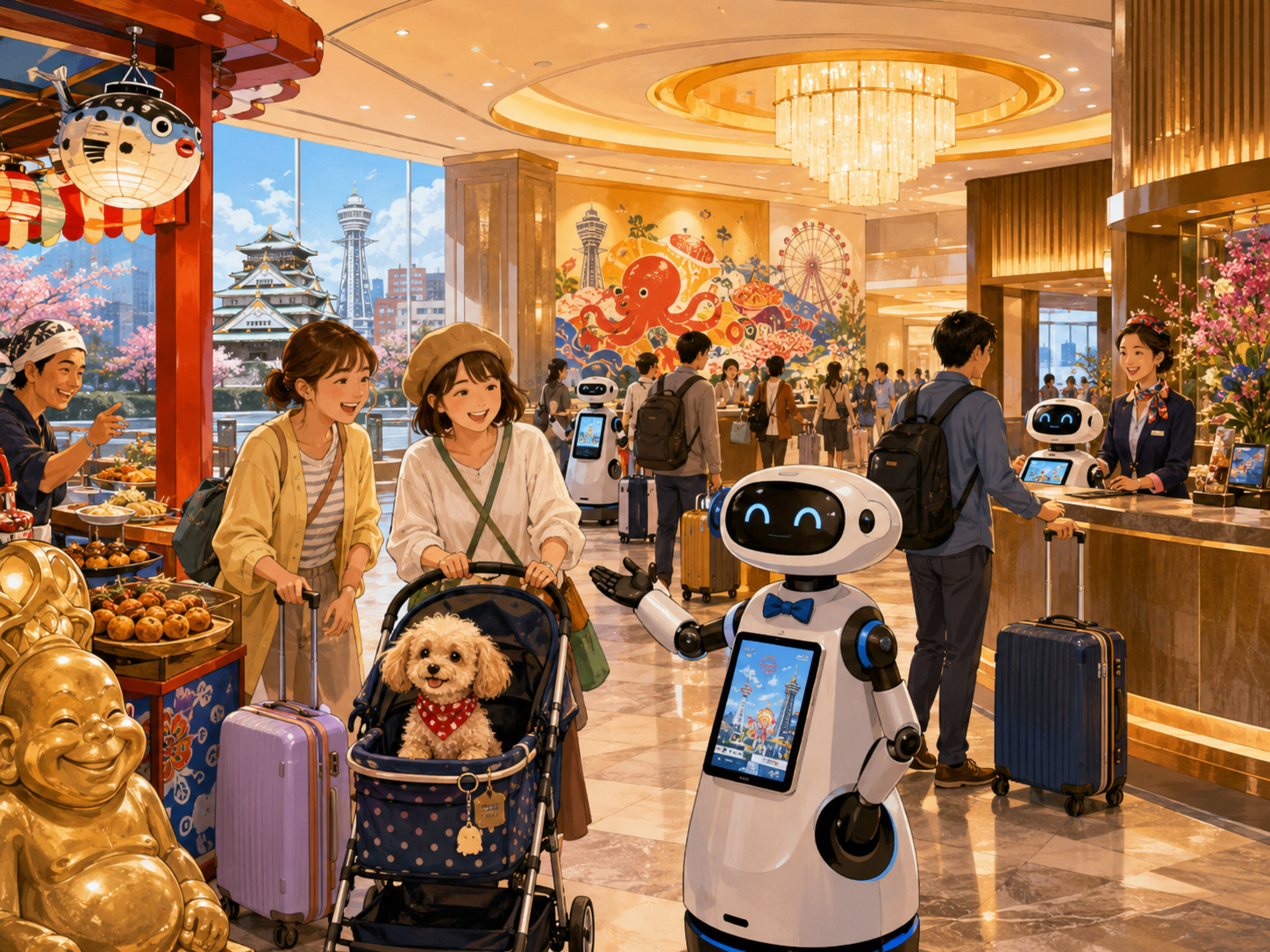
Imagine a hotel lobby in Osaka. A family with suitcases waits at an automated check-in kiosk. A foreign visitor opens a translation app. A delivery robot moves quietly beside the counter. A small dog in a pet stroller heads toward the elevator. Regional food booths display wagyu, dashi, fermented foods, chilled noodles, and sweets. Behind the scenes, hotel managers worried about labor shortages listen to a presentation on AI-driven reservation and staffing tools.
This is not a fantasy. It is the kind of future reflected by Hotel & Restaurant Show & FOODEX JAPAN in Kansai 2026, held from July 22 to 24 at INTEX Osaka. The show brings together themes such as AI and data utilization, robots, extreme-heat countermeasures, pet tourism, hotel equipment, regional food, restaurants, accommodation, and tourism.
That combination is what makes the event interesting. Hotels, food, robots, pets, and heat countermeasures might look like separate topics. In Japan today, they are connected. Foreign tourists are back. Hotels are short of workers. Summer heat is becoming dangerous. Pets are joining family trips. Regional economies want tourism spending. Service businesses must handle multiple changes at once.
The Kansai trade fair becomes a crossroads for all of them.
What the Kansai edition of FOODEX reveals
Hotel & Restaurant Show & FOODEX JAPAN in Kansai is one of the Kansai region’s largest service-industry trade fairs, gathering hotels, ryokan, restaurants, retailers, tourism companies, and food businesses. The 2026 edition is planned for Halls 4 and 5 at INTEX Osaka, with around 450 exhibitors, 500 booths, and 15,000 visitors expected.
The FOODEX name carries weight. FOODEX JAPAN began in 1976 and has become one of Asia’s major international food and beverage exhibitions, supporting food exports, imported ingredients, restaurant trends, regional brands, and the globalization of Japanese agricultural and seafood products.
The hotel and restaurant show side is closer to the worksite of hospitality: guest-room equipment, kitchen tools, cleaning, reservation systems, labor saving, uniforms, amenities, payment systems, frozen foods, and regional ingredients. It is a world of countless small improvements behind the guest experience.
Holding the event in Kansai matters. Osaka, Kyoto, Nara, Kobe, Wakayama, and Shiga form a dense tourism region, connecting food, history, urban travel, inbound visitors, post-Expo international exchange, and regional circulation. It is a different tourism ecosystem from Tokyo.
Labor shortage is inviting robots inside
Japanese hotels and restaurants are interested in robots not only because Japan likes technology. The main reason is labor shortage.
Accommodation and food service are labor-intensive. Check-in, cleaning, delivery, dishwashing, guidance, baggage handling, phone calls, reservation management, complaints, breakfast service, and night reception all depend on people. Without workers, service collapses. But Japan is aging, the young workforce is shrinking, and wage competition is intense.
Robots are not magic replacements for humans. They are tools that can take over repetitive, physically demanding, or simple tasks so that humans can focus on work that requires judgment, empathy, or hospitality. Delivery robots, cleaning robots, guide robots, baggage robots, check-in kiosks, and AI phone systems are changing the shape of hotel and restaurant labor.
In 2026, Japan Airlines is also starting trials of humanoid robots for baggage handling at Haneda Airport, showing how automation is moving into travel operations. Safety decisions remain human responsibilities, but machines are increasingly being tested for repetitive and physically demanding work.
Japan’s robot hotels have already experienced success and failure
No discussion of hospitality robots in Japan can avoid Henn na Hotel, which opened in 2015 at Huis Ten Bosch in Nagasaki Prefecture. Dinosaur robots and humanoid robots greeted guests at the front desk, and the hotel became famous as the world’s first robot-staffed hotel.
But the story was not simple success. Some robots could not answer guest questions well. Some room assistants reacted at the wrong times. In some cases, human staff had to do more work, not less. The hotel later reduced some robots and shifted toward more practical automation.
That experience matters. A robot cannot survive in hospitality simply by being cute or unusual. Does check-in become faster? Does the staff workload actually fall? Do guests understand what to do? Who handles failures? Robots must move from novelty to usefulness.
That is why service robots in 2026 should be judged differently from robot hotels in 2015. The question is not whether the dinosaur is amusing. The question is whether robotics can realistically support labor-short hotels and improve guest experience.
Does omotenashi become weaker when machines arrive?
Japanese hospitality is often described through the word omotenashi. Notice what the guest needs before they ask. Reflect the season. Do not impose. Arrange details carefully. Help the guest feel safe. At first glance, that culture may seem incompatible with robots.
But is it really? If a robot carries plates so that human staff can spend more time advising guests, the robot may support omotenashi rather than weaken it. If a check-in kiosk shortens the line and allows front-desk staff to help a confused international guest, that too can be hospitality.
The question is where humans should remain. Ryokan proprietors, concierges, chefs, sommeliers, guides, and final room inspection all require human judgment and warmth. But repeated corridor deliveries, simple guidance, inventory checks, and payment processing may be automated.
The future of Japanese hospitality is not human versus robot. It is the design of where humans and robots should stand.
Pet tourism is a new form of family travel
Among the show themes, pet tourism reflects a particularly Japanese shift. Dogs and cats were once expected to stay home. Now more people travel with them as family members. Pet strollers, pet-friendly hotels, dog-run lodging, pet menus, pet-friendly cafes, and tourism photo spots are changing travel behavior.
Japan’s low birthrate and aging society have made pets more emotionally central to many households. Small-dog culture is especially strong. In cities, seeing dogs in strollers is no longer unusual. For some older people, pets are daily companions.
For tourism businesses, this is not a tiny market. Travelers with pets need lodging, food, transport, cleaning, odor control, insurance, etiquette, and facility rules. If handled well, pet-friendly travel can raise spending and encourage repeat visits.
But it is not simple. Allergies, barking, cleaning, room damage, distance from other guests, public transport, and restaurant hygiene rules all matter. Pet tourism cannot be built on cuteness alone. It requires rules, equipment, and staff training.


Osaka is a natural test bed for pets and robots
Osaka is well suited to experimentation in hospitality. It is less bound by formality than Tokyo and less constrained by cultural-property tourism than Kyoto. It is a city of food, commerce, humor, and practical solutions. If a new service is convenient and entertaining, Osaka may accept it quickly.
Kansai tourism also combines many experiences over short distances: eating in Osaka, walking temples in Kyoto, meeting deer in Nara, visiting the port in Kobe. Adding pet-friendly travel and robot-supported service could change how visitors combine transport, lodging, dining, and regional spending.
After Expo 2025 Osaka-Kansai, the region must think about how to turn one-time visitors into sustained tourism demand. Hotels, restaurants, regional food, experience tourism, pet-friendly services, and labor-saving technology may all be part of the answer.
Extreme heat is now central to tourism
The fact that extreme-heat countermeasures are a show theme is important. Japan’s summer has become both a tourism asset and a risk. Gion Festival, Tenjin Festival, fireworks, beaches, mountains, shaved ice, and summer vacation all attract visitors. But heatstroke risk is becoming more serious.
Hotels, restaurants, and tourism facilities must think about heat. Air-conditioning efficiency, outdoor queues, shade, misting systems, cooling products, hydration, staff breaks, kitchen heat, temperature-controlled delivery, and pet heat safety are now part of service design.
For pet tourism, heat is even more serious. Small dogs are vulnerable, and reflected heat from asphalt can be dangerous. Pet-friendly hotels and tourism sites must think about animal safety as well as human comfort.
In the age of tourism strategy, climate change is changing the travel product itself.
Regional food lets travelers take memory home
FOODEX’s other major role is connecting regional food to travel experience. Travelers remember not only scenery, but taste: Osaka flour-based dishes, Kyoto pickles, Nara persimmon-leaf sushi, Kobe Western-style cuisine, Wakayama plums, Shiga’s Omi beef. Regional food is both the exit point of travel and an advertisement that continues after visitors go home.
For hotels and restaurants, regional ingredients are a form of differentiation. Not a breakfast that could be served anywhere, but one that tastes of the place. Not a souvenir available everywhere, but food with a regional story. For inbound visitors, food is one of the easiest cultural experiences to understand.
AI and robots may support the back of the house, but food remains in human memory. That is why FOODEX belongs inside a future-oriented hospitality show. The hotel of the future may use machines for efficiency and local taste for emotion.
AI and data are changing the back of hospitality
AI and data utilization are also central themes. In hotels and restaurants, AI is not only the robot guests can see. The larger impact may be behind the scenes.
Demand forecasting, pricing, inventory, food-loss reduction, staffing, cleaning schedules, review analysis, multilingual communication, cancellation prediction, and congestion forecasting can all affect profitability.
In a labor-shortage era, staff allocation becomes critical. How many people are needed at breakfast? How should rooms be cleaned when checkout is concentrated? How should multilingual support be placed when foreign arrivals peak? AI can become not only a substitute for tasks, but a tool for deciding where people should work.
But AI needs good data. Reservations, guest mix, room occupancy, staff shifts, ingredients, weather, events, and transport conditions all matter. Japanese service businesses must organize operational data before they can fully benefit from AI.
Humans may become the luxury
If robots and AI increase, does the value of human service fall? It may be the opposite. As simple tasks become automated, human presence, judgment, conversation, and care may become luxury.
In high-end ryokan and hotels, the question will not be full automation. It will be when a human appears. A robot may move luggage, but a person must be available when something is wrong. AI may manage reservations, but a staff member may advise on an anniversary dinner. Machines may assist delivery, but a human tells the story of the food.
In a labor-shortage era, service done entirely by humans becomes more expensive. That makes it necessary to divide what machines can do from where humans create value. This is not degradation of service. It is redesign.
The future hotel is part zoo, part factory, part home
A hotel is no longer only a place to sleep. It is a workplace, a dining space, a gateway to a region, a place to stay with pets, a place to meet robots, and a small city optimized by data.
What makes the Kansai show interesting is that it does not hide this complexity. AI, robots, pets, heat, regional food, tourism, labor shortage — all of them appear in the same venue. That is the reality facing Japan’s service industry.
A robot politely rolls down the corridor. A dog heads to a guest room in a stroller. A chef turns regional ingredients into a new menu. A hotel manager studies an AI dashboard. Cleaning staff look for ways to handle more rooms with fewer people. A foreign visitor enjoys Osaka food with a translation app in hand.
It is a little strange, a little funny, and very Japanese.
- Hotel & Restaurant Show & FOODEX JAPAN in Kansai 2026 is scheduled for July 22–24 at INTEX Osaka.
- AI, robots, heat countermeasures, pet tourism, and regional food are core themes.
- Japan’s hotel and restaurant labor shortage is pushing robotics and data tools into daily operations.
- Pet tourism reflects demographic change and a new idea of family travel.
- The future hotel must decide where automation belongs and where human hospitality should remain.
Sources and references
This feature is based on public information from the trade fair, JETRO/J-messe, reporting on hospitality robots, and service-robot research.
- Hotel Restaurant Show & FOODEX JAPAN in Kansai 2026 official site
- JETRO J-messe: Hotel Restaurant Show & FOODEX JAPAN in Kansai 2026 themes
- Exhibitor note: 2026 show dates, venue, planned scale
- The Guardian: humanoid robots tested as baggage handlers in Japan
- Wired: hybrid hospitality and Japan's robot hotels
- Behavioral Sciences: service robots in tourism and hospitality research
- Mordor Intelligence: Japan hospitality industry trends and labor shortage response