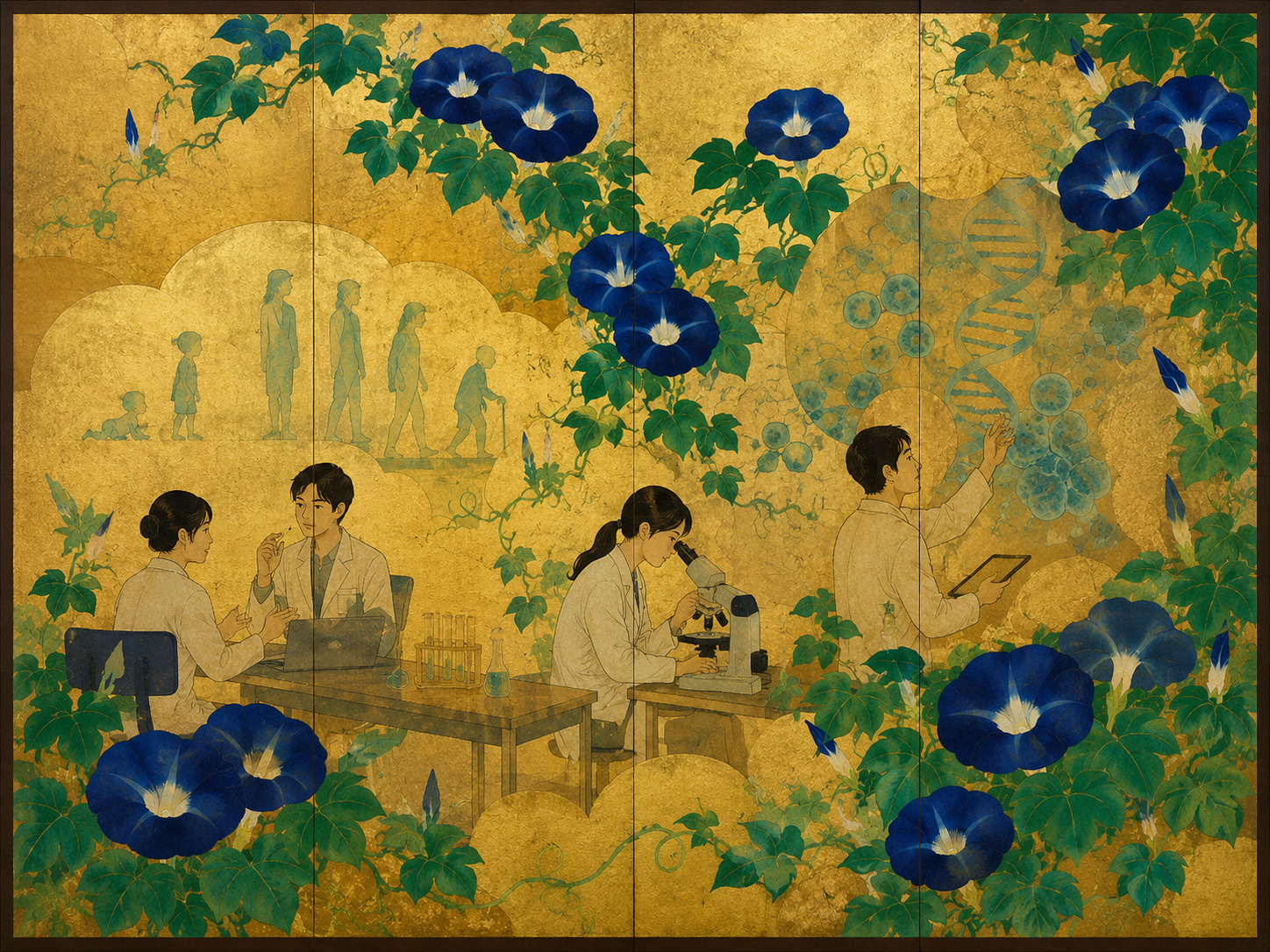
A parsley leaf does not look like a vehicle for information. Under the microscope, however, cells do more than hold molecules inside themselves. They release membrane-wrapped particles into the space around them—tiny packages capable of carrying lipids, proteins and nucleic acids. TIME TRAVELER, a young Tokyo biotechnology company with research space inside the University of Tokyo, is betting that particles isolated from an edible plant can become part of a much larger argument: whether the functional losses of aging can be measurably pushed backward.
On August 11, XPRIZE named TIME TRAVELER–Plant-EVs as one of ten Milestone 2 awardees in its $101 million Healthspan competition. Each of those ten teams receives $1 million and access to shared clinical-testing resources. TIME TRAVELER announced the result in Japan on August 20, emphasizing a parsley-derived supplement and an exploratory human study completed during the semifinal stage.
The language sounds almost impossibly large: “restore” muscle, cognitive and immune function by at least ten years, with a goal of twenty. But this is exactly where precision matters. The prize is designed to force longevity research out of slogans and into standardized functional testing. And the Japanese team has not won the grand prize. It has won the right—and funding—to enter a much harder phase.
The capsule entered a much stranger race than most supplements ever will
XPRIZE Healthspan was launched in November 2023 as a seven-year incentive competition. Its premise is deliberately uncomfortable for conventional medicine. Instead of waiting for a named disease and then treating it, teams are asked to intervene in the biological processes associated with aging and show that function can be restored while people are still living independently.
The target is not simply a blood test that looks “younger.” XPRIZE centers three domains that matter in daily life: muscle, cognition and immune function. The prize structure ties money to a change equivalent to years of age-related decline—at least ten years, with higher grand-prize tiers for fifteen- and twenty-year-equivalent restoration. A therapy must work within a year or less.
More than 600 teams from 58 countries entered the competition. Forty semifinalist teams received Milestone 1 awards in 2025. In August 2026, XPRIZE advanced 20 teams as finalists and selected ten of them for the second $1 million milestone award. From 2026 through 2029, finalists move into coordinated clinical testing, with the University of Utah Data Coordinating Center overseeing trial and data management and the UC San Diego Stein Institute for Research on Aging coordinating shared laboratories, biomarkers and biological sample storage. The grand prize is scheduled for 2030.
That structure matters because longevity science has a credibility problem as well as a discovery problem. The field sits beside legitimate geroscience, commercial supplements, elite clinics, animal studies, biomarkers whose meaning is still debated, and a culture that can turn an exploratory signal into a promise before replication has begun. XPRIZE is trying to make wildly different interventions answer the same broad question: do older people actually function better in ways that correspond to meaningful years of aging?
A million-dollar milestone is not proof that aging has been reversed. It is payment for surviving the transition from an interesting idea to a testable one.
What TIME TRAVELER actually tested
The public trial registry is unusually useful because it removes much of the promotional fog. UMIN000059942 is titled “An Exploratory Study on the Effects of a Test Food Product on Physical Performance, Immune Function, and Cognitive Function.” It was registered in December 2025 and conducted in Japan as a randomized, parallel-group, double-blind, placebo-controlled intervention.
The target population was men and women aged 55 through 69. The planned enrollment was 40. TIME TRAVELER says 39 participants completed the study. Participants were assigned to take either one capsule of the test food or one capsule of placebo daily for eight weeks.
The registered endpoints span the same broad territory that makes the XPRIZE difficult. Physical measures included VO₂max, heart-rate change during exercise, Borg perceived-exertion ratings, skeletal muscle mass, grip strength, lower-limb strength and Timed Up & Go. Immune and inflammatory measures included natural-killer-cell activity, IL-6, GDF15 and LPS. Cognitive function was assessed with Cognitrax, and sleep with the Athens Insomnia Scale.
That is a meaningful design feature. Randomization and double blinding reduce several common biases. A placebo control gives the investigators a comparison group. Measuring multiple domains acknowledges that “healthspan” is not a single number.
It also creates a statistical challenge. When a small exploratory trial measures many endpoints, apparently positive changes can arise by chance, and the interpretation depends heavily on prespecified analyses, effect sizes, confidence intervals, multiplicity handling and whether findings replicate. The registry tells us what was planned. It does not publicly provide the arm-by-arm results.
TIME TRAVELER says its clinical data were evaluated by XPRIZE and contributed to the selection. That is important. But the August 20 announcement does not publish numerical treatment-versus-placebo outcomes, a full statistical analysis or a peer-reviewed paper from this trial. Japan.co.jp therefore cannot independently say which endpoints improved, by how much, or whether any change corresponds to “ten years” of rejuvenation.
- Public: randomized, double-blind, placebo-controlled design; 40-person target; ages 55–69; eight-week intervention; registered physical, immune, cognitive and sleep endpoints.
- Public from the company: 39 participants completed the trial; XPRIZE judges evaluated the submitted clinical data; TIME TRAVELER–Plant-EVs received a $1 million Milestone 2 award.
- Not public in the materials reviewed for this article: full treatment-vs-placebo numerical results, adverse-event tables, effect sizes, confidence intervals, multiplicity-adjusted statistics, or a peer-reviewed report of the completed study.
Why parsley?
TIME TRAVELER describes its approach as parsley-derived plant “exosomes” and markets a supplement called exofull FUJI. The broader scientific field usually uses a more cautious term: plant-derived extracellular vesicles, or P-EVs/PDEVs.
Extracellular vesicles are lipid-bilayer-delimited particles released by cells. Their potential importance comes from what the membrane can protect and transport. In animal systems, EVs can carry proteins, lipids and nucleic acids between cells. Researchers are investigating them as biomarkers, therapeutic agents and drug-delivery systems.
Plants appear to produce extracellular vesicles too. That opens a particularly attractive possibility for oral products: edible plants are abundant, culturally familiar and potentially scalable. Reviews in 2025 and 2026 describe plant-derived vesicles and related nanoparticles as promising oral delivery systems because some preparations tolerate acidic and enzymatic gastrointestinal conditions and can carry bioactive molecules.
But the field is still sorting out what, exactly, researchers isolate when they process plant tissue. A 2026 review from Texas A&M stresses the distinction between extracellular vesicles that were actively secreted by living plant cells and nanoparticles that can form during tissue disruption. Those populations may overlap in size and composition but do not necessarily have the same biological origin.
This is not pedantry. If a therapeutic claim depends on how a particle was made, what it carries and how cells take it up, then isolation and characterization are part of the mechanism—not merely manufacturing details.
Even the word “exosome” carries a warning label
The International Society for Extracellular Vesicles’ MISEV2023 guidelines recommend the generic term “extracellular vesicle” unless researchers can demonstrate a specific biogenesis pathway. “Exosome,” in the strict sense, refers to a vesicle originating inside the endosomal system and released when a multivesicular body fuses with the cell membrane. In many studies, that origin has not been established.
TIME TRAVELER uses “plant exosome” in its corporate and product language. XPRIZE itself labels the team “TIME TRAVELER–Plant-EVs,” which is closer to the current consensus terminology. For this article, “plant extracellular vesicle” is used for the general scientific category, while “exosome” is retained when describing the company’s own terminology and product.
The caution is especially relevant to plant materials. Recent reviews note unresolved questions about purification, batch-to-batch variation, pharmacokinetics, mechanism, regulatory classification and how to distinguish secreted vesicles from particles generated when plant tissue is crushed or processed.
None of that makes the field imaginary. It makes it young.
From cellular garbage bags to biological messages
The history of extracellular vesicles is a useful antidote to both hype and dismissal. In the 1940s, researchers studying blood coagulation encountered particulate material that would later be recognized as part of the EV story. In the 1960s, electron microscopy revealed vesicle-like structures in plant systems, including suspension-cultured carrot cells.
The landmark animal-cell work came in 1983. Two research groups studying maturing reticulocytes—immature red blood cells—showed that the cells disposed of transferrin receptors in small membrane vesicles. The process looked, at first, like cellular housekeeping: a maturing cell throwing away components it no longer needed.
That interpretation did not survive. By the 1990s and 2000s, extracellular vesicles increasingly appeared to have signaling roles. They could carry proteins and nucleic acids, interact with immune cells and influence recipient cells. The conceptual shift was profound: what looked like garbage disposal could also be communication.
Plant biology followed its own path. Observations of vesicle-like structures date back decades, but modern interest accelerated when researchers began isolating nanoscale particles from edible materials and asking whether they could survive digestion, interact with the gut, influence inflammation or carry therapeutic cargo.
1940s — Early observations of particulate material in blood become part of the later EV history.
1960s — Electron microscopy reports extracellular vesicle-like structures in plant cell systems, including carrot cultures.
1983 — Reticulocyte studies establish a pathway for secretion of vesicles from multivesicular endosomes.
1990s–2000s — EVs move from a “cellular waste” interpretation toward roles in signaling, immunity and intercellular communication.
2010s–2020s — Edible-plant vesicles and plant-derived nanoparticles become an expanding area of oral-delivery and functional-food research.
2024 — TIME TRAVELER is founded in Tokyo around University of Tokyo-linked aging research.
2025 — Its drug-development team becomes an XPRIZE Healthspan Top 40 Milestone 1 semifinalist and receives $250,000.
2026 — A separate Plant-EVs entry, using the competition’s late-registration path, becomes one of ten Milestone 2 awardees receiving $1 million.
A startup with two clocks
TIME TRAVELER was established in January 2024. The company says it grew from research in the University of Tokyo’s Institute for Quantitative Biosciences, particularly the Laboratory of Molecular and Genetic Information led by Tetsu Akiyama, whose academic program includes cell proliferation, tumorigenesis and senescence.
The company’s first XPRIZE route was not parsley. It entered with a drug-development program aimed at aging-related biology, using approaches that include antibodies, small molecules and nucleic-acid medicines. That program reached the Top 40 semifinal milestone in 2025 and received $250,000.
Then the competition’s clock became a strategic problem. Drug discovery proceeds through a long sequence of target validation, pharmacology, toxicology and staged clinical testing. XPRIZE, by design, demands a human functional result on a much shorter timescale. TIME TRAVELER says it therefore used the competition’s discretionary late-registration mechanism to enter a second team around its plant-EV healthcare business.
That is one of the more revealing parts of the story. The same company is running two versions of longevity development under very different evidentiary and commercial rules: one resembles conventional drug discovery; the other begins with a food-category product that is already accessible to consumers and is now being pushed toward much more demanding clinical claims.
The second route has a built-in advantage for an incentive prize that explicitly values scalability and accessibility. If an orally consumed plant-derived preparation truly produces robust, reproducible improvements in muscle, cognition and immune function, manufacturing and distribution could look very different from cell therapy, gene therapy or complex biologics.
But accessibility is only valuable after efficacy is established. A capsule is easier to ship than a cell therapy. It is not easier to prove.
The supplement is already on sale; the XPRIZE claim is not
exofull FUJI is not a hypothetical laboratory formulation hidden until the end of the competition. TIME TRAVELER has already marketed the parsley-derived product in Japan, including department-store and online channels. That creates an unusual overlap between consumer commerce and a still-developing clinical evidence base.
Consumers should not confuse those two layers. A product can legally exist as a food or supplement without having demonstrated the sort of age-restoration efficacy demanded by XPRIZE. The prize does not retroactively turn a commercial supplement into an approved anti-aging medicine. Nor does selection as a milestone awardee certify that the product makes users ten years younger.
What it does show is that XPRIZE judges considered the scientific rationale, submitted data, scalability/accessibility and readiness for the next clinical phase strong enough to place TIME TRAVELER–Plant-EVs among the ten teams receiving second-stage funding.
That is significant. It is simply a different statement from “the supplement works.”
Japan is unusually visible in this aging race
TIME TRAVELER is not the only Japanese presence among the ten Milestone 2 awardees. Goda Lab—a collaboration involving the University of Tokyo, Tohoku University, NanoTitan and Tokyo Relife Clinic—also received $1 million. Other finalists span stem cells, mitochondrial biology, targeted molecular degradation, existing-drug combinations, gene-related approaches, extracellular vesicles and personalized care.
Japan’s prominence is not surprising. It is one of the world’s oldest societies, and the practical questions of frailty, independence, care burden and healthy life expectancy are not abstract demographic forecasts here. They shape hospitals, households, pensions, community design and the labor force now.
That can create urgency, but also a market unusually receptive to “anti-aging” promises. The scientific task is therefore double: discover interventions that matter, and build standards strong enough to separate measurable function from persuasive branding.
The hard part starts after the award ceremony
The next phase should be more informative than the milestone announcement. XPRIZE says the finalists will conduct rigorous trials through 2029 under shared data and laboratory infrastructure. That coordination is designed to make competing approaches more comparable and to reduce the freedom teams have to choose only the metrics that flatter their own intervention.
There is still some public inconsistency in XPRIZE materials about the age band. The current competition page continues to describe the winning test in adults aged 50–80, while XPRIZE’s August 11 announcement says the coordinated finalist trials will evaluate adults aged 50–90. The important point is not the typography of the age range but the structure: older adults, standardized functional domains, controlled trials and a requirement for changes large enough to be interpreted against age-related decline.
TIME TRAVELER’s own eight-week exploratory study was much smaller than what would be needed to settle the question. Forty participants can reveal safety signals, feasibility and potentially interesting efficacy signals. It cannot carry the evidentiary weight of a definitive anti-aging claim across multiple biological systems.
| Claim | What the evidence supports | What it does not establish |
|---|---|---|
| “TIME TRAVELER is global Top 10.” | The company uses that wording; officially, XPRIZE named 20 finalists and selected 10—including TIME TRAVELER–Plant-EVs—as $1M Milestone 2 awardees. | That XPRIZE ranked all 20 finalists from 1 to 20 or declared the ten awardees the only finalists. |
| “There was a human clinical trial.” | UMIN000059942 registered a randomized, double-blind, placebo-controlled eight-week exploratory study with a 40-person target; the company says 39 completed it. | That the trial has been peer reviewed or that every registered endpoint improved. |
| “Parsley exosomes reverse aging.” | XPRIZE judged the team’s rationale and submitted data strong enough for a milestone award and next-stage testing. | That public evidence currently demonstrates ten-year rejuvenation, disease treatment or proven life extension. |
| “Plant EVs are a real research field.” | Peer-reviewed literature describes plant-derived EVs/nanoparticles, oral-delivery potential and preclinical biological activity. | That plant preparations are standardized, mechanistically understood or clinically effective across indications. |
What would make the parsley story convincing?
First, the semifinal data need to become inspectable. A peer-reviewed paper or detailed public dataset would allow outsiders to see baseline balance, endpoint definitions, effect sizes, adverse events and whether the statistical plan matches the claims.
Second, the material itself needs rigorous characterization. What particles are present? How consistent are batches? Which components survive manufacturing and digestion? Are the observed effects attributable to vesicles, co-isolated plant molecules, or both? If the mechanism depends on “exosomes” specifically, can their biogenesis be established? If not, extracellular-vesicle or particle terminology is scientifically safer.
Third, replication must scale beyond a small exploratory cohort. Effects should survive larger populations, independent analysis, longer follow-up and the standardized XPRIZE testing environment.
And finally, the prize’s hardest demand has to be met simultaneously: not one favorable biomarker, not one improved test, but convincing restoration across muscle, cognition and immune function on a scale equivalent to years of age-related decline.
Parsley is the memorable part of the story. Measurement is the part that will decide whether the story lasts.
A very old dream enters a very small package
Human beings have spent millennia looking for substances that promise longer life. The containers have changed: herbs, tonics, hormones, pills, gene vectors, cells. The desire has not.
What makes the current moment different is not that a plant is again being associated with longevity. It is that the claim is being forced into a competition that has written down what success should mean and attached enormous money to proving it.
TIME TRAVELER’s name makes the metaphor almost too easy. There is no evidence that its parsley-derived particles transport a person backward through chronological time. The challenge is narrower and harder: can an intervention make an older body perform in measurable ways more like a younger one?
For now, the answer is not public. We know there was a controlled exploratory trial. We know XPRIZE saw data and selected the Plant-EVs team for $1 million in milestone funding. We know the underlying field of extracellular vesicles has evolved from obscure microscopy to a serious—and still unsettled—area of biomedical research.
The next step is where longevity stories usually become less glamorous and more useful: larger trials, standardized assays, negative results that cannot be edited away, and numbers that other scientists can inspect.
If those numbers eventually hold, the image will be irresistible: one of the world’s largest scientific prizes helped turn a common green herb into a route toward healthier aging. If they do not, the experiment will still have done something valuable. It will have forced an extraordinary claim to meet ordinary scientific rules.
- XPRIZE, Aug. 11, 2026 — 20 finalists and 10 Milestone 2 awardees
- XPRIZE Healthspan — competition structure, prize purse and judging target
- TIME TRAVELER, Aug. 20, 2026 — Plant-EVs award announcement and trial summary
- UMIN-CTR UMIN000059942 — registered exploratory clinical study
- Japan Registry of Clinical Trials portal — study status and intervention summary
- TIME TRAVELER — company and University of Tokyo laboratory information
- TIME TRAVELER, May 2025 — earlier Top 40 Milestone 1 award for its drug-development team
- University of Tokyo IQB — Akiyama laboratory research on cell growth, tumorigenesis and senescence
- MISEV2023 — International Society for Extracellular Vesicles nomenclature and rigor guidelines
- Yu et al., 2026 — review of plant-derived extracellular vesicles and translational limitations
- Alsaid et al., 2026 — plant extracellular vesicles versus plant-derived nanoparticles
- The Plant Cell — history of plant endomembrane research and 1960s observations of plant EV-like structures
- Harding et al. retrospective — 1983 discovery of the exosome secretion pathway
Editor’s note: TIME TRAVELER’s press release describes the result as selection among a global “Top 10.” XPRIZE’s current official materials say 20 teams are finalists and ten of those teams are Milestone 2 awardees receiving $1 million each. We use the XPRIZE classification. The company says judges reviewed clinical data, but the public registry and announcement reviewed for this article do not disclose full treatment-versus-placebo numerical results; therefore this article does not claim that the parsley-derived product has demonstrated ten-year rejuvenation. MISEV2023 also recommends “extracellular vesicle” over “exosome” unless endosomal biogenesis is demonstrated. The exchange-rate strip is an editorial reference and unrelated to the research.