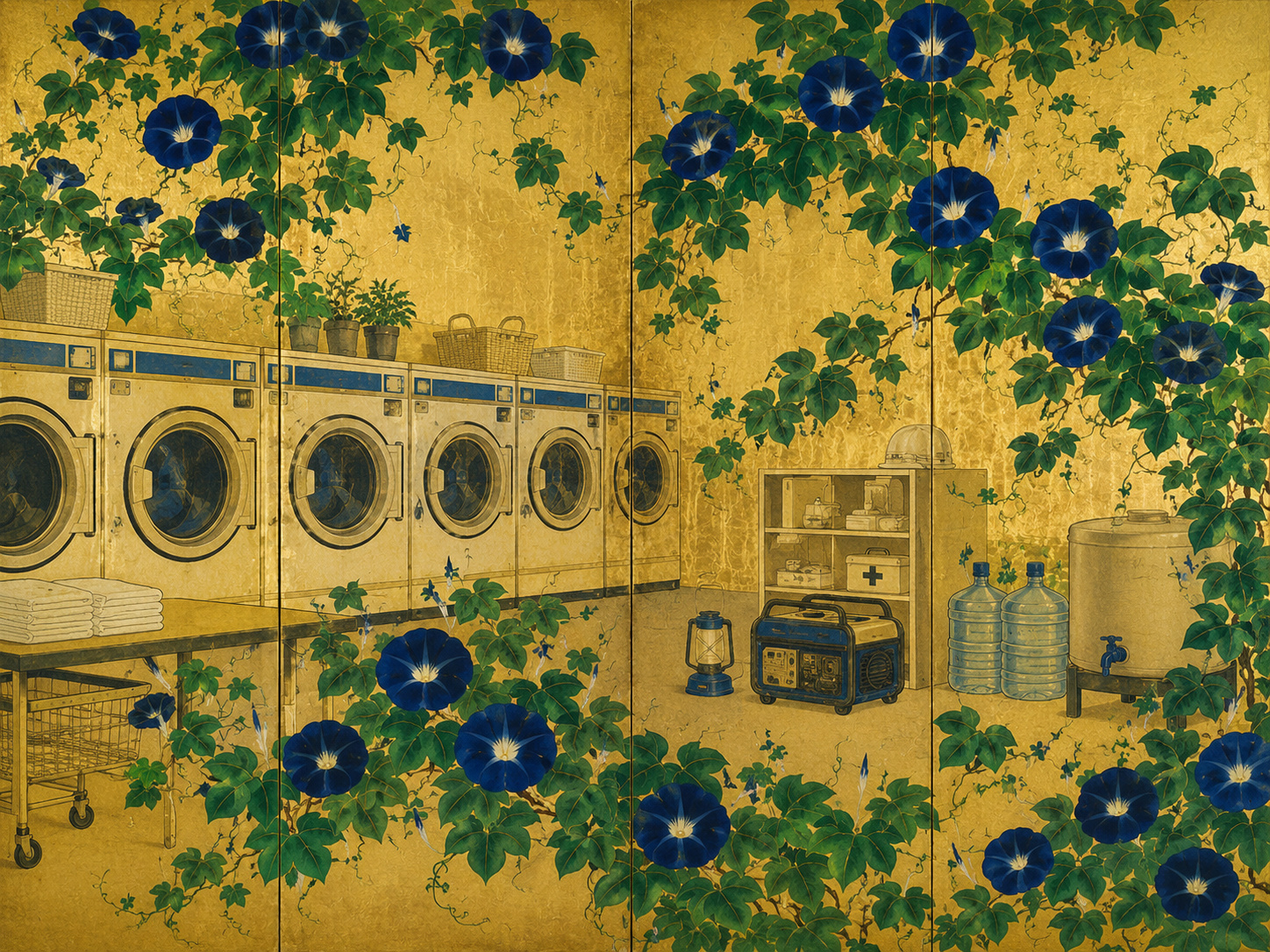
On August 21, a new laundromat opens in Nanao, Ishikawa Prefecture. From the parking lot, Blue Sky Laundry’s Genky Mankomachi location looks like an ordinary piece of neighborhood infrastructure: rows of washers and dryers inside a building meant for one of the most routine jobs in domestic life. But the site carries a second job in reserve. The disaster-ready model is built around stored LP gas, portable generation, emergency cooking equipment and the possibility of serving as a temporary local support point when electricity, water or normal household routines fail.
A second disaster-ready store opens the same day in Saijo, Ehime. In July, operator GIB reported 299 disaster-ready locations. Adding the two August 21 openings takes the network to 301, crossing the 300-store threshold. Two more are scheduled in Nagano on August 28 and 31, bringing the planned month-end total to 303. Blue Sky Laundry as a whole is expected to reach 419 stores by the end of August, meaning roughly seven in ten locations will carry some form of disaster-response equipment.
Those numbers could be treated as an expansion announcement. Nanao makes the milestone harder to dismiss as corporate arithmetic. The city was hit by upper-6 shaking on Japan’s seismic intensity scale during the January 1, 2024 Noto Peninsula earthquake. Roads, buildings and water infrastructure were damaged across the city; at least 2,681 people were in evacuation shelters at the peak recorded by the city, and potable water service was not restored citywide until April 4. Laundry is an unusually good illustration of why disasters are systems problems: a task that feels trivial in normal life suddenly requires water, power, heat, access and functioning roads all at once.
It began when people drove toward the electricity
The concept grew out of Japan’s 2019 typhoon season. In its 2026 account, GIB points to Typhoon No. 15—the storm later named the Reiwa 1 Boso Peninsula Typhoon—as the turning point. Long-duration outages spread across Chiba. Household washing machines stopped with the grid, while Blue Sky Laundry stores in areas that retained power attracted customers from blackout zones. The company remembers enough cars arriving to create what it called “laundry traffic.”
The 2019 storm produced a maximum of roughly 935,000 power outages in Tokyo Electric Power’s service area. Two transmission towers collapsed, and 1,996 utility poles were damaged or brought down. The deeper lesson was not simply that electricity had failed. A long outage exposed how many supposedly separate household functions—communications, refrigeration, air conditioning, hot water and laundry—were all riding on the same electrical system.
Laundry is not the first priority in the first hours after a major disaster. Drinking water, rescue, emergency medicine and fire suppression come first. But the hierarchy changes when evacuation stretches from days into weeks. Underwear, towels, bedding and clothing become questions of hygiene, skin health, privacy and dignity, especially for children, older residents and people living in crowded shelters. Japan’s 2026 Disaster Management White Paper now treats access to laundry alongside warm meals and bathing as part of the living environment that shelters should secure.
That makes the 2019 laundromat queues more than a curious consumer response. They were a map of missing redundancy. When the home stopped functioning, people went looking for another building that could temporarily perform one of the home’s jobs.
The first store appeared in Utsunomiya in 2020
The first formal answer opened on January 31, 2020, in Utsunomiya, Tochigi Prefecture. Blue Sky Laundry’s Utsunomiya Hiraide store, built in the parking area of a Cainz home center, became GIB’s first disaster-response laundromat. Air Water joined as franchise owner and supplied expertise in LP-gas emergency power.
The original design was explicitly tiered. The standard specification included an LP-gas tank sized for about three days, a portable generator, a battery and a connection point for an outside generator. That was enough to preserve lighting and phone charging, while a mobile generator or portable external unit could be connected to support washers and dryers. A medium- and long-duration specification added a 9.8-kW LP-gas generator and air conditioning so the laundromat itself could continue operating during a blackout. A still higher “disaster base” specification added stored water, an assembly shower and cooking equipment.
The point was never to turn a 66-square-meter laundromat into a replacement for a school gymnasium. The architecture works in the opposite direction. Instead of concentrating all resilience inside a few large emergency facilities, it adds small pockets of electricity, heat, water-handling and cooking capability to ordinary commercial sites people already know.
Why LP gas matters more than the washers
The technical center of the model is not the washing machine. It is stored energy. Japan’s Agency for Natural Resources and Energy describes LP gas as a decentralized energy source that can operate independently of the electric grid. Because fuel can be stored in cylinders or tanks at the point of use, it does not depend on the continuity of a long urban gas pipeline. It also stores well and can be converted into heat or electricity when the grid is unavailable.
Disaster resilience is not only a question of which energy system is most efficient in ordinary operation. It is also a question of what remains physically present when a network is severed. If fuel is still on the property after the power lines fail, a generator can turn it into light and charging capacity, while a stove can turn it into hot food. During the 2024 Noto Peninsula earthquake response, the energy agency says LP gas was used for shelter cooking, laundry needs and temporary housing.
That does not make LP gas invulnerable. Tanks and piping need inspection after severe shaking. Long emergencies still require deliveries, and deliveries require roads. Generators need maintenance and people who know how to start them safely. Laundry also requires water, so a blackout solution alone cannot solve a water outage. Resilience is not the disappearance of failure. It is the preservation of another path when one path is gone.
Disaster planning is not about making every system impossible to break. It is about leaving something else in the neighborhood that still works when one system does break.
What is actually common across the 300-plus stores?
GIB’s August 2026 description says disaster-ready locations carry equipment capable of storing roughly three days of LP gas, along with portable generators, emergency cooking pots and gas stoves. The three main functions it emphasizes are emergency cooking, limited electricity for phones and simple appliances, and temporary refuge or community support.
Blue Sky Laundry’s disaster-response page says stores covered by its agreements can make available simple generators and a large cooking pot capable of preparing roughly 120 portions. But the company also states an important limitation: food and tableware are not stocked as part of the standard emergency kit. Those have to come from local volunteers, government or other organizations.
That incompleteness is not merely a flaw. It defines the model. A laundromat is not a self-contained emergency shelter. It contributes a platform—fuel, a generator, floor space, cooking hardware and sometimes laundry capability—onto which municipalities, neighborhood associations, fire brigades, shopping-center operators and residents have to layer people, supplies and information.
The harder problem is deciding who knows how to use it
Emergency equipment has a predictable failure mode. It is purchased, installed and left untouched. Years later, nobody is certain where the key is, how the generator connects, whether the gas valve sequence is correct or which organization has authority to use the equipment.
That is why the number GIB pairs with 300 stores may be more important: 63 disaster-cooperation agreements with municipalities and local groups as of August 2026. In February, about 15 residents and organizers in Nagoya’s Atsuta Ward practiced operating a simple generator and setting up and igniting the cooking equipment. GIB described that as its 17th disaster drill nationwide. In May, residents of the Chanokidaira neighborhood association in Fuji, Shizuoka—under an agreement dating to 2022—conducted their own equipment checks.
That is the unglamorous part of resilience. In a real disaster, head-office technicians cannot be assumed to arrive at hundreds of stores at once. Roads may be blocked, communications unreliable and store staff themselves affected. A piece of equipment becomes local infrastructure only when people nearby know it exists and know enough to use it safely.
September–October 2019 — Successive typhoons cause long power outages in Chiba and surrounding areas; the company traces the idea to customers driving from blackout zones to powered laundromats.
January 31, 2020 — The first disaster-response Blue Sky Laundry opens in Utsunomiya.
2022 — The overall chain reaches 200 stores as disaster agreements and training continue expanding.
2024 — Blue Sky Laundry as a whole reaches 300 stores; disaster agreements pass 50 locations.
February 2026 — A Nagoya drill becomes GIB’s 17th disaster exercise nationwide.
July 2026 — Disaster-ready locations reach 299.
August 21, 2026 — Openings in Nanao and Saijo take the count to an inferred 301, pushing the network over 300.
End of August 2026 — Two Nagano openings are scheduled to lift the disaster-ready total to 303 and the full chain to 419.
The laundromat itself has changed
The model works partly because Japan’s coin laundromats no longer serve only households without washing machines. Ministry of Health, Labour and Welfare data counted 10,228 coin-operated laundry facilities in fiscal 1996 and 16,693 by fiscal 2013. A recent private-sector estimate cited by FNN puts the 2025 total around 26,500.
Demand expanded beyond single-person households. Large bedding, rainy-season drying, pollen avoidance, time savings for dual-income families and the ability to run laundry while shopping all widened the customer base. Blue Sky Laundry built much of its expansion around shopping centers, supermarkets, drugstores and home centers—places already embedded in daily movement.
That geography happens to work for disaster response. The stores often have parking. Residents know where they are. They sit near roads and commercial facilities. Many already use gas for drying, making emergency fuel integration technically natural. And because the building earns money in normal times, the disaster equipment is attached to a site that is maintained, visited and visible rather than a dedicated emergency facility that may sit unused for years.
Laundry matters in the second half of a disaster
Disaster response has phases. The first hours are about rescue, collapse, fire, tsunami, drinking water and emergency medicine. As displacement continues, different failures begin to shape health: toilets, sleep, hot meals, bathing, laundry and privacy.
The Noto Peninsula earthquake forced Japan to confront that second phase again. Damage to roads and water systems prolonged evacuation conditions across the peninsula. In response, national guidance has increasingly treated laundry access as part of shelter quality rather than a luxury to be considered after everything else. In March 2026, the Cabinet Office even published a collection of good practices from bathing and laundry support during the Noto response.
That gives the new Nanao location unusual symbolic weight. But symbolism is not capability. What the store can do in the next disaster will still depend on whether water is available, roads remain passable, someone can open the site, people know how to run the generator, supplies arrive and local officials and residents know the arrangement exists. Disaster readiness is always hardware multiplied by operations.
A local support point is not automatically an official shelter
The company describes these laundromats as possible temporary refuge points and community support bases. That can be useful without making them equivalent to officially designated municipal shelters. Capacity, building safety, stockpiles, operating responsibility and activation rules differ by location. Even where a disaster agreement exists, the exact terms matter.
Three hundred stores also does not mean every Japanese community has one nearby. Japan has more than 1,700 municipalities. Distribution is uneven. And while 63 local-government or community agreements show a growing institutional network, they do not mean all 303 planned disaster-ready stores are covered by individual agreements.
Still, the design belongs to a broader Japanese resilience strategy: turn ordinary private infrastructure into emergency infrastructure when necessary. Convenience stores, service stations, roadside stations, logistics hubs and electric vehicles have all been pulled into versions of the same idea. Instead of building a separate emergency city that waits unused for catastrophe, add emergency capabilities to the city people already use.
| Claim | What the evidence supports | What it does not prove |
|---|---|---|
| “The network passed 300 stores.” | The July count was 299; two stores opened August 21, and four August openings would produce a month-end total of 303. | That all 303 were already operating on August 22. The last two were scheduled for August 28 and 31. |
| “They work in blackouts.” | Common equipment supports stored LP gas, portable generation, charging, cooking and local support. | That every store can run every washer and dryer normally throughout a grid outage. |
| “They can be shelters.” | The company and some agreements envision temporary refuge and support use. | That every location is an officially designated municipal evacuation shelter. |
| “LP gas is disaster-resilient.” | Fuel can be stored locally and used independently of grid electricity or long gas pipelines. | That it is unaffected by equipment damage, road failures, fuel depletion or water loss. |
One building, two jobs
A laundromat is an odd building to describe as emergency infrastructure. It is designed to consume resources—water, electricity and gas—in large amounts. Change the system around it, however, and the same building can become a place that distributes power and heat when nearby homes have lost them.
In 2019, people drove toward laundromats that still had electricity. In 2020, one Utsunomiya store turned that behavior into a design. In 2026, the design has spread past 300 locations. The growth in store count is corporate expansion. The more interesting growth is in the number of jobs the building can perform.
On ordinary days, it dries bedding. During an outage, it may charge phones. A large pot may begin producing hot food. Neighbors may use the space as a temporary support point. At higher-spec sites, laundry itself may be restored. None of those functions looks as dramatic as a fire engine or rescue helicopter. But after a disaster moves from the phase of surviving into the phase of living again, the undramatic functions become the ones people notice.
Most days, the machines at the new Nanao store will simply spin. That is exactly the point. The strongest emergency infrastructure is often infrastructure that earns its place in the neighborhood every day—and then, when the neighborhood changes, knows how to change jobs with it.
- GIB, Aug. 20, 2026 — disaster-ready laundromats pass 300 locations
- Blue Sky Laundry — disaster-response equipment and drills
- GIB corporate history
- Blue Sky Laundry, Jan. 31, 2020 — first disaster-response store
- Air Water — development history of the disaster-response laundromat
- Agency for Natural Resources and Energy — disaster resilience of LP gas
- Energy White Paper 2020 — Typhoon No. 15 blackout damage
- Cabinet Office — Disaster Management White Paper 2026
- Nanao City — four months after the 2024 Noto Peninsula earthquake
- Nanao City — restoration of water service
- GIB — February 2026 disaster drill in Nagoya
- GIB — May 2026 neighborhood drill in Fuji
- Ministry of Health, Labour and Welfare — historical coin-laundry counts
- FNN Prime Online, July 2026 — recent laundromat estimate
Editor’s note: GIB’s August 2026 retrospective identifies Typhoon No. 15 in 2019 as the trigger for the disaster-ready concept, while publicity around the first store in 2020 also referred to Typhoon No. 19. This article treats the sequence of 2019 typhoons and prolonged Chiba blackouts as the broader context while following the company’s current account in centering Typhoon No. 15. The figure of 301 stores on August 21 is a Japan.co.jp calculation from GIB’s July count of 299 plus the two August 21 openings; the company’s formally announced month-end target is 303. The exchange-rate strip is an editorial reference and unrelated to the story.