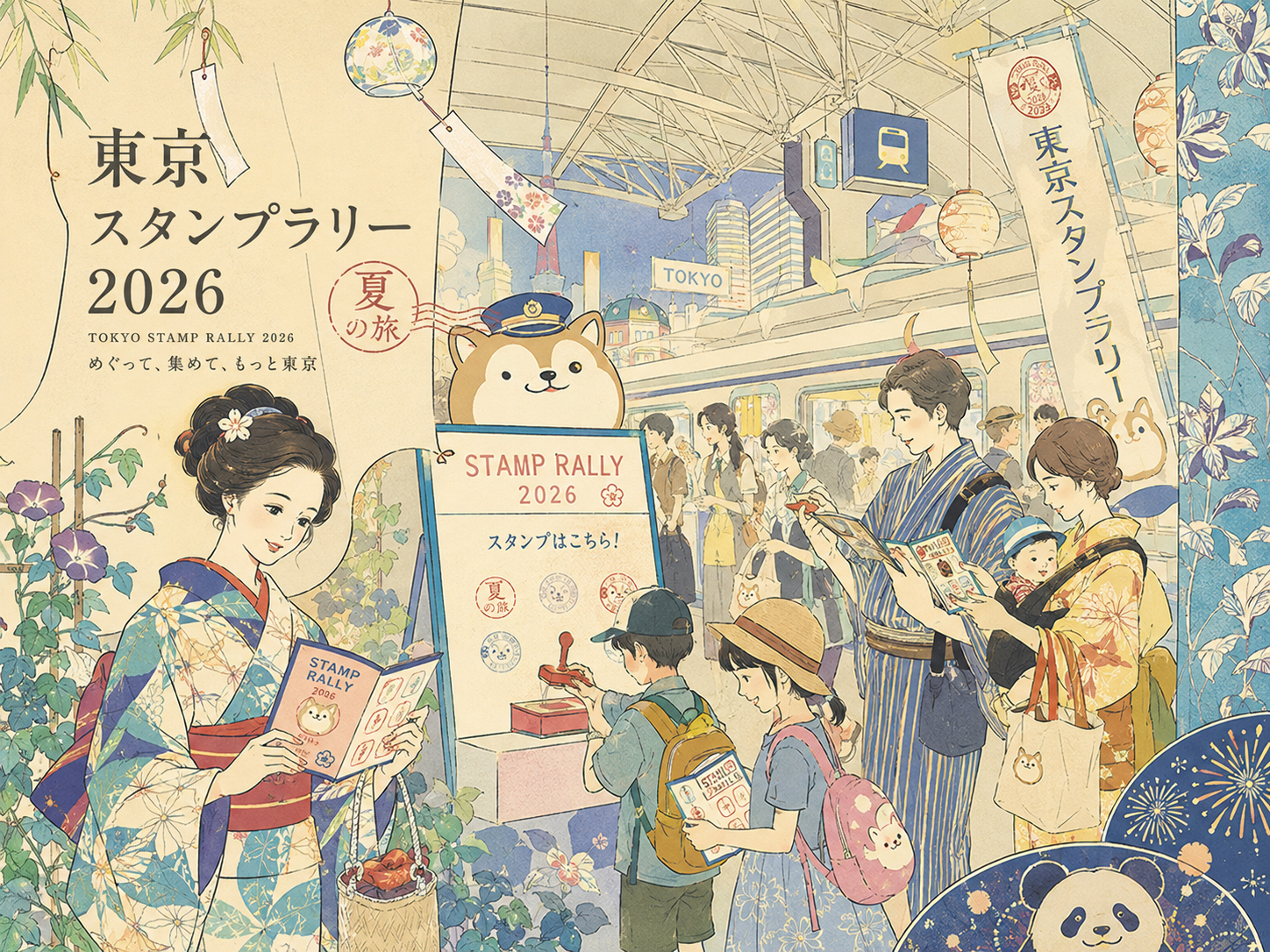
Tokyo’s summer has a sound. It is the chime before the doors close, the shuffle of families on a platform, the soft thump of a rubber stamp landing on paper, and the small gasp when a child finds the Pokémon that everyone wanted. The JR East Pokémon Stamp Rally is back for 2026, and on the surface it is almost impossibly simple: ride trains, find stamps, fill a book, get a prize.
But that simplicity is why it works. In a city where visitors often see the rail network as a maze and residents see it as daily infrastructure, the rally turns Tokyo into a game board. Stations stop being mere transfer points. They become checkpoints, small destinations, memory markers, and family photographs. The event is cute, yes. It is also a remarkably efficient piece of urban circulation design.
JR East’s 2026 rally runs from July 16 to August 31, with prize exchange continuing through September 1. The official English guide lays out several goals: a six-station course, a nine-station course, a thirty-six-station course, and a Shinkansen-linked course. Stamp books are distributed in the Tokyo area and at Shinkansen stations, and the stamp book itself is available in Japanese. The prizes include items such as a ticket-style sticker, a neck strap, and a key ring, with some rewards available only while supplies last.
A summer ritual disguised as a railway promotion
The Pokémon Stamp Rally belongs to a very Japanese category of public play. The stamp rally asks people to collect impressions from different places — stations, museums, shops, rest stops, city offices, tourist sites — then rewards completion with a small prize. It borrows the logic of pilgrimage, school notebooks, passport stamps, and arcade collecting, but it places the activity inside ordinary public space.
That is why the format is so powerful. A stamp rally does not require a giant stage or a new building. It activates places that already exist. It can send people to a station they usually skip, a platform they have never used, a suburban transfer point, a tourist office, a highway service area, or a shopping arcade. The reward is minor. The journey is the product.
For JR East, the Pokémon version has a long pedigree. The railway company began staging Pokémon stamp rallies in the Tokyo metropolitan area in 1997. Early editions placed stamps at major stations during the school summer vacation period. Over time, the event grew, shrank, paused, returned, and changed shape with the city, the railway business, and Pokémon itself. The 2026 version is therefore not a novelty. It is the latest chapter in a relationship between Tokyo rail, family travel, and character culture that is now nearly three decades old.
The 1997 origin: when Pokémon met the Yamanote Line
The first great Pokémon boom in Japan was already a cultural event by 1997. The games had launched in 1996. The anime followed in 1997. Pikachu was becoming a national face. JR East’s decision to place Pokémon stamps around Tokyo’s rail network gave that new enthusiasm a physical route.
The early rally was centered on Tokyo’s major lines and stations, especially the symbolic circle of the Yamanote Line. For children, it turned the map into a treasure hunt. For parents, it turned a summer day into a structured outing. For JR East, it encouraged off-peak leisure travel, station familiarity, and brand goodwill. For Pokémon, it moved the characters out of screens, cards, and television and into the built environment of the capital.
That was important. Pokémon’s central fantasy has always been movement: leave home, meet creatures, collect, train, trade, compare, and return with stories. A railway stamp rally is almost a perfect real-world version of that loop. The child becomes the trainer. The station becomes the route. The stamp book becomes the Pokédex.
Why Tokyo is perfect for stamp rallies
Tokyo is not a city with one center. It is a constellation of centers connected by rail: Tokyo, Shinjuku, Shibuya, Ikebukuro, Ueno, Shinagawa, Oimachi, Akihabara, and dozens more. A rally can rearrange that constellation for one summer. It can make a family pass through places they might never visit for work or school.
This matters because railways are not only transportation companies in Japan. They are neighborhood developers, retailers, hotel operators, media platforms, advertisers, and cultural conveners. A stamp rally fits that ecosystem. It creates reasons to ride, to transfer, to pause, to buy lunch, to browse station shops, and to talk about the railway as a shared experience rather than a utility bill.
In 2026, that logic extends beyond rail. Pokémon is also appearing in highway rest-stop promotions, with SoraNews24 reporting that hundreds of service and parking areas are part of a summer Pokémon campaign that includes exclusive merchandise, decorations, photo panels, and a stamp rally. Pokémon GO Fest Tokyo also used the stamp-rally concept digitally, sending players to designated PokéStops in Minato, Koto, and Shinagawa. The physical stamp, the highway checkpoint, and the smartphone PokéStop are now variations on the same idea: visit places, mark the visit, complete the route.
The mechanics of the 2026 rally
The official JR East guide emphasizes rules as much as prizes. Stamps must come from different stations. Some courses require specific stamp books or digital coupons. Some rewards are limited while supplies last. The stamp book is Japanese-only. These details may sound fussy, but they are part of how the event stays orderly while thousands of people move through busy stations.
There is also a small civic lesson inside the rules. Participants learn how to read maps, follow rail lines, plan transfers, respect queues, manage time, and keep track of paper. That is why the stamp rally feels educational without becoming school. It turns transit literacy into play.
Pokémon, trains, and the collectible city
Pokémon is uniquely suited to Tokyo rail. Its world is made of routes, towns, characters, badges, regions, and collections. Japanese rail travel is also made of routes, stations, lines, passes, timetables, and signs. The stamp rally fuses the two systems. Each stamp is a tiny proof of presence: I went there. I found it. I completed part of the map.
That psychology is stronger than the monetary value of the prize. Children remember the chase. Adults remember the family logistics. Collectors remember which station had which character. Visitors remember the surprise of seeing a leisure game unfold inside one of the world’s busiest transit systems.
The rally also demonstrates how Japan’s character economy differs from simple advertising. Characters are not only printed on posters. They are placed into routes, rituals, train wraps, station meals, ticket campaigns, regional tourism, and seasonal habits. Pokémon can sell goods, but it can also organize movement.
The railway as summer memory machine
There is a reason these rallies happen during summer vacation. Tokyo in summer is hot, humid, crowded, and often exhausting. The stamp rally gives families a reason to convert that season into a plan. One day for six stamps. Another for nine. A more ambitious family might chase thirty-six. Some will quit early and still have a story.
That may be the most charming part. The rally does not need everyone to finish. It gives people permission to wander within a structure. It transforms a practical day pass into an adventure. It makes the city legible to children, but it also reminds adults that infrastructure can be playful.
Japan.co.jp view
Tokyo’s Pokémon Stamp Rally is not important because of one prize or one character. It is important because it shows how Japan excels at making small rituals out of everyday systems. A train station becomes a game. A stamp becomes proof. A transfer becomes a quest. A summer day becomes a family archive.
That is why the story belongs in the same newspaper as markets, diplomacy, immigration policy, and technology. Culture is infrastructure too. Sometimes it is the soft layer that makes the hard city feel human.
For July 2026, the return of the rally gives Tokyo one of its best low-stakes summer stories: cheerful, logistical, mildly obsessive, and perfectly Japanese. Somewhere this month, a tired parent will stand near a stamp table while a child presses Pikachu or another favorite into a book. The train will come. The platform bell will ring. The next station will be waiting.
Reader takeaways
| Item | Meaning |
|---|---|
| What happened | JR East’s Pokémon Stamp Rally returns for summer 2026 across Tokyo-area and Shinkansen-linked stations. |
| Why it matters | The rally converts ordinary rail travel into a family-friendly urban treasure hunt. |
| Historical frame | JR East’s Pokémon stamp-rally tradition dates back to 1997. |
| Business logic | Stamp rallies increase leisure travel, station engagement, merchandise attention, and regional circulation. |
| Culture logic | Pokémon’s world of routes and collecting maps naturally onto Tokyo’s train system. |
Sources and references
This article draws on JR East’s official 2026 Pokémon Stamp Rally guide, historical summaries of JR East Pokémon stamp rallies, Pokémon GO Fest Tokyo materials, and SoraNews24 reporting on related Pokémon summer stamp-rally activity at Japanese highway rest stops.