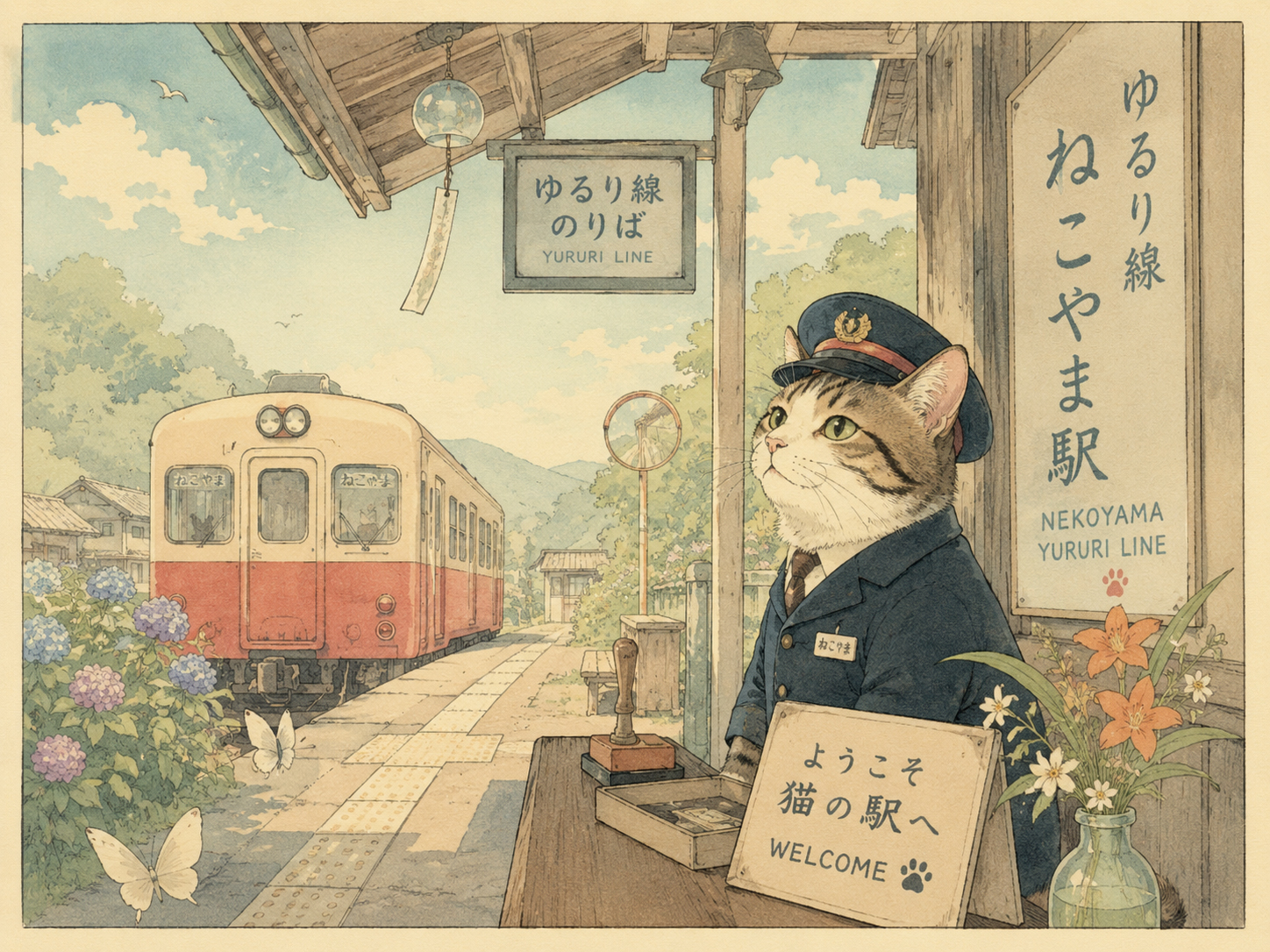
The most famous railway executive in rural Japan did not hold an MBA, did not drive a turnaround plan through a consulting deck, and did not speak at press conferences. She wore a tiny stationmaster’s cap, slept in a ticket window, accepted a salary of cat food, and changed the fate of a small railway line in Wakayama Prefecture.
Her name was Tama. In 2007, Wakayama Electric Railway appointed the calico cat as stationmaster of Kishi Station on the Kishigawa Line. What followed has become one of Japan’s most beloved local-revival stories: passengers returned, cameras appeared, souvenirs sold, trains were redesigned, a station was rebuilt with a cat-like face, and a struggling rural line acquired something far more precious than publicity. It acquired affection.
The story returned to the news in 2026 with the rise of Yontama, the latest cat stationmaster in the lineage. After Nitama, Tama’s successor, died in late 2025, the railway promoted from within. Yontama, already a trained cat stationmaster at Idakiso Station, took up the Kishi Station role in January 2026, continuing a tradition that is at once adorable, absurd, and economically revealing.
The cat who saved a station
Kishi Station was not a natural tourist destination. It sat on a local line serving communities outside Wakayama City. Like many rural railways, the Kishigawa Line faced depopulation, car dependence, rising costs and declining riders. In 2006, Wakayama Electric Railway destaffed stations to cut costs. The future looked uncertain.
Tama had been living around the station and was cared for by local people. Rather than remove her, company president Mitsunobu Kojima saw what many rural planners miss: a living symbol can make an infrastructure asset feel personal. Tama became stationmaster on January 5, 2007. Her duty was simple. She greeted passengers.
The result was not simple. Media attention grew. People came to ride the train because of the cat. They bought goods, took photographs, talked about the line, and gave Kishi Station a story. Early reports credited Tama with a passenger increase and a local economic effect later estimated around ¥1.1 billion. Whether every yen can be measured with precision matters less than the main fact: the cat turned a transport problem into a destination.
From mascot to local economy
Japan is full of mascots, but Tama was different. She was not a costume, a government logo, or a committee-designed character. She was a real cat with a schedule, successors, rituals and a workplace. That difference gave the story unusual credibility. Visitors were not just consuming a brand. They were making a pilgrimage to a living local celebrity.
The railway built around the feeling. The Tama Train, the Ichigo Train and other whimsical designs turned the journey into part of the attraction. Kishi Station itself was rebuilt in 2010 with a cat-face design by industrial designer Eiji Mitooka. A shrine, Tama Jinja, later honored Tama as a guardian figure after her death in 2015. The line’s narrative became layered: transport, design, memory, animals, local pride and soft tourism.
This is what rural economic development often struggles to create. A small town may have scenery, food, history or craft, but without a simple story it can remain invisible. Tama gave the Kishigawa Line a story that could be explained in one photograph: cat, hat, station.
Why this matters in 2026
The cuteness hides a hard national problem. Japan’s rural railways are under pressure from the same forces hollowing out many local economies: a declining birthrate, aging communities, urban migration, labor shortages and increased car use. A railway can be socially necessary while still losing money. It can be loved in principle while ignored in daily use.
In 2026, discussions over unprofitable JR and local lines continue across Japan. Some communities fight closures; others negotiate bus conversions, public subsidies or new local-management schemes. The problem is not only transportation. When a line dies, a region loses a civic spine. Stations become quieter. Students, older residents and visitors have fewer options. Local identity contracts.
That is why Tama’s lesson still matters. A cat cannot solve rural depopulation. But a cat can prove that ridership is not only a timetable issue. It is also an imagination issue. People ride when a line means something.
The lineage: Tama, Nitama, Yontama
Tama died in June 2015 at age 16. Her funeral drew national attention, and she was honored as a kind of railway guardian. Nitama, her successor, carried the office through the next decade, becoming the second face of the line and continuing the ritual of feline station service. Nitama died in late 2025, with hundreds attending her funeral.
In January 2026, Yontama became the third cat stationmaster at Kishi Station. The promotion was presented with corporate seriousness and public delight. She had already served at Idakiso Station, so the line could describe the succession almost like a railway personnel transfer: experience, training, promotion.
That bureaucratic seriousness is part of the charm. Japan’s cat stationmasters work because the joke is never treated as a joke. The hat matters. The title matters. The schedule matters. The rituals matter. The railway gives the fantasy enough structure to become real.
Japan’s mascot economy, but warmer
Regional branding in Japan often begins with a mascot. Prefectures, towns, police departments, airports and tourism offices have characters. Some are famous. Many are forgettable. Tama’s genius was that she turned mascot logic upside down. She was not invented to represent the place. The place reorganized itself around her.
That created trust. Visitors could sense the story was not merely promotional. A stray station cat became a caretaker, then an employee, then a symbol, then a shrine figure. The emotional arc felt like folklore updated for the age of social media.
In a country where local governments compete for attention, that matters. Rural tourism is rarely only about spectacular scenery. It is often about the small reason to make a trip: a bakery, a train, a shrine, a seasonal flower, a local festival, a character, a view from a platform, a cat in a hat.
The economics of being remembered
The hardest thing for a rural place is not always poverty. It is invisibility. If people cannot name the town, cannot picture the station, and cannot explain why they would go, the place disappears from the national imagination long before it disappears from the map.
Cat stationmasters solve this problem at miniature scale. They give the traveler a hook. They make newspapers, blogs, tourists and television crews repeat the same phrase: cat stationmaster. The phrase itself carries the trip. It is weird enough to remember and wholesome enough to share.
But the deeper success is that Tama did not float alone. The railway built trains, goods, station design, schedules, memorials and successors around the story. That turned one lucky cat into an institution.
Limits of the cat strategy
There are limits. Many rural lines cannot survive on tourism alone. Some routes serve residents who need practical daily transportation, not Instagram moments. A cat stationmaster cannot repair track, solve driver shortages, reverse aging or replace a serious mobility plan.
There is also an animal-welfare lesson. The cat must be protected from crowds, heat, stress and exploitation. The reason the Wakayama story works is that the cats are treated as members of the railway family, with schedules, rest and public rituals that reinforce care.
The lesson, then, is not “appoint a cat.” The lesson is: give local infrastructure a story, make the story true, and support it with design, operations and respect.
Japan.co.jp view
Cat stationmasters are easy to laugh at. They are also one of Japan’s clearest examples of soft-power regional economics. Tama did what many official campaigns fail to do. She made a small station beloved.
In the long struggle to keep rural railways alive, Japan will need money, policy, governance reform, tourism strategy, mobility planning and honest choices about which routes can survive. But it will also need affection. People fight for places they love. A cat in a cap reminded Japan that infrastructure is not only steel, timetable and subsidy. It is memory, ritual and attachment.
That is why the stationmaster cats matter. They are cute. They are funny. They are also a serious economic development plan with whiskers.
Reader takeaways
| Item | Meaning |
|---|---|
| What happened | Japan’s cat stationmaster tradition continues in Wakayama with Yontama following Tama and Nitama. |
| Why it matters | The story shows how a rural railway can turn affection, design and local identity into tourism demand. |
| Historical anchor | Tama became Kishi Station’s stationmaster in 2007 and helped transform the Kishigawa Line’s public image. |
| Economic lesson | Branding works best when it grows from a true local story rather than a top-down campaign. |
| Limit | Cuteness cannot replace serious rural transport policy, but it can keep a line visible and loved. |
Sources and references
This article draws on Japan Today and GaijinPot reporting on cat stationmasters, JNTO and Wakayama tourism materials on Kishi Station, SoraNews24 and international coverage of Yontama’s 2026 promotion, earlier reporting on Tama’s passenger and economic impact, and broader analysis of Japan’s rural railway crisis.