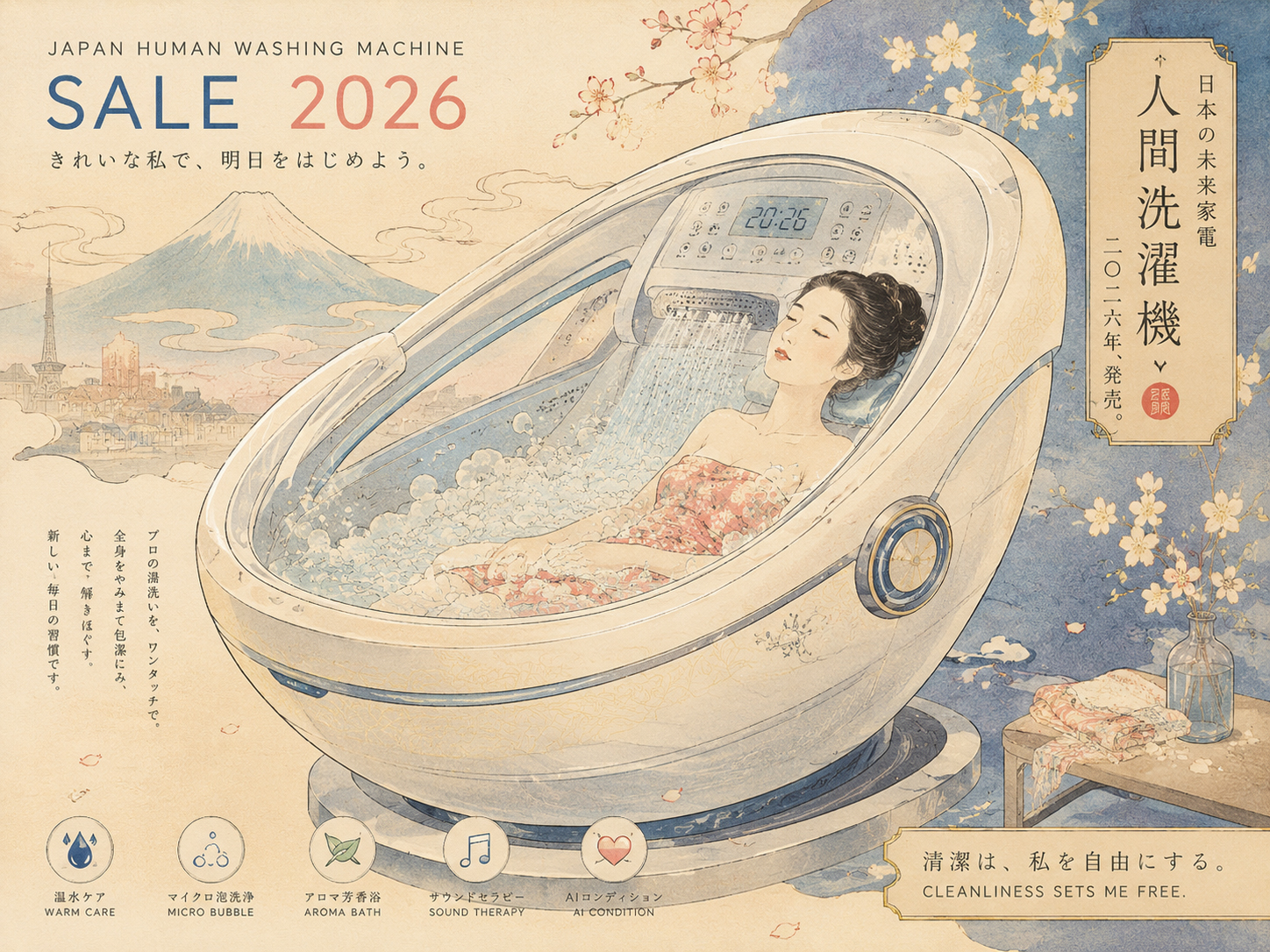
It looks like a joke from a future that arrived slightly overdressed: a person climbs into a sleek capsule, lies back, and waits for warm water, mist, microbubbles, sensors, images and air to perform the ordinary work of bathing. But Japan’s “human washing machine” is not only a viral gadget. It is a very Japanese story about Expo memory, bathroom culture, aging society, consumer electronics, luxury hospitality and the national habit of turning domestic convenience into technological theater.
The machine now moving toward public sale is Science Co.’s Mirai Ningen Sentakuki, literally the “future human washing machine.” The Osaka-based shower and bath-technology company revived an idea first made famous at the 1970 Osaka World Expo, then rebuilt it for the 2025 Osaka-Kansai Expo with microbubble cleaning, biometric sensing and a more wellness-centered experience. Reports say only about 50 units are planned, with a price around ¥60 million, putting it far outside ordinary home use and squarely in the world of hotels, spas, care facilities and destination retail.
The machine is often described as cleaning and drying a person in about 15 minutes. The user reclines inside a pod. Warm water, mist and fine bubbles wash the body. Sensors monitor biological data such as pulse and comfort; visual and audio elements turn the process into a mood-controlled bath rather than a simple shower. Science Co. has presented the concept as a device that washes the body and refreshes the mind.
The 1970 ghost inside the 2026 machine
To understand why the human washing machine feels so familiar in Japan, begin in 1970. Expo ’70 in Osaka was held under the theme “Progress and Harmony for Mankind” and attracted more than 64 million visitors. It was Japan’s declaration that the postwar industrial miracle had become a full modern civilization: bullet trains, electronics, new homes, new appliances and an engineered future.
At that Expo, Sanyo Electric displayed the Ultrasonic Bath, a human washing machine that sprayed warm water, used ultrasonic cleaning, offered massage effects and dried the user. It became one of the great absurd icons of Japanese futurism. People remembered it because it was funny, intimate and ambitious all at once. It asked the central question of consumer technology in the high-growth era: if machines could wash clothes, dishes and rice, why not people?
The original never became a household item. It was large, expensive, theatrical and ahead of the domestic space available in most Japanese homes. But it stayed alive as an image. In 2025, when Osaka hosted another world exposition, the idea returned. That comeback matters. Japan did not merely invent a new bathing pod. It reopened a 55-year-old dream and asked whether the future that looked silly in 1970 could become a premium service in 2026.
Why bathing technology matters in Japan
Bathing in Japan is not only hygiene. It is ritual, recovery, privacy, family routine, public culture and tourism. The household bath, the sento public bath, the onsen resort, the hotel spa and the elder-care bath all belong to the same national grammar: warm water is not just a utility; it is a social technology.
That is why the human washing machine lands differently in Japan than it might elsewhere. In many countries, the obvious question is whether anyone needs an automated shower. In Japan, the better question is where such a machine fits into a larger bathing ecosystem. Hotels may use it as a premium novelty. Electronics retailers may use it as a traffic magnet. Care facilities may imagine a safer assisted-bathing system. Wellness centers may market it as a timed relaxation pod. Tourism operators may see it as a story guests will photograph, post and remember.
Japan has spent decades refining small domestic conveniences: heated toilet seats, automatic bath filling, mist saunas, shower heads, compact appliances and bathrooms designed around limited space. The human washing machine is excessive by comparison, but it comes from the same lineage. It automates an everyday act and wraps it in a promise of comfort, cleanliness and controlled time.
Science Co. and the microbubble turn
Science Co., based in Osaka, is known for shower and bath products, especially fine-bubble and microbubble technologies. That background is important because the 2026 machine is not simply a prop from science fiction. Its commercial logic is tied to the idea that water can be engineered more finely: smaller bubbles, gentler cleaning, less friction, better sensation, and a wellness story that fits hotels and spas.
The machine’s reported production run — roughly 50 units — is small enough to preserve rarity. At about ¥60 million, it is also expensive enough to signal that this is not yet a mass-market appliance. This is the kind of product a hotel buys so guests can say, “I tried the human washing machine in Osaka.” It is technology as attraction, service and advertisement.
Yamada Holdings’ role in showcasing trial experiences points to another side of the story: destination retail. Japanese electronics stores have long been museums of near-future domestic life. A washing machine for humans belongs perfectly in that world, even if most visitors will never buy one. They come to see it because it says something about what Japan still wants to be — surprising, precise, slightly strange and willing to make everyday life into an engineered performance.
Numbers behind the pod
The aging-society question
The amusing version of the story is that Japan made a bath capsule because Japan makes wonderfully odd machines. The serious version is that automated bathing has obvious relevance in a country with one of the world’s oldest populations. Bathing assistance is physically demanding. Care workers must help people move, wash, rinse and exit safely. Falls, heat stress and privacy concerns all matter.
The current Mirai Ningen Sentakuki is priced and presented as a premium experience, not a cheap care device. Yet the direction of travel is worth watching. If future versions become smaller, cheaper and more clinically oriented, the technology could move from novelty hospitality into elder care, rehabilitation or assisted living. Japan has already turned robots, sensors and monitoring systems into aging-society tools. A bathing pod is not absurd in that context; it is one more attempt to automate a labor-intensive care task without removing comfort.
That future will require caution. A device that encloses a human body, uses hot water, monitors vitals and dries the user is not a toy. Safety, sanitation, emergency release, maintenance, accessibility, skin conditions, disability use and operator training will matter as much as the spectacle.
Why the world keeps laughing — and looking
International coverage treats the human washing machine with amused disbelief, and that reaction is part of its value. Japan’s best viral inventions often sit at the border between elegance and comedy. The machine is funny because the human body is funny. It is compelling because everyone understands bathing. It is futuristic because it takes a private daily ritual and makes it mechanical, visible and strange.
But the laughter should not obscure the industrial pattern. Japan’s postwar appliance makers built global reputations by reducing domestic labor. The refrigerator, rice cooker, washing machine, television, vacuum cleaner, air conditioner and toilet seat changed the texture of home life. The human washing machine extends that lineage to the body itself. It is the appliance dream taken to its logical and slightly surreal end.
Japan.co.jp view
The human washing machine is not important because every household will buy one. They will not. It is important because it shows how Japan still packages the future: through a blend of engineering, ritual, hospitality, care, spectacle and a little absurdity.
At its best, the machine is a reminder that Japan’s technology culture is not only about chips, AI, robots and defense systems. It is also about baths, toilets, stations, shops, elderly care, hotel experiences and the small daily ceremonies that make life feel civilized. A machine that washes a person is ridiculous. It is also very revealing.
The most interesting question is not whether the pod will replace showers. It is whether Japan can turn a delightful Expo curiosity into a real category of service: automated bathing for hotels, wellness centers and eventually care environments. The future may not arrive in every bathroom. It may arrive first as something you reserve, photograph, try once, and remember.
| Item | Meaning |
|---|---|
| What happened | Science Co.’s Mirai Ningen Sentakuki, a revived human washing machine concept from Expo 2025, is moving toward limited public sale. |
| Historical root | The idea descends from Sanyo’s Ultrasonic Bath at Expo ’70 in Osaka. |
| Commercial model | At roughly ¥60 million and about 50 planned units, it is aimed at hotels, spas, retail showrooms and premium services rather than ordinary homes. |
| Technology story | Microbubbles, mist, biometric sensing and entertainment make the pod a wellness experience, not simply an automated shower. |
| Why it matters | The machine connects Japan’s Expo futurism, bathing culture, aging society and domestic-appliance imagination. |
Sources and references
This article draws on reporting and background from Tokyo Weekender, New Atlas, Mainichi, Core77, People, Channel Japan by Nikkei, Wired, Canadian Affairs and coverage of Sanyo’s Expo ’70 Ultrasonic Bath and Science Co.’s Mirai Ningen Sentakuki.
- Tokyo Weekender: Japan’s Human Washing Machine Is Here and You Can Try It for Free.
- New Atlas: Japanese human washing machine of the future is here.
- Mainichi: Back from the future: AI-updated 1970 human washing machine.
- Core77: A Washing Machine for Human Beings, from 1970.
- People: futuristic pod cleans users in 15 minutes, costs about $385,000.
- Channel Japan by Nikkei: Being washed in the human washing machine at Expo 2025 Osaka.
- Wired: Retro appliance: ultrasonic carwash for humans.