Tokyo’s prices have begun to move higher again. In June 2026, the consumer price index for Tokyo’s 23 wards excluding fresh food rose 1.6% from a year earlier, up from 1.3% in May. It was not a dramatic number. But in Japan, where the memory of deflation still shapes every monetary-policy argument, it was enough to keep the Bank of Japan’s rate-hike debate alive.
The number matters because Tokyo’s inflation data arrives before the national CPI and is treated by markets and policymakers as an early read on where Japan’s prices may be heading. When Tokyo turns, the national conversation often turns with it.
What the June data showed
Reuters reported that Tokyo’s core CPI, excluding volatile fresh food, rose 1.6% year on year in June, accelerating from 1.3% in May. The initial pressure came from electricity, gas and other energy-related costs, but the concern for policymakers was that those pressures were beginning to spread into other categories, including food. The index excluding both fresh food and fuel, a measure closely watched by the Bank of Japan as a cleaner read on underlying inflation, rose 1.9%, up from 1.6% in May.
At first glance, 1.6% still sits below the BOJ’s 2% target. But central banks do not look only at the level. They look at direction, persistence and breadth. Tokyo’s June numbers suggested that price pressures were no longer simply fading. They were becoming more complicated.
Why Tokyo CPI carries weight
The national CPI is broader. Tokyo’s CPI is faster. It captures price changes in Japan’s largest urban economy before the nationwide data arrives, making it a useful early signal for the BOJ, investors, companies and households.
Monetary policy always works with a lag. The CPI measures what has already happened; interest rates influence what happens later. That makes early indicators especially important. Tokyo can tell policymakers whether the price environment is cooling, stabilizing or beginning to reheat.
Japan’s long memory of deflation
To understand why a 1.6% inflation print can become a national policy story, remember that Japan spent decades fighting the opposite problem. After the asset bubble burst in the early 1990s, deflation and weak growth became the country’s defining economic challenge. Companies hesitated to raise prices. Consumers learned to wait. Wages stagnated. Expectations narrowed.
Abenomics and the BOJ’s massive monetary experiment after 2013 tried to break that psychology. The central bank set a 2% inflation target and used asset purchases, negative rates and yield-curve control to push inflation expectations higher. But the inflation that eventually arrived was not a textbook wage-led inflation. It was mixed with yen weakness, imported energy, food costs, geopolitical shocks and supply pressures.
The BOJ’s two fears
The BOJ is trying to avoid two mistakes at once. Tighten too early, and it may cool a wage-and-demand recovery that Japan has waited years to see. Wait too long, and the weak yen, import costs and energy prices may squeeze households and businesses, damaging consumption in a different way.
Former BOJ board member Makoto Sakurai told Reuters that the central bank may raise rates twice by the end of the fiscal year in March. The BOJ has already lifted its policy rate to 1%, the highest level in 31 years. The question is whether Tokyo’s inflation data becomes evidence for another step, or whether the bank decides the underlying trend is still too fragile.
The political complication
The timing is delicate because the government’s economic blueprint is pressing the other side of the argument. Reuters reported that Prime Minister Sanae Takaichi’s draft economic plan urges monetary policy to support private demand. That language, more assertive than usual, reflects a growth-first agenda that wants investment, wages and corporate activity to keep moving.
The government’s case is understandable. Japan is pursuing more than ¥370 trillion in investment by 2040 in strategic sectors such as semiconductors, AI, space, energy and advanced infrastructure. Higher rates can make that investment more expensive. They can also hit mortgage borrowers, small businesses and regional companies that rely on credit.
But the BOJ has its own responsibility. A central bank that appears to subordinate price stability to a political growth agenda risks weakening confidence in the currency. If the yen falls further, imported inflation can rise again, leaving households paying the bill for cheap money.
What 1.6% feels like at home
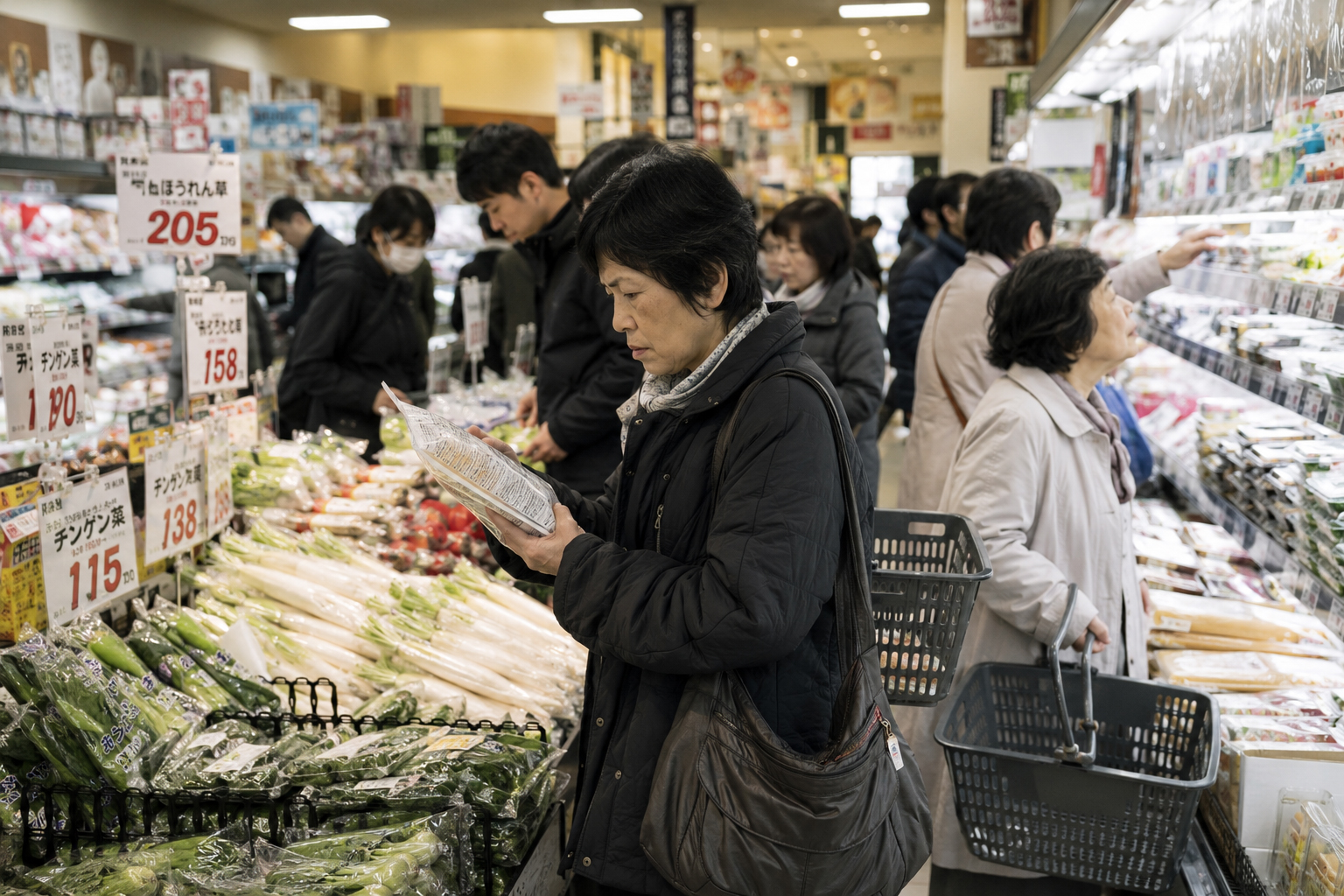
Average inflation is not the same as lived inflation. A household does not experience the CPI basket as a spreadsheet. It experiences rice, bread, eggs, vegetables, electricity, gas, school supplies, train fares, rent and convenience-store meals. If the items bought every day are rising, inflation feels much stronger than the headline suggests.
Tokyo is especially sensitive to this. Housing is expensive, commutes are long, and many households depend heavily on prepared food, eating out and urban services. For single-person households, older residents, students, parents and workers on unstable incomes, food and utility inflation is immediate.
What 1.6% means for companies
For companies, Tokyo’s inflation uptick is not automatically bad. Large firms with pricing power can pass on costs and protect margins. But small retailers, restaurants, logistics companies, care providers and construction firms often face a harder equation: higher wages, higher utilities, higher materials and, if rates rise, higher borrowing costs.
Wage growth is the hopeful side of Japan’s inflation story. If wages rise, prices rise and consumers keep spending, Japan can move into a healthier cycle. If wages fail to keep pace and consumers cut back, inflation becomes less a sign of growth than a tax on daily life.
What markets will watch next
| Indicator | Why it matters |
|---|---|
| National CPI | Shows whether Tokyo’s uptick is spreading across Japan. |
| Ex-fresh-food-and-fuel CPI | Tests whether underlying inflation is broadening beyond energy. |
| Wage data | Determines whether households can absorb higher prices. |
| Yen exchange rate | A weak yen can feed import and energy inflation. |
| BOJ meetings | Language, dissents and projections may signal the next hike. |
The conclusion: Tokyo’s number is small, but not quiet
June’s 1.6% Tokyo core CPI is not an inflation shock. But it is not nothing. It tells the BOJ that price pressures have not disappeared. It tells the government that growth policy cannot ignore household costs. And it tells markets that the next rate hike is still a live question.
Japan is no longer trapped in the old world where the central question was how to make prices rise at all. It is in a harder transition: how to allow prices and wages to rise without making daily life feel smaller. In that debate, Tokyo’s supermarket shelves may be the most honest economic indicator in the country.
Sources and references
- Reuters: Tokyo core inflation accelerated to 1.6% in June; index excluding fresh food and fuel rose 1.9%; energy and food pressures broadened.
- Reuters: Former BOJ policymaker Makoto Sakurai said the BOJ may raise rates twice by March; policy rate at 1%.
- Reuters: Government draft blueprint urges BOJ policy to support private demand and growth.
- Statistics Bureau of Japan: Consumer Price Index release information and official CPI data portal.
- Bank of Japan: Core CPI indicator data and research series.