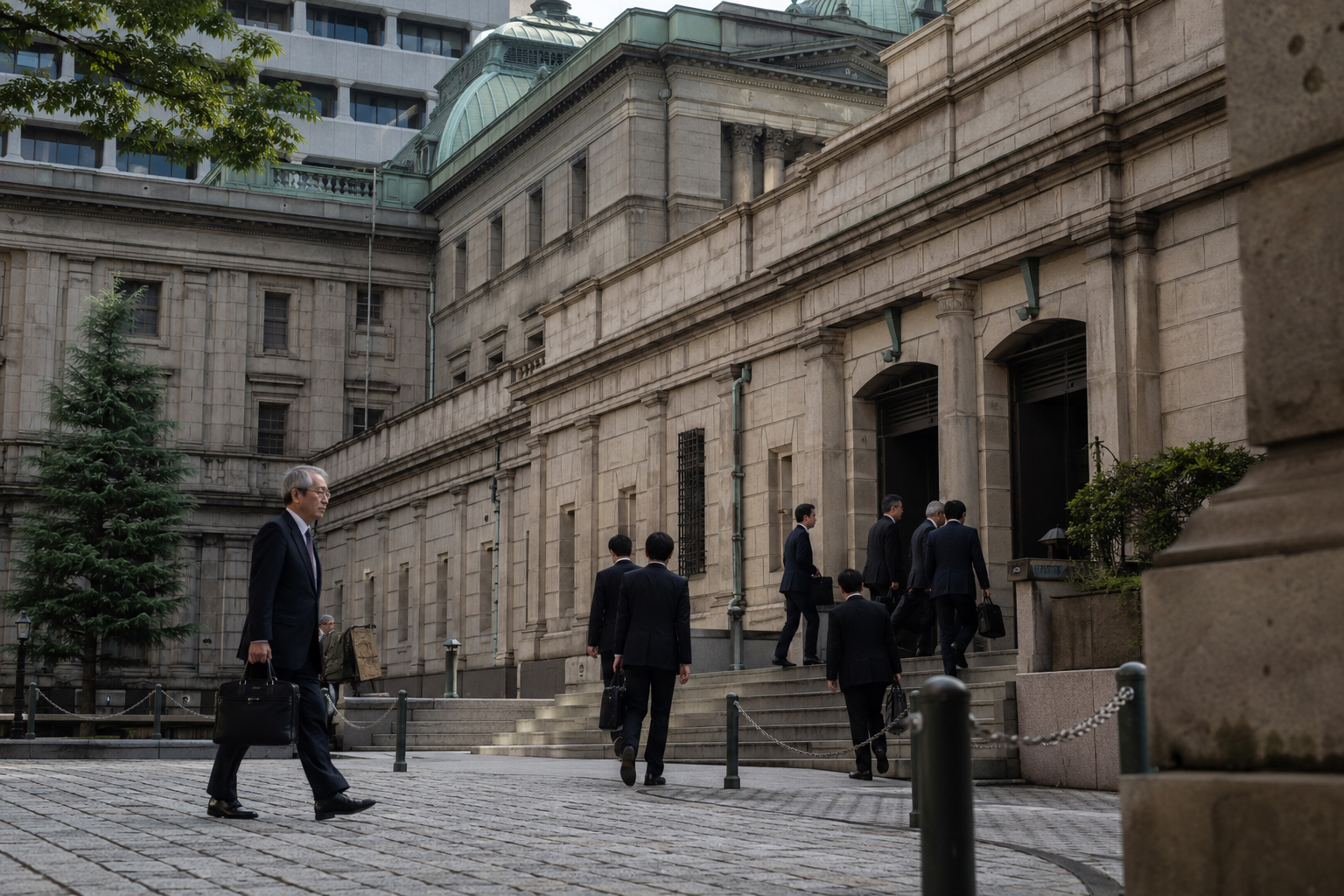
Central-bank independence is usually a quiet institution. It lives in meeting minutes, bond yields, inflation forecasts, policy statements, and legal clauses that most people never read. In June 2026, however, the Bank of Japan’s independence moved from the back pages of economic governance into the center of Japan’s political economy. The reason was simple: interest rates, the yen, inflation, wages, mortgages, corporate investment, and Prime Minister Sanae Takaichi’s growth strategy were suddenly all on the same table.
The sentence that mattered
According to a draft reviewed by Reuters, Japan’s government will call for monetary policy that supports private demand through stable price rises. It will also urge the Bank of Japan to align decisions with Prime Minister Takaichi’s push to reflate growth, citing legal provisions that require policy coordination between the central bank and the government. In ordinary times, this might sound like bureaucratic phrasing. In June 2026, it landed as a market signal.
The timing is the story. The BOJ had just raised its policy rate to 1% at its June 15–16 meeting, the highest level in 31 years, as inflation risks intensified around higher fuel costs and the energy shock linked to the Middle East conflict. The government, meanwhile, is preparing a long-term growth blueprint centered on investment, strategic industries, and private demand. Put plainly: the government is watching the accelerator, while the central bank is checking the brake. The vehicle is the same Japanese economy.
What BOJ independence actually means
Bank of Japan independence does not mean the central bank floats outside democratic government. The BOJ’s own explanation of the Bank of Japan Act says the Bank’s autonomy regarding currency and monetary control shall be respected. The same framework also requires the Bank and the government to maintain close contact and exchange views so that monetary policy and the government’s basic economic policy are compatible.
That is where the tension lives. Independence is not the right to ignore the elected government. Coordination is not the right of the government to order the policy rate. Japan’s monetary system walks on the narrow bridge between those two ideas. The 1998 revision of the Bank of Japan Act sharply reduced the government’s old supervisory authority and strengthened independence and transparency. But it also preserved channels for government representatives to attend Monetary Policy Meetings, express views, submit proposals, and request a postponement of votes. Independence and coordination were designed together.
Why the government wants caution on rates
Takaichi’s economic program puts growth and investment at the front of the stage. Reuters has reported that the new growth strategy targets more than ¥370 trillion in investment through fiscal 2040 across 17 strategic sectors, including artificial intelligence, chips, space, shipbuilding, energy, and quantum technologies. That is not merely a stimulus package. It is an attempt to rebuild Japan’s industrial future.
Large investment plans are sensitive to interest rates. When a company builds a semiconductor plant, adds a research facility, powers a data center, or expands a regional supply chain, the cost of capital affects the decision. Higher rates make borrowing heavier. They also increase pressure on government debt service, household mortgages, and smaller firms. Politically, it is natural for the government to want monetary policy that supports private demand.
But natural is not the same as easy. If prices are rising, the yen is weak, and import costs are squeezing households, keeping rates low for too long creates a different kind of pain. A weak yen can help exporters, but it hurts households and small businesses that pay more for energy, food, and raw materials. If the growth strategy is meant to protect living standards, currency and price stability cannot be treated as side issues.
What the BOJ is watching
The BOJ has its own fear: tighten too fast and Japan could damage the very demand it has spent years trying to revive. Japan remembers deflation. It remembers falling prices, stagnant wages, cautious consumers, and companies that delayed investment. The extraordinary policies of the past decade — massive asset purchases, yield-curve control, and negative rates — were aimed at breaking that psychology.
But 2026 is not 2013. Today’s inflation is not purely the healthy demand-led inflation the government wants. It includes energy costs, import prices, yen weakness, and geopolitical risk. Reuters reported that some BOJ members called for faster rate hikes as inflation pressures mounted. A hawkish board member, Naoki Tamura, argued for raising rates once every few months. The BOJ is not fighting yesterday’s deflation. It is trying to prevent today’s cost shock from becoming tomorrow’s expectations.
This is not a simple government-versus-central-bank fight. Inside the BOJ, there are voices urging faster tightening and voices warning against hurting output and jobs. Politics is not monolithic either. Markets are divided too: some investors fear a weaker yen, others cheer equities, bond investors watch yields, and households watch mortgage rates and grocery bills. Everyone is looking at a different speedometer.
The meaning of the 1998 reform
The modern Bank of Japan Act emerged from the wreckage and reform atmosphere of the 1990s. After the bubble burst, Japan faced bad loans, banking stress, policy delays, and a crisis of institutional credibility. A central bank too closely tied to short-term government convenience could lose price stability and credibility. A central bank too insulated from society could look technocratic and indifferent to employment and growth. The 1998 reform therefore strengthened both independence and transparency.
The BOJ decides policy independently. It must also explain itself. The government is responsible for economic policy. It does not directly command the policy rate. In calm times, that architecture is almost invisible. But when inflation rises, the yen weakens, bond yields move, and the prime minister announces a huge investment roadmap, the architecture becomes the story.
The shadow of Abenomics
The draft attracted attention partly because Takaichi is widely seen as sympathetic to the Abenomics tradition. Former Prime Minister Shinzo Abe’s economic program combined bold monetary easing, fiscal spending, and growth strategy. In 2013, the government and BOJ set a 2% inflation target as part of a national effort to escape deflation.
Back then, Japan’s challenge was to make prices rise at all. Today, the issue is the quality of inflation. Inflation driven by wages and demand is very different from inflation driven by imports, energy, and a weak currency. The government wants the first. The BOJ fears the second. That is why language about “stable price rises” and “private demand” carries so much weight. It is a fight over what kind of inflation Japan is experiencing, and what kind of inflation it wants.
The yen speaks plainly
Foreign-exchange markets are less polite than policy papers. Reuters reported that the yen hovered near ¥161.73 per dollar while the Nikkei surged more than 3.5% after the blueprint report offset hawkish BOJ commentary. The market read the draft as a possible signal that the pace of rate hikes could slow. Lower-rate expectations often help stocks. They often weigh on the currency.
That is Japan’s dilemma. Low rates support investment and equities, but may weaken the yen and lift import prices. Higher rates can support the yen and restrain inflation, but they burden borrowers, fiscal accounts, and investment plans. Japan must walk between those outcomes. It cannot simply choose one without paying for the other.
The government’s message, and the BOJ’s problem
The government is not openly denying BOJ independence. The draft uses the language of coordination, the 2% target, wage-price cycles, private demand, and stable growth. It is a carefully worded political document. But words do not derive their force only from grammar. They derive it from timing, speaker, and market context.
For Takaichi, premature rate hikes could weaken the investment strategy before it gathers speed. For the BOJ, delayed tightening could allow inflation and yen weakness to become harder to control. If either side misjudges the moment, the public pays. The government is judged at the ballot box. The BOJ is judged by credibility. The responsibilities differ, but the stage is the same economy.
What this means for households
This is not only a story for Kasumigaseki and Nihonbashi-Hongokucho. It touches variable-rate mortgages, deposit rates, corporate borrowing costs, municipal finance, pension portfolios, imported food, gasoline, electricity bills, and travel costs. Interest rates and the exchange rate are not abstract numbers. They are pipes that carry policy into everyday life.
If the BOJ keeps raising rates, savers may benefit a little, while borrowers feel pressure. If the BOJ slows down, investment and stocks may benefit, while the yen and import costs may suffer. Every path has winners and losers. That is why monetary policy becomes political: it chooses which pain is treated first and which risk is carried longer.
What to watch in July
- The final government blueprint: Will July’s final language be stronger, softer, or unchanged from the draft?
- The July 30–31 BOJ meeting: How will the BOJ update its inflation and growth forecasts?
- The yen: Does the currency remain in the 160s, or do policy signals reverse the move?
- Long-term yields: How will bond markets price fiscal expansion and BOJ normalization?
- Wages and consumption: Can wages keep up enough to create the private demand the government wants?
The real test of independence
Central-bank independence is not tested when the government and central bank agree. It is tested when the government wants growth, the central bank sees inflation risk, markets sell the currency, and households worry about living costs. Japan has entered that test.
The answer is not for the government to fall silent, nor for the BOJ to become isolated. The government must explain why growth investment matters. The BOJ must explain why price stability matters. Each must respect the other’s objective, and each must ultimately own its own decision. That is what the institution is for.
BOJ independence is not a shield built only to justify rate hikes. The government’s growth strategy is not a flag built only to keep rates low. What Japan needs is a path that avoids a return to deflation without being swallowed by inflation; a path where investment strengthens the real economy and wages support living standards.
That path is narrow. That is why the words matter: one sentence from the government, one paragraph from the BOJ, one comment from a policymaker, one day in the currency market. Together, they will shape Japan’s next economic chapter.
Sources and references
This article draws on public reporting and reference material from Reuters, the Bank of Japan, Bank of Japan Act materials, Ministry of Finance / FSA archives, and historical policy context. Markets, exchange rates, policy rates, and government plans are fluid; readers should consult the latest BOJ, government, and major news updates.
- Reuters: Japan government blueprint nudges BOJ to fuel demand, clouding rates path.
- Reuters: Some BOJ members call for faster rate hikes, summary shows.
- Reuters: Hawkish BOJ policymaker calls for rate hike once every few months.
- Bank of Japan: What independence means for the Bank.
- Ministry of Finance / FSA archive: Report concerning the revision of the Bank of Japan Law.