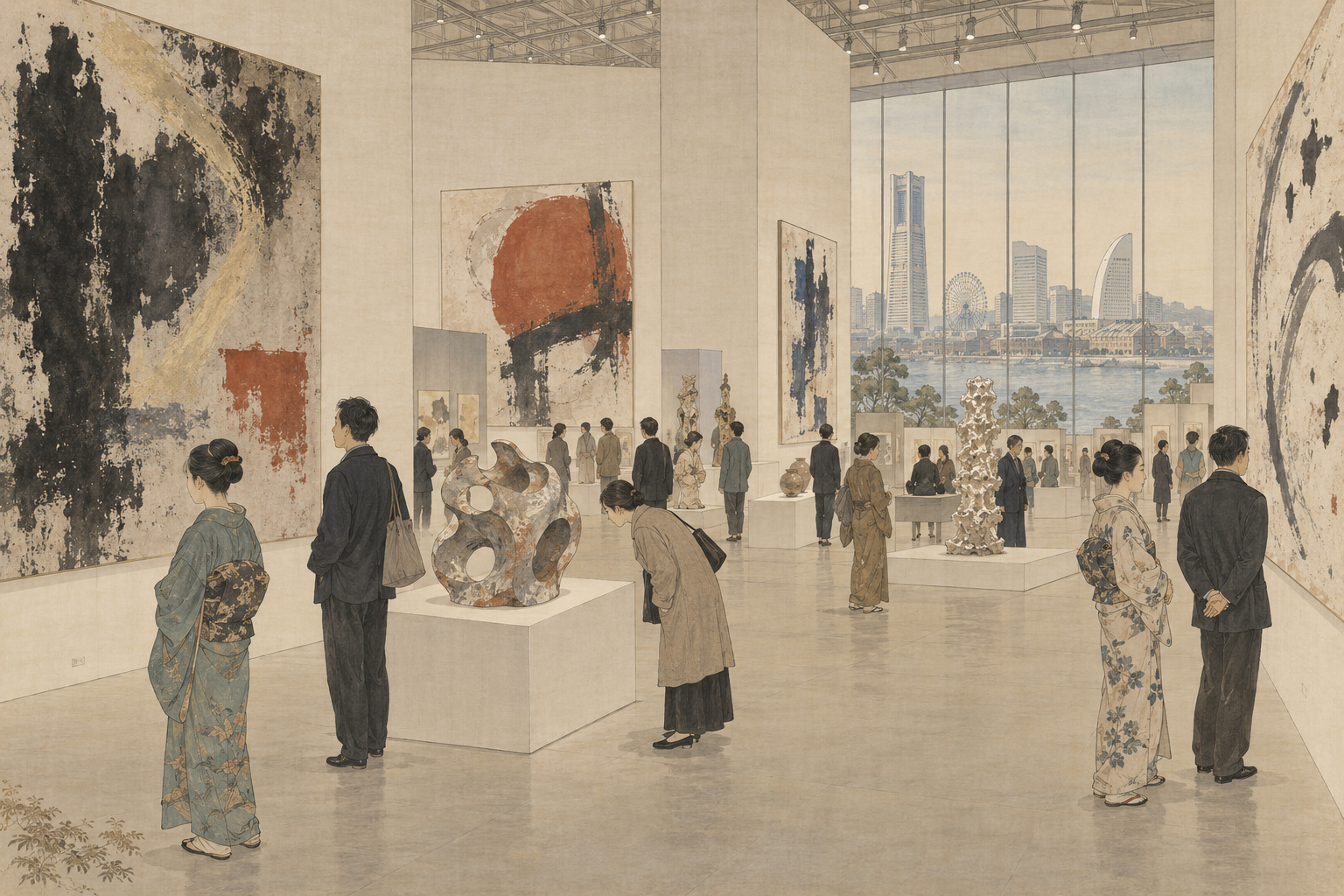
An art fair can enlarge the conversation before it enlarges the market. Tokyo Gendai’s fourth edition, which concluded at PACIFICO Yokohama on September 13 after a September 10 preview and three public days, offers a useful test of that distinction. Its importance lies in the kinds of encounters it made possible—and in whether those encounters can outlast the weekend.[1]
The program added a works-on-paper sector and brought back a dedicated space for digital media. Those choices deserve attention alongside the international gallery names. They suggest a fair trying to broaden the ways people approach contemporary art, at a time when the evidence for uninterrupted growth in Japan’s wider market is less straightforward than promotional enthusiasm might imply.[3]
An international roster with a wider Japanese map
The official roster placed Taka Ishii Gallery, TARO NASU and KOTARO NUKAGA alongside participants such as Pace Gallery and Sadie Coles HQ. It also included GALLERY MONMA from Sapporo, Marco Gallery from Osaka and STANDING PINE, with locations in Tokyo and Nagoya. The domestic picture therefore extended beyond the capital, even under a fair name that foregrounds Tokyo.[2]
That geographical range matters as an opportunity, rather than a result in itself. A regional gallery may gain introductions that would be difficult to arrange through its own premises. An overseas dealer can meet a collector without requiring that person to travel abroad. Neither benefit proves that a sale followed, that a new buyer entered the market or that a relationship will continue. Those are separate questions for the months after the fair.
Five sectors, several ways into collecting
The main Galleries section was accompanied by Hana, for early- and mid-career artists, and Eda, for established, historical or thematic presentations. The new Miki section focused on works on paper, prints and photography. Tane returned after a two-year absence to accommodate digital practices, including moving-image work.[3]
The strongest argument for this arrangement is that it can change how visitors look. A drawing may expose a stage of thought that a finished monumental painting conceals. A photographic sequence asks for comparison. A video requires a visitor to stay long enough for something to happen. These are different relationships with attention, not simply different product categories.
It would nevertheless be premature to call the new paper section evidence of a more affordable market. Medium and dimensions do not determine price on their own. Nor does introducing a digital section establish that a new generation of collectors has arrived. The fair’s structure creates possibilities; assessing their success requires information about the works, the buyers and what happens after their first encounter.
A painter in depth, a collaboration across galleries
Pace’s published presentation centered on new paintings by Lauren Quin in a solo booth. Its list included the 2026 oils Bearings and Gampr (Siphr), the former measuring 218.4 by 180.3 centimeters and the latter 35.6 by 30.5 centimeters. The contrast in scale offered a way to examine one artist across markedly different formats.[4]
A solo presentation also makes a particular commitment: it asks visitors to spend time with a practice instead of treating a booth as a sample of a dealer’s inventory. That can be productive for an audience encountering an artist for the first time. This assessment concerns the published selection and its organizing idea; it does not claim firsthand inspection of the paintings or their installation.
Another model emerged in the organizer’s interview with Taipei’s Project Fulfill Art Space. The gallery described collaborating with Double Square Gallery and Chi-Wen Gallery to introduce Taiwanese moving-image art. Rather than presenting international exchange only as individual foreign galleries traveling to Japan, the project placed cooperation among galleries inside the exhibition itself.[5]
The interview identified ZHANG XU Zhan’s Termite Feeding Show as combining live action and stop-motion animation. That meeting of handmade forms and screen-based presentation complicates any simple division between traditional craft and digital art.[5]
For viewers, that kind of partnership can provide more than a national label. It offers people who can explain the work’s context and sustain a conversation after a screening. For a prospective owner, moving-image art can also raise practical questions about the edition, display arrangements and what is supplied with the work. The value of a dedicated section depends partly on how well those questions can be answered.
How a summer launch became an autumn fixture
Tokyo Gendai began at PACIFICO Yokohama on July 7–9, 2023. By its third edition, held September 12–14, 2025, it had moved into the autumn calendar. The 2026 edition continued that September positioning. This is a short institutional history, but it already shows a fair adjusting the circumstances in which it seeks an international audience.[7][8]
Calendar choices affect who can come, how galleries allocate staff and whether collectors can combine destinations. The attraction of an Asian itinerary is easy to understand. Its benefits are not automatic: neighboring events may share visitors, but they may also compete for shipping budgets, attention and purchases. Repetition becomes an asset only when a fair gives people a reason to return.
The published nine-session Art Talks program included the Yokohama Triennale, moving-image expression and the position of a new generation of galleries. Such subjects connected the commercial fair with questions that also occupy museums, artists and curators. A talk schedule is not proof of institutional collaboration, but it is a useful indication of what the event considers worth discussing beyond a transaction.[6]
Read the year behind the growth claim
Japan’s market story changes depending on which year is being measured. Artnet’s February 2026 account of government-commissioned research put Japanese art sales in 2024 at $692 million, up 2 percent. That performance offered a relatively resilient picture during a year of global contraction. It was a finding about 2024, not a tally of activity in 2026.[9]
The Art Basel and UBS Art Market Report 2026 covers the next year. Its overview says Japanese sales declined 1 percent in 2025, while worldwide sales rose 4 percent to $59.6 billion. These are estimates for the broader art and antiques market. They do not measure Tokyo Gendai’s turnover or isolate Japan’s contemporary-art trade.[10]
The distinction prevents two misleading conclusions. International exhibitors do not, by their presence alone, establish that the national market is booming. Equally, a small national decline does not tell us that a particular gallery failed or that outreach to new buyers has stopped. Aggregate value can obscure considerable differences among artists, price levels and businesses.
A useful review therefore keeps market size separate from the work of developing a market. The first is measured through annual estimates and defined categories of sales. The second involves repeated visits, understandable information and confidence in the people handling a work. A fair may contribute to that process without moving a national total noticeably in its first few years.
What the early sales report can support
Observer reported that KOTARO NUKAGA sold more than 20 works through presales and the preview. That is a gallery-level account with a specific cutoff, not a public-weekend total or a measure of the whole fair.[11]
The inclusion of presales is revealing as a matter of interpretation. A fair transaction can be the visible endpoint of a conversation that began earlier. Counting it as activity during an event may be reasonable, but it does not demonstrate that the buyer discovered the artist while walking the aisles. Without comparable definitions, individual reports cannot simply be added into a reliable measure of performance.
Sales counts also leave much unanswered. They say little about price, expense or the distribution of results among exhibitors. A compelling booth and a commercially rewarding booth are not necessarily the same thing. The most responsible conclusion from a favorable early account is that some business was reported—not that every part of the market shared in it.
The next test is continuity
Observer also reported plans to move the fair to Tokyo’s Ariake GYM-EX in 2027. This remains a reported plan. If implemented, it would change the relationship between the event and gallery visits in the capital, while opening a new chapter after its Yokohama beginnings.[11]
A different address could make some journeys easier, but location alone cannot supply the reasons to take them. The more consequential questions concern continuity: whether exhibitors return, whether visitors keep looking, and whether the people who introduce a work remain available to explain and support it afterward. Those are the connections through which a temporary gathering becomes useful to an artistic community.
This edition’s most persuasive proposition was the invitation to look in more than one way: closely at a single painter, patiently at a moving image, or comparatively across galleries from different cities. The longer-term verdict will depend on whether that variety leads to sustained relationships. Japan’s contemporary-art market will gain depth when the encounter continues after the exhibition hall closes.
Sources and references
- Tokyo Gendai: official dates and closing notice
- Tokyo Gendai: 2026 exhibitor roster
- Tokyo Gendai: fourth-edition galleries and sectors
- Pace Gallery: Lauren Quin at Tokyo Gendai 2026
- Tokyo Gendai: Project Fulfill Art Space interview
- Tokyo Gendai: complete Art Talks program
- Tokyo Gendai: inaugural edition, 2023
- Tokyo Gendai: third edition, 2025
- Artnet: government-commissioned research on Japan’s 2024 art market
- Art Basel and UBS Art Market Report 2026: global sales in 2025
- Observer: fourth-edition sales and reported 2027 venue move
Evidence reviewed September 14, 2026, Japan time. This review draws on organizer and gallery publications, market research and attributed reporting; it does not claim on-site attendance. Interpretations are Japan.co.jp analysis unless otherwise attributed.