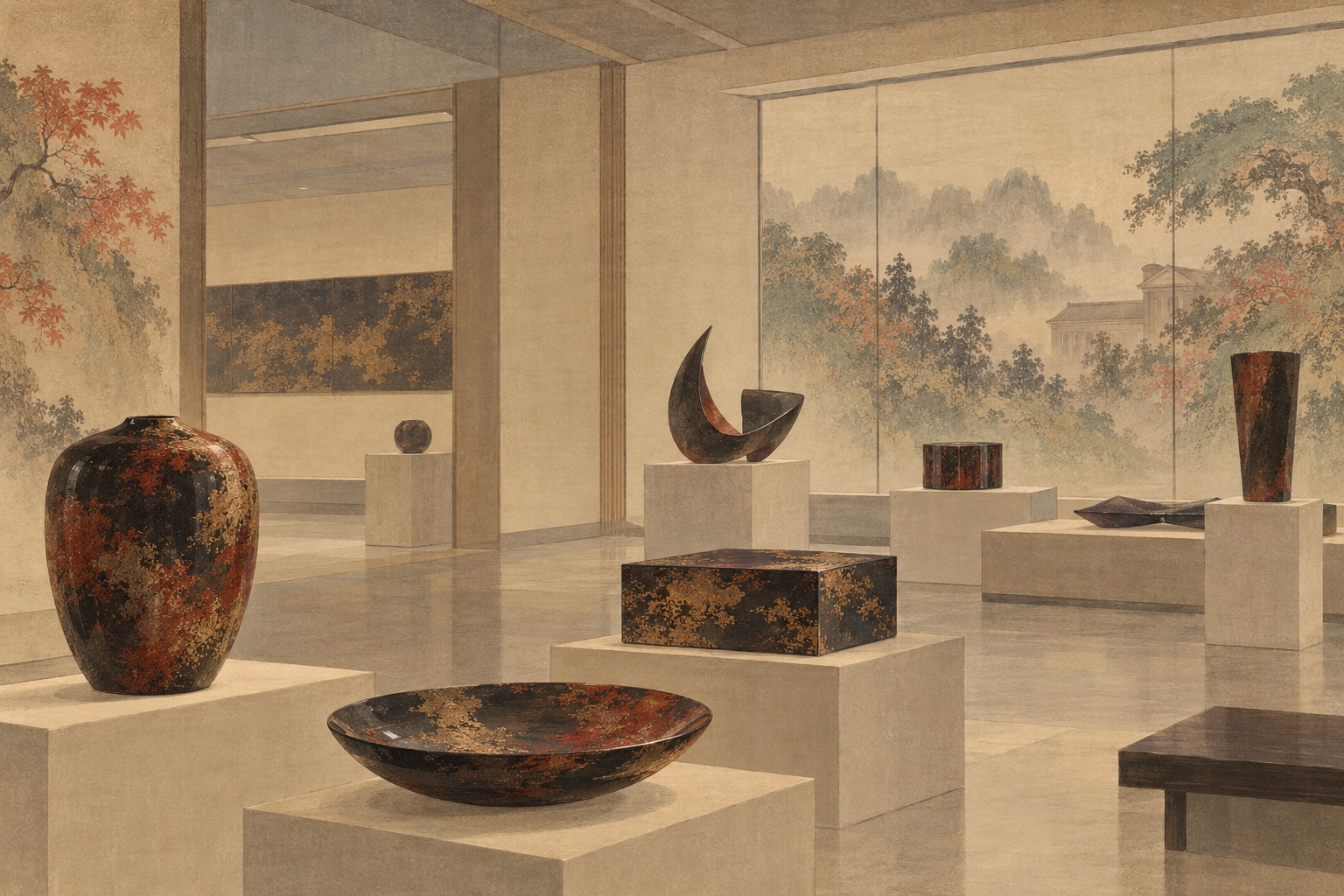
There is no single correct answer to the title Urushi no Katachi — “Forms of Urushi.” A viewer might picture a bowl or box, a polished black sculptural mass, gold-powder maki-e, mother-of-pearl raden, or a hollow form built from layers of cloth and lacquer. Tokyo University of the Arts began the Urushi no Katachi research exhibition in 2007; in 2026 it reaches its 20th year. Running from September 10 through 23 on the second floor of the University Art Museum’s Chinretsukan Gallery, this year’s show brings together emeritus professors Chori Onishi, Kiichiro Masumura, Arisumi Mitamura and Norihiko Ogura, current faculty, and master’s and doctoral students including international students.[1]
The anniversary does not matter because one style has been protected unchanged for twenty years. Its significance is almost the reverse: successive generations have worked with the same demanding natural material while repeatedly asking what can still count as lacquer art. Tokyo Geidai’s own lacquer education reaches back much further, to the lacquer-craft component of Tokyo Art School’s original craft education when instruction began in 1889. The exhibition’s twenty-year history therefore sits inside an institutional craft lineage approaching a century and a half.[2] [3]
Urushi can be the surface — or the structure itself
Urushi is tree sap. Japan’s Forestry Agency describes it as a material used since antiquity as both coating and adhesive, valued for protecting substrates and for the beauty of its finished surface. Sap is typically collected during the warmer months from mature trees, and the agency says a single tree yields only about 200 grams before it is cut and the cycle begins again from new shoots.[13] [15]
Lacquer also does not “dry” in the ordinary sense. The enzyme laccase becomes active under suitable temperature and humidity and reacts with oxygen as the coating hardens. The Forestry Agency gives roughly 20–25°C and 75–85% humidity as favorable conditions, which is why workshops use controlled lacquer cabinets, or urushi-buro, rather than simply leaving a wet surface in dry air.[14]
Those material properties allow urushi to function as more than a finishing coat. Tokyo Geidai explicitly teaches it as coating, adhesive, forming material and pictorial medium. It can cover a wooden vessel, bind cloth into a dry-lacquer body, receive metallic powders in maki-e, or hold shell in raden. The same material system can determine a work’s skeleton, color, depth and reflection.[4]
At Geidai, personal expression begins with tools, ground layers and repetition
A contemporary art university does not begin lacquer education by telling students simply to “make something original.” Tokyo Geidai’s curriculum starts with preparing spatulas and sharpening blades, then moves through ground preparation, coating and polishing. Students learn maki-e variants including togidashi, hira, taka and togikiri maki-e, as well as raden, eggshell, heimon and other decorative processes. The 2026 Crafts guide also lists dry lacquer, wooden-body construction, chinkin and experimental coating techniques.[4] [5]
This creates a productive paradox. To become freer, the student first learns constraint. How thick can a ground layer be? What disappears when it is polished? How does metal-powder grain change reflected light? At what angle does shell flash? How will a shift in humidity change the next morning’s surface? Traditional technique becomes a vocabulary for understanding what the material can do, rather than a requirement to reproduce historical design.
A twenty-year exhibition becomes a family tree in one room
The 2026 exhibition is especially revealing because emeritus professors, current teachers and graduate students are not separated into historical compartments. Onishi, Masumura, Mitamura and Ogura are all listed by the Department of Crafts as emeritus professors in urushi. The present faculty includes Professor Kodo Aoki and Lecturer Kansei Arai; the university’s 2026 materials give their English names as Aoki Kodo and Arai Kansei.[5] [6] [7]
This is not quite an alumni exhibition. The emeritus professors are not merely “the past,” and the students are not simply “the future.” Senior artists continue producing new work; students can use old processes in contexts their teachers never did. The same exhibition becomes a place where technique moves in more than one direction — inherited, questioned and re-read.
The international dimension is also longstanding. The 2015 exhibition listed current and former faculty, master’s students and researchers from China, Vietnam and the Netherlands. The 2026 show again specifically includes overseas graduate students. The lineage of lacquer education at Geidai is therefore no longer a closed national genealogy, even while its techniques remain deeply rooted in Japanese craft history.[11] [1]
Kiichiro Masumura shows how deep the foundation of kyushitsu can be
Among the emeritus participants, Kiichiro Masumura represents another form of continuity. In 2008, Japan’s Agency for Cultural Affairs recognized him as an individual holder of the Important Intangible Cultural Property kyushitsu, the status popularly known as Living National Treasure.[8] [9]
Kyushitsu can sound deceptively simple when translated as lacquer coating. In cultural-property terms it encompasses the broad sequence of making a substrate, preparing ground layers, applying lacquer and finishing the surface. Before decorative imagery is added, the form and coating themselves can constitute the art.
That depth of foundation is not at odds with Urushi no Katachi’s contemporary side. The more unusual a form becomes — a free sculptural surface, a dry-lacquer body, a pictorial panel — the more precisely the maker must understand where lacquer will flow, harden, polish and reflect.
Norihiko Ogura pushed inherited decoration toward painting
Norihiko Ogura, another emeritus participant in the 2026 show, retired from Tokyo Geidai after the 2025 academic year. The University Art Museum’s retirement exhibition described a career built around maki-e and raden boxes and tea objects inspired by plants and landscapes, but also around panel works using a distinctive application of togidashi maki-e to depict scenery encountered abroad.[10]
That is one example of lacquer leaving the vessel without abandoning technique. Maki-e has a long history as surface decoration on objects. Move it to a panel and the depth of polishing and reflection of metallic powder begin to operate as pictorial light and atmosphere. The technique stays recognizable while the category of the artwork becomes less stable.
Ogura’s retirement exhibition also placed works by Chinese university teachers alongside his own, reflecting the international exchange he had developed through lacquer education. The point is important: urushi is not a material isolated inside Japan. Related lacquer cultures extend across East and Southeast Asia, and Geidai’s contemporary teaching increasingly treats international comparison as part of technical research.[10]
One year, the exhibition asked how lacquer could stay close to daily life
Urushi no Katachi has not always been presented in exactly the same form. In 2020, a related edition at Geidai Art Plaza used the theme “close to daily life.” Twenty-nine faculty members and students showed work ranging from art pieces to chopsticks made by the participating artists.[12]
That shift matters because lacquer can inhabit radically different value systems. It can be museum art or a utensil at the table. It can become a sculptural object no one touches, or a pair of chopsticks designed to absorb use, fingerprints and time. Urushi is one of the rare materials for which “craft,” “design,” “painting,” “sculpture” and “daily object” can overlap without the material changing identity.
Kodo Aoki and Kansei Arai mark the program’s present tense
Today, Professor Kodo Aoki and Lecturer Kansei Arai are central faculty in the urushi program. Geidai’s 2026 Crafts guide identifies Aoki’s theme as dry-lacquer form, with keywords including kanshitsu, coating expression, lacquer refining and decorative form. His approach treats lacquer as primary material from the construction of form through the final visual surface.[5] [6]
The exhibition program itself stages generational dialogue. It lists a September 13 gallery talk by Aoki and Arai, and a September 20 talk by emeritus professors Masumura and Mitamura. Without claiming what was or will be said in those talks, the pairing is revealing: one conversation belongs to the current teaching studio; the other brings together two figures who helped shape earlier decades of its practice.[1]
Preserving lacquer art also means preserving trees, harvesters and chemistry
A discussion of “tradition” can easily stop at technique and ignore supply. The Forestry Agency says one mature lacquer tree produces only about 200 grams of sap. Trees are cut after harvesting, then regenerated from shoots for a future cycle. A lacquer culture therefore depends on forests, harvesters, refinement and distribution before an artist ever opens a container in the studio.[15]
It is telling that Geidai’s 2026 description of Aoki’s research includes lacquer refining. Natural lacquer varies, and its hardening behavior depends on material composition and environment. The artist is connected to chemistry and forestry as directly as to art history.
To preserve lacquer tradition, then, is not merely to keep finished objects in a museum. It requires the continued existence of material supply, tool knowledge, technical teaching, and young makers who are permitted to do something with those skills that their predecessors did not.
- Compare how emeritus professors, current faculty and students define “form” using the same material.
- Watch how maki-e and raden move from vessel decoration into panels and sculptural work.
- Look for works in which kanshitsu or kyushitsu makes form and coating — rather than ornament — the central expression.
- Consider how international students bring different cultural assumptions into a shared lacquer vocabulary.
- Notice where lacquer as a daily-use material and lacquer as autonomous art meet rather than separate.
Perhaps the exhibition lasted twenty years because it never fixed the answer
Urushi no Katachi is an unusually open title. It does not say “lacquerware,” “maki-e,” “student work” or “traditional craft.” It sends the question back to every maker: what form can urushi take now?
Since Tokyo Art School began teaching lacquer craft in 1889, the social place of lacquer has changed dramatically. Everyday use of lacquerware has changed; the border between art and craft has shifted; overseas students have entered the studio; works have moved from vessels toward sculpture, panels and contemporary installation-like forms. Yet the material still has to be coated, hardened, polished and understood at the level of physical behavior.
The 20th-year exhibition therefore resists the easy opposition between “traditional” and “contemporary.” Learning old technique accurately and using it to make something previously unseen can belong to the same education. Historical skill becomes contemporary not by being forgotten, but by being understood well enough to ask a different question with it.
No one can know what Tokyo Geidai will call a “form of urushi” twenty years from now. That uncertainty may be the exhibition’s most durable achievement. Lacquer hardens. The definition of lacquer art does not.
- University Art Museum, Tokyo University of the Arts: Urushi no Katachi 2026 — dates, 20th year, participants and gallery talks
- Tokyo University of the Arts Department of Crafts: history — 1889 Tokyo Art School and lacquer/metal craft origins
- Tokyo University of the Arts: institutional history — instruction began in February 1889
- Tokyo University of the Arts: Urushi Art program — educational philosophy, techniques, research and international exchange
- Tokyo University of the Arts: 2026 Crafts guide — Professor Kodo Aoki, Lecturer Kansei Arai and lacquer curriculum
- Tokyo University of the Arts Department of Crafts: current Urushi Art faculty
- Tokyo University of the Arts Department of Crafts: emeritus professors including Chori Onishi, Kiichiro Masumura, Arisumi Mitamura and Norihiko Ogura
- Geidai Art Plaza: Kiichiro Masumura profile
- Agency for Cultural Affairs: Kiichiro Masumura recognized in 2008 as a holder of the Important Intangible Cultural Property kyushitsu
- University Art Museum: Norihiko Ogura retirement exhibition — maki-e, raden and international exchange
- University Art Museum: Urushi no Katachi 2015 — exhibition history since 2007 and international participants
- Geidai Art Plaza: Urushi no Katachi 2020 — 'close to daily life' theme and 29 participating artists
- Forestry Agency: urushi sap as coating, adhesive and craft material
- Forestry Agency: lacquer chemistry — laccase, oxygen, temperature and humidity
- Forestry Agency: urushi harvesting — season, refining and roughly 200 g of sap per mature tree
Editorial note: Some 2024 and 2025 exhibition pages print “Meiji 21 (1889),” but 1889 corresponds to Meiji 22. Tokyo University of the Arts' institutional and Crafts histories place the beginning of instruction in 1889 (Meiji 22), and this article follows that chronology. “20th year” is the museum's own description of the 2026 exhibition; Japan.co.jp has not independently reconstructed every annual edition. Individual 2026 work titles and techniques are not identified in the public exhibition text and have not been guessed.