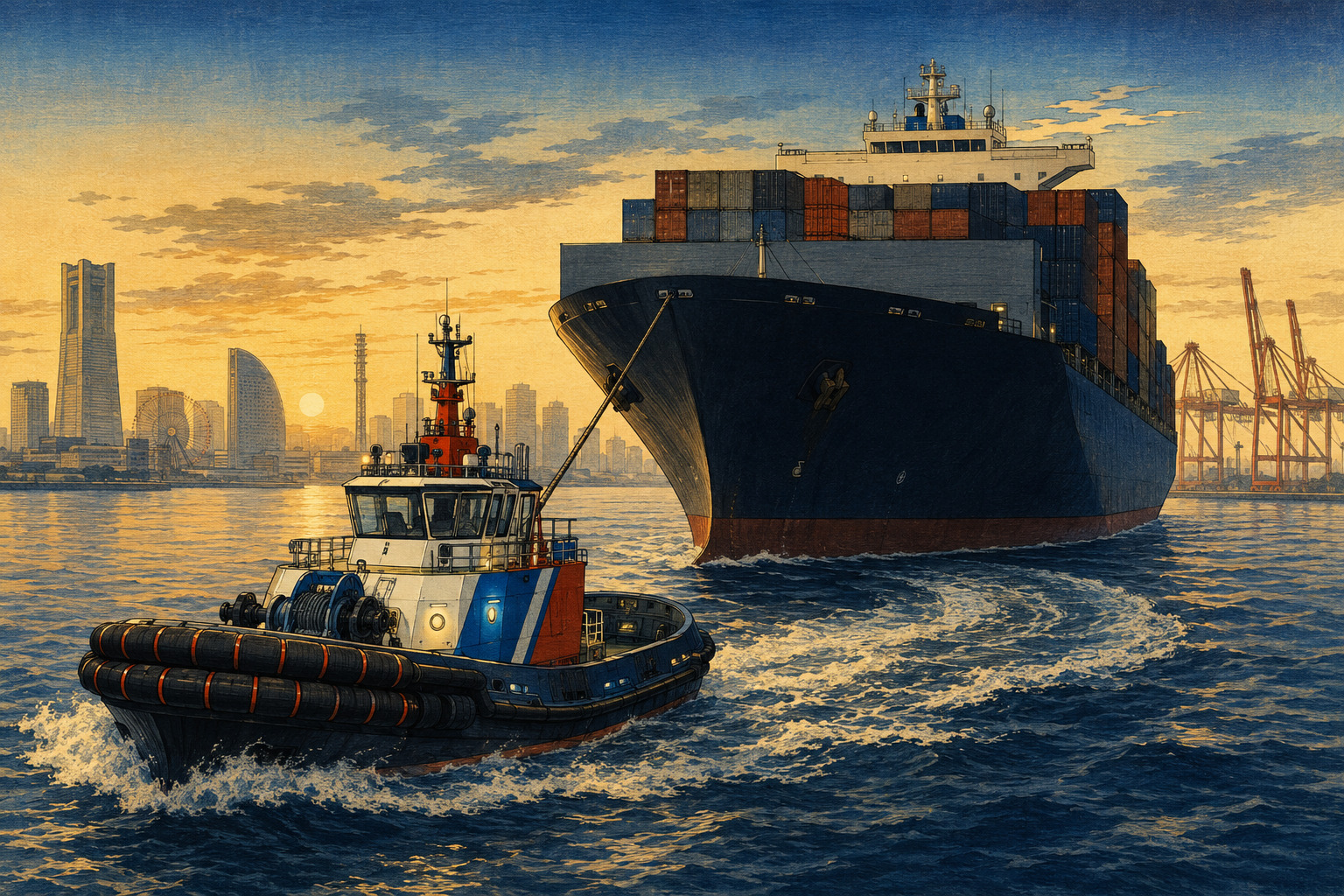
A second tug—and an attempt at a standard
On July 9, Daito Corporation and parent Kawasaki Kisen Kaisha, known as “K” Line, announced Daito’s second electric tugboat. Hongawara Ship Yard in Fukuyama, Hiroshima Prefecture, will build it. Kawasaki Heavy Industries will supply and integrate propulsion and control systems. TOA Corporation will design and construct the shoreside charging installation. Completion is scheduled for July 2028.
The consequential word was not “second” but “standard.” Daito’s first EV tug is a 199-gross-ton-class vessel intended for Yokohama and Kawasaki and due in May 2027. No. 2 grows to 37.2 metres and the 260-gross-ton class so it can cover a broader range of towage throughout Tokyo Bay. Daito and Kawasaki say the higher-output package is intended to become a standard model for future electric tugs.
A harbor tug pushes a much larger ship from the side, pulls it on a line and controls its attitude at low speed. Top speed alone says little about capability. Bollard pull—the sustained force measured while the tug is secured—matters, as do immediate response, the ability to direct thrust through 360 degrees and enough redundancy to finish or safely abort a job after a fault.
How much more tug comes from the same battery?
Kawasaki Heavy Industries published a useful side-by-side specification. No. 2 is 3.8 metres longer, 0.2 metres wider and draws 0.4 metres more water. Its gross-tonnage class is about 31% higher. Yet both tugs retain a 14-knot maximum speed and approximately 3.2 MWh of battery capacity.
| Specification | EV Tug No. 2 | EV Tug No. 1 | Change |
|---|---|---|---|
| Length × beam × draft | 37.2 × 9.8 × 4.4m | 33.4 × 9.6 × 4.0m | Larger hull |
| Gross tonnage | 260-ton class | 199-ton class | Class figure about 31% higher |
| Continuous maximum output | 4,400 PS | 3,600 PS | 22.2% higher |
| Maximum ahead bollard pull | 52 tonnes | 48 tonnes | 8.3% higher |
| Maximum speed | 14 knots | 14 knots | Unchanged |
| Battery | About 3.2 MWh | About 3.2 MWh | Unchanged |
| Charger | 900 kW | 600 kW | 50% higher |
At the standard metric conversion, 4,400 PS is roughly 3.24 MW. Motor output cannot be converted directly into bollard pull: propeller diameter, nozzle, hull, draft, losses and water conditions intervene. The more meaningful advertised working figure is 52 tonnes. The power number still tells a historical story. Battery-centered propulsion has reached the 4,400 PS band that Daito has used for its mainstream high-powered conventional tugs since 2009.
Electric, but not pure battery
The label needs a boundary. A large lithium-ion battery is the main power source, charged from shore and feeding propulsion motors. When charge becomes insufficient, however, an auxiliary generator starts automatically. Public material does not disclose its fuel, rating or number, but the companies say the control system is intended to reduce fossil-fuel consumption. No. 2 is therefore best understood as a battery-centered hybrid-electric tug, not a vessel that can never burn fuel.
That choice is not an embarrassment; it is a safety and availability compromise. Harbor assignments are often short and predictable, but ship delays, severe weather, emergency assistance and consecutive dispatches are not. A tug cannot let go of a large vessel halfway through a maneuver because its charging window disappeared. The generator supplies range and reserve. It also means that “zero-emission operation” must be limited to periods when the tug is running from its battery without the generator.
A separate Tokyo Kisen–Marindows project announced in 2025 explicitly proposes a tug that would operate only from onboard batteries. Its concept studies 6.66 MWh aboard, 3 MW of propulsion and two 1 MW chargers for service in Yokohama and Kawasaki from 2030. At announcement, the final construction decision was still conditional on a feasibility study. Daito’s 2028 hybrid and Tokyo Kisen’s 2030 pure-battery plan are not contradictory headlines; they explore different positions between assured availability and eliminating routine onboard combustion.
Why tug duty can suit batteries
An ocean-going cargo ship may remain away from shore for weeks and must carry immense energy. A harbor tug repeatedly returns to a home port, while the place and duration of much of its work are comparatively knowable. Its day combines standby, transit and intense but often brief pushing or pulling. Supplying energy only when demanded can be more efficient than keeping large diesels running through low-load periods.
Electric motors produce strong torque from low speed and respond quickly to commands. Reducing main-engine hours can cut exhaust, vibration and noise around a quay. Benefits for crews, dockworkers and nearby communities include more than carbon dioxide: local nitrogen oxides, sulfur oxides and particulate matter can fall during battery operation.
Tug loads are also severe. Peak power is high even when the maximum-pull interval is short. Batteries occupy weight and volume and require cooling, fire protection, isolation and constant monitoring. A late ship can erase a charging opportunity; several electric vessels returning together can make the grid connection the bottleneck. The useful system is therefore not just a boat. It includes dispatch schedules, charger availability, electrical capacity and procedures for a shore-power failure.
A DC spine for battery, generator and propulsors
No. 2 introduces a DC main-distribution system. Batteries store direct current, and power electronics condition electricity for permanent-magnet motors. Avoiding unnecessary repeated AC/DC conversions can reduce losses and allows batteries, generators, propulsion and hotel loads to be connected and controlled more flexibly.
Kawasaki will supply its RexPeller azimuth propulsion units, combining permanent-magnet motors with high-efficiency propellers. The units rotate through 360 degrees, directing thrust without relying on a conventional rudder. For a tug moving the bow or stern of a large ship sideways, thrust direction is as important as straight-line efficiency.
Efficiency does not create free power. DC faults must be isolated selectively so that one failure does not black out the entire tug. High-voltage insulation, salt exposure, cooling, software maintenance, spares and crew competence become new maintenance domains. Removing some diesel running does not remove complexity; it relocates complexity into electrical protection, controls and integration.
What 900 kW changes
Dividing a nominal 3.2 MWh by 900 kW produces a simple empty-to-full figure of about three hours and 33 minutes. That is not a promised charge time. Real charging includes conversion losses, temperature control, a protected state-of-charge window, battery-life limits and reduced power near the top. Even so, a 50% increase from No. 1’s 600 kW has operational significance.
More energy can be restored between jobs, potentially reducing generator use. But a 900 kW charger is an industrial load, not a domestic cable. TOA’s shoreside role can involve receiving equipment, interlocks, emergency shutdown, a connection that tolerates tide and vessel movement, ship–shore communication, water and salt protection, and a safe route for heavy equipment around working crew.
The announcement does not yet identify the charging berth, contracted grid capacity, source or environmental attributes of the electricity, or whether stationary storage will smooth demand. In practice, the decisive specification may not be the nameplate on the vessel. It may be how many kilowatt-hours the port can deliver before the next call.
Operating data will decide when fuel is burned
A condition monitoring system, or CMS, will combine position, electricity use and battery state and accumulate data from actual work. No. 2 will use those records when controlling auxiliary-generator output, with the goal of avoiding unnecessary combustion. A dispatcher should also be able to match a tug’s remaining energy with the distance and expected intensity of the next assignment.
Power curves for each class of job can improve charging schedules, reserve margins and estimates of battery degradation. Deviations may reveal hull fouling or equipment problems. Experience from the first boat can be fed into the second; operations become part of the design loop that turns a bespoke project into a repeatable model.
The companies do not call this artificial intelligence. Data use should not be relabeled AI for effect. What matters is whether control logic remains conservative, understandable to crews, able to operate locally after communications fail and subject to tested change management.
Cameras and trim are part of the public trial
Japan’s Agency for Natural Resources and Energy and the Ministry of Land, Infrastructure, Transport and Tourism selected one project—Daito’s—for the relevant fiscal 2026 subsidy. The published test program covers optimization of generator operation; electric propulsion that combines thrust and towing performance; all-around cameras to make berthing and unberthing more efficient; trim adjustment to reduce hull resistance; and the DC-distribution and high-capacity charging system.
All-around cameras may reduce blind spots and operator burden at night or in poor weather. They also need tests for rain and salt on lenses, glare, darkness and video latency. Trim is the fore-and-aft attitude of the hull, which changes with job, fuel, battery and ballast. Small adjustments may reduce resistance, but towing stability and safe margins come first.
A subsidy is not a prize for buying a boat with an environmental label. It is public investment in validating technology during real work and making it transferable to coastal shipping. A successful program should return measurement methods and lessons—including failed approaches—to the industry.
A tug-power race that began in 1952
Daito’s tug history did not begin with batteries. The company was founded as Daito Unyu in 1934 to conduct port transport and act for Kawasaki Kisen in the Keihin area. Tug service began at Chiba in 1952. In 1957 it introduced VSP Daito Maru, fitted with Voith Schneider propulsion capable of directing force around a full circle.
In 1968, Daito completed the 3,200-horsepower VSP Kurogane Maru, which its company history describes as the world’s highest-powered tug at the time. In 1969 came Sachi Maru, with two ZP units developed through operating and technical work with Niigata Engineering. The aim was greater push-pull force with fully azimuthing propulsion and greater domestic technological control.
The new Daiō reached 3,600 horsepower in 1986. Kurogane became Daito’s first 4,000-horsepower tug in 2005. The 4,400-horsepower line then ran through Hayabusa in 2009, Kiyosumi in 2014, Kagayaki in 2016, Suzukaze in 2018, Daiō in 2019, Tenzan in 2020, Akebono in 2021 and Kurogane in 2023.
The 2028 boat’s 4,400 PS is therefore not a rejection of the past. It moves an established mainstream Tokyo Bay capability into battery-centered electric propulsion. A company that pursued maneuverability with VSP and locally developed ZP units in the 1950s and 1960s is now integrating DC distribution and electric azimuth units. The historical problem remains: extract controllable, dependable force from a compact working vessel.
No. 1 opened both an engineering and financial route
Daito decided in November 2024 to build its first 3.2 MWh EV tug. Daizo is constructing the vessel and Kawasaki is integrating propulsion and controls. It will be 33.4 metres long, in the 199-gross-ton class, with a 14-knot maximum speed and 48 tonnes of ahead bollard pull. Completion is expected in May 2027, followed by service at Yokohama and Kawasaki.
For No. 1, “K” Line projected approximately 60% less CO₂ than a conventional tug by combining hull improvement, electrification, control of onboard demand and electricity described as green. In March 2025, Daito arranged a Mizuho Bank green loan under the City of Yokohama’s Carbon Neutral Port Sustainable Finance Framework. It became the first private-company use of a municipality-developed, use-of-proceeds framework in Japan.
That 60% estimate must not be copied onto No. 2. The July 2026 announcement gives no vessel-specific emissions-reduction percentage. No. 2 is larger and more powerful, and its job mix and charging pattern will differ. The first tug’s estimate is a useful benchmark; the second tug needs its own measured result.
Tokyo Bay does not have one electric-tug lineage
| Vessel or project | Architecture and disclosed figures | Status |
|---|---|---|
| Tokyo Kisen’s TAIGA | Series hybrid; 2.486 MWh battery | In service since January 2023 |
| Daito EV Tug No. 1 | 3.2 MWh; 3,600 PS; 48 tonnes; 600 kW charging | Completion planned May 2027 |
| Daito EV Tug No. 2 | 3.2 MWh; 4,400 PS; 52 tonnes; 900 kW charging | Completion planned July 2028 |
| Tokyo Kisen–Marindows pure-battery concept | 6.66 MWh under study; 3 MW; 53 tonnes; 2 × 1 MW charging | Final decision after feasibility work; 2030 target |
Tokyo Kisen put TAIGA into service in January 2023 as Japan’s first series-hybrid electric tug with a large battery. The pure-battery program launched in 2025 builds on about two and a half years of its operating experience.
Daito is establishing a different learning curve: place the 3.2 MWh, 48-tonne first boat in service, then extend the architecture to 52 tonnes while using operating records. Tokyo Bay can become more valuable than a single dramatic “Japan first.” It can be a place where multiple operators compare battery size, backup strategy and charging under real conditions.
The world already operates a 70-tonne electric tug
Sparky, operated by Ports of Auckland in New Zealand, was delivered in 2022 as Damen’s 70-tonne-bollard-pull electric tug. The builder says it can complete multiple assignments between charges and recharge in about two hours. Eight battery packs are divided between two insulated, temperature-controlled rooms for redundancy. Generators intended for firefighting can also provide emergency charging and propulsion backup.
That precedent illustrates why even a tug described as all-electric can carry generator machinery. The useful distinction is what supplies normal operation and when fuel is used. Annual shore-electricity consumption, generator hours, fuel and completed work tell more than a label.
Nor can a global number simply be transplanted to Tokyo Bay. Traffic, current, berth geometry, job duration, firefighting requirements, electricity tariffs, spare vessels and regulation differ. No. 2’s significance is not that it is the largest in the world. It is that this capability is being fitted into ordinary Japanese port work, domestic shipbuilding, Japanese marine equipment and shore-power practice.
A Carbon Neutral Port is not a single neutral vessel
In December 2020, MLIT began Carbon Neutral Port discussions in six areas. The policy combines more efficient, lower-emission port functions with infrastructure to receive and use hydrogen, ammonia and other energy carriers. The scale is strategic: 99.6% of Japan’s imports and exports pass through ports, while many power, steel and chemical sites belonging to industries responsible for roughly 60% of national CO₂ emissions are located on waterfronts.
A 2022 Port and Harbor Act amendment created a structure for public and private decarbonization measures to be organized in port plans. Kawasaki adopted its plan in September 2023 and had listed 108 projects by 40 entities as of March 2024. Yokohama has developed its statutory plan and the municipal finance framework that connected Daito’s first tug to a green loan.
Electric tugs are one item. Cargo-handling equipment, trucks, warehouses, shore power for visiting ships, renewable electricity, hydrogen and ammonia logistics, and waterfront industry must also change. It is accurate to say No. 2 contributes to CNP formation. It would be inaccurate to say one tug makes Tokyo Bay carbon-neutral.
Carbon moves from the stack to the cable
While operating from its battery without the generator, the tug avoids onboard combustion emissions of CO₂, NOx, SOx and particulates. That is valuable in a port close to workers and communities. Yet generation of the charging electricity, grid losses, battery manufacture, replacement and recycling do not vanish. When the auxiliary generator starts, onboard emissions return.
Two ledgers are needed. Tank-to-Wake accounting records energy and emissions aboard the vessel. Well-to-Wake accounting includes production of electricity and fuel. If renewable attributes are purchased through certificates, the accounting claim should be distinguished from the physical power mix and from the new load placed on the local grid.
Noise merits measurement too. Electric motors can be quieter, but propellers, pumps, cooling fans and the generator still produce sound. Underwater noise affecting marine life and the occupational environment experienced by crew and people ashore are separate outcomes.
Battery safety rules are growing with the technology
Lithium-ion batteries offer high energy density but can enter thermal runaway after damage, manufacturing failure, overcharge or loss of cooling. Protection is layered: cell monitoring, thermal control, compartment separation, propagation resistance, ventilation, detection, suppression, emergency isolation and layouts that account for collision and flooding. Charging requires interlocks against electric shock, arcing and incorrect connection.
DNV identifies propagation protection, adequate ventilation and fire suppression among the necessary measures for large marine batteries. In January 2026, the International Maritime Organization finalized a work plan covering safety rules for marine lithium-ion batteries and swappable traction-battery containers, with a 2028 milestone for SOLAS amendments that would allow batteries to serve as a main source of electrical power and lighting.
The point is not that electric ships are unregulated until then. Early vessels proceed under class and flag-state requirements and vessel-specific risk assessment, while experience feeds global rules. The auxiliary generator supplies energy reserve, but redundancy must be demonstrated fault by fault: battery, DC bus, one propulsor, charger, shore grid and CMS. For each failure, the operator needs to know what towing force remains and how the tug disengages safely.
Economics is more than a fuel bill
An electric tug and its charger demand more capital at the start. Electric motors have fewer moving parts, and reduced diesel operating hours may lower lubricants, filters and overhaul costs. The fair comparison is lifetime cost: electricity and fuel prices, demand charges, battery replacement, interest, subsidy, maintenance and residual value.
If utilization is too low, an expensive battery sits idle. If it is so high that charging cannot keep pace, the generator runs and erodes the benefit. The optimum belongs to the fleet, not one vessel. Results change depending on whether conventional tugs remain as reserve, two EV tugs alternate charging, or several berths share an electrical connection.
Yokohama’s finance framework matters because it can translate environmental performance into access to capital. A green label is not a performance guarantee, however. Confidence requires reporting during the loan: use of proceeds, actual carbon reduction, electricity procurement and service availability.
The scorecard Tokyo Bay should publish
The operating record after the ceremony will be more valuable than the launch photograph. At minimum, publish energy per assignment and per unit of towage work; shore electricity; generator hours and fuel; state-of-charge range; charging time and failures; battery temperature and degradation; availability; degraded-mode events; faults and maintenance time.
Environmental reporting should compare Tank-to-Wake and Well-to-Wake CO₂-equivalent, NOx, SOx, particulates and noise against a conventional tug performing equivalent work. Operational reporting should go beyond whether 52 tonnes was achieved. What capability remains in bad weather, consecutive jobs, emergencies and low state of charge? The CMS should be judged by quantified reductions in generator use, empty travel, waiting or dispatch inefficiency.
Faults should not be hidden. Small charging interruptions, dirty sensors, communications loss, nuisance alarms and manual transfers are what make the third vessel safer. Publishing only success percentages forces every operator to rediscover the same weaknesses.
The next push in Tokyo Bay
Since beginning tug service at Chiba in 1952, Daito has moved through VSP propulsion, domestically developed ZP units, higher horsepower and electronic monitoring. No. 2 is the first attempt in that lineage to standardize a battery-centered package at the familiar 4,400 PS level. It looks revolutionary in a headline; in the history of a working port it is the next deliberate improvement in maneuverability, reserve and control.
The advances are specific. The same 3.2 MWh is asked to deliver 52 tonnes; charging rises 50%; accumulated data should keep generator operation to what is needed. The unknowns are equally specific. Daito has not yet disclosed No. 2’s projected carbon-reduction rate, generator specifications, charging site, electricity source, construction cost, annual workload or battery-life assumptions.
When the boat is completed in July 2028, the story will not be finished. Every assistance job will test a system that includes battery, quay, dispatcher, crew and grid. If that record is transparent, No. 2 can become more than “a more powerful electric tug.” It can be evidence that Japan moved port decarbonization from a policy document into the daily work of pushing ships.
Sources and further reading
- Kawasaki Kisen Kaisha, “Daito Corporation to Build Second Electric Tugboat” (July 9, 2026): owner, project partners, completion date and CNP purpose.
- Kawasaki Kisen Kaisha, Japanese release (July 9, 2026): Japanese-language primary announcement.
- Kawasaki Heavy Industries, high-output electric-propulsion order (July 9, 2026): dimensions, 3.2 MWh, 4,400 PS, 52 tonnes, 900 kW and system functions.
- Daito Corporation, decision to build 260-gross-ton-class electric tug (July 9, 2026): operating purpose, DC distribution, CMS and auxiliary generator.
- Agency for Natural Resources and Energy and MLIT, fiscal 2026 grant selection (May 21, 2026): sole selected project and five demonstration elements.
- Kawasaki Kisen Kaisha, first Daito electric tug decision (November 8, 2024): 3.2 MWh, green electricity, projected 60% reduction and May 2027 completion.
- Kawasaki Kisen Kaisha, municipal-framework green loan (March 25, 2025): No. 1 specifications, Yokohama CNP framework and financing first.
- City of Yokohama, first financing under the Port of Yokohama CNP framework (March 25, 2025): municipal confirmation.
- Daito Corporation, towing history: VSP, ZP, high-power tug and environmental/electronic milestones from 1952.
- Daito Corporation, company history: 1934 founding and development in the Keihin and Tokyo Bay region.
- Tokyo Kisen and Marindows, pure-battery tug project (August 13, 2025): TAIGA, proposed 6.66 MWh vessel, 53 tonnes, 2030 target and conditional final decision.
- Damen, “Navigating to zero with Ports of Auckland”: Sparky operations, 70-tonne force, charging and backup generation.
- Damen, all-electric RSD-E Tug 2513 (2022): battery rooms, redundancy, charging and lifecycle design.
- MLIT, launch of Carbon Neutral Port discussions (December 18, 2020): origin and definition of the CNP policy.
- MLIT, Port and Harbor Act amendment bill (October 14, 2022): legal structure for public-private port decarbonization.
- City of Kawasaki, Carbon Neutral Port formation: 2023 plan, 40 entities, 108 projects and 2050 goal.
- City of Yokohama, Port Decarbonization Promotion Plan: current Yokohama CNP plan page.
- MLIT, policy direction for Carbon Neutral Ports (August 31, 2021): ports’ role in trade and heavy industry.
- IMO, work plan for safety rules on battery-powered ships (January 29, 2026): international battery-safety roadmap.
- DNV, safe implementation of decarbonization technologies: thermal-runaway protection, ventilation, suppression and shore-connection safety.
Editorial note: No. 2 specifications are those disclosed on July 9, 2026. Percentage comparisons were calculated from Kawasaki Heavy Industries’ two-vessel table and rounded. The approximately three-hour-33-minute charging figure is nominal capacity divided by charger rating; it ignores losses, the charge curve and protected battery limits and is not an advertised charge time. No. 2 uses batteries as its main source but starts an auxiliary generator when necessary, so this report does not call it pure-battery or permanently zero-emission. The approximately 60% CO₂-reduction estimate belongs to No. 1 and has not been transferred to No. 2. Hero art is an editorial illustration. Currency strip: 1 US Dollar = 162.39 Japanese Yen, supplied for this edition.