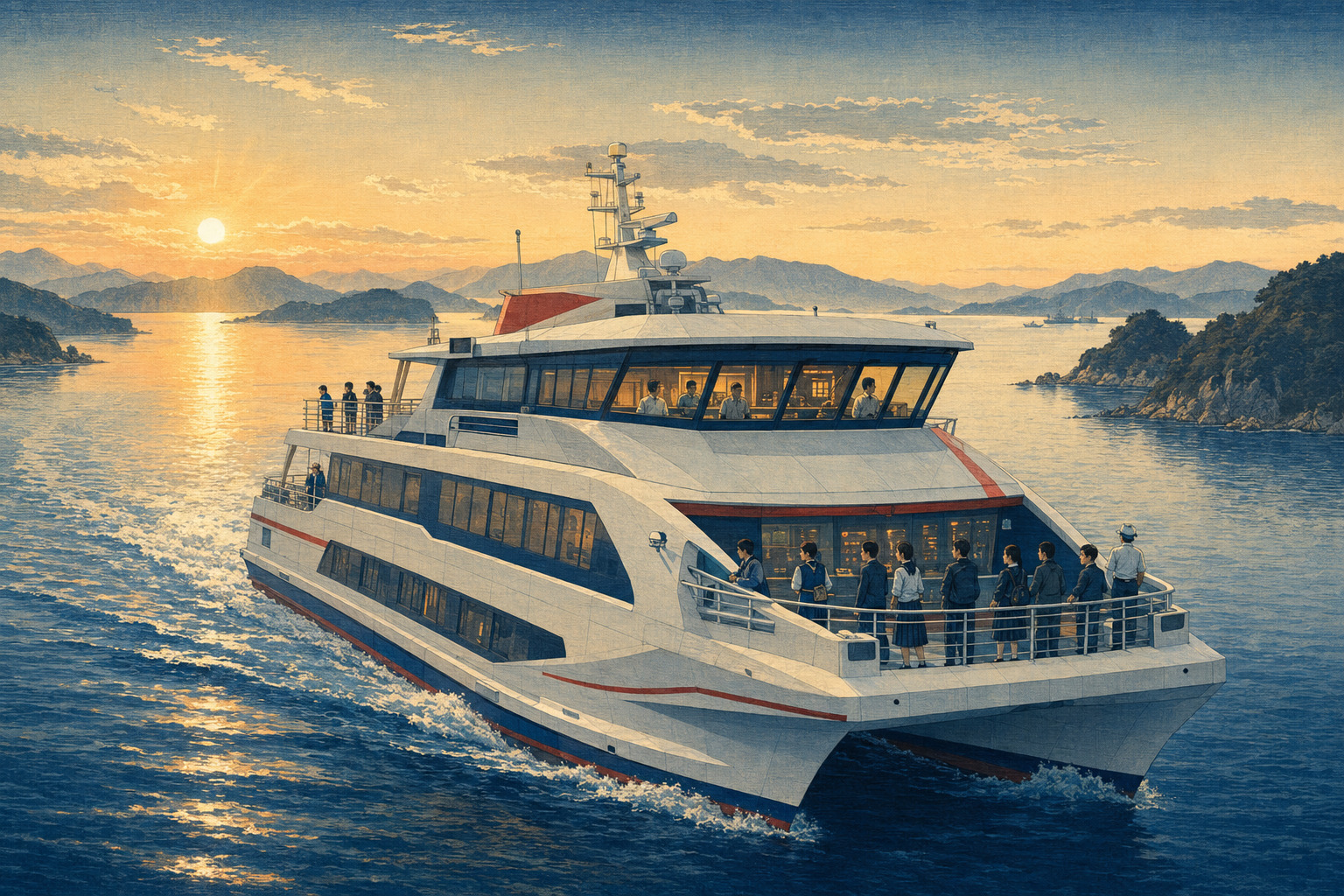
Ninety-four passengers meet a ship that can decide
On July 5, Olympia Dream Seto left Shin-Okayama Port on a charter lasting about two hours. The Nippon Foundation had invited students to learn about shipping through puzzles rather than a technical seminar. QuizKnock founder and quiz player Takuji Izawa led questions about the sea, maritime work and autonomous navigation. Eleven participants who cleared the final problem received signed certificates.
The passenger list told the larger story. Ninety-four people, primarily middle- and high-school students, had been chosen from 257 applicants nationwide. The event’s stated purpose was to give the generation that will be working in 2040 direct contact with a maritime industry most people use indirectly. Containers, fuel, food and island lifelines move by ship, yet a teenager inland may never see a bridge or meet a mariner.
The ship was not a futuristic prototype built for the afternoon. It is a 942-gross-ton ferry that entered service in May 2019 and normally links Shin-Okayama with Tonosho on Shodoshima. Its maritime automation was inspected in two stages, first in July and then in December 2025. On December 5 it received Japan’s first ship inspection certificate for an “autonomous vessel”; commercial service using the functions began from December 11.
First, define “world first”
The headline needs boundaries. The Nippon Foundation describes the case as the world’s first regular commercial passenger-ferry service carrying general passengers and using autonomy equivalent to Level 4. The footnote matters: it is the foundation’s research as of December 2025, and “Level 4” borrows an automotive scale because international maritime definitions were still developing when the project adopted the label.
Other vessels reached related milestones earlier. Finland’s car ferry Falco made an autonomous demonstration voyage with 80 invited guests in 2018 and returned under remote control, but that was a demonstration rather than routine commercial autonomous service. Norway’s battery-electric container ship Yara Birkeland entered commercial operation in 2022 and made a fully autonomous voyage under supervision in 2023, but Yara reported that three crew still operated aboard while certification work continued. The crewless Mayflower Autonomous Ship crossed the Atlantic in 2022 as a research vessel, not a passenger ferry.
Olympia Dream Seto therefore did not become the first automated ship, the first autonomous ferry demonstration, the first crewless ocean crossing or the first commercial vessel designed for autonomy. Its defensible first is narrower and socially important: a government-certified system entered recurring service on a public ferry route that transports ordinary passengers.
| Milestone | What happened | Why it is different |
|---|---|---|
| Falco, Finland, 2018 | Autonomous ferry demonstration with 80 invited guests; remote-control return | Test event, not recurring autonomous commercial passenger service |
| Yara Birkeland, Norway, from 2022 | Electric container ship in commercial cargo service; autonomous functions tested | Cargo vessel; crew supervision remained during gradual certification |
| Mayflower, 2022 | Crewless autonomous research voyage across the Atlantic | No commercial route or passengers |
| Olympia Dream Seto, Japan, 2025 | Certified Level 4-equivalent functions used in regular commercial ferry service | Foundation’s claimed first for an ordinary passenger route |
It is autonomous, not abandoned
“Unmanned ship” is the program’s Japanese label; it is not a literal description of every present voyage. Experienced crew remain on Olympia Dream Seto, monitor the automation and retain manual override. They also perform jobs that navigation software does not replace: passenger safety, loading vehicles, line handling, machinery checks, firefighting, evacuation, medical response and judgment when conditions leave the approved operating domain.
Level 4-equivalent means that within a designated area and defined conditions, the system can complete the assigned navigation functions without continuous human intervention. It does not mean the ferry can depart any port, in any weather, with no people responsible. A route-specific system is closer to a highly capable certified colleague than an all-purpose mechanical captain.
Nor does “commercial service” prove that every crossing runs end to end in autonomous mode. It means the certified functions may be used during revenue service. The project reported an autonomous voyage with general passengers at the end of February 2026, and commercial data are now being gathered. Publication should distinguish authorization, actual autonomous-use periods and conventional operation.
A working ferry before it became a technology platform
Olympia Dream Seto entered service on May 1, 2019. Eiji Mitooka designed it around the idea of an “amusement park running on the sea.” It has promenade decks, a lounge-like interior, children’s spaces and a miniature Chuggington train. The contrast is useful: the public face is playful, while the hidden retrofit has to satisfy conservative marine safety engineering.
The vessel is 65.56 meters long, 942 gross tons, rated at 13 knots and certified for 500 passengers. Its vehicle deck can carry 60 ordinary cars or 10 sightseeing buses. On its usual Okayama route, it makes the crossing between Shin-Okayama and Tonosho in about 70 minutes, part of a timetable with multiple departures in both directions.
The water is not an empty test lake. The Seto Inland Sea is broken by islands, reefs and narrow passages and busy with ferries, coasters, fishing boats and pleasure craft. Near Kojima Bay, the operator cites shoals, aquaculture rafts, bottom-trawl activity and vessels crossing the route. A predictable scheduled path helps automation, but the traffic surrounding it is not predictable.
There is also a timely reminder that the ship remains part of an ordinary fleet. The operator scheduled it as a substitute on the Takamatsu–Ikeda route from July 13 through 23 while another ferry was in dock. That notice does not say the autonomous function is certified for use on the substitute route. Autonomy belongs to an approved operational context, not simply to the hull wherever it sails.
How the system sees, thinks and moves
The simple description has three verbs: perceive, decide, act. Sensors and navigation instruments build a picture of the ferry, surrounding vessels, fixed hazards and voyage state. Planning software predicts motion and proposes a safe route. Control systems turn the plan into commands for propellers, rudder and thrusters. Alarm management checks whether the machinery and connected subsystems remain healthy.
Several planners were developed and compared rather than treating one algorithm as an unquestioned brain. Japan Marine Science, Mitsubishi Shipbuilding and Tsuneishi Solutions Tokyo Bay worked on collision-avoidance or action-planning functions, while Furuno developed a standardized autonomous-navigation integration layer. Furuno reports that partner systems could be switched while autonomous functions continued—important in an industry where a ship lasts decades and equipment from many vendors must interoperate.
Mitsubishi’s SUPER BRIDGE-X uses own-ship and traffic information to identify collision or grounding risk and generate avoidance plans consistent with maritime traffic rules. If a course alteration alone is insufficient, it can combine a turn with slowing down. It also monitors connected equipment and alarms. Tsuneishi’s intelligent Route Planning System predicts other vessels and plans avoidance and berthing according to conditions such as wind; its seamless Maneuvering Control System then controls propulsion, rudder and thrusters to follow the route.
| Layer | Function | Failure question |
|---|---|---|
| Perception | Fuse position, traffic, obstacle and equipment-state information | Can rain, glare, clutter, small craft or a faulty sensor hide a target? |
| Planning | Predict encounters; choose route, speed and berthing plan | Does the plan obey collision rules and remain understandable to humans? |
| Control | Operate propeller, rudder and thrusters | What is the safe response to actuator, power or network failure? |
| Alarm management | Judge system health and request attention or fallback | Will the crew receive the right alert with enough time to act? |
| Human / shore support | Monitor, approve, intervene and manage the voyage | Who has authority, situational awareness and legal responsibility? |
Berthing is where the sea becomes unforgiving
Open-water route keeping is only part of a ferry’s work. Every crossing ends with a large hull approaching concrete, often in wind and current, on a timetable. Speed falls, hydrodynamic response changes and small errors become visible. Vehicles and passengers wait for a gentle contact, not an impressive algorithm.
Automatic departure and arrival therefore matter as much as mid-route autonomy. The system must plan an approach, control heading and lateral motion and coordinate propulsion, rudder and thrusters. It must also know when conditions exceed its limits. Mooring lines and the passenger terminal remain physical, human environments.
This is why a successful demonstration does not by itself prove a service. Commercial evidence requires repeated arrivals through seasons, equipment degradation, ordinary traffic and schedule pressure. Useful metrics would include autonomous engagement rate, interventions per crossing, false and missed alerts, docking dispersion, weather limits, delay, and safe fallback performance. The public releases provide milestones but not yet a full operational dashboard.
Japan built an inspection regime around the machine
Before 2025, a developer could demonstrate an autonomous ship without a dedicated Japanese pathway for certifying routine commercial use. The Ministry of Land, Infrastructure, Transport and Tourism established an advisory committee in June 2024 and published its conclusions in June 2025. The resulting process examines whether sensors, collision-avoidance planners, controls and their integration perform as intended.
The inspection is two-stage. The first reviews design, equipment installation and onboard performance but still requires human involvement in all automated tasks; Olympia Dream Seto passed that stage in July 2025. The second confirms the higher autonomous arrangement and operating conditions; it passed on December 5. The Chugoku District Transport Bureau then issued the first Japanese ship inspection certificate for an autonomous vessel.
Classification and statutory inspection are related but distinct. Class societies independently evaluate ship design and systems and are important for insurance and finance. The government decides whether the vessel meets public-law requirements to operate. Mitsubishi’s SUPER BRIDGE-X obtained a ClassNK Technology Qualification showing that its novel safety was assessed as equivalent to established-regulation technology; the ferry still needed the national statutory inspection.
A history that starts in the engine room
Japan’s autonomous-ship story did not begin with AI. In 1961, Mitsui’s general cargo ship Kinkasan Maru introduced bridge control of the main engine and centralized engine-room monitoring. Mitsui O.S.K. Lines and the Japan Society of Naval Architects and Ocean Engineers describe it as the world’s first automated ship. The automation moved commands and information; it did not replace the navigating officer.
Over the following decades, autopilots held headings, radar and ARPA tracked targets, GPS fixed position, electronic charts combined information, engine controls centralized machinery, and dynamic positioning held specialized vessels over a point. Each removed or assisted a task. Modern autonomy differs by closing more of the loop: sensing the changing environment, planning a response and executing it while checking system health.
Japan published a roadmap in 2018 aiming to commercialize what it then called Phase 2 autonomous ships by 2025 and helped open IMO discussion of international rules. In February 2022, MLIT issued safety guidelines covering design, installation and operation. These policy steps were as necessary as better cameras or planners because a shipowner cannot insure and deploy a safety-critical system that regulators cannot inspect.
| Year | Milestone | What changed |
|---|---|---|
| 1961 | Kinkasan Maru automates engine control and monitoring | Control moves from engine room toward bridge |
| 2018 | Japan sets 2025 roadmap; IMO begins regulatory scoping | Autonomy becomes a rule-making problem, not only R&D |
| 2020 | Nippon Foundation launches MEGURI2040 | Joint program links ships, shore centers, communications and regulation |
| Jan–Mar 2022 | Six Stage 1 vessels conduct demonstrations | Existing routes, busy water, long voyages and automatic berthing tested |
| 2024–25 | Japan develops autonomous-ship inspection method | Commercial certification path opens |
| Dec 2025 | Olympia Dream Seto passes inspection and enters service | Ordinary passengers enter the certified commercial case |
| Mar 2026 | All four Stage 2 ships certified; multi-ship shore support tested | Single demonstration becomes a small operating fleet |
| May–July 2026 | IMO adopts non-mandatory MASS Code, effective July 1 | First global safety framework begins experience-building |
MEGURI2040 crossed from demonstrations to service
The Nippon Foundation launched MEGURI2040 in February 2020. Stage 1 used six very different vessels between January and March 2022: the container ships Suzaku and Mikage, car ferry Sunflower Shiretoko, amphibious tour vessel Yamba Nyagaten-go, small tourist boat Sea Friend Zero and new ferry Soleil.
Soleil demonstrated a roughly 240-kilometer, seven-hour voyage at up to 26 knots from Shinmoji toward the Iyonada, including autonomous functions. Other trials addressed Tokyo Bay congestion and a long route between Tomakomai and Oarai. The Suzaku system later reported autonomous-use rates of 97.4% outbound and 99.7% returning over a 790-kilometer round trip. High engagement is not perfect independence; the remaining percentages and the reasons for intervention are where safety engineering learns.
Stage 2 turned toward social implementation. By March 2026, all four selected ships had passed national inspection: passenger ferry Olympia Dream Seto, new 700-TEU container ship Genbu, Ro-Ro vessel Hokuren Maru No. 2, and the retrofitted 749-gross-ton container ship Mikage. Different hulls and routes test whether the architecture can become an industry rather than one bespoke vessel.
The shore center is part of the ship
An autonomous ship is better understood as a distributed operating system: vessel, communications and shore support. MEGURI2040 built a permanent Fleet Operation Center and a mobile center that can be moved for disaster redundancy. Operators can monitor several ships, while navigation and engineering specialists focus on one vessel when support is needed.
In March 2026, the project reported the first simultaneous monitoring and support of multiple commercially operating autonomous ships, again according to its research-defined category. This offers new work patterns: some experienced mariners could move to shore, serve several vessels and spend less time away from home.
It also creates dependencies. Connectivity can fail; satellite and mobile networks have coverage, latency and cybersecurity limits. A shore operator supervising several quiet voyages may suddenly face two emergencies. Interfaces must show enough context to rebuild situational awareness without drowning the operator in alarms. The mobile center adds resilience only if power, communications, staffing and exercises work under disaster conditions.
The global rulebook arrived this month
The International Maritime Organization adopted the first international MASS Code on May 22, 2026, and it took effect on July 1. The timing makes the July student voyage a hinge between national experiment and global framework. The code covers risk assessment, operational context, software, alerts, navigation, connectivity, remote operations, fire safety, security, search and rescue, machinery, manning and training.
It is non-mandatory and applies directly to relevant SOLAS cargo ships, not as a passenger-ferry certificate for Olympia Dream Seto. States are encouraged to gain experience before a mandatory code is developed. IMO’s roadmap targets mandatory-code adoption by July 2030 and entry into force in January 2032.
Most important, the code does not dissolve command. IMO says the master retains overall responsibility at all times, even if not aboard. Autonomous ships receive no priority over conventional traffic. Existing collision, safety and environmental duties continue. Technology has forced the law to define where the master, remote operator, owner, manufacturer and software meet, but it has not found a responsibility-free sea.
Why island routes make the argument urgent
Japan has more than 400 inhabited remote islands and close to 300 island routes by the project’s count. Ferries are not optional mobility there: they carry residents to hospitals and schools, deliver food and parcels, move vehicles and bring tourists. Cutting a sailing can make island life less viable, deepening the population decline that caused the labor shortage.
Japan had 28,713 domestic-shipping seafarers in 2024, according to MLIT’s definition of Japanese crew and reserves employed by Japanese shipowners. The headcount alone does not measure vacancies by license, region or schedule. The harder issue is recruitment and retention: aging cohorts, long absences, demanding watch systems and limited local labor pools. Automation may reduce watchkeeping burden and widen shore-based careers.
It cannot simply remove crew from a passenger ship and declare the shortage solved. Evacuation and service duties scale with passengers, not with the number of turns a planner automates. Training needs may rise before staffing falls because mariners must understand conventional seamanship, automation limits, cyber procedures and mode transitions. The safer promise is augmentation first: make a scarce crew more capable and the job more sustainable.
Safety improves only if the new errors are smaller
Machines do not become tired, distracted or tempted to cut a corner. They can maintain a continuous sensor watch, calculate closest points of approach and repeat a docking profile. Automation can reduce some human errors and let people concentrate on exceptions. But it introduces failure patterns of its own.
A sensor can be blinded or spoofed; an AIS message can be wrong; a chart or software model can be stale; a planner can satisfy a mathematical objective while confusing a nearby human mariner; networks can drop; maintenance can misconfigure an interface. A crew that watches reliable automation for weeks may lose attention or manual skill, then receive an urgent takeover request with little context. This is automation bias and the out-of-the-loop problem, not proof that humans are always safer.
Passenger vessels add fire, flooding, crowd movement, vehicle-deck hazards and evacuation. Navigation autonomy does not fight a fire or assist a child into a lifejacket. Safety cases must examine the whole ship and its people, not only collision avoidance. Near-miss reporting, independent incident investigation and software-change control will be essential once the publicity voyage is over.
Cybersecurity becomes seaworthiness
When perception, planning and propulsion are connected, cybersecurity is not an office IT concern. Integrity matters as much as secrecy: a falsified position, corrupted route, unauthorized command or disabled alarm can create physical danger. Availability matters too; ransomware or a failed update cannot be allowed to immobilize an island lifeline.
Defenses include segregated networks, authenticated commands, least-privilege access, signed software, logging, redundant sensors and communications, tested manual fallback and exercises that assume the shore center is unavailable. Vendors need coordinated vulnerability disclosure and long-term patch support measured in ship lifetimes, not phone lifetimes.
Transparency has a boundary. Publishing performance and incident categories builds trust; exposing exploitable system detail does not. Regulators, class societies, operators and independent investigators need fuller access than the general public, and contracts must ensure that proprietary software cannot make a casualty unreadable.
The human-machine handover is the real bridge
A well-designed system must say what mode it is in, what it sees, why it intends to act, how confident it is and how much time remains before intervention. A captain should not have to infer whether the planner has detected a small fishing vessel or why it is slowing. Explanations must be brief enough for a collision encounter, not an engineering report delivered afterward.
Authority also needs choreography. Can shore support alter a plan or only advise? Can the bridge veto instantly? What happens if both command paths act? Who declares the operating domain exceeded? Procedures must be trained under stress with realistic simulators and live drills. The best fallback is not always “hand it to the human”: a startled person may need the system first to slow, hold position or create sea room.
These questions explain why carrying students matters. Social acceptance is not produced by hiding the crew and presenting magic. It grows when passengers understand the division of work, see the safeguards and know who answers when a system is wrong.
From a 2024 family tour to the 2026 quiz voyage
The July event had a predecessor. In March 2024, before autonomous equipment was scheduled for installation, about 100 children and family members rode the same ferry, visited the bridge and heard about ships and seafarers. The 2026 voyage moved from a promise to an inspected system.
This time the foundation used an entertainment format and a familiar public figure. Participants explored the ship, gathered clues and heard the MEGURI2040 goal: autonomous operation for 50% of Japan’s domestic fleet by 2040. One participant said the target made it possible to imagine what the sea might look like when the students become adults.
The event was also publicity organized by the project funder, and its participant comments were selected for a press release. It does not measure broad public consent or technical competence. A serious social program would add open operational data, community consultation, accessibility testing, crew perspectives and clear passenger information when autonomous mode is engaged.
What should be measured between now and 2040
The 50% goal is ambiguous unless “autonomous” and the denominator are defined. Does a ship count if it uses automatic collision avoidance on part of one route, if it is capable but rarely engaged, or only if it completes most voyages within an approved domain? Counting equipped hulls can reward installation without proving benefit.
A better scorecard would include autonomous nautical miles and operating hours; domain and weather; human interventions and reasons; false and missed detections; near misses; docking accuracy; delays; connectivity loss; cyber events; software versions; fuel and emissions; crew workload and retention; passenger confidence; and route cancellations avoided. Comparisons need equivalent conventional operations and independent review.
Economics matters as much as technical availability. Retrofitting sensors, controls, communications and redundancy is costly. Shore centers and specialist staffing add fixed expense. Savings depend on fleet scale, insurance, maintenance, crew rules and whether automation lets an operator preserve service rather than merely buy equipment. A system that is safe but unaffordable will not save a remote-island route.
The next generation is both passenger and operator
On July 5, the students were passengers in a story prepared for them: solve the questions, see the future, take the idea home. Yet by 2040 they may be the masters, remote operators, software assurance engineers, regulators, mechanics, island residents and skeptical passengers who decide whether the project deserved its name.
Olympia Dream Seto has crossed a meaningful line. It moved autonomy from a closed demonstration into a certified commercial passenger operation on a complex inland sea. It did so with a crew aboard, an operating domain, government inspection and shore support. Those qualifications do not weaken the accomplishment. They are the safety architecture that made it possible.
The ferry’s next journey is less photogenic: years of uneventful service, transparent performance, careful software changes and crews who remain ready without being reduced to ceremonial backups. If that record holds, the young passengers of 2026 will remember not the day a robot replaced a captain, but the day maritime work began to change shape in front of them.
Sources and further reading
- Nippon Foundation release, “MEGURI2040 onboard quiz tour” (July 7, 2026): July 5 event, 94 participants, 257 applicants, program and comments.
- Nippon Foundation, event announcement (April 3, 2026): eligibility, schedule, educational purpose and campaign.
- Nippon Foundation, commercial-service announcement (December 10, 2025): certification, defined world-first claim, vessel and inspection history.
- Nippon Foundation, English commercial-service release: route, dates, Stage 2 vessels and shore support.
- MLIT Chugoku District Transport Bureau, Japan’s first autonomous-vessel inspection certificate (December 2025): statutory confirmation and system functions.
- Mitsubishi Heavy Industries, SUPER BRIDGE-X on Olympia Dream Seto: collision/grounding avoidance, alarm management and ClassNK technology qualification.
- Tsuneishi Solutions Tokyo Bay, autonomous maneuvering and route-planning systems: sMCS, iRPS, berthing and control functions.
- Furuno, Level 4-equivalent passenger ship enters commercial operation: standard interfaces and integration of partner systems.
- Nippon Foundation, Olympia Dream Seto working group: consortium, design objectives and island-route rationale.
- Working-group page in English: technical development and shore monitoring.
- Kokusai Ryobi Ferry, vessel introduction: 2019 entry, dimensions, speed, passenger and vehicle capacity.
- Kokusai Ryobi Ferry, Okayama route timetable: current 70-minute route and scheduled sailings.
- Kokusai Ryobi Ferry, inspection-certificate statement: local operating hazards and operator perspective.
- Kokusai Ryobi Ferry, July 13–23 substitute-vessel notice: the ship’s temporary operational assignment at publication time.
- MEGURI2040 program overview: Stage 1, Stage 2 and 2040 objective.
- Nippon Foundation, permanent Fleet Operation Center: architecture, Stage 1 utilization rates and multi-vessel concept.
- Nippon Foundation, simultaneous monitoring of multiple autonomous vessels (March 27, 2026): all four inspections and shore-support test.
- Nippon Foundation, autonomous ferry Soleil demonstration (2022): 240-kilometer Stage 1 voyage.
- MLIT, autonomous-ship safety guidelines (February 1, 2022): design, installation and operation framework.
- MLIT, IMO begins autonomous-ship rule discussion (May 2018): Japan’s roadmap and early regulatory work.
- MLIT, Japanese seafarer statistics: 2024 domestic, oceangoing, fishing and other seafarer counts.
- IMO, first global MASS Code adopted (May 22, 2026): scope, human responsibility and regulatory roadmap.
- IMO, autonomous-shipping FAQ: definition, certification, Remote Operations Centres and July 1 effective date.
- Mitsui O.S.K. Lines, Kinkasan Maru bridge engine-control heritage: Japan’s 1961 automation milestone.
- Rolls-Royce and Finferries, Falco autonomous-ferry demonstration (2018): the earlier demonstration comparator.
- Yara, Yara Birkeland two years on: commercial cargo operation, autonomy trials and crew supervision.
- IBM and ProMare, crewless Mayflower research voyage (2022): non-commercial autonomous-ocean comparator.
Editorial note: The July 5 quiz voyage and participant numbers come from a Nippon Foundation press release distributed through PR Times; quotes there were selected by the organizer. The “world first” is the foundation’s claim within a precise category: regular commercial navigation by a ferry carrying general passengers using Level 4-equivalent autonomous functions, as researched in December 2025. The label borrows the automotive SAE scale and is not identical to IMO’s maritime framework. The ferry retains qualified crew and manual override; authorization to use autonomous functions does not prove that every crossing is fully autonomous. IMO’s non-mandatory MASS Code took effect July 1, 2026, applies directly to relevant SOLAS cargo ships, and does not itself certify this domestic passenger ferry. Hero art is an editorial illustration, not event documentation. Currency strip: 1 US Dollar = 162.39 Japanese Yen, supplied for this edition.