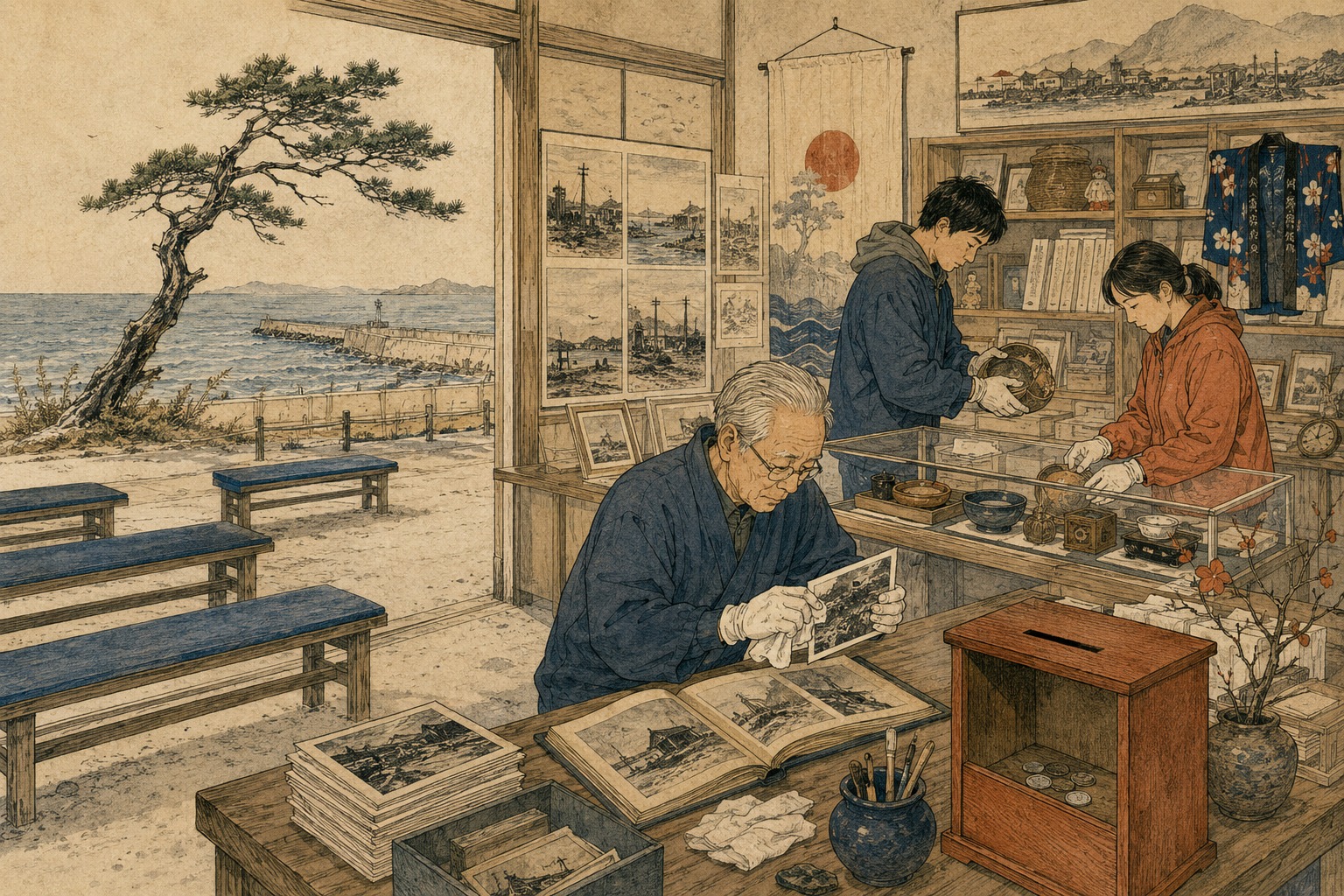
Near the coast in Sendai, Miyagi Prefecture, a school building holds two kinds of time. On March 11, 2011, the tsunami reached the second floor of Arahama Elementary School. Some 320 pupils, staff members and residents evacuated inside the building and survived above the water. Today visitors see scarred walls, compare the neighborhood before and after the wave, and follow the hours from earthquake to rescue. Admission is free.
Free does not mean without value. It means a child, a distant family and a municipal employee studying the next evacuation can enter regardless of ability to pay. That is a public choice. But behind the free door, concrete ages, exhibits change, video must be preserved, staff interpret the site and safety must be maintained. Someone still receives the bill.
Fifteen years and five months after the Great East Japan Earthquake, the Public Interest Incorporated Association 3.11 Memorial Network placed that hidden bill at the center of its first funding-focused survey. Visitor revenue covered at least half of the “necessary costs and burden” for 36% of organizations providing disaster-learning programs, but only 11% of the organizations operating memorial facilities. None of the program groups said visitor revenue covered nothing; 39% of facility operators said exactly that.
Fifty-Three Answers, Two Different Economies
The survey ran from July 26 through August 10 by email request and online form. Responses came from 25 learning-program groups—six in Iwate, 16 in Miyagi and three in Fukushima—and 28 facility-operating organizations—six in Iwate, 14 in Miyagi and eight in Fukushima. The 3.11 Memorial Network conducted it with Tohoku University disaster researcher Associate Professor Shosuke Sato as adviser and the Michinoku Future Creation Support Organization cooperating.
A program group and a facility are not merely small and large versions of one operation. Storytellers and field-learning groups schedule schools, survey routes, create teaching materials, travel, train speakers, respond to emotional testimony and handle invoices. A visible 90-minute encounter sits on top of hours a visitor never sees. Their shortfalls have been filled with earnings from unrelated operations, donations and unpaid cooperation.
A facility carries heavier fixed costs. It conserves ruins and artifacts and pays for climate control, security, cleaning, research, digital preservation, accessibility and public safety. Those costs do not disappear on a day with ten visitors instead of a thousand. Facility respondents relied primarily on municipal budgets for what visitors did not cover. The 39% reporting no visitor coverage are not therefore necessarily insolvent. A publicly operated, admission-free site may never have been designed to fund itself at the gate.
| Preliminary result | Learning-program groups | Facility operators |
|---|---|---|
| Visitor revenue covers at least half | 36% | 11% |
| Visitor revenue covers nothing | 0% | 39% |
| Main support for the gap | Other business income, donations, unpaid cooperation | Municipal budgets |
| Dedicated national/local memory budget is “ideal” | About 80% | About 70% |
| That budget is “realistic” for the future | About 30% | About 70% |
| Anxious about continuity | 86% | 68% |
The most consequential figure may be the difference between what groups want and what they expect. Roughly four in five program groups considered dedicated national or local disaster-memory budgets ideal for the next generation, yet only about three in ten regarded them as realistic. Many believe the public should carry responsibility while expecting future workers to survive on fees, cross-subsidy and unpaid help. Among facilities, public budgets were the leading answer—about seven in ten—both ideally and realistically.
In 2011, Memory Moved Before the Buildings Did
At 2:46 p.m. on March 11, 2011, the largest earthquake recorded in Japan, magnitude 9.0, struck offshore. Tsunami and the accident at TEPCO’s Fukushima Daiichi nuclear power station created a compound catastrophe, leaving roughly 20,000 people dead or missing. Houses and livelihoods vanished, but so did neighborhood maps, the sound of shopping streets, festivals, distances from the sea and embodied knowledge of which road someone took to escape.
Residents began collecting photographs, speaking, walking and guiding almost immediately. Governments built digital archives. Yet preservation was never self-evident. A shattered school or municipal office can be a life-saving lesson and a wound visible every morning. Some bereaved families wanted ruins removed; other residents wanted them kept. Safety, maintenance and land use complicated the choice. The government’s own record says preservation decisions require forums bringing together government, commercial and tourism interests, residents and experts—and must recognize that opinion changes with time.
Large commemorative institutions eventually took shape. The Iwate Tsunami Memorial Museum in Rikuzentakata opened in September 2019. The Great East Japan Earthquake and Nuclear Disaster Memorial Museum in Futaba, Fukushima, followed in September 2020. Miyagi’s 3.11 Tsunami Disaster Memorial Museum in Ishinomaki opened in June 2021. The 3.11 Densho Road began connecting ruins, museums and storytelling across the region so that no site would remain an isolated dot, but part of a network for preparedness.
March 11, 2011 Earthquake, tsunami and nuclear disaster; residents begin archiving and storytelling.
2012 The Reconstruction Agency is established; passing down lessons develops alongside rebuilding lives, cities and industry.
2017 The 3.11 Memorial Network begins annual activity surveys; Iwate’s “Kibou” digital archive also goes online.
2019–2021 The principal museums in Iwate, Fukushima and Miyagi open as the Densho Road network expands.
2023 The survey series identifies a peak in combined visits.
2024–2025 Overall attendance declines for two consecutive years.
2026 Japan enters a third reconstruction period; the 15th-year survey makes funding and succession anxiety visible.
The Budget That Builds and the Budget That Remembers
The first 15 years were also an era of vast reconstruction: roads, seawalls, housing, land readjustment, industry and long-term support for survivors. The national framework designated fiscal 2011–2015 the Intensive Reconstruction Period, 2016–2020 the Reconstruction and Revitalization Period, and 2021–2025 its second phase. A third period began in fiscal 2026. Policy sought to bring reconstruction projects in earthquake- and tsunami-affected areas to the fulfillment of their role by the end of the second phase, while work in Fukushima’s nuclear-disaster areas remains long-term.
Here lies the institutional seam. A construction project has a completion date and a percentage complete. “Do not forget” never reaches 100%. Collections are never finally catalogued; testimony is not finished because it has been recorded once; each later disaster makes society ask old evidence new questions. After spending 15 years building vessels of memory, Japan needs a different promise to operate those vessels for 30 or 50 more.
The Reconstruction Agency has not disappeared; it is authorized through fiscal 2030, and a third five-year policy phase now exists. It would be wrong to say every form of public reconstruction support ended. But the survey organizer describes the previous funding framework for Iwate and Miyagi as reaching its conclusion after fiscal 2025. The task is crossing from time-limited reconstruction accounts into durable education, cultural stewardship and disaster-prevention services.
Visits Are Down. Attendance Is Not the Whole Value.
A separate visitor survey released by the network in February found that combined visits to participating organizations and facilities turned downward in 2024 and slipped again in 2025. After school excursions to Tohoku increased during the pandemic, the share and number of visitors through high-school age gradually weakened. When respondents explained increases, program groups most often chose “program quality”; facilities most often chose the effect of collaboration and referrals.
The February visitor survey and August funding survey had different numbers of respondents. They are not a fixed-panel analysis connecting each organization’s revenue with its footfall. The 15th anniversary may also have lifted short-term attention. The funding release says one- and three-year outlooks for money and personnel improved from the previous survey, perhaps with anniversary interest, while more respondents answered “do not know” about the 30-year horizon. A commemorative year must not be mistaken for an endowment.
Footfall matters, but it is not the only outcome. A pupil may hear a tsunami warning and go uphill instead of returning home. A school may rewrite its evacuation plan. A business may redesign continuity procedures. A distant municipality may learn from failures in sheltering older residents. The return can emerge years later, in another prefecture, on the worst day. A ticket system can count extra visitors; it cannot count a life that was not lost.
When the Witnesses Are Gone, Is the Work Over?
Fifteen years is long enough for succession to become concrete. A storyteller who was 50 in 2011 is now 65. Then-elementary pupils are working adults. Children born after the disaster are becoming guides to an event they did not experience. If only eyewitnesses are authentic, memorial work expires with the last survivor.
What is needed is not a counterfeit eyewitness memory but documented succession. Testimony, video, public records and physical ruins can be checked against one another. A young guide can distinguish “I saw” from “the record shows.” Training must cover not only disaster history but trauma-aware conversation, correction of misinformation, difficult questions and the ability to resist flattening Fukushima’s nuclear disaster into one official story.
The detailed 2024 survey report describes university students in Miyagi learning from storytellers and receiving pay to serve school trips and seminars. “Paid” is not incidental. Volunteer work reveals community strength, but when a system assumes free labor, it selects for people who can afford to give time away. Paying the next generation enough to develop skill and remain in the work is part of quality control—and a form of respect for testimony.
- Benefits spread: Schools, firms, governments and future generations gain, not just the visitor.
- Fixed costs persist: Ruins, collections, safety, research and digital records need care even on an empty day.
- Access conflicts with price: High fees deter the school groups and families that public education intends to reach.
- Local value escapes the ledger: Hotels, restaurants and transport may earn money that never returns to the memorial operator.
- Emotional labor is hidden: Preparation, travel, debriefing and successor training exceed the visible hours of a tour.
Five Layers to Finance the Next Thirty Years
The choice is not public money or self-help. A durable model would stabilize the public foundation while allowing high-value services to earn income on top of it.
| Layer | What it should carry | Design safeguard |
|---|---|---|
| 1. Multi-year public baseline | Conservation, permanent professional staff, safety, free or affordable access | Define national, prefectural and municipal duties; do not renew annually on footfall alone |
| 2. Education purchasing | School guides, transport, materials, preparation and follow-up | Buy a professional educational service instead of requesting volunteers |
| 3. Paid specialist programs | Corporate risk training, municipal exercises, research fieldwork | Reinvest revenue in content and people rather than replacing the baseline |
| 4. A pooled fund and donations | Small groups, urgent repairs, experimental successor projects | Prevent famous sites from absorbing everything; publish allocation and outcomes |
| 5. Shared infrastructure | Booking, promotion, translation, digital preservation, training and referrals | Use networks such as Densho Road to reduce duplication and move visitors across communities |
This structure does not reject tourism. Walking the affected coast, staying, eating and meeting present-day communities ties memory to regional recovery. Corporate programs can charge for genuine value in risk management and leadership. But those revenues should complement universal services. They are not a reason to place conservation and testimony at the mercy of consumer popularity.
Public Money Has Risks, Too
A public baseline does not entitle government to become the sole narrator. If exhibits show only successful reconstruction, they can erase prolonged evacuation, isolation, disaster-related death, lost livelihoods, and conflict or distrust after the nuclear accident. Grant criteria can smooth distinct community memories into a comfortable administrative account.
Funding agreements therefore need editorial and research independence, multiple voices, access to source records, resident participation, and systems for complaints and correction. Mourning and preparedness, tourism and quiet, national lessons and a single person’s memory will sometimes conflict. Mature transmission displays the tension instead of deleting it.
Measures of success should also change. Alongside visitors and sales, track repeat schools, improved evacuation plans, paid employment for new guides, use of preserved sources, adoption by other regions and post-visit behavior. In the 2024 report, 93% of responding groups and all responding facilities believed their work contributed to visitor awareness or behavior change. That is practitioners’ assessment, not proof of effect, but it identifies the outcome the system is trying to buy.
Treat Memory as Infrastructure
A road is not valued only by money dropped into a toll box. A seawall is not abandoned after a day without revenue. A library does not preserve its collection from a fee on every borrowed book. Disaster memory belongs in the same family. It is a place of mourning, a local history and social infrastructure that may make the next evacuation faster.
The preliminary survey cannot calculate the required budget. A full report should disclose fixed costs by facility size, paid and unpaid hours, yen by revenue source, the length of municipal contracts, maintenance reserves and costs per school participant. The conditions of nonrespondents—and of organizations already suspended, closed or transferred—matter. These 53 answers show the entrance to the problem, not its total price.
At the free entrance to Arahama Elementary School, the question becomes simple: who will hand this place to the next child? If the answer is only “the visitor,” memory contracts in a year when attendance falls. If the answer is only “someone’s goodwill,” transmission stops when a storyteller is exhausted.
Fifteen years ago, people in that school moved upward. Fifteen years later, the financing principle can be equally clear: recognize life-saving memory as a public duty, promise its core costs for years, pay expertise, then layer tourism, education and philanthropy on top. Preserving memory is not merely storing the past. It is making sure that, when a future warning sounds, someone runs in the right direction.
Reporting note and principal sources
This article uses public information available through August 12, 2026 at 9:18 AM JST. The release’s opening sentence calls the questionnaire a “2024” survey, but the survey title, July–August field dates and future-work section all identify it as the 2026 survey; we therefore treat that reference as a typographical error. Percentages are published figures and are not converted into headcounts because of rounding and multiple-choice items. Policy proposals and public-goods analysis are Japan.co.jp’s.
- 3.11 Memorial Network: Preliminary 2026 disaster-memory activity survey (August 11, 2026)
- 3.11 Memorial Network: Original preliminary results page
- 3.11 Memorial Network: 2025 visitor survey and second consecutive annual decline (February 3, 2026)
- Detailed 2024 Great East Japan Earthquake Legacy Activity Survey report (December 2025)
- Reconstruction Agency: Preservation of memories and lessons; museum and archive history
- 3.11 Densho Road: Purpose and classification of the facility network
- Arahama Elementary School ruins: Damage, evacuation, exhibits and visitor information
- Reconstruction Agency: Current status and future reconstruction work (July 2026)
- Reconstruction Agency: History and continuation through fiscal 2030
- Reconstruction Agency: Scale and effects of the Great East Japan Earthquake