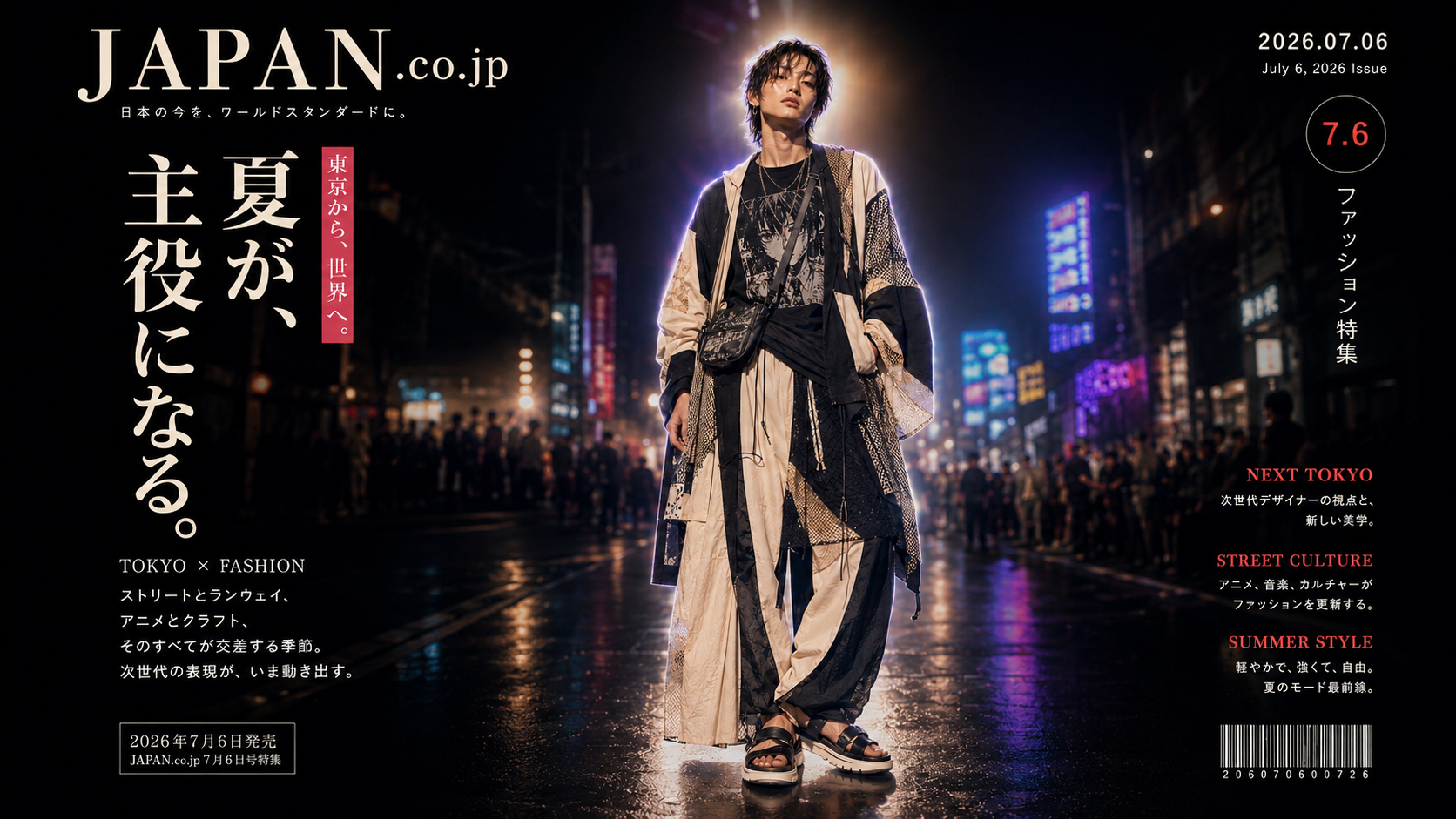
Today’s art choice is not simply a fashion photograph. It is a fashion artwork: Tokyo night, layered streetwear, runway light, anime print, sacoche bag, sandals, magazine typography, vertical Japanese text, neon, and wet pavement gathered into one frame. Clothing here is not a product shot. It is a portrait of a city.
The uniqueness of fashion art lies in what makes it different from painting or sculpture. Clothing is not complete when it hangs on a wall. It gains meaning when it is worn, walked, sweated through, lit, photographed, judged, desired, bought, copied, archived, and remembered. For today’s edition, the right image could not be a quiet museum object. It had to be a person standing inside Tokyo at night.
The July 6 Japan.co.jp edition reads Human Made and Undercover, Sacai and Birkenstock, Saint Michael and lain, Fuji Rock, the Paris menswear heatwave, doublet, jirai-kei, Next Fashion Designer of Tokyo, and Rakuten Fashion Week Tokyo. In other words, it appears to be about clothing, but it is also about capital, body, climate, music, anime, materials, youth culture, e-commerce, listed companies, and the future of the city. Fashion art can hold all of that in one image.
Why fashion art?
Fashion is the most intimate art form. Most people do not buy a painting every day. They do not select a sculpture every morning. But they choose clothes: shoes, T-shirts, bags, uniforms, suits, dresses, vintage pieces, hats, sandals. Without saying so, people turn their bodies into small exhibitions before they leave home.
That makes fashion art democratic and cruel at the same time. Everyone can participate, but no one fully escapes the gaze. Clothes communicate age, gender, work, class, desire, resistance, belonging, loneliness, and mood before language arrives. Fashion seems silent, but it speaks loudly.
When museums accepted fashion
Fashion was long treated as applied art, decoration, commerce, or trend — lower than “pure” fine art. Twenty-first century museums have changed that view. In 2017, the Metropolitan Museum of Art presented “Rei Kawakubo/Comme des Garçons: Art of the In-Between,” reading Kawakubo’s clothes not as garments only, but as forms that challenge beauty, the body, and binary thinking.
That same year, the Museum of Modern Art opened “Items: Is Fashion Modern?”, examining 111 garments and accessories that shaped society in the 20th and 21st centuries. Levi’s 501s, the white T-shirt, the Little Black Dress, the sari, the kippah, the keffiyeh. Fashion was treated not only as luxury clothing, but as design that changes how society lives.
The V&A’s “Kimono: Kyoto to Catwalk” presented kimono from the 1660s to the present as living fashion. Kimono is traditional, but also dynamic: a visual language that continues to influence designers, street style, stage, film, and contemporary dress. Japanese clothing is not only something preserved from the past. It is art that continues to mutate.
Japanese fashion art: from kimono to Harajuku
Japanese fashion art can be read from the straight lines of kimono. Unlike Western clothing cut closely around the body, kimono begins as flat cloth arranged over the body. Line, space, obi, sleeve, seasonal pattern, dyeing, weaving. The garment creates space between fabric and body rather than only emphasizing the body’s outline.
That space between body and cloth continues into modern Japanese fashion. Issey Miyake’s pleats, Rei Kawakubo’s swollen silhouettes, Yohji Yamamoto’s black volume, Junya Watanabe’s structures, Chitose Abe’s hybrids: Japanese fashion often does not simply decorate the body. It questions the body.
Harajuku and Shibuya turned that question into everyday life. Lolita, gyaru, Ura-Harajuku, vintage, uniforms, gothic, jirai-kei, sneakers, anime T-shirts, festival merch. In Tokyo, clothing is exhibited on sidewalks, at stations, in live houses, convenience stores, and social media. Today’s visual is a picture of that street gallery.
The power of fashion photography and magazines
Fashion art does not exist through clothing alone. Photography and magazines turn it into memory. Twentieth-century fashion photography — Irving Penn, Richard Avedon, Helmut Newton, Guy Bourdin, Paolo Roversi, Juergen Teller — transformed clothes into desire, body, city, and story.
The fascination of fashion photography lies in the border between commerce and art. It sells products and becomes an image of its age. It shows clothing while changing who is seen, who looks, and what beauty means. The magazine page distributed dreams faster than the store.
Today’s Japan.co.jp visual belongs to that lineage. Large masthead, vertical Japanese headline, editorial cover lines, date, barcode, right-side feature copy. This is not only a news thumbnail. It is an issue cover. It does not merely show clothes; it tells the reader how to read Tokyo fashion today.
Clothing is moving sculpture
Sculpture occupies space. Clothing does too, but clothing moves. Sleeves swing. Hems catch wind. A sacoche cuts a diagonal across the body. Thick sandal soles alter the walk. Mesh and layers let light pass. Clothing turns the body into small architecture.
That is why today’s image centers the figure. Tokyo is blurred behind. Neon and crowds become atmosphere. The subject is the clothed body. The rim light lifts the garment from the street while returning it to the street. This is the moment between runway and sidewalk.
Fashion art is unique because the artwork and viewer are never fully separate. The viewer is also wearing clothes. To look at fashion is also to think about how one is seen.
Anime, streetwear, and runway in one frame
Today’s fashion edition includes the Saint Michael x serial experiments lain story. A 1998 anime returns as a 2026 T-shirt. That shows something essential about fashion art: clothing makes other media wearable. Film, manga, music, games, sports, festivals, religion, politics, regional memory — clothing transplants them onto the body.
Tokyo fashion is especially strong at this media crossing. An anime T-shirt is not just merchandise. It signals what the wearer watched, which internet era shaped them, which music or manga saved them. Sacoche bags and festival tees carry place and time. Sneakers become sport, street, and tourism at once.
That is why the visual includes anime print, layers, sandals, sacoche, and a neon city. Tokyo fashion is not a single garment. It is a cultural composite.
Fashion art in the climate era
Fashion in 2026 cannot escape climate. Paris menswear unfolded in a heatwave, making shorts, sandals, lightweight tailoring, linen, and breathability matters of bodily safety rather than seasonal styling. In Japan, the new term kokushobi for 40°C heat is changing how cities, labor, healthcare, and daily life are discussed.
Fashion art can visualize climate change. Coolness, sweat, sun, rain, fabric, layering, open footwear, hats, bags, water bottles — these are aesthetic choices and survival choices.
The sandals and lighter layers in today’s visual are not merely stylish. They are clothing for walking through a hot city, existing in a rainy night, and protecting the body while still presenting it. That is the realism of fashion art in 2026.
Fashion as market, fashion as poetry
Fashion is poetry and market at once. UNIQLO, ASICS, MUJI, ZOZO, ABC-Mart, Shimamura. Tokyo’s equity board includes listed fashion companies whose stock prices move on yen weakness, inbound tourism, wages, e-commerce, inventory, and brand assets. Clothing is an emotional product and a logistics-and-margin business.
This double nature is exactly what makes fashion art compelling. Behind one beautiful image are factories, materials, shoots, models, advertising, e-commerce, stock, returns, currency, and tourist spending. Fashion sells dreams, but those dreams are supported by a very real industry.
Today’s art choice does not hide that duality. It looks like a magazine cover, but it also connects to the Market Desk. It is runway and stock board, culture and company, Tokyo image and Tokyo industry.
Fashion images in the AI era
In the AI era, fashion images change again. Clothing has always multiplied through photographs, magazines, advertising, e-commerce, social media, lookbooks, and runway video. AI accelerates that multiplication. The faster images become, the more important selection becomes.
For today’s visual, the goal was not simply “a stylish person.” The image needed one focal point, Tokyo night, vertical Japanese copy, issue-date signals, layered clothing, sandals, sacoche, and an anime-like print. Even an AI-generated fashion image requires editorial intention. The image must carry the meaning of the issue, not just look cool.
Fashion art fits AI because fashion itself is already quotation, remix, styling, and synthesis on the body. But if AI drifts into mere “fashion-looking” surfaces, the image becomes empty. The key is deciding why this garment, why this city, why this light.
JAPAN.co.jp view
Today’s art choice is a cover image designed to make Tokyo fashion the lead actor. The figure is both model and representative of the city. The clothing is both product and memory. Tokyo in the background is stage, magazine page, and market.
Fashion art is often treated as lighter than other art. That lightness is not a weakness. Clothing moves. It changes. It washes, stains, sells, becomes vintage, is thrown away, is rediscovered. It is closer to daily life than painting, closer to the body than sculpture, and more woven into routine than film.
If the July 6 Japan.co.jp edition is a fashion issue, its art had to show this: fashion is not surface. It is the intersection of body, city, market, and memory. That is why today’s image makes the clothed human figure the protagonist of Tokyo night.
Reader guide
| Item | Meaning |
|---|---|
| Today’s art choice | Tokyo fashion visual: night street, streetwear, runway, anime, e-commerce, magazine-cover language. |
| Why it fits | The July 6 edition is a fashion issue reading clothing as industry, body, city, climate, youth culture and listed-company exposure. |
| Historical context | Kimono, Rei Kawakubo, Issey Miyake, Yohji Yamamoto, Harajuku, fashion photography and museum exhibitions. |
| What makes fashion art unique | It is worn on the body, moves through the city, and carries social gaze and market value at the same time. |
| How to read it | See the figure as moving sculpture and Tokyo as gallery, magazine page and market. |
Sources and references
This article draws on materials from the Metropolitan Museum of Art, MoMA, V&A, Vogue, New Yorker, Wallpaper, and public histories of fashion photography and Japanese fashion.
- The Met: Rei Kawakubo/Comme des Garçons: Art of the In-Between.
- Google Arts & Culture / The Met: Art of the In-Between and the concept of in-betweenness.
- MoMA: Items: Is Fashion Modern?
- V&A: Kimono: Kyoto to Catwalk.
- Vogue: The Met’s Costume Art exhibition and the dressed body.
- Wallpaper: Yves Saint Laurent and photography.