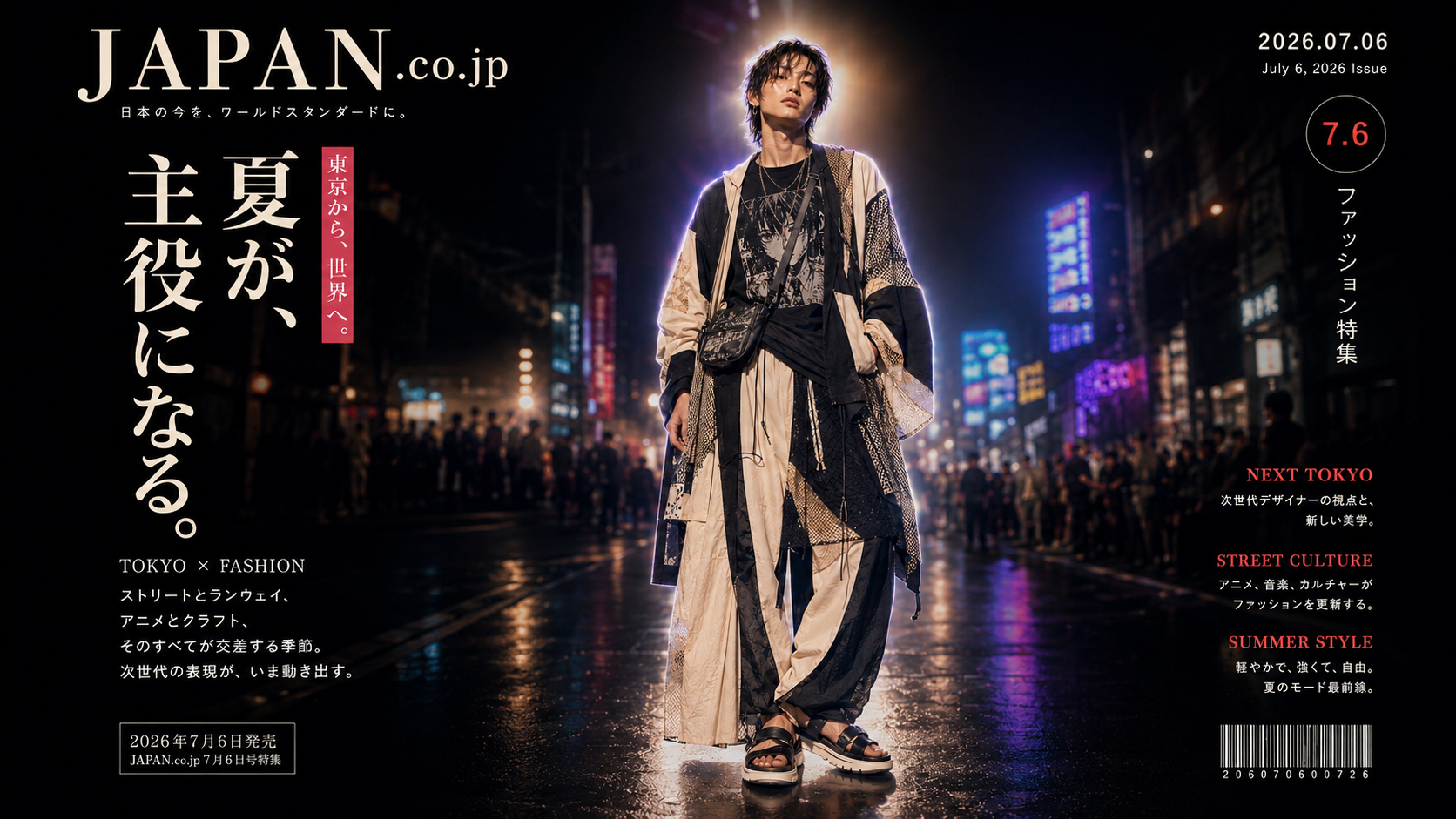
Japan.co.jp’s July 6 edition is a fashion issue, so today’s Japan Market Desk becomes a special report on listed fashion companies. Tokyo has more fashion exposure than “apparel retail” suggests: Fast Retailing owns UNIQLO, ASICS owns Onitsuka Tiger, Ryohin Keikaku owns MUJI, ZOZO operates ZOZOTOWN, ABC-Mart sells the shoes, Shimamura watches the household budget, and and ST HD, Onward, World, TSI, and United Arrows sit in the mid-cap apparel fight.
Japanese fashion stocks cannot be read as one simple sector. Fast Retailing is a global apparel manufacturer-retailer and a major index stock. ASICS is both sports performance and sneaker fashion, with Onitsuka Tiger becoming a high-margin global lifestyle business. Ryohin Keikaku is not just apparel; it is lifestyle, household goods, food, stores, and overseas expansion. ZOZO is not just a clothing seller; it is data, e-commerce, sizing, advertising, and platform infrastructure.
That means Tokyo fashion equities are where investors read the yen, inbound tourism, wages, consumption, e-commerce, low-price retail, materials, logistics, inventory turnover, brand assets, AI sizing, tourist shopping, and the global sneaker cycle at once.
Fashion stocks fall into three markets
Japan’s listed fashion companies are easiest to read in three groups. First, global brand companies: Fast Retailing, ASICS, and Ryohin Keikaku. Second, domestic consumption and price-channel retailers: Shimamura, ABC-Mart, and ST HD, Onward, United Arrows, World, and TSI. Third, clothing transaction infrastructure: ZOZO.
The stock drivers differ. Global companies move on overseas growth, brand power, weak-yen translation, store expansion, and supply chains. Domestic retailers move on wages, real household income, pricing power, inventory, weather, and sale timing. Platforms move on GMV, advertising, data, AI, membership, logistics, and returns.
Fast Retailing: UNIQLO is a world stock
Fast Retailing is the center of Japanese fashion equities. Reuters reported in April that the UNIQLO owner’s operating profit for the quarter ended February rose 29.4% year on year to ¥189.8 billion, and that the company raised its full-year operating profit forecast to ¥700 billion, pointing to a fifth consecutive record year. North America and Europe were key growth engines.
Fast Retailing’s own IR materials also showed UNIQLO International first-half FY2026 revenue at ¥1.2413 trillion and business profit at ¥233.0 billion, both sharply higher year on year. If investors ask which Tokyo-listed fashion stock matters most, the answer is 9983.
But Fast Retailing is not a simple growth story. China consumption, US and European store expansion, raw materials, currency, logistics, labor costs, succession after Tadashi Yanai, and the durability of LifeWear all matter.
ASICS / Onitsuka Tiger: sportswear becomes fashion sneaker economics
ASICS is one of the most interesting fashion-adjacent names in Japan. Reuters reported in June that ASICS will transfer high-end sneaker brand Onitsuka Tiger to OT Group, a wholly owned subsidiary, to speed decision-making and global expansion. Onitsuka Tiger sales rose 43% in 2025 to ¥136.5 billion with a 38% margin, and early-2026 sales rose by about a third with a margin around 40%.
This is the story of a sportswear company containing a fashion brand with economics closer to luxury than ordinary athletic goods. Mexico 66, low-profile sneakers, tourism, retro sneaker demand, and fatigue with mega-brands like Nike and Adidas are all part of the thesis.
The market is watching more than running shoes. It is watching whether ASICS can separate performance sports from Onitsuka Tiger’s fashion identity and allow both to grow.
Ryohin Keikaku: MUJI as a lifestyle index
Ryohin Keikaku is a lifestyle company, not only a clothing company. Reuters describes it as the operator of MUJI / Mujirushi Ryohin with domestic, East Asia, Europe and Americas, and Southeast Asia/Oceania businesses. Investing.com reported in April that MUJI’s operator raised its 2026 net profit forecast to ¥62 billion from ¥50.8 billion and expected revenue of ¥887 billion.
MUJI belongs in a fashion issue precisely because its clothing does not shout design. White, ecru, gray, black, linen, cotton, function, storage, daily use: MUJI clothing is less trend than living standard. For investors, it can work when consumers turn away from decorative excess and toward useful, well-priced goods.
ZOZO: fashion platform as data stock
ZOZO is the most platform-like fashion equity in Japan. ZOZOTOWN sits at the center of Japanese apparel e-commerce, while WEAR, size data, advertising, payments, logistics, and online sales infrastructure support the ecosystem. ZOZO’s own IR material estimates the fashion e-commerce market at roughly ¥2.7 trillion and suggests its GMV share still leaves room for growth.
Fashion retail is hard because inventory is hard. A platform can create value through transaction volume, advertising, data, membership, returns management, and size precision. ZOZO’s investment question is not only whether clothes sell, but how efficiently they sell.
Shimamura and ABC-Mart: value and utility
Shimamura and ABC-Mart are important domestic consumption gauges. Shimamura is a low-price apparel defensive name: when households feel inflation pressure, value and store network matter. ABC-Mart sits between daily necessity and fashion. Reuters describes ABC-Mart as primarily engaged in shoe sales and product planning/development, with domestic and overseas segments.
These names may not tell the global story as dramatically as Fast Retailing or ASICS, but they show what Japanese households can afford, what they postpone, and which price points still move. If the 5% wage-hike story is going to show up in consumption, everyday apparel and shoes are useful thermometers.
and ST, Onward, World, TSI, United Arrows: the mid-cap apparel fight
and ST HD, Onward Holdings, World, TSI Holdings, and United Arrows sit at the center of Japan’s mid-cap apparel trade. They cannot match Fast Retailing’s global dream, but they reveal brand operations, store reform, e-commerce, wholesale, inventory, department-store exposure, urban consumption, younger customers, and some inbound demand.
The key is not the number of brands a company owns. It is which brands it keeps, which stores it closes, how far it pushes e-commerce, and where it protects gross margin. Department-store-heavy companies, suburban companies, e-commerce growers, and younger-customer brands deserve different valuations.
Listed fashion watchlist
| Name | Code | Category | Investment theme |
|---|---|---|---|
| Fast Retailing | 9983 | Global apparel | UNIQLO global expansion, LifeWear, US/Europe growth, index impact |
| ASICS | 7936 | Sports / sneakers | Onitsuka Tiger spin-off, retro sneakers, sports x fashion |
| Ryohin Keikaku | 7453 | Lifestyle | MUJI, lifestyle consumption, overseas stores, apparel and household goods |
| ZOZO | 3092 | E-commerce platform | ZOZOTOWN, data, advertising, sizing technology |
| ABC-Mart | 2670 | Shoe retail | Shoes, sneakers, domestic stores, tourist shopping |
| Shimamura | 8227 | Value apparel | Household defense, suburban stores, value pricing |
| and ST HD | 2685 | Casual / lifestyle | GLOBAL WORK, LOWRYS FARM, niko and, cross-brand e-commerce |
| Onward Holdings | 8016 | General apparel | Department stores, e-commerce, brand restructuring |
Five needles investors should watch
Market Movers Timeline
Japan Market Desk View
Japanese fashion equities are splitting into two worlds. Companies with overseas growth and brand assets — Fast Retailing, ASICS, Ryohin Keikaku — have the yen and global expansion story behind them. Domestic-heavy names — Shimamura, ABC-Mart, and ST, Onward, World, TSI, United Arrows — are trades on household budgets, store productivity, inventory, and e-commerce execution.
For investors, fashion stocks in 2026 are not about whether something is stylish. They are about which market is being sold to, whether the yen is a friend or enemy, whether inventory turns, whether the brand travels overseas, and whether AI or data can improve recommendations and returns.
The conclusion is simple: Tokyo’s fashion stocks are cultural names, but also currency names, consumption names, tourism names, and e-commerce names. To read tomorrow’s fashion issue, watch not only the runway but also the equity board.
Sources and references
This special Market Desk report draws on public information from Reuters, Fast Retailing IR, ZOZO IR, Google Finance, MarketWatch, Investing.com and related company profiles. Stock prices can be delayed or vary by reference time; use your broker and exchange data for investment decisions.
- Reuters: Fast Retailing Q2 profit and raised full-year outlook.
- Fast Retailing IR: FY2026 first-half results summary.
- Reuters: ASICS / Onitsuka Tiger global expansion and margin context.
- Reuters: ASICS to move Onitsuka Tiger into OT Group.
- Investing.com: Ryohin Keikaku / MUJI forecast upgrade.
- ZOZO IR: Fashion e-commerce market environment and ZOZO share context.
- Reuters: ABC-Mart company profile and market data.