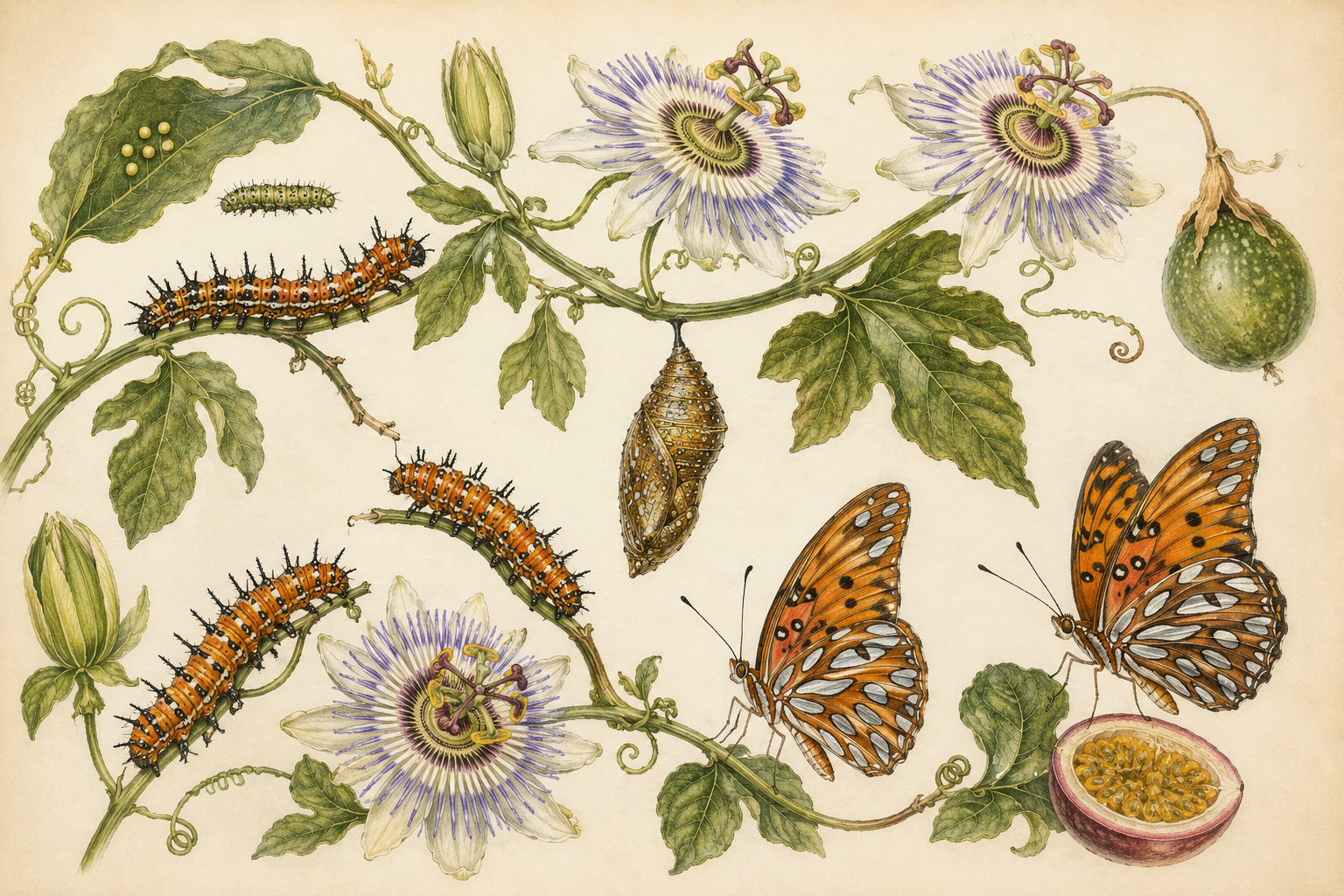
START with the branch, not the butterflies. It rises through a white field and gives every other form a place: a caterpillar at its food, a pupa in suspension, two winged adults at the end of a change. The picture makes several moments occupy one botanical structure.
That structure belongs to plate 7 of Maria Sibylla Merian’s 1705 Metamorphosis Insectorum Surinamensium. The Rijksmuseum registers the Dutch title as West-Indische kers (Malpighia glabra) met twee vlinders, rups en een pop—West Indian cherry with two butterflies, a caterpillar and a pupa. The small number 7 at lower right marks it as a page in a book, not an isolated easel painting.
It is tempting to call the page a watercolor by Merian and move on. The object refuses that shortcut. Pieter Sluyter made the etching after Merian’s drawing from Suriname; the hand coloring is attributed to her. Observation, drawing, engraving, printing and color meet in one sheet.
The Plant Is Evidence, Not Ornament
Flower painting had taught Merian how to make a stem direct the eye. In plate 7, that inherited elegance performs a second job. The plant is where an insect feeds, waits and changes. Its leaves are not decorative filler around a specimen; they are part of the claim the image makes about a life.
The Rijksmuseum describes Merian as among the earliest artists to draw insects and as the first to illustrate the plants on which they lived. Japan’s Biohistory Research Hall emphasizes the same union in different terms: caterpillar and food plant, collection place, duration of the pupal stage and adult wing markings could be connected through image and accompanying text.
That does not turn every plate into a modern ecological data set. Scale could be adjusted for composition, and later identification has raised questions about some associations. The museum’s subject record supports the cherry, butterfly, caterpillar and pupa shown here; it does not license a confident species-level claim for every insect in every later reproduction.
This Is Not Simply a Watercolor by Merian
Watercolor belongs to the story, but not in the way the shorthand implies. The Rijksmuseum holds drawings associated with Merian made in opaque and transparent watercolor over graphite on vellum. The image distributed in the 1705 book, however, was pulled from a copper plate and colored by hand.
For plate 7, the catalogue names Pieter Sluyter as printmaker, Merian’s Suriname drawing as the source, and Merian as the attributed colorist. The technique is etching with hand coloring. Its printed area measures 385 by 290 millimeters; the full page is 525 by 345 millimeters.
Buyers could also encounter counterproofs, made by pressing a damp fresh impression onto another sheet. The lighter, reversed line allowed color to dominate and brought the printed image closer to the appearance of a watercolor. “A work by Merian” can therefore contain different papers, line qualities, workshop decisions and degrees of attribution.
Sixty Plates Built a Large Stage for Small Lives
Merian was born in Frankfurt in 1647 and trained in the studio of her stepfather, flower painter Jacob Marrel. The Rijksmuseum says she began collecting caterpillars and studying their transformations at about 13. She later published a flower model book and volumes on caterpillar metamorphosis while teaching drawing and embroidery.
After moving to Amsterdam with her daughters in 1691, she entered a market rich in specimens, collectors and printing expertise. The city’s cabinets could display dead wonders arriving through global trade. Merian wanted the less collectible facts: what the larvae ate, how the pupa felt and how the adult moved.
The book she self-published in 1705 was more than half a meter tall and contained 60 hand-colored plates. Customers could select Dutch or Latin text. That scale mattered. It elevated caterpillars and damaged leaves from marginal details in flower pictures into subjects that demanded a viewer’s full attention.
A Journey Inside a Colonial Economy
In June 1699, Merian, then 52, sailed to Suriname with her 21-year-old younger daughter, Dorothea Maria Graff. Suriname was a Dutch colony whose plantation economy depended on enslaved labor. Mother and daughter collected living insects, raised them and recorded them with the plants around them.
Illness forced Merian to return to Amsterdam in 1701, earlier than planned. She brought drawings, notes and specimens, then turned them into the 1705 book. The journey was daring, but a heroic-traveler narrative is incomplete. Ships, investors, collectors, markets and coercive plantation labor formed the system through which the journey and its knowledge became possible.
The immediacy of the plates came from seeing living creatures rather than rearranging dead specimens. It also came from access structured by colonial rule. Both conditions belong to the object’s history; neither cancels the other.
1647 Born in Frankfurt.
1691 Moved to Amsterdam with her daughters.
1699–1701 Worked in Suriname with Dorothea.
1705 Self-published Metamorphosis Insectorum Surinamensium.
1717 Died in Amsterdam.
The Knowledge Was Never Hers Alone
The Rijksmuseum states that Indigenous inhabitants and enslaved people collected specimens for Merian and helped provide names and knowledge. Her published text also recorded the abuse of enslaved people. Those passages show that she saw part of the violence around her; they do not make her research independent of the colonial system.
The public object records do not recover most collaborators’ personal names or let a reader assign each observation to a particular person. Knowledge given locally became a costly publication sold under Merian’s name in Amsterdam. Responsible admiration has to retain that asymmetry instead of converting unnamed assistance into atmosphere.
Authorship is layered in Europe as well. Merian’s daughters Johanna and Dorothea drew, colored and managed work in the family studio. For one Rijksmuseum metamorphosis watercolor assigned to the workshop, Dorothea is considered a possible maker. Engravers translated drawings into copper; colorists completed individual impressions. The book grew from a woman-led workshop, not a solitary hand.
She Did Not Discover Metamorphosis
The neat claim that Merian revealed a process nobody understood is memorable and wrong. Significant studies of insect metamorphosis were already underway in seventeenth-century Europe. Jan Swammerdam and other naturalists challenged older accounts of spontaneous generation and investigated insect development.
Merian’s contribution is more interesting than a false first. She repeatedly collected a caterpillar, fed it, watched it pupate and recorded the adult that emerged. She connected those observations to a plant and made successive states readable without diagrams or arrows.
Her images also cross boundaries that later institutions hardened. Color carries descriptive information. A curving stem makes a composition and proposes a habitat. A damaged leaf is both visual texture and evidence of feeding. Calling the work “art” or “science” alone leaves out the method by which each strengthens the other.
How to Look at Plate 7 Now
Begin with the West Indian cherry and follow its branch before identifying the insects. Find the caterpillar’s contact with the leaves, then the enclosed stillness of the pupa. Only afterward move to the two butterflies and compare the angles of their wings with the plant’s upward motion.
Then step outside the image. Check the museum record for the printmaker, the drawing it follows, the attributed coloring and the object’s public-domain status. Ask whether the image in front of you is the original page, a reproduction, a modern crop or an editorial illustration. Those distinctions change what the picture can prove.
- Work: Plate 7 from Metamorphosis Insectorum Surinamensium
- Rijksmuseum title: West-Indische kers (Malpighia glabra) met twee vlinders, rups en een pop
- Date: 1705
- Printmaker: Pieter Sluyter, after a drawing by Maria Sibylla Merian
- Coloring: Attributed to Maria Sibylla Merian
- Object number: BI-2024-2536-9
- Rights: Public domain
The plate contains more than a butterfly’s arrival. It contains the leaf consumed before flight, the waiting of the pupa, and the work of the observers, collectors, daughters, engraver, printer and colorist who made that sequence visible. Merian did not make metamorphosis beautiful. She used beauty to make its relationships possible to see.
- Rijksmuseum — Plate 7 object record, makers, techniques, dimensions and rights
- Rijksmuseum — Maria Sibylla Merian and the insects of Suriname
- Rijksmuseum — Bibliographic record for the 1705 first edition / Rijksmuseum — Suriname research and publication
- Rijksmuseum — Watercolor on vellum / Rijksmuseum — Workshop attribution and the daughters’ roles
- Tokyo National Museum — Japanese institutional form of Merian’s name and book title / National Diet Library Search — Japanese name variants
- JT Biohistory Research Hall — Japanese account of food plants, rearing and workshop practice / Natural History Museum, London — Host plants, local knowledge and colonial labor / Royal Society journal — Seventeenth-century studies of insect metamorphosis
This article was independently reported from museum and national-institution records available through August 29, 2026. The English rendering of the individual plate title is editorial; the Rijksmuseum catalogue displays the title in Dutch. Where the catalogue says “attributed to,” “workshop of” or “possibly,” this report preserves that uncertainty. It does not treat later copies or the lead editorial illustration as evidence for an original object’s technique, species or authorship.