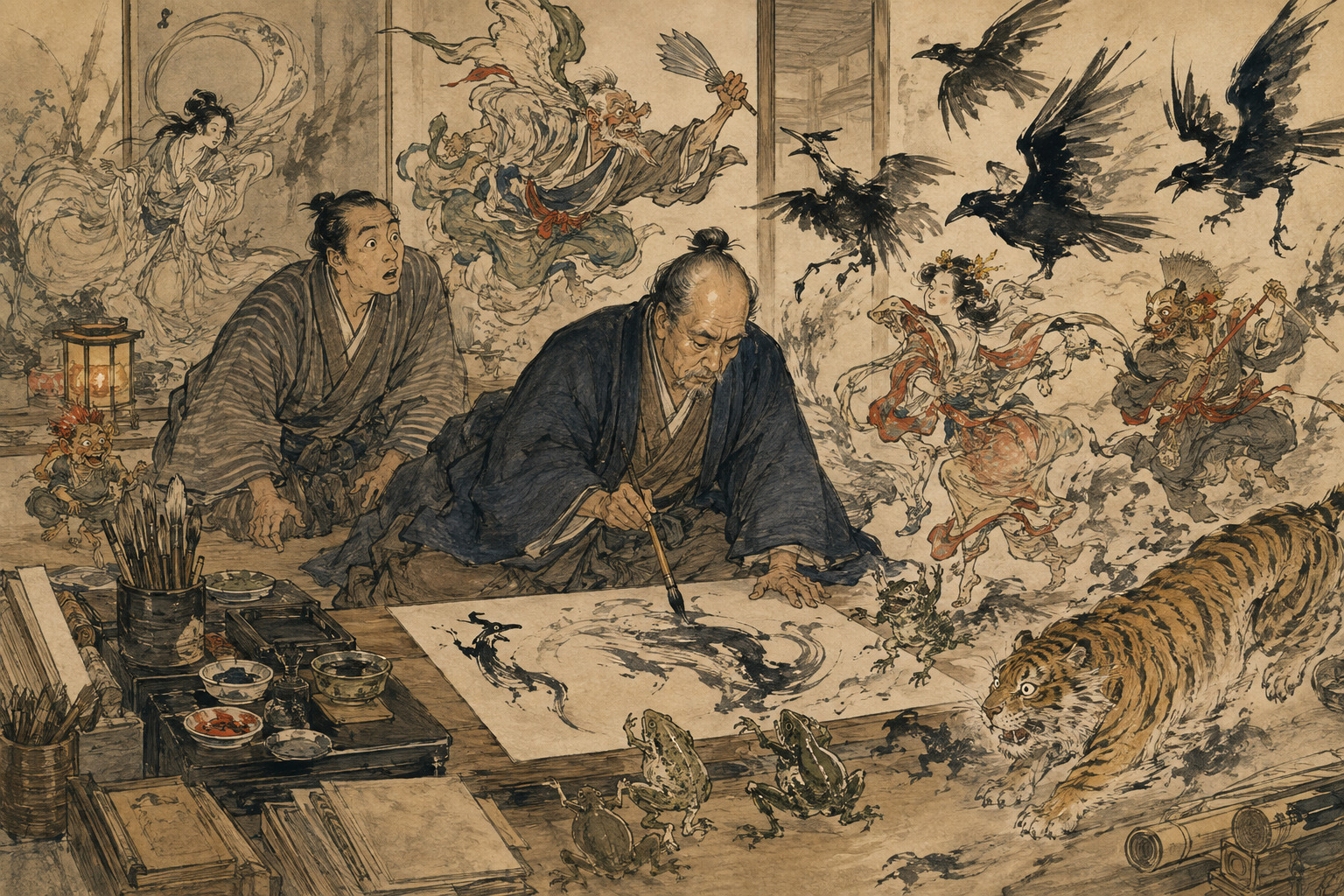
The astonishing thing about a Kawanabe Kyōsai line is not that it moves quickly. Many marks are quick. It is that the line appears to know what the creature is doing before the creature has fully arrived. A crow pitches its body into wind. A frog leans like a wrestler. A demon runs, drinks, boasts or suffers. A skeleton keeps time on a shamisen. One turn of ink can be anatomy, momentum and joke at once.
That is the “wild intelligence” of the brush: not uncontrolled expression, but knowledge released at speed. Kyōsai could work before an audience at a commercial painting-and-calligraphy party, yet he could also build a formal Buddhist or mythological picture with the discipline of the Kanō school. He could be delicate enough to suspend a swallow beside falling water and unruly enough to fill a screen with a night procession of supernatural beings. He did not choose between mastery and mischief. He made each sharpen the other.
The choice is unusually timely. Kyōsai’s World: The Israel Goldman Collection is now at Kobe City Museum through September 23, following its Tokyo opening and before an autumn stop in Shizuoka. The exhibition draws on a collection assembled over more than 40 years and presents about 110 paintings, prints, books, sketches and illustrated diaries. Organizers say more than 60 works in the touring project are being shown in Japan for the first time.
This is not an exhibition review; Japan.co.jp has not observed the installation or interviewed its curators. Works can rotate for conservation, and a work discussed here may not be on the wall on a particular day. The exhibition is our doorway, not our evidence of how the rooms feel. Beyond it, the Metropolitan Museum of Art and Japan’s National Diet Library offer a second doorway: digital access to Kyōsai’s demon book, now in the public domain.
The rebel first learned every rule
Kyōsai was born in 1831 in Koga, in what is now Ibaraki Prefecture, and moved with his family to Edo while very young. At around seven, he began learning from Utagawa Kuniyoshi, the ukiyo-e master famous for warriors, cats, caricature and scenes that could barely contain their own action. Even this early contact matters. Kuniyoshi treated popular print culture not as a lesser cousin of serious painting, but as a space where observation and imagination could collide.
Kyōsai then entered the Surugadai branch of the Kanō school. From about age 10, he trained for nine years under Maemura Tōwa and then Kanō Tōhaku Norinobu. The Kanō system carried centuries of workshop practice: controlled brushwork, copying exemplary models, command of Chinese-derived themes and the ability to organize a large surface with authority. At 19 he received the art name Tōiku, evidence that he had not merely visited the tradition. He had qualified within it.
That history corrects the easiest myth about him. Kyōsai was not an untaught eccentric who defeated academic art with personality. His freedom was expensive. It was purchased through years of repetition, correction and memory. Because he knew how a stable composition worked, he knew exactly where to make it tilt. Because he could describe a body, he could exaggerate one joint without losing the animal. Because he understood solemn images, he could place a joke inside their visual authority.
Kyōsai’s chaos is convincing because the bones are correct. The brush can misbehave only after the hand has learned what holds a world together.
| Source of discipline | What Kyōsai made it do |
|---|---|
| Ukiyo-e and Kuniyoshi popular subjects, print design, action, animals and humor | He brought the pressure of the present—fashion, foreigners, social absurdity and political unease—into pictures. |
| Surugadai Kanō copying, formal composition, ink control and classical themes | He could make finished religious and historical paintings, then destabilize academic order from within. |
| Direct observation animals, bodies, faces and daily work | A few marks could carry weight, balance, reflex and character. |
| Public performance painting before paying audiences at shogakai | Speed became a professional language: risk visible in real time, supported by deep rehearsal. |
A new name after the state looked back
When he became independent around 1857, the artist used the name Kyōsai written 狂斎—roughly, “crazy studio,” sharing the character kyō with kyōga, comic or satirical pictures. The name was not a diagnosis. It was an artistic position, a claim to license, comic intensity and deviation from polite limits.
Those limits were political as well as aesthetic. In 1870, at a shogakai gathering where artists made work for customers, an intoxicated Kyōsai painted images authorities judged objectionable. He was arrested and imprisoned. Accounts of precisely what he drew and how often he ran afoul of officials vary, especially in later retellings. The secure core is narrower: the arrest happened, it was connected to caricature at the gathering, and after his release he used the name 暁斎, pronounced the same way but replacing “crazy” with a character associated with dawn or enlightenment.
The change is often presented as a taming. His later work argues otherwise. The state had taught him that a comic picture could be read as action. He continued making satire, topical prints and grotesque comedy; he simply did it as an artist whose range and reputation were expanding. From around 1863, his satirical print designs had already begun pulling the stable geometry of Kanō composition into the turbulence of contemporary life. Meiji modernization gave him more material: Western clothes, schools, trains, new professions, new hierarchies and the spectacle of people performing adaptation.
Satire did not require a politician’s portrait. A long nose could make vanity visible. Skeletons could reveal appetites that remained “in the bones.” Animals could stage the crowd. Supernatural creatures could attend school, stumble into modern systems or imitate the human beings who had supposedly outgrown them. Displacement was protection and power: by giving the action to a frog or demon, Kyōsai made the human behavior easier to see.
1831 — Born in Koga, Shimōsa Province; the family soon moves to Edo.
About 1837 — Begins lessons with Utagawa Kuniyoshi.
About 1840–49 — Trains in the Surugadai Kanō school; receives the name Tōiku.
About 1857 — Works independently and adopts “Kyōsai” written 狂斎.
1870 — Arrested after caricatures made at a painting-and-calligraphy gathering.
From 1871 — Uses 暁斎, the familiar form of his name today.
1881 — Crow on a Withered Branch wins the highest painting award at the Second Domestic Industrial Exposition.
1889 — Dies in Tokyo; the demon book associated with him appears posthumously.
The animal is observed before it becomes an actor
Kyōsai’s animals are funny because they are first alive. A frog’s squat center of gravity makes its borrowed human pose persuasive. A cat’s spine retains feline elasticity even when the creature turns monstrous. A crow is not a black symbol pasted onto a branch; it has claws, balance and a wary distribution of weight.
The Metropolitan Museum’s long handscroll Sketches of Birds and Animals, made before 1870, offers an anatomy of this intelligence. The rapidly rendered studies were probably models for students. Across more than five meters, line tests posture and motion. Their brevity is not vagueness. It is selection: which contour makes the beak turn, which dark patch gives the torso mass, which pause around the ink allows air to move.
Frogs and crows became signatures. Exhibition research repeats a family tradition that the first subject Kyōsai drew, at the age of three, was a frog. Whether remembered exactly or shaped into a fitting origin story, the persistence of frogs is visible. They shoot targets, carry lanterns, make music and parody sumo. They also connect him to the classical Scrolls of Frolicking Animals, where species become human society without losing their bodies.
The crow brought another kind of recognition. In 1881, Crow on a Withered Branch won the top award in the painting section of the Second Domestic Industrial Exposition. The asking price of 100 yen—reported as roughly ten times his ordinary market price—was paid. Afterward, the crow was not only a subject. It became a brand of virtuosity, requested because the public already knew what a Kyōsai crow promised.
That success complicates the romantic image of the wild outsider. Kyōsai was popular, commercially responsive and deeply networked. He made paintings for collectors, prints and book illustrations for reproduction, fan designs for use, religious images for patrons and rapid works at gatherings. Wildness was not outside the market. It was one of the things the market purchased.
One hundred demons—and no fixed border between object and life
Kyōsai’s Pictures of One Hundred Demons is an accordion-fold woodblock book meant to be read from right to left. The Metropolitan Museum dates its copy to 1890, a year after Kyōsai’s death, and identifies it as one of several editions of a popular work. The pages gather a nocturnal procession of supernatural creatures drawn from premodern folklore. The Met makes the object record and public-domain images available for unrestricted use.
The title participates in the long visual tradition of hyakki yagyō, the “night procession of one hundred demons.” The hundred need not operate as an audited head count. It means profusion: a world overfull with beings that ordinary daylight does not admit. Tools, vessels, musical instruments, animals, bones and impossible composites gain agency. Human categories fail after dark.
Kyōsai did not merely repeat an inherited parade. The National Diet Library notes that his procession moves in the opposite direction from older models and inserts passages that resemble a confrontation between skeletons and yōkai. Reversal turns quotation into action. The book remembers a tradition while making it misbehave.
Look carefully and the demons are not a single moral category. Some threaten. Others hurry, quarrel, perform or make fools of themselves. In Kyōsai’s wider work, oni may be hell’s jailers, attendants of Buddhist figures, forces expelled in ritual, followers of wind and thunder gods, drinkers or victims of the demon-queller Shōki. Many are comic and oddly sympathetic.
This sympathy has a personal edge. His Kanō teacher Maemura Tōwa reportedly called the young prodigy gaki—a “demon of painting,” with a punning echo of “kid.” Kyōsai’s fondness for drink was also folded into his demon imagery. The demon was not simply an enemy outside civilization. It was appetite, talent, embarrassment and energy inside the artist and audience.
In Kyōsai’s hands, a demon is a diagnostic instrument. It reveals what a person wants, fears, represses or pretends not to be.
- Begin at the right and move left, respecting the accordion book’s sequence.
- Track direction: Kyōsai deliberately alters the inherited movement of the procession.
- Watch objects become bodies—handles, cords, lids and tools turn into limbs and faces.
- Do not ask only “What creature is this?” Ask what human behavior the creature performs.
- Notice rhythm across folds: clusters compress, gaps release, and the parade becomes visual music.
The sacred and the ridiculous share a brush
Reducing Kyōsai to monsters and jokes misses half his power. He painted Kannon, Daruma, Monju, Shōki, the Seven Lucky Gods, historical figures and episodes from the life of the Buddha. Around 1879 he became a Buddhist disciple at Reiunji temple and used the Buddhist name Jokū alongside his other art names. The Met’s Shakyamuni Subjugating Demons, from around 1888, presents a serious religious subject while altering conventional details with a flaming dragon, cave setting and changed gesture.
For Kyōsai, reverence and parody were not mutually exclusive media. A deity could function as an icon in one work and behave with secular comedy in another. The Kanō tradition itself contained playful images of Buddhist and Daoist figures; Kyōsai extended that permission into the modern street. He could know a symbol’s ritual force and still test its social life.
This doubleness explains why his demons feel substantial. A painter who does not take the sacred seriously can produce only costume. Kyōsai understood the visual authority of Buddhist narrative, protective figures and hell imagery. Comedy gains force by rubbing against belief, not by floating free of it.
Painting as an event, not just an object
Kyōsai was renowned for seki-ga, pictures made on the spot, and frequently appeared at shogakai, commercial gatherings where visitors paid an entrance fee and requested painting or calligraphy from participating artists. His illustrated diaries record these events, private sessions, work at home and painting at the house of his close pupil Josiah Conder.
The modern temptation is to call this “content creation” and stop thinking. The more revealing comparison is live music. A public painting asks the hand to reveal time. The audience sees the irreversible decision: a wet stroke cannot be argued backward. Speed produces suspense because craft is exposed to failure.
Yet apparent spontaneity can conceal labor. The student models, copied traditions and repeated subjects were the rehearsal. Kyōsai had stored thousands of decisions in muscle and memory. When he painted quickly, he was not inventing every beak, robe fold or claw from nothing. He was recombining a visual vocabulary under pressure.
That distinction matters now, when speed is too easily confused with shallowness. A fast result can be empty, or it can be compressed expertise. Kyōsai gives us a test: does the mark merely arrive quickly, or does it carry structure, memory, risk and a specific observation that could not be swapped for any other?
The architect who became the student
Josiah Conder arrived in Japan in 1877 to teach architecture at the Imperial College of Engineering. He would help shape Meiji institutional architecture and train a generation of Japanese architects. But the direction of instruction reversed when he studied painting with Kyōsai. The British Museum holds an owl painted by Conder in Kyōsai’s style and dates it to 1884–89.
Conder became student, friend, patron and biographer. He was present when Kyōsai died in 1889, and in 1911 published Paintings and Studies by Kawanabe Kyosai. That record helped construct the artist’s reputation abroad. Other foreign residents and visitors collected him; the physician William Anderson’s large collection, acquired by the British Museum in 1881, brought many Kyōsai sketches into a national institution while the artist was still alive.
The story is not simply “the West discovered a forgotten Japanese genius.” Kyōsai was already popular and institutionally honored in Japan. International exhibitions in Vienna in 1873 and Paris in 1883 expanded his visibility. Foreign collectors selected particular Kyōsais—often the eccentric, demonic and rapid—and their tastes helped shape what later audiences saw.
The 2026 Goldman exhibition is part of that afterlife. A London collection travels back through Japanese museums, with more than half the touring group reportedly new to exhibition audiences in Japan. Circulation can restore access while reminding us that reputation is made by collectors, markets, museums, catalogues and digitization—not only by the dead artist’s intentions.
Why Kyōsai belongs to this morning’s news
Today’s edition is full of events that occur too quickly for a static description. Kazuyoshi Miura, 59, finds scoring space inside younger bodies and a long football history. Kotaro Kiyomiya meets a 157-kilometer-per-hour pitch in an extra inning when recognition and movement must become one. RIKEN researchers trace the brain’s response to an unexpected sound—a signal defined by the difference between prediction and arrival. At Sado’s Earth Celebration, taiko converts trained movement into pressure, timing and collective attention.
Kyōsai is not an illustration service for those stories. The connection is formal. His brush also lives at the threshold between anticipation and event. The crow must already be balancing in the painter’s understanding before the ink commits it. A demon parade works because every instability is placed. The viewer experiences surprise; the artist has built the conditions for it.
That is why his style can connect a football record, a walk-off hit, a neural prediction error and a harbor drum without making them look the same. The common subject is intelligence under pressure: a system trained deeply enough to respond before conscious explanation catches up.
How to look without turning “eccentric” into an excuse
Museum descriptions often call Kyōsai eccentric, and the word is not wrong. It becomes weak when it substitutes for analysis. “Eccentric” can turn a working artist into a charming exception—drunk, demonic, ungovernable—while his education, business practice, patrons, collaborators and careful finished paintings disappear.
Try a stricter sequence. First, locate the line that bears the most weight. Second, ask what the empty paper contributes. Third, identify whether the body could actually balance. Fourth, find the inherited form: Kanō composition, Buddhist icon, folk monster, animal-scroll precedent, ukiyo-e actor or topical print. Only then ask where Kyōsai breaks the rule.
The method reveals that delicacy and chaos are not opposites. A swallow near a waterfall and a riot of demons both depend on calibrated intervals. The sparse picture makes a few marks carry more pressure; the crowded picture makes many marks remain legible. In each, intelligence is spatial.
It also prevents satire from becoming a hunt for one-to-one codes. Not every frog is a named official and not every monster is a policy statement. Comic art can expose a structure of behavior—vanity, appetite, imitation, cowardice—without assigning each creature a single real-world identity. Ambiguity helped satire survive, and it keeps the image active after its immediate controversy has faded.
The afterlife of a moving hand
Kyōsai’s legacy was carried by people as well as objects. His daughter Kawanabe Kyōsui became an accomplished painter and authenticated work by her father. The Kawanabe Kyōsai Memorial Museum opened in Warabi, Saitama, in 1977, preserving material held through the family. Conder’s book preserved the viewpoint of a student. Museums in Japan, Britain and the United States conserved paintings, prints, books and drawings under different collection histories.
Digital public-domain access now changes the scale again. The Met’s demon book can be moved through page by page from anywhere. The National Diet Library’s image bank highlights the reversals and confrontations inside its copy. This does not replace the object: screen light cannot reproduce the paper, binding, printed color or pace of opening folds. But it permits close, repeated looking once reserved for owners and specialists.
There is an ethical distinction between access and style. Public-domain images may be legally reusable, but Kyōsai’s work should not be reduced to a bag of crows, demons and scratchy lines. The interesting inheritance is not surface imitation. It is his method: observe until the body is understood, study traditions until their authority is felt, then introduce enough disorder to make the present visible.
The wild brush is not the hand doing whatever it wants. It is the hand that has learned enough to know which rule can be broken—and what new life the break will release.
The last creature is the viewer
In the demon procession, everything unstable has been given legs. In the animal pictures, human behavior returns wearing fur, feathers or wet amphibian skin. In the sacred works, solemnity and humor exchange places without canceling each other. Kyōsai’s world is crowded because identity is never completely secure.
The viewer enters that instability. We laugh at the boastful tengu and recognize our own vanity. We admire the drunk demon and meet appetite made visible. We call the skeleton grotesque, then notice it is the best musician in the room. The joke travels outward and comes back.
This is why the brush still feels intelligent rather than merely skillful. It does not only describe a crow or monster. It predicts our response, gives us the pleasure of superiority, then shifts the ground beneath it. The chaos is controlled. The control is alive. And somewhere inside the line, Kyōsai is still faster than the person looking.
- Kobe City Museum — current 2026 Goldman Collection exhibition
- City of Kobe — dates and overview for Kyōsai’s World
- Suntory Museum of Art — touring exhibition overview, scale and itinerary
- Suntory Museum of Art — exhibition research on training, beasts, people, demons, divinities and prints
- Suntory Museum of Art — Kyōsai’s circle, Josiah Conder and illustrated diaries
- National Diet Library — official biographical record
- Metropolitan Museum of Art — Kyōsai’s Pictures of One Hundred Demons, 1890, public domain
- Metropolitan Museum of Art — alternate copy and edition history of the demon book
- National Diet Library Image Bank — direction and added confrontation in Kyōsai Hyakki Gadan
- National Diet Library Image Bank — animals in Kyōsai Rakuga
- Metropolitan Museum of Art — Sketches of Birds and Animals
- Metropolitan Museum of Art — Buffalo and Herdsman and Kyōsai’s Kanō training
- Metropolitan Museum of Art — Shakyamuni Subjugating Demons
- Metropolitan Museum of Art — Tanuki Viewing Its Reflection and late international reception
- British Museum — demons before Enma, from William Anderson’s collection
- British Museum — frogs, rabbit and monkey parodying sumo
- British Museum — Josiah Conder’s owl in Kyōsai’s style
- British Museum — Josiah Conder biography and study with Kyōsai
- Kawanabe Kyōsai Memorial Museum — family museum in Warabi
Editorial note: This article is based on museum records, exhibition research and digitized collections. It contains no independent interview or on-site review of the Kobe installation. The exhibition includes changes of display, so readers should check the museum’s current list before visiting. Accounts of Kyōsai’s childhood and the exact imagery or punishment connected to his 1870 arrest differ across retellings; the article labels tradition as tradition and uses the narrow facts supported by museum sources. The hero is a new editorial illustration, not a historical document or a Kyōsai original. The Met identifies the linked demon-album images as public domain. The exchange-rate strip is an editorial reference unrelated to the art.