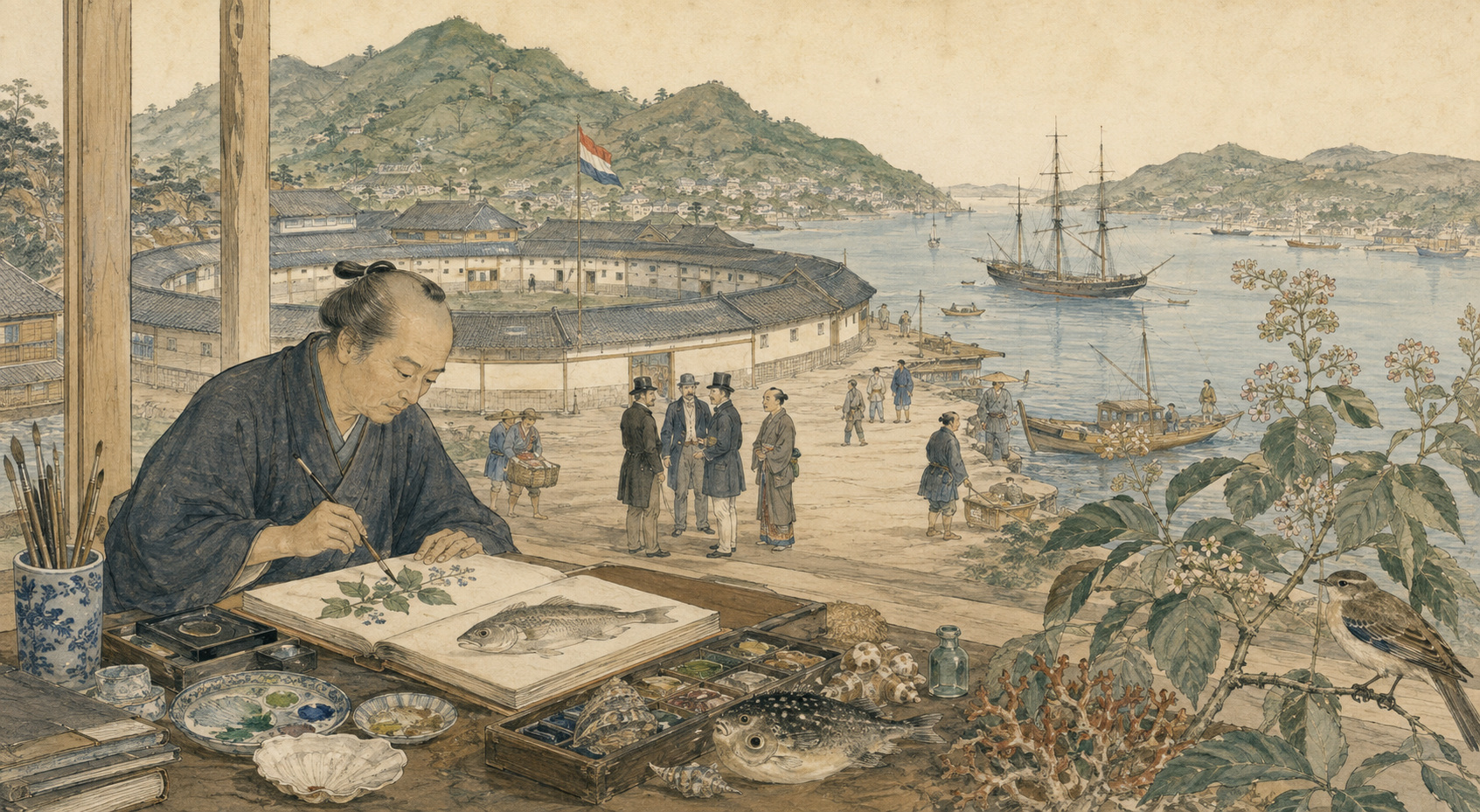
Begin with the bridge. It is narrow enough to understand at a glance: on one side, the streets and hills of Nagasaki; on the other, a fan of made land edged by water, warehouses and a wall. Goods can cross. Interpreters can cross. Officials, cooks, carpenters, courtesans and a specially authorized painter can cross. Most people cannot. The geometry is simple because control is the point.
In Kawahara Keiga’s views of Dejima, the eye often travels more freely than a body could. It rises above roofs, looks through courtyards and follows the harbor toward islands and distant mountains. The painting turns a restricted compound into legible space. One can identify gates, storehouses, boats, tables and human tasks. Yet the very fluency of that view is a warning. Keiga did not merely copy the world in front of him. He organized it.
That organizing intelligence is why his work survives as more than picturesque evidence of “old Japan.” Keiga served patrons at the Dutch trading post, worked with European naturalists, absorbed techniques of linear perspective and helped convert local plants and animals into portable scientific knowledge. He painted a city in which Japanese, Chinese, Dutch, German, Javanese and other lives met under unequal conditions. His work is beautiful because it is exacting. It is historically important because its exactness was never innocent.
How to look at today’s choice
Keiga rewards a slow, investigative look. First trace the horizon. In a large harbor panorama it may appear natural, but the artist uses it to hold together an enormous inventory: sea lanes, mountains, roofs, masts and weather. Then inspect the line. Buildings are not softened into atmosphere. Eaves, screens and hulls keep their identities. Color is often clear and thin enough to preserve the drawing beneath it.
Next, look for work. A Keiga scene is rarely empty architecture. Boatmen strain on towlines. Porters move cargo. Servants prepare food. Officials supervise. Interpreters mediate. In the celebrated scrolls now held by the Nagasaki Museum of History and Culture, trade becomes a sequence: a ship arrives, goods are unloaded and weighed, merchants bid, animals are tended, a banquet is served, billiards are played, the ship departs. The image is not a frozen view so much as an operating system rendered in episodes.
Finally, look for control. The single bridge, sea gate, fences, guard points and bounded compounds tell the political story. Then ask what has moved to the center and what has been pushed aside. Wereldmuseum Leiden notes that on Keiga’s unique folding screen, Dejima is placed more centrally than strict geography would require—probably to emphasize it for a likely Dutch commissioner. Perspective creates plausibility; composition creates importance.
- Trace the routes: bridge, gates, ships, towboats and paths show who and what can circulate.
- Count the workers: named officials are only one layer of a world sustained by boatmen, porters, cooks, interpreters, servants, artisans and women.
- Test the perspective: what is enlarged, centered or made unusually visible?
- Read the materials: Japanese brush line, mineral and organic color, silk or paper, and Western-derived shading or perspective coexist.
- Notice the absences: an accurate-looking view can still minimize Chinese trade, colonial labor, surveillance or the identity of its commissioner.
A fan-shaped island made for control
Dejima was completed in 1636 with money from twenty-five leading Nagasaki merchants. It was built first to confine Portuguese residents amid the Tokugawa government’s escalating suppression of Christianity. The Portuguese were expelled in 1639. In 1641, the Dutch East India Company’s factory was transferred from Hirado to the vacant island. The Dutch could trade, but their movements, religious practices, cargo and information were tightly watched.
The island’s small scale made supervision architectural. A single stone bridge connected it to the city. Japanese officials and interpreters managed contact. Christian objects and public worship were prohibited. Ships were inspected; cargo passed through controlled gates. Foreign residents experienced the post as both an opening and a confinement. To the shogunate, that was not a contradiction. Dejima was designed to admit useful commerce and knowledge while limiting religious and political danger.
“Japan’s only window to the West” is accurate if “West” is kept in the sentence. It becomes false when shortened to “Japan’s only window.” Early modern Japan maintained other structured relations: Chinese commerce at Nagasaki; diplomacy and trade with Korea through Tsushima; relations with the Ryukyu Kingdom through Satsuma; and trade and political relations with Ainu communities through Matsumae. Historian Arano Yasunori’s “four portals” framework replaces the image of a hermetically sealed country with a system of regulated gateways.
| Portal | Principal connection | What it corrects in the old “closed country” image |
|---|---|---|
| Nagasaki | Chinese and Dutch commerce; interpreters, books, medicine, commodities and world reports | Dejima was the Western post, but Chinese trade was a larger and older presence in the port. |
| Tsushima | Diplomatic and commercial relations with Korea | Foreign relations included formal East Asian diplomacy, not only European trade. |
| Satsuma–Ryukyu | Relations with the Ryukyu Kingdom and routes extending toward China | The southern islands linked political worlds that modern national borders can obscure. |
| Matsumae–Ezo | Trade and unequal political relations with Ainu communities | The northern portal exposes internal expansion and Indigenous history as part of “foreign” relations. |
Keiga’s Dejima therefore depicts something more precise than isolation or openness. It depicts filtration. Books, sugar, textiles, glass, medicines, copper, porcelain, reports and people moved through channels whose narrowness gave authorities leverage. The bridge is not just a charming visual motif. It is policy made visible.
The painter who was allowed to cross
Keiga was born in Nagasaki in 1786, the son of a painter. He is understood to have studied under Ishizaki Yūshi, one of the city’s leading painters in a milieu receptive to Chinese and Western visual ideas. Nagasaki did not produce a single “school” in the tidy academic sense. Its painters encountered Ōbaku Buddhist art, Chinese bird-and-flower painting, literati traditions, local popular prints and European pictures arriving through the port. Hybrid sight was ordinary there before it became a label in an art-history textbook.
In 1811, Nagasaki authorities appointed Keiga the designated painter for Dejima. The privilege was exceptional. Aside from people whose trades required entry—officials, interpreters and service workers—few local residents could move inside the compound. Keiga’s access became his artistic capital. Dutch residents unable to travel freely wanted pictures of Japanese landscapes, customs, ceremonies and occupations. Japanese customers, in turn, were curious about the foreign lives behind the gate.
The result was a two-way theater of looking. Keiga painted Dutchmen dining, smoking, playing billiards and watching ships. He made views of childbirth, marriage, funerals, festivals and crafts for foreign patrons seeking a visual encyclopedia of Japan. Neither side saw the other without expectation. The customers wanted types, systems and recognizable difference. Keiga answered with specificity, but also with repeatable subjects that could circulate.
Japanese line, European space
It is tempting to describe Keiga as the artist who brought “Western realism” into Japanese painting. The phrase is too blunt. Japanese and Chinese painting traditions already possessed highly disciplined modes of observation. Keiga’s botanical line, seasonal sensitivity and handling of color did not disappear when he learned new spatial devices. What changed was the repertoire available to him.
Through Dejima, he encountered European pictures and worked with Carl Hubert de Villeneuve, a draftsman resident at the post from 1825 to 1836. Wereldmuseum research suggests that Keiga learned techniques such as locating a vanishing point outside the composition, enabling a broad scene to recede without forcing its center into a conspicuous tunnel. In some botanical drawings the collaboration became physical: Keiga worked in ink, De Villeneuve in pencil.
The exchange was not a simple handoff from European teacher to Japanese pupil. Keiga supplied knowledge De Villeneuve and other foreign patrons did not possess: how to hold the defining edge of a leaf, which parts of a fish established its identity, how local architecture joined, how seasonal life unfolded, and how to translate these things into a pictorial language Japanese makers could execute and foreign viewers could read.
His harbor views therefore feel both mapped and lived. Linear recession stabilizes the bays and streets, while Japanese brush contours keep individual forms distinct. In plant studies, a stem can be isolated against plain paper with the authority of a specimen and the rhythm of calligraphy. The work is not half Japanese and half European. It is a Nagasaki solution to a Nagasaki problem: how to make different visual systems useful to one another.
The Dutch flag is not the whole harbor
Dejima’s miniature scale and the bright Dutch flags in harbor views make it irresistible as a symbol. They can also distort Nagasaki’s history. The rectangular Chinese compound, Tōjin yashiki, stood elsewhere in the city; Chinese ships, merchants, temples, food, language and festivals were foundational to Nagasaki life. A Nagasaki City historical account records 117 Chinese ships entering in 1688, followed by roughly seventy to eighty in many years before the shogunate imposed a thirty-ship annual limit in 1715. Dutch traffic was generally much smaller and was restricted to two ships a year from 1715.
Keiga himself gives us a way past the imbalance. His paired scrolls of the Dutch Factory and the Chinese Quarter, now designated an Important Work of Art, devote ten scenes to each. The Chinese sequence includes arrival, unloading, the compound gate, courtesans entertaining residents, a dragon dance, a play, departure and the burning of a ship model for the dead. The Dutch sequence moves from arrival and auction to kitchen, banquet and billiard room. Put together, the scrolls describe not a bilateral Japan–Netherlands romance but a port built from multiple Asian and global routes.
Even the “Dutch” world was more than Dutch. Company ships reached Nagasaki through Batavia, today’s Jakarta. Some paintings include Southeast Asian servants. A work at the Metropolitan Museum, cautiously catalogued as “Attributed to Kawahara Keiga,” shows a Dutch official with a Javanese servant holding a parasol. The museum’s record connects the image to colonial dress made by Asian tailors and to the enslavement embedded in Dutch Asian networks. A graceful silhouette can carry a violent history.
This changes how the viewer counts figures. The official whose name survives is not necessarily the person who made the scene possible. A parasol, tray, rope or loaded boat can reveal the labor hierarchy more honestly than a title does. Visual memory becomes fuller when we stop treating background people as decoration.
Nature made portable
Keiga’s most consequential partnership began after Philipp Franz von Siebold arrived at Dejima in 1823 as the trading post’s physician. Siebold practiced medicine, taught Japanese students and pursued a vast program of collection. Plants, animals, seeds, maps, tools, household objects and observations were assembled into a material account of the archipelago. Accurate images were essential, especially when color faded, a specimen changed in preservation, or the object could not travel.
Keiga became one of the project’s central image-makers. He drew plants with leaves, buds, flowers, fruit and roots arranged to make a life cycle intelligible. He painted fish, birds, reptiles, crustaceans and mammals with attention to diagnostic structure. These sheets did not merely illustrate conclusions reached elsewhere. They preserved information from which comparison and classification could proceed.
The afterlife was enormous. Naturalis Biodiversity Center still holds Japanese fish collected by Siebold together with Keiga drawings; its image archive identifies Keiga’s Japanese drawings for Siebold as a special collection. Fauna Japonica, published in Leiden between 1833 and 1850, drew on Siebold and Heinrich Bürger’s collections and Keiga’s images. The five-volume series was the first European-language monographic treatment of Japanese zoology and introduced Japanese fauna to European readers on a large scale.
That circulation created knowledge and redistributed credit. European naturalists authored the taxonomic volumes; European institutions kept many specimens and drawings; Keiga’s labor often became the visual substrate beneath scientific names. It would be too simple to call the project theft: Japanese students, collectors, patients, officials and artists actively shaped it, and Keiga was a professional participant. It would be equally simple to narrate it as frictionless cooperation. Access, ownership, authorship and imperial networks were unequal.
- A local collector, fisher, student or patient identified and obtained a plant or animal.
- Japanese knowledge supplied habitat, season, use and vernacular naming.
- Keiga and collaborators converted the living form into a durable, portable image.
- Specimens and drawings traveled through Dejima and Batavia to Dutch collections.
- European naturalists compared, named and published them—often making the local chain of knowledge less visible.
Look again at a Keiga fish. Its isolated body is not lonely; it is crowded with relationships. It joins the fisher who knew the water, the artist who knew the body, the interpreter who moved between languages, the collector who commissioned the sheet, and the classifier who later printed a Latin name. Scientific illustration is a social object disguised as a solitary animal.
The 2,400-kilometer sketchbook
In 1826, Keiga accompanied the Dutch court mission and Siebold on the journey from Nagasaki to Edo. The route, partly by boat but mostly on foot, covered about 2,400 kilometers and lasted more than three months. The Dutch chief factor’s ceremonial visit to the shogun was an old obligation; for Keiga, the trip expanded his field of vision far beyond the port.
He recorded roads, inns, bridges, towns, Mount Fuji and people at work. The pictures converted travel into an ordered sequence, just as the Dejima scrolls converted trade into one. They also show the asymmetry of mobility. Europeans were famous for being confined, yet the official mission could cross the realm under surveillance. Most Japanese subjects never undertook such an extensive journey. Keiga’s exceptional access was again made possible by the institution that constrained it.
Travel also led toward danger. In 1828 authorities discovered sensitive maps and other geographic material in Siebold’s possession. The episode, remembered as the Siebold Incident, is often compressed into a spy story. Maps of Japan—especially northern territories—could indeed be treated as military and state information that was forbidden to leave. But scholarship also examines them as tools exchanged within networks of collaborative study. The legal consequences were unambiguous even if every participant’s intention was not: Siebold was expelled, and Keiga received a comparatively light prison sentence of three months for failing, in the authorities’ view, to guard adequately against the acquisition.
Wereldmuseum research connects a later punishment in 1842 to Keiga’s depiction of clan crests on patrol boats in Nagasaki Bay. The precision valued by patrons could become incriminating when the subject was strategic geography. A roofline was art; a harbor disposition might be intelligence. Keiga’s career makes the border between image and data visible because he repeatedly worked on that border.
Why “photographer without a camera” helps—and fails
Japan Museum SieboldHuis has called Keiga a “photographer without a camera.” The phrase captures his extraordinary descriptive range and the way modern viewers use his paintings as windows onto daily life before photography. It also risks hiding what paintings do.
A camera does not guarantee neutrality, but the metaphor encourages us to imagine an instantaneous witness. Keiga’s works were slower. They were commissioned, selected, composed and sometimes repeated. A broad panorama could alter an angle to improve legibility or satisfy a patron. A type of figure could descend from an earlier Nagasaki print. A plant might combine stages that never appeared on one stem at the same moment. That is not falsification. It is how an image turns observation into knowledge.
Museum labels provide another warning. The British Museum identifies an album leaf of two Dutchmen and a servant as painted by Keiga, but gives its date as uncertain and one sitter only as “possibly” Hendrik Doeff. The Metropolitan Museum says “attributed to” Keiga. Wereldmuseum describes more than five hundred works as by “Keiga and his studio.” These distinctions matter.
Like many productive artists, Keiga worked within practices of copying, models and assistance. “Keiga” can name an individual hand, a workshop and a recognizable visual system. Modern connoisseurship often wants a solitary genius and an autograph object. The archive answers with collaboration. Rather than diminishing the artist, that fact reveals how hundreds of pictures could meet the demand of merchants, naturalists and collectors.
A screen that moves an island
The four-and-a-half-meter folding screen acquired by Wereldmuseum in 2018 condenses these questions into one spectacular object. No other folding screen is currently known in Keiga’s oeuvre. It depicts Nagasaki Bay around 1836, including the Dutch vessel Marij & Hillegonda, Dejima and the Chinese compound. Its hybrid technique and panoramic scale make the harbor feel comprehensive.
Yet museum research found that Dejima’s angle and position are adjusted, moving the trading post toward the compositional center. The likely Dutch commissioner receives the harbor he expected to matter most. The Chinese compound remains present but easier to overlook. The painting is geographically informative and rhetorically arranged at the same time.
That is a useful model for every historical image. The question is not “document or art?” It is “what kind of document has this art become?” Keiga’s screen records architecture, shipping and terrain. It also records a patron’s horizon of importance. Its distortions are not noise to be removed from the evidence; they are evidence.
When Dejima disappeared
The historic island did not remain fixed after the Dutch factory closed in 1859. Port improvement, reclamation and the diversion of the Nakashima River altered its edges. By 1904, Dejima’s famous fan shape had disappeared into the city. The place survived as property lines, buried remains, records and memory rather than as an island one could recognize from Keiga’s panoramas.
Nagasaki City began acquiring land and planning restoration in the postwar period and launched a full-scale project in 1996. Reconstructed buildings now allow visitors to walk streets that were once controlled corridors. The city’s own restoration account is admirably instructive about method: a detailed model made by former chief factor Jan Cock Blomhoff was valuable, but its building heights were exaggerated, so researchers compared it with excavations, documents and surviving late-Edo and Meiji architecture. Restoration is not the enlargement of one old picture. It is an argument assembled from imperfect witnesses.
Keiga belongs in that evidentiary company. His images restore motion that archaeology cannot: a ship under tow, an auction, smoke from a kitchen, a game at a billiard table. Archaeology and models test his space; his paintings return people to it. Each source corrects the temptation created by the other.
1636 Dejima completed to confine Portuguese residents.
1641 Dutch East India Company trading post moves from Hirado to Dejima.
1786 Kawahara Keiga born in Nagasaki.
1811 Appointed designated painter for Dejima.
1823 Philipp Franz von Siebold arrives; Keiga’s natural-history work intensifies.
1826 Keiga joins the long court journey to Edo.
1828–29 Siebold Incident; Siebold is expelled and Keiga is briefly imprisoned.
c. 1836 Monumental Nagasaki Bay folding screen records—and rearranges—the port.
1859 Dutch factory closes; Dejima’s exclusive role ends.
1904 Harbor works erase the island’s fan-shaped outline.
1996 Nagasaki begins full-scale restoration.
2018 Wereldmuseum acquires Keiga’s previously unknown folding screen.
Visual memory, on August 9
On August 9, Nagasaki is rightly named around the world above all as the city devastated by an atomic bomb in 1945. No earlier beauty balances that catastrophe, and no harbor panorama should be asked to. But historical memory becomes thinner when a city is reduced to the day of its destruction.
Keiga restores another Nagasaki: not an innocent city, but a working one. It is a port of coercive religious policy and remarkable intellectual exchange; of Chinese merchants and Dutch officials; of Japanese interpreters, women, artisans and laborers; of colonial routes through Southeast Asia; of curiosity disciplined by checkpoints. The contradiction is the history.
His paintings also resist the idea that contact began when Western gunboats “opened” Japan. Long before 1853, people in Nagasaki were translating books, treating patients, examining specimens, bargaining over silk and sugar, learning one another’s visual habits and worrying about what information crossed the bridge. The world was already present. It was unevenly admitted and intensely managed.
This is why Keiga belongs at the close of an August 9 edition. Visual memory is not a substitute for testimony, archaeology or archives. It is one way a city exceeds the event by which outsiders know it. Keiga’s line carries roofs, fish scales, towropes and human gestures across two centuries. We should accept the gift without mistaking it for an unframed view.
Return, then, to the bridge. In the painting it is a short stroke between city and island. Historically it is a machine for sorting bodies, goods and knowledge. Artistically it is the line that makes the whole composition intelligible. Keiga stood among the few permitted to cross it. What he brought back was not a photograph of Nagasaki, but something more demanding: a visual memory precise enough to study, beautiful enough to trust—and composed enough that we must keep asking why.
Research note and principal sources
This historical art feature draws on museum collection records, official Dejima histories, natural-history archives and scholarship available by August 8, 2026. Dates and attributions follow the caution used by the holding institutions. “Keiga” should not be assumed to mean an autograph work unless the cited catalog says so.
- Nagasaki Museum of History and Culture: collection highlights, including Keiga’s Dutch Factory and Chinese Quarter scrolls
- Nagasaki Museum of History and Culture: Nagasaki Yugaku list of works and scroll descriptions
- Wereldmuseum Leiden: Kawahara Keiga—documenting Japan’s nature and culture
- Wereldmuseum Leiden: research and restoration of the Keiga folding screen
- Wereldmuseum Leiden: Dejima’s placement in the folding-screen composition
- Japan Museum SieboldHuis: “Kawahara Keiga, photographer without a camera”
- British Museum: Keiga album leaf of Dutchmen and a servant
- Metropolitan Museum of Art: Dutchman with a Servant, attributed to Keiga
- Naturalis Biodiversity Center: Siebold’s Japanese fish collection and Keiga drawings
- Naturalis: archive and image collection, including Keiga drawings for Siebold
- Biodiversity Heritage Library: Keiga’s drawings and Fauna Japonica
- artscape Japan: the botanical illustrations of Kawahara Keiga
- Official Dejima site: history of the island and trading post
- Official Dejima site: restoration research and plans
- National Diet Library Newsletter: Dejima’s construction, dimensions and controlled life
- Nagasaki City: Nagasaki—International Trading Port
- Arano Yasunori: foreign relations in early modern Japan and the “four portals” framework
- International Institute for Asian Studies: a user-centered reinterpretation of the Siebold Incident