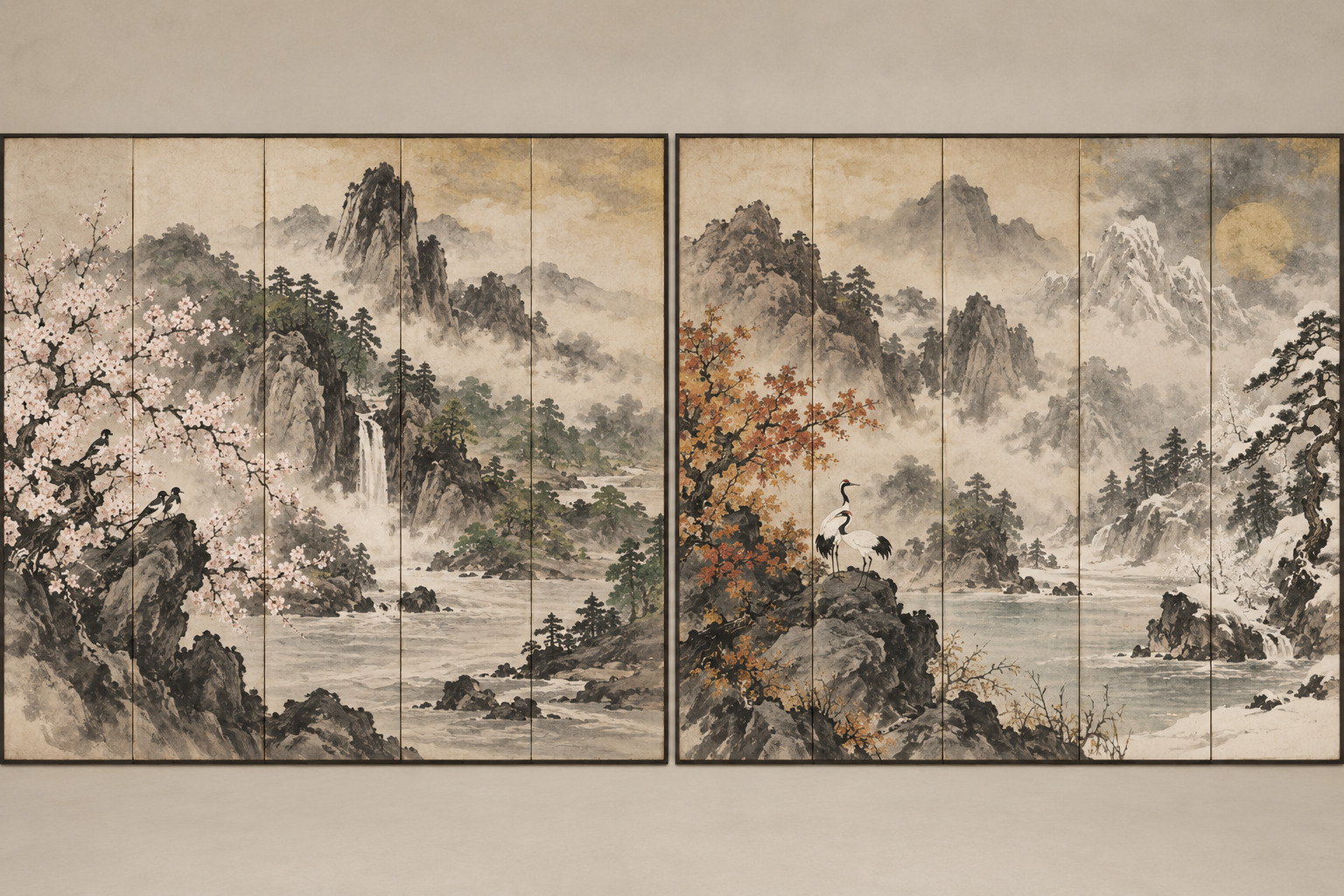
The eye enters among flowers at the right and travels toward water, birds and pale mountains at the left. Rocks and plants hold the foreground. A wide waterscape relaxes the middle distance. Beyond it, ridges rise through mist. No border declares that spring has ended and summer begun. The seasons pass because blossoms, foliage and avian behavior gradually change across six sheets of folded paper.
The Cleveland Museum of Art dates Birds and Flowers in a Landscape of the Four Seasons to the second half of the sixteenth century. It is one six-panel folding screen—not a surviving pair—painted in ink and color on paper. The image alone extends almost 3.6 meters; with its mounting, the object is more than 3.74 meters wide. It is not a window hanging on a wall. It is a landscape capable of standing inside a room.[1]
Beside today’s Gifu exhibition of modern and contemporary screens, the work reveals both the age and flexibility of the format. A screen stands because it folds; those same folds change reflected light, compress distance and make the image respond when the viewer moves. The “movable architecture” used by twentieth- and twenty-first-century artists in Gifu already operates here, joining birds, plants and land into a single ecology.
Sesshū’s name, another artist’s hand
The authorship must come first. Although the name “Sesshū” appears on the screen, the Cleveland museum does not accept it as a work by Sesshū Tōyō (雪舟等楊, 1420–1506?). Its catalog assigns the painting to an accomplished but unidentified follower active around the middle of the sixteenth century. A famous name on a premodern picture is evidence to interpret, not an automatic modern certificate of individual authorship.[1]
That distinction does not diminish the painting. It changes the question from “What did Sesshū paint?” to “How did Sesshū’s authority travel?” Born in Bitchū Province, in present-day Okayama Prefecture, Sesshū trained in Kyoto’s Zen world and later moved west to Yamaguchi. Under the patronage of the Ōuchi lords, he sailed to Ming China in 1467 and returned about two years later. He absorbed Chinese techniques, subjects, materials and formats, then established a forceful, structurally rigorous language of ink painting that reshaped later Japanese practice.[2][3]
Influence does not spread through exact repetition. Students and followers adapt a master’s visual vocabulary to new patrons, buildings and tastes. The Cleveland painter inherited the large bird-and-flower landscape associated with Sesshū, but tuned it toward a notably peaceful society of birds.
The screen is not most interesting as a failed claim to authenticity. It is evidence that one artist’s name had become a cultural force capable of organizing work across generations.
Spring to winter on a single screen
According to the museum, flowering plants indicating the seasons unfold from right to left. Peonies and irises occupy the right side; lotus leaves, white blossoms and reeds rise near the water toward the left. Birds, often paired, feed, perch, fly and attend to one another. Their modest activities prevent the seasonal program from feeling like a diagram. A broad middle-ground waterscape carries the eye toward distant mountains.[1]
The four seasons are not four boxes. There is no line where spring stops. One set of flowers yields to another while water and mist keep the landscape continuous. The eye’s right-to-left journey and the alternating mountain-and-valley folds supply the rhythm of time.
Bird-and-flower painting and landscape painting are equally inseparable. Plants and animals establish the near, bodily scale; water opens the middle distance; mountains close the world far away. A bird’s brief action and the land’s deep seasonal duration coexist. Nature is not presented as specimens on a neutral ground but constructed as a place that could be inhabited.
The hawks that are not there
The Cleveland museum singles out an absence: there are no birds of prey. Hawks, admired by samurai as emblems of ferocity and controlled strength, appear frequently in sixteenth-century screens by Kanō- and Soga-school painters. Here the birds are usually paired and absorbed in ordinary activity. Coexistence displaces predation; quiet replaces threat.[1]
A monumental screen in an elite residence did not need to advertise power only through aggression. Seasonal plants, paired birds and open water brought an ordered exterior world indoors. A person seated before it did not simply observe nature at a distance; the freestanding screen placed that person inside its imagined order.
The headline’s “golden world” is poetic, not a statement about materials. Neither the English title nor the museum’s medium—ink and color on paper—specifies a gold ground or gold leaf. The phrase describes the enveloping richness of the warm, misted landscape; it should not be read as a technical attribution.
The many screens called “Sesshū”
This is not the only four-seasons bird-and-flower screen associated with Sesshū. Japan’s National Institutes for Cultural Heritage says more than ten such works survive with traditional Sesshū attributions. Their brushwork and structures differ, and most are thought to have been made by the generation of his followers. In the Important Cultural Property at the Tokyo National Museum, a comparatively flat foreground and a dominant plum tree on the left screen signal a transformation leading toward Momoyama-period architectural painting.[4]
The Important Cultural Property at the Kyoto National Museum occupies a different position. That museum describes it as the only work among the group it regards as painted by Sesshū himself. Massive pine and plum trees organize the pair of six-panel screens, while seasonal plants and birds interlock around them. Bent trunks and assertively rendered birds create a tension quite unlike Cleveland’s peace. The museum points to the probable effect of Ming bird-and-flower painting, while explicitly noting that a tradition dating the work to a 1483 succession celebration for Masuda Munekane lacks confirmation.[5]
The comparison makes “Sesshū style” less fixed, not more. Some works use giant trees as structural bones; some push flora and birds against the picture plane; others open water and mountains into depth. Scholars compare inscriptions, brushwork, composition and provenance to rebuild the group one object at a time. “Anonymous follower” is not a void where knowledge failed. It is a considered conclusion.
| Cleveland screen | Major “Sesshū” screens in Japan |
|---|---|
| Anonymous follower; second half of the 1500s; one six-panel screen; ink and color on paper; peaceful paired birds; no raptors; broad water and distant mountains | The Tokyo National Museum work is a pair of six-panel screens and is generally placed in the followers’ generation. The Kyoto National Museum work is also a pair and is regarded by that museum as Sesshū’s own hand. Similar titles do not mean identical objects, dates, configurations or attributions. |
A screen crosses an ocean; a museum opens the image
The documented provenance begins with D. Konoike in Osaka. It later belonged to Helen Wade Greene Perry, who gave it to the Cleveland Museum of Art in 1960. The work is not currently displayed, so a trip to Cleveland does not guarantee an encounter with the physical screen.[1]
Digitally, however, it is unusually accessible. Cleveland marks the object for open access and says users may copy, modify and distribute it without asking permission. The museum applies Creative Commons Zero to eligible high-resolution images and collection data, permitting reuse in education, scholarship, publishing, art and commercial projects. Attribution is not legally required under CC0, although naming the work, museum and accession number remains good editorial practice.[6]
A folding screen that once crossed the Pacific can now unfold as data everywhere. But freedom to reuse an image is not freedom to simplify its history. Calling it “a Sesshū” may be convenient; doing so erases the most revealing part of the object. An unknown painter inherited the master’s name and compositional intelligence, then produced a different calm. Preserving that distance is how a five-hundred-year-old act of creation remains alive rather than merely famous.
- Cleveland Museum of Art, Birds and Flowers in a Landscape of the Four Seasons — attribution, date, medium, measurements, description, provenance and display status.
- Yamaguchi Prefectural Art Museum, The Trip to Sesshū — Sesshū’s origins, Kyoto and Yamaguchi years, Ōuchi patronage, Ming journey and style.
- Cultural Heritage Online, Autumn and Winter Landscapes — Sesshū’s learning, constructive space and later influence.
- e-Museum, Birds and Flowers of the Four Seasons — the group of traditional attributions, follower-generation assessment and transition toward Momoyama architectural painting.
- Kyoto National Museum, Birds and Flowers of the Four Seasons — authorship assessment, format, medium, Ming influence and caution about the 1483 tradition.
- Cleveland Museum of Art, Open Access — CC0 scope and reuse terms.
Editorial note: “Golden world” is poetic headline language; the museum records ink and color on paper, not a gold ground or gold leaf. The object is one six-panel screen, not a pair. The museum dates it broadly to the second half of the 1500s and identifies the artist as a follower of Sesshū, despite the name “Sesshū” on the work. Its period label, “Muromachi period (1392–1573),” does not cover the full possible 1550–99 date range; that metadata tension is preserved in the accompanying editorial notes rather than silently resolved.