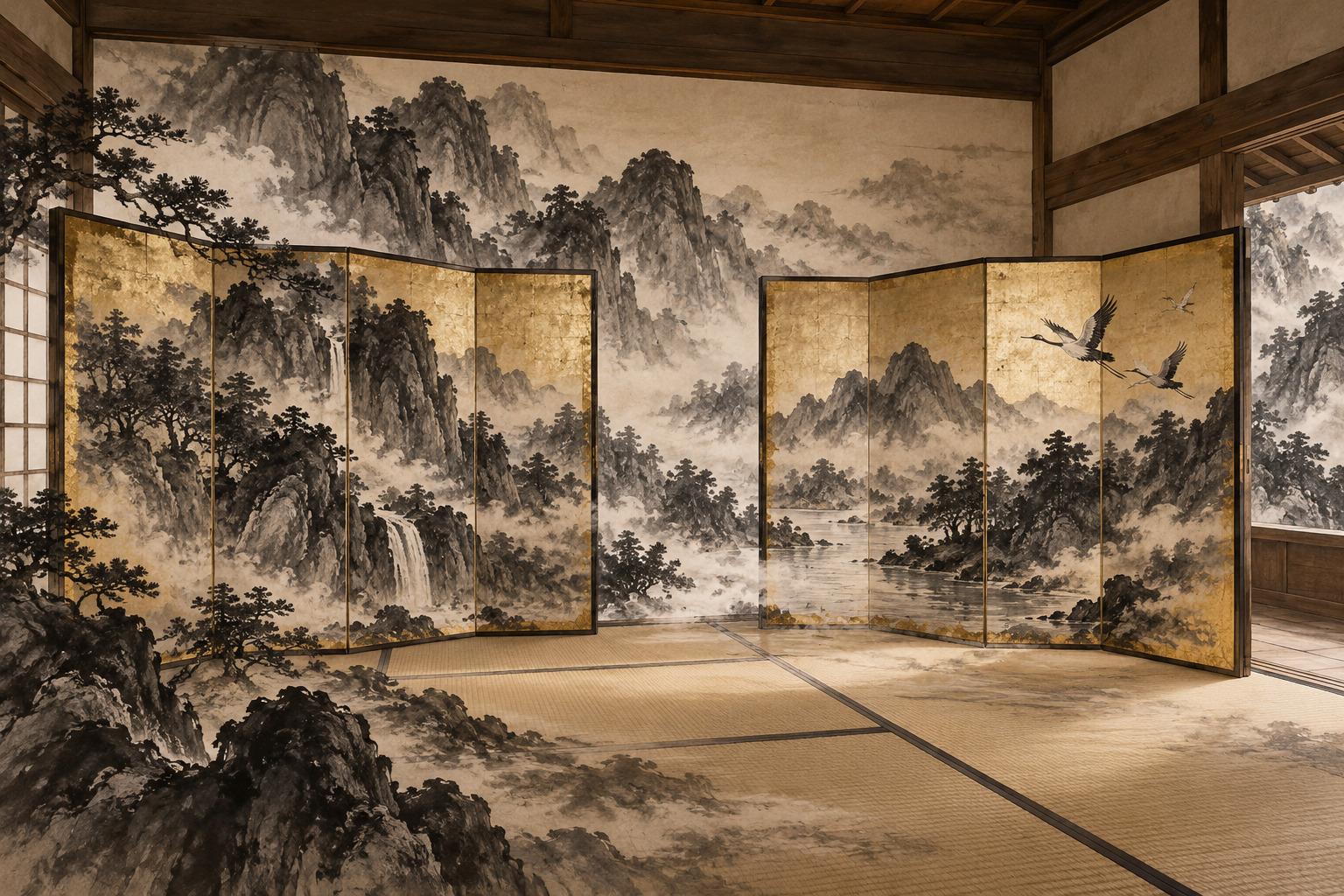
A folding screen is a wall that refuses to stay put. It stands without becoming architecture, vanishes into a stack when folded, and changes shape each time it is opened. Put a painting on that surface and the image acquires a physical life that a picture fixed flat against a wall cannot possess. Light alternates across ridges and valleys. Figures approach or recede as the angles change. The viewer does not merely look at the scene; walking alongside it activates the scene.
That is the premise of a collection exhibition that opened September 8 at the Museum of Fine Arts, Gifu. Its Japanese title, Gifu no Nihonga: Byōbu — Dai-gamen ni miru bi no sekai, may be rendered descriptively as “Gifu’s Nihonga: Folding Screens — Beauty Seen on a Monumental Surface.” This seventh installment of the museum’s “Gifu no Nihonga” series places the format, rather than a single artist or subject, at center stage. The official checklist contains 17 screens dating from the Meiji era to 2017, divided between two rotations.[1][2]
This distinction matters. The show is not a survey of celebrated ancient screens, and it does not claim an unbroken, unchanged Japanese tradition. It asks a more revealing question: what did modern and contemporary artists do with an old, practical support after painting itself had entered the era of museums, juried exhibitions, international expositions and abstraction?
Movable architecture, made from paper
The Japanese word byōbu is conventionally explained through the idea of shielding or blocking wind. The form came from ancient China, but in Japan it developed distinctive paper hinges connecting the individual panels, called sen. Those hinges allow the joins to bend in either direction while leaving little visual interruption between panels. A typical six-panel screen is a rokkyoku; one screen is an isseki, while a matched pair is an issō. Layers of paper underneath the painted surface give the object both resilience and an ability to respond to changes in humidity.[3]
The structural vocabulary explains the visual experience. A reproduction flattens the image into a long rectangle. In the gallery, the screen stands in a zigzag. As viewers move, one plane catches illumination while its neighbor falls into relative shade. Gold flashes and dims. Inked emptiness becomes shallow on one fold and deep on another. A distant bank, branch or animal can appear to migrate even though no mark has moved.
The museum’s checklist identifies “the passage of seasons and the expression of time flowing within the picture” as a focus. Folds act almost like punctuation: they separate episodes without sealing them off. The viewer supplies the tempo by walking. A screen is therefore more than furniture carrying an image. It is movable architecture that rebuilds a room through painting.[2]
A folding screen does not simply occupy exhibition space. It edits that space—directing the body, changing the light and deciding how quickly an image can be read.
The first rotation: an old pine and three lives in civil war
One of the first rotation’s anchors is Kawai Gyokudō’s 1928 Rōshō Sōyō, a title rendered here descriptively as “Old Pine and Goshawk.” At 171.5 by 372 centimeters, it is large enough to work on the scale of the body. The museum records the technique as ink and light color on silk, with urahaku—foil applied behind the pictorial silk. Rather than overstate what that construction looks like under this exhibition’s lighting, it is safer to attend to what the documented materials promise: ink, restrained color and a broad field in which the old pine and blue-gray hawk hold a taut distance from each other.[4]
Gyokudō was born in 1873 in what is now Ichinomiya, Aichi Prefecture, and grew up in Gifu. In Kyoto he studied under Kōno Bairei, whose Meiji-period Shiki Sōka-zu Byōbu—descriptively, “Flowers and Plants of the Four Seasons”—also appears in the first rotation. Their proximity lets viewers compare generations without pretending they share a single fixed style: the flower-and-bird lineage of the Kyoto art world on one side, and Gyokudō’s later handling of observed nature and charged space on the other.
Moriya Tadashi’s 1983 Ransei ni ikiru (Nobunaga, Hiyoshi, Takechiyo) is more overtly narrative. The museum’s collection database gives the official English title as Living through Turbulent Times (Nobunaga, Hideyoshi, Takechiyo). Across 171 by 365.5 centimeters, Moriya brings together Oda Nobunaga, Hiyoshi—the youthful name associated with the future Toyotomi Hideyoshi—and Takechiyo, the childhood name of Tokugawa Ieyasu. These are not merely three portraits of eventual unifiers. They are three lives placed inside the uncertainty of an age before their futures were settled. The screen lets separate times and destinies coexist without collapsing them into a single theatrical instant.[5]
Moriya was born in Ōgaki and made history painting central to his practice. Here the folding format offers a stage whose joins can mark difference and continuity at once. The first rotation also includes Ōhashi Suiseki’s circa-1938 Tora-zu (“Tiger”), Gyokudō’s 1918 autumn landscape and circa-1946–48 screen of seasonal waka poem cards, Tamaya Shunki’s 1933 Isobe, Kawasaki Shōko’s late-Taishō Haru, and Okamura Tomoharu’s 2017 Komorebi. The distance from Meiji Bairei to a work completed in 2017 is the exhibition’s real historical span.[2]
The second rotation: tiger, gold fish and the sound of tides
From October 14, a different tiger by Suiseki becomes one of the key works. The checklist dates this gold-ground, color-on-paper screen to the early Shōwa period. Suiseki was born in 1865 in present-day Ōgaki. He won gold medals at the Paris Exposition of 1900 and the Louisiana Purchase Exposition in St. Louis in 1904. His path to specialization was marked by loss: after the deaths of his teacher and mother, he returned home; the 1891 Nōbi earthquake then destroyed the family house and killed his father. Repeated observation helped him refine the tiger subjects for which he became famous. On a gold ground, the animal is not merely contained by distant scenery. A screen can make it appear to share the room.[6]
Maeda Seison’s circa-1921 Yūgyo (“Swimming Fish”) shifts from weight to suspension. Each screen measures 139 by 272.3 centimeters. The museum describes the medium with unusual precision: color on paper, “gold pigment only.” Fish articulated in gold pigment establish water without requiring the artist to paint water as a solid thing. Seison, born in the Nakatsugawa area of Gifu and best known for historical figure painting, reduces the image to bodies, intervals and an implied depth. The folds become currents.[7]
Hirakawa Toshio’s 1990 Naruto Chōsei—descriptively, “The Sound of the Naruto Tides”—uses ink on paper. The title invokes sound, not simply a view. Repeated marks and the screen’s alternating planes can turn the famous whirlpools into a rhythm perceived across the gallery. Murai Masanari’s untitled work from the 1970s, also ink on paper, pushes farther from representational Nihonga. Murai is associated with Japanese abstract painting; his inclusion quietly breaks any equation between folding screens and traditional subject matter.
The second rotation also contains Gyokudō’s circa-1899 Rin Nasei and 1931 Shōsho Sōkaku, two Taishō-period screens by Tamaya Shunki, and Suiseki’s tiger. Taken together, the rotation allows paper and silk, ink and light color, gold ground and gold pigment, figuration and abstraction to be compared inside the same physically articulated format.[2]
| Rotation | Selected works | Questions to watch |
|---|---|---|
| First Sept. 8–Oct. 12 | Bairei’s four seasons; Gyokudō’s Old Pine and Goshawk; Moriya’s Living through Turbulent Times; Suiseki’s circa-1938 tiger; five others | Seasonal progression, narrative distance, urahaku, the continuity of the format from Meiji to 2017 |
| Second Oct. 14–Nov. 3 | Suiseki’s early-Shōwa tiger; Seison’s Swimming Fish; Hirakawa’s Naruto Chōsei; Murai’s untitled abstraction; four others | Gold ground versus gold pigment, ink rhythm, implied water, abstraction on a traditional support |
“Nihonga” is modern, even when the screen is old
The antiquity of the screen can obscure the comparatively recent history of the category “Nihonga.” In the Meiji period, when oil painting derived from European practice came to be discussed as yōga, a range of painting practices associated with established materials and lineages were gathered and reshaped under the name Nihonga. This was not simply the conservation of everything old. Artists negotiated imported realism, perspective, new pigments, international expositions and modern institutions while revising line, blank space and support.
The National Museum of Modern Art, Tokyo has described this history through the unstable boundary between Nihonga and yōga, emphasizing experiment “between” the categories rather than two sealed camps. That frame helps explain Gifu’s show. Its artists did not retreat into the screen. They used it to test how a work addressed modern viewers and modern exhibition rooms.[8]
The Museum of Fine Arts, Gifu began collecting in 1979, before it opened on November 3, 1982. Its stated policy gives particular weight to artists connected to Gifu, including Yamamoto Hōsui, Kumagai Morikazu, Kawai Gyokudō, Maeda Seison and the ceramic artist Arakawa Toyozō. The regional emphasis does not make the collection parochial. It gives the museum a way to place locally rooted careers inside the larger history of modern Japanese art.[9]
The 17 works make that network visible. Gyokudō was born across the prefectural border but raised in Gifu. Suiseki and Moriya came from Ōgaki; Seison from Nakatsugawa. Their routes led through the Kyoto painting world, the Japan Art Institute, state-sponsored exhibitions, overseas expositions and postwar abstraction. Birthplace is not the argument. The argument is that artists with different institutional lives repeatedly found the foldable monumental surface useful.
How to look: use your feet
The most rewarding way to see a folding screen is not to remain at one central viewpoint. Begin far enough away to grasp the horizontal sequence. Then move diagonally, watching where illumination changes across each fold. A gold ground will brighten and recede with the angle; the apparent density of empty paper in an ink work can change as one plane turns away. Move closer to distinguish paper from silk, gold pigment from a gold ground, monochrome ink from ink with light color.
Seeing both rotations would reveal continuity more clearly than following any single subject. Flowers, tigers, historical figures, fish, whirlpools and abstract forms all become parts of the room once placed on screens. That is the force behind the exhibition’s “monumental surface.” Monumentality here does not mean size alone. It means an image large and mobile enough to reorganize the space in which its audience stands.
Visitor information
The exhibition is in Gallery 1d at the Museum of Fine Arts, Gifu, 4-1-22 Usa, Gifu City. Hours are 10:00 AM to 6:00 PM, with admission ending 30 minutes before closing; the museum remains open until 8:00 PM on October 16. It is generally closed Mondays, or the following weekday when Monday is a national holiday. That makes Monday, October 12—the final day of the first rotation—an open holiday, followed by a closure on October 13. The second rotation begins October 14. Admission is ¥370 for adults and ¥240 for university students; visitors of high-school age and younger enter free. Group discounts and disability-related exemptions are available.[1]
- Museum of Fine Arts, Gifu: exhibition page — dates, hours, admission, rotation and principal works.
- Museum of Fine Arts, Gifu: official 2026 checklist — all 17 works, artists’ readings, dates, media and rotations.
- Tokyo National Research Institute for Cultural Properties: “Byōbu” — history, terminology, paper hinges and layered construction.
- Museum of Fine Arts, Gifu collection: Kawai Gyokudō, Rōshō Sōyō — date, dimensions and medium.
- Museum of Fine Arts, Gifu collection: Moriya Tadashi, Living through Turbulent Times — official English title, date, dimensions and medium.
- Museum of Fine Arts, Gifu: Ōhashi Suiseki retrospective — biography, international exposition medals and the Nōbi earthquake.
- Museum of Fine Arts, Gifu collection: Maeda Seison, Yūgyo — date, dimensions, medium and birthplace.
- National Museum of Modern Art, Tokyo: “Modernity in Flux” — experimentation between Nihonga and yōga.
- Museum of Fine Arts, Gifu: collection policy — collecting history and Gifu-connected artists.
Editorial note: The museum has not supplied a formal English title for the exhibition or for most works. English renderings are therefore descriptive unless expressly identified as official. Artwork names, dates and media follow the museum’s Japanese checklist. Panel counts and configurations for individual works are not stated there and have not been inferred. This report is based on official opening information, not an on-site review.