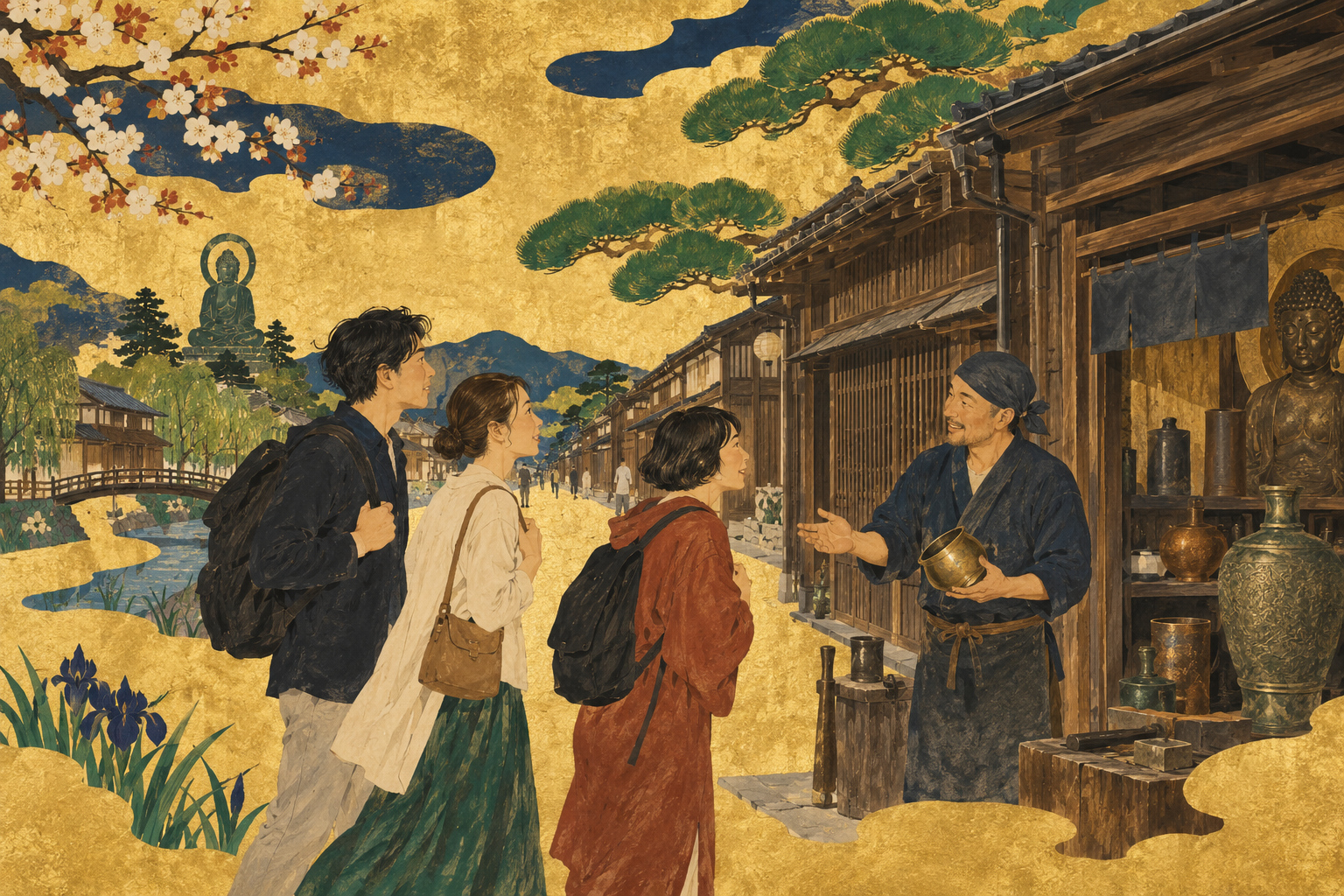
An object bought on a trip can become part of everyday life: a bowl on a table, a small piece of metalwork used each morning. Takaoka is inviting people to reverse that journey—to meet the makers and consider whether the place behind the object might also become somewhere to live.
The city’s autumn “adult school trip” is a one-night programme on October 24–25 for people aged 18 or older who live outside Toyama Prefecture. It combines a craft event, downtown walks and a visit to casting manufacturer Nousaku. Applications close September 25, with roughly five groups and ten participants sought. The city presents the experience as an introduction to local life through encounters with residents; its itinerary remains provisional. [1]
A weekend cannot establish whether relocation will work. It can make the next questions more specific, and introduce people who can help answer them. That is the practical possibility behind this small programme.
Seeing the city at different hours
The proposed first day begins at Takaoka Station, followed by the Tsuginote craft event and a walk around the Great Buddha area. Participants are to stay at Daibutsu Ryokan downtown and join an evening walk and exchange gathering. The next day offers an optional morning-market visit, followed by Nousaku, a making activity and lunch at its IMONO KITCHEN. The planned finish is around 3 p.m. at Takaoka Station. [1][2]
Staying overnight makes it possible to see the same streets after daytime visits are over and again the following morning. That is a feature of the itinerary, not a report of what participants have already experienced. Nor is the programme a stay in an ordinary rental home or a survey of every neighbourhood. It provides one selected view of central Takaoka.
A craft fair about present-day work
Tsuginote’s organisers have announced 128 exhibitors for October 24–25 at the municipal central parking facility connected to Takaoka Station. The event combines displays of production skills with craft, design and food markets. Admission to the event itself is free, with web registration required. That separate admission arrangement should not be confused with the paid overnight programme. [3]
The attraction for a prospective resident is the chance to see craft as current work: what people make, how they find customers and how they explain an object’s use. A conversation that begins with a purchase might lead to questions about a working life in the city.
It does not amount to recruitment or an apprenticeship offer. The municipal itinerary makes no such promise. Someone considering a career in craft would need a further discussion about skills, employment conditions and training.
The town that outlived its castle
Takaoka’s connection between making and living has a long history. The city’s official heritage account dates its early modern foundation to Maeda Toshinaga’s construction of Takaoka Castle in 1609. He also brought seven metal casters to establish the production community associated with today’s Kanayamachi. [4][10]
The castle was abandoned six years after the town’s foundation under the one-castle-per-province policy. In the municipal account, Maeda Toshitsune subsequently promoted commerce, distribution and manufacturing. Takaoka’s future came to depend on the activities of merchants and craftspeople as its original castle-town role receded. [4]
That history was recognised on April 24, 2015 through Japan Heritage, in a narrative connecting Takaoka’s townspeople, skills and culture with the Maeda family. The designation recognises a story connecting cultural assets. It offers a way to understand the streets and industries in relation to the people who sustained them. [5]
The contemporary trip is not an equivalent of early modern population policy; the circumstances and freedom to choose where to live are different. The useful connection is more modest: work and settlement belong in the same account of how a city develops.
At Nousaku, continuity includes changing the product
Nousaku dates its founding to 1916, making cast objects including Buddhist implements. Its company history records a move into products made from 100 percent tin in 2003. The development of tableware and household objects illustrates how inherited casting skills can be applied to changing uses. These dates and product details come from the manufacturer. [6]
In its regular NOUSAKU LAB workshops, the company uses a sand-mould process called namagata chūzōhō, 生型鋳造法. Participants compact sand to form a mould; the published sequence assigns the pouring of metal to staff. The city has not specified the particular item or detailed workshop format for this tour, so the normal public menu should not be treated as the confirmed group activity. [7]
Making something can change the questions a visitor asks. How is a shape held in the mould? What does the material allow a designer to do? A short exercise cannot reproduce a craftsperson’s accumulated skill, but it can make the work behind the finished object easier to discuss.
From an autumn weekend to a working year
For relocation, the most useful follow-up may concern what happens when no event is taking place. A commute, shopping, healthcare, housing costs and the needs of other household members cannot be assessed from an attractive streetscape alone. Japan.co.jp suggests using the trip’s introductions to ask about those everyday conditions.
Season is another limit. Takaoka’s relocation website advises drivers about winter tyres and roads freezing as temperatures fall. An October visit cannot demonstrate winter travel or the upkeep of a home through the snow season. What preparation and responsibilities a particular location involves is a question to take further. [8]
The city offers a route for doing so. Its relocation concierge covers housing, work, childcare, transport, shopping and relationships with the community. The service welcomes people still gathering information, with online consultations and advance-booked local guidance available. This is a separate service, rather than an additional activity guaranteed within the overnight itinerary. [9]
What applicants need to know
| Dates | October 24–25, 2026; two days and one night. |
|---|---|
| Eligibility and places | Aged 18 or older and resident outside Toyama Prefecture. Approximately five groups, ten people; lottery or selection if oversubscribed. |
| Applications | September 7–25, 2026. |
| Fee | Published amount: ¥10,000. Travel to Takaoka is at participants’ expense. Confirm the detailed cost conditions with the city. |
| Meeting and finish | Takaoka Station; scheduled finish around 3 p.m. on October 25. Itinerary subject to change. |
| Information and application | Use the official municipal recruitment page. City contact: 0766-20-1101. |
The city asks participants to bring suitable walking clothes and shoes, rain gear and overnight necessities. Anyone requiring particular arrangements should confirm them, along with the cost conditions, with the organiser before applying. [1][2]
Japan.co.jp analysis: the value of a better question
Immediate relocation commitments would be too narrow a measure of this programme. It could also be useful if participants leave able to compare living conditions more accurately, arrange another visit or continue a conversation about work. Discovering that some aspect of a place does not suit a household can improve a decision too.
The programme’s craft emphasis gives that inquiry a tangible starting point. Behind an object are people who have continued to make, trade and live in the city. Meeting them offers a chance to connect Takaoka’s historical identity with questions about a possible future there.
The strongest outcome need not be an answer reached by Sunday afternoon. It may be knowing what to ask next—and having someone in Takaoka to ask.
- Takaoka City, autumn adult school trip recruitment, updated September 7, 2026
- Takaoka City, autumn programme flyer and provisional itinerary
- Tsuginote Executive Committee, 2026 event announcement, August 10, 2026
- Takaoka City, official Japan Heritage historical narrative
- Takaoka City, Japan Heritage designation and its 2015 date
- Nousaku, company profile and chronology
- Nousaku, NOUSAKU LAB casting workshops
- Takaoka relocation website, everyday-life questions
- Takaoka relocation website, concierge consultations
- Takaoka City, English historical narrative and name cross-check