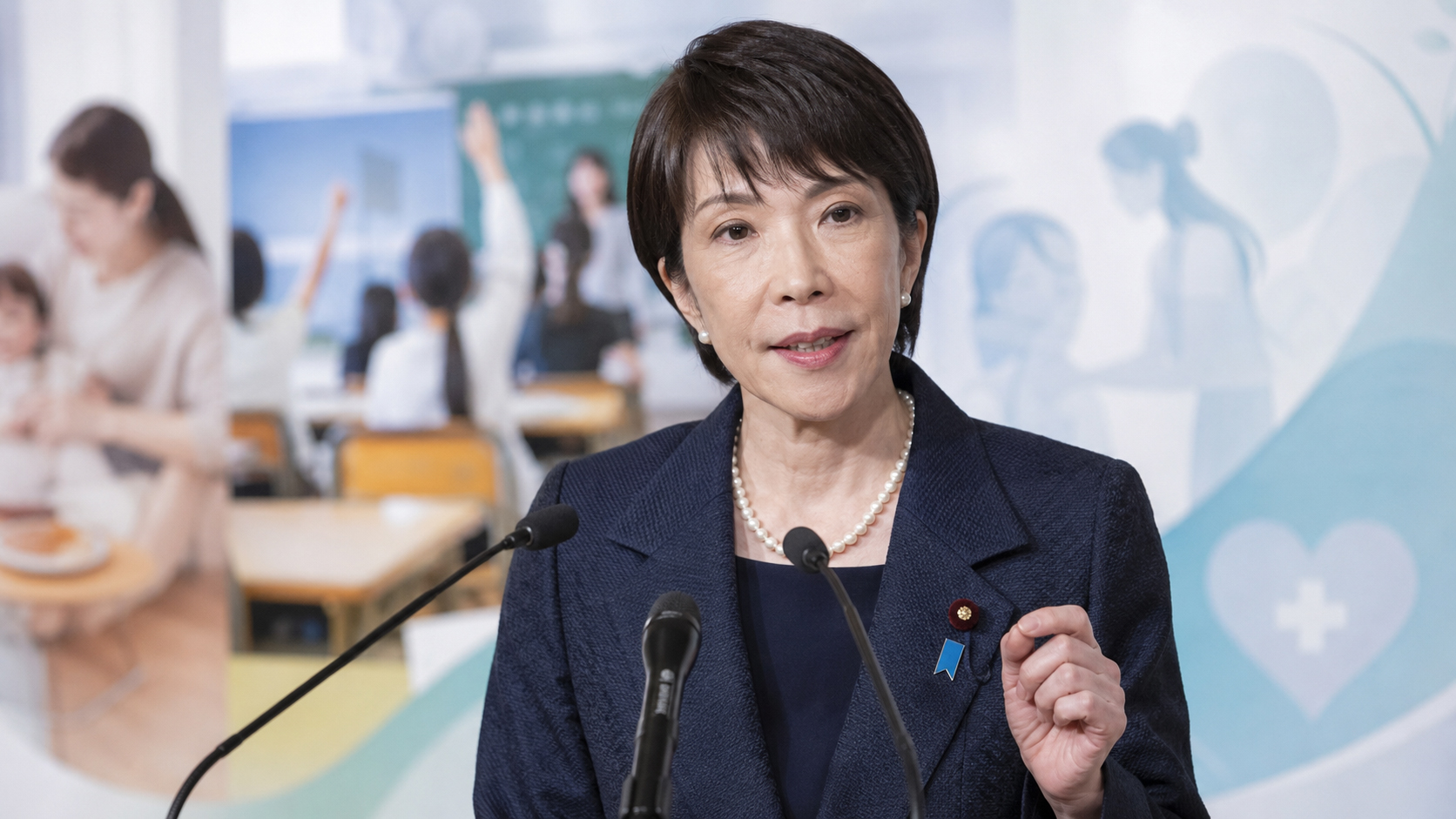
When Japanese politics talks about women’s policy, the conversation usually turns quickly to childbirth, nursery schools, parental leave and the number of women in management. Those are still important. But Prime Minister Sanae Takaichi’s women’s policy blueprint is striking because it moves toward words that Japanese politics has often treated as too private, too awkward or too ordinary to become national policy: menopause, rheumatoid arthritis, school education, housekeeping and babysitting support. They do not sound dramatic. Yet they touch the hidden structure of Japanese life — work, family, health, aging and the unpaid labor that still falls heavily on women.
Seeing women’s health as a work issue
The Japan Times reported that one pillar of the blueprint is support for women’s health across life stages, including greater support for people with rheumatoid arthritis, a condition that disproportionately affects women during menopause. That is not simply a medical footnote. It asks whether menstruation, pregnancy, fertility treatment, childbirth, menopause and chronic illness should remain private problems that women manage alone, or whether they belong in the design of schools, workplaces and public policy.
For decades, many women in Japan have been expected to endure. Go to work despite pain. Attend the meeting despite poor sleep. Avoid mentioning menopause because the office has no language for it. Carry housework and caregiving after the workday ends. Delay medical care because there is no time. The result is not only private suffering. It becomes resignation, lost productivity, stalled promotion, mental strain and a quieter loss of human potential.
Health and Global Policy Institute, citing a 2024 Ministry of Economy, Trade and Industry estimate, says women-specific health issues cost the Japanese economy about ¥3.4 trillion a year, with menopausal symptoms accounting for more than half of that, or roughly ¥1.9 trillion. In other words, menopause is not just a private transition. It is a productivity issue, a retention issue, a wage issue and a leadership issue.
Why Takaichi makes the story complicated
Takaichi is Japan’s first female prime minister, but her gender politics cannot be reduced to a simple progress narrative. She is a conservative leader known for traditional positions on family law, imperial succession and social issues. Yet she has also spoken publicly about her own menopause experience and about the need for men to understand women’s health. That tension is the core of this policy story.
This is not a liberal gender-equality package in the usual sense. It is a conservative administration trying to connect women’s health, education and household support to labor-force participation, national productivity and demographic survival. That is why reactions are likely to be mixed. To some, it will look like pragmatic progress. To others, it will look like an old family-centered model updated with new policy language.
Politics often advances through contradictions. If women’s health policy moves forward in Japan, it may do so not because every faction agrees on feminism, but because labor shortages, medical costs, corporate retention, birthrates and local survival force the issue. Takaichi’s blueprint may be significant because it opens that practical door.
How menopause became a policy word
Medically, menopause is associated with hormonal changes around the end of menstruation. Socially, it often arrives during one of the busiest periods of life: prime earning years, management-track work, children’s education, elder care, mortgages and community duties. Some people experience mild symptoms. Others face sleep problems, hot flashes, sweating, joint pain, mood changes, lower concentration or fatigue that disrupts work and daily life.
The problem is that the workplace has rarely been built to recognize this variety. Compared with pregnancy or childbirth, menopause has been harder to institutionalize. Employees may not know how to explain it. Managers may not know how to ask. Male colleagues may have little knowledge. Even among women, symptoms differ widely, making a single support model difficult. The result is familiar: those who suffer most often carry the burden silently.
Good policy does not require treating every symptom the same. It requires connecting consultation, screening, treatment, flexible work, management training, school education and corporate disclosure. Women’s health cannot sit at the edge of corporate welfare. It belongs closer to labor policy, human-capital strategy and occupational health.
The importance of naming rheumatoid arthritis
The inclusion of a condition such as rheumatoid arthritis matters because it makes the policy concrete. Rheumatoid arthritis is an autoimmune disease that can cause joint pain, swelling, fatigue and difficulty with everyday movement. It affects many women and can overlap with working age and midlife. When chronic illness and menopause collide, the burden on work and family life can become invisible but severe.
Too often, women’s health policy is narrowed to pregnancy and childbirth. But women’s lives do not end there. Women in their 40s, 50s and 60s work, manage, care for parents, support households and hold communities together. If midlife health and chronic illness are ignored, a society asking women to work longer will quietly lose them.
That is why the rheumatoid arthritis reference is more than a clinical detail. It signals that women’s policy must include midlife and older working women, not only young families. A serious labor policy must include treatment, job adjustment, return-to-work support and the reality of long-term health management.
Education must start before the workplace
The education element also matters. Ignorance about women’s health does not suddenly appear when people enter companies. It begins when students grow up without enough practical knowledge, then become adults who cannot discuss menstruation, menopause, infertility, gynecological disease or chronic illness without embarrassment. If schools do not teach, the knowledge gap becomes a health gap and later a workplace gap.
Education in this area must be handled carefully. Health, bodies and sex education can touch family values, religious views and politics. But avoiding the subject does not create neutrality. It creates inequality. Students from families with knowledge and access get help; others learn to endure.
Men and boys also need the education. As long as women’s health remains knowledge held only by women, managers, coworkers, spouses and policymakers will remain unprepared. Takaichi’s own emphasis on male understanding is important because policy will fail if it stops at paperwork. Culture changes when people learn how to speak without embarrassment or prejudice.
The politics of housekeepers
The blueprint’s references to housekeeping and babysitting support may sound like a lifestyle-service issue, but they point to one of Japan’s deepest structural problems. Housework, childcare, school duties, elder care, neighborhood obligations and family coordination still fall disproportionately on women. If women work more hours but the unpaid labor at home does not fall, the burden simply doubles.
Considering tax or other support for household services is therefore a way of making invisible labor visible. But it also raises difficult questions. Will the support reach middle-income households or only the wealthy? Will domestic workers be protected? Will Japan rely more heavily on migrant labor? Could outsourcing housework become an excuse for men not to change their role at home?
A good policy would not frame housekeeping support only as a tool to help working women cope. It would frame it as recognition that housework is labor. Someone is spending time, skill and energy to do it. If that understanding spreads, “housekeeper” becomes more than a service label. It becomes part of a national conversation about the work hidden inside the home.
Why women’s advancement stalls
Japan has increased women’s labor-force participation, especially through earlier womenomics policies, childcare expansion and corporate demand for workers. But gaps remain in management, boardrooms, politics, regular employment and wages. Japan ranked 118th out of 148 countries in the World Economic Forum’s 2025 Global Gender Gap Index, and Nippon.com noted that Japan was the only G7 country outside the top 100.
Progress stalls for several reasons. Women enter the workforce, but housework and caregiving often do not redistribute enough. Companies still reward long hours, transfers, after-hours networking and uninterrupted career tracks. Health problems may push women out, but the reason may never appear clearly in HR data.
That is why a policy that touches menopause and household support matters. Increasing the number of women is not enough. Women must be able to remain, advance, lead and stay healthy. The middle of the career pipeline — where health, family and promotion collide — is where many policies have failed.
Conservative policy or social reform?
Takaichi’s blueprint contains both conservative and reformist possibilities. Emphasizing household support may draw criticism that it keeps women at the center of family labor. Yet naming menopause, chronic illness and domestic work as public policy issues also brings hidden burdens into the open.
The test will be implementation. How specific will school education become? Will companies face more than soft encouragement? Will small businesses be able to use the programs? Will nonregular workers be reached? Will regional medical access improve? Will household support become a tax benefit for the comfortable, or a practical tool for caregivers, single parents and middle-income households?
Policy names can be elegant. Lives change in details. Can a woman get an appointment? Can she tell her boss? Can she take leave without punishment? Can a household actually afford help? Is there a gynecologist nearby? Do boys learn the same facts as girls? That is where a blueprint becomes reality.
This is growth strategy, not a side issue
Takaichi’s administration is also pushing a large growth agenda around AI, semiconductors, energy, shipbuilding, defense and quantum technology. But growth ultimately depends on people. If skilled workers leave because of untreated illness, family overload or workplace silence, industrial policy loses strength from underneath.
Women’s health policy is therefore both compassionate and strategic. Teaching menopause protects productivity. Linking chronic illness and work preserves talent. Supporting household labor turns invisible work into an economic issue. Education changes the next generation of workplace culture.
The question is whether Takaichi can turn personal experience into universal design. If it remains a story, it will fade. If it becomes systems, it may change how Japanese workplaces and households speak about women’s lives.
Quiet policies can change society
Menopause, rheumatoid arthritis, education, housekeeping. These are not the loudest words in politics. They do not produce the spectacle of a defense bill, a tax fight or a diplomatic confrontation. But in daily life, such issues decide whether people stay in work, seek treatment, accept promotion, have children, care for parents or leave the labor force.
Japan has long told women: please work, but also keep the home together. Please lead, but do not bring body issues into the office. Please have children, but manage education costs, elder care and household labor. Those contradictions have returned as low birthrates, wage stagnation, labor shortages and political frustration.
That is why this blueprint deserves attention. It asks whether Japan can treat private burdens as public policy without turning them into slogans. Can women’s bodies be discussed without silence? Can household labor be measured instead of assumed? Can education create a generation that understands health before crisis?
The strongest policies are not always the loudest. Sometimes they are the ones that give public language to burdens people have carried quietly for years.
Sources and references
This article draws on public reporting and documents from The Japan Times, the Gender Equality Bureau of the Cabinet Office, the Prime Minister’s Office of Japan, Health and Global Policy Institute, Nippon.com, The Guardian and the World Economic Forum. Policy details, budget measures, tax design and implementation may change through cabinet decisions, Diet debate and ministry-level execution.
- The Japan Times: Takaichi's blueprint of women's policies focuses on menopause, education and housekeepers.
- Gender Equality Bureau, Cabinet Office: Gender equality policies, white papers and official framework materials.
- Prime Minister's Office of Japan: Policy speech by Prime Minister Takaichi Sanae.
- Health and Global Policy Institute: Policy recommendations on menopausal women's health as a social issue.
- Nippon.com: Japan's 2025 Global Gender Gap ranking and G7 comparison.
- The Guardian: Takaichi cabinet representation and political context.