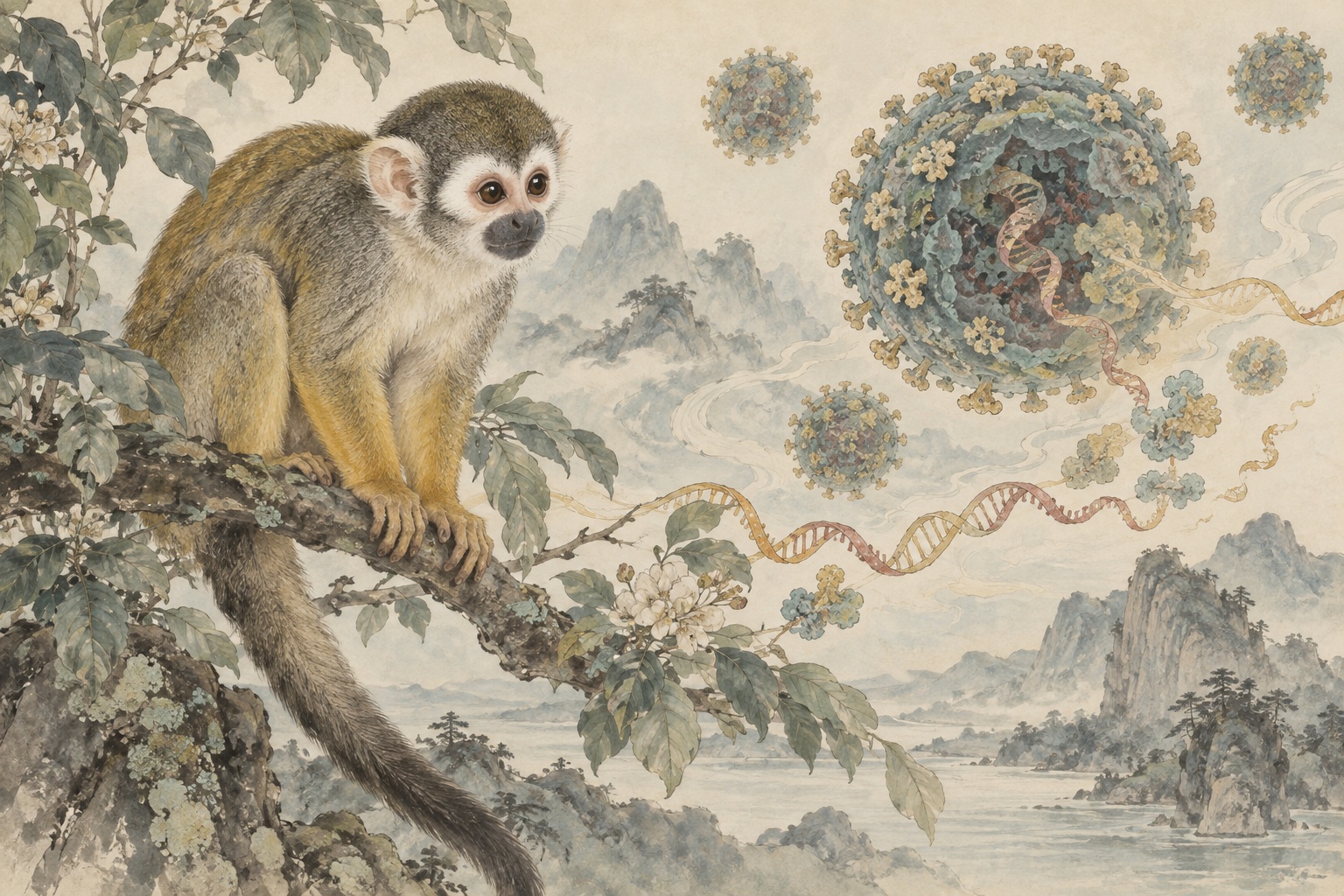
A virus adapted to a South American squirrel monkey carries a protein whose evolutionary signal points somewhere unexpected: toward the MHC class I genes of Old World monkeys. Researchers at Nagoya University, Tokyo University of Agriculture and Technology and Yamaguchi University have identified the S9 protein of squirrel monkey cytomegalovirus — Saimiriine herpesvirus 4, or SBHV4 — as an unusually close viral look-alike of the immune molecules that vertebrate cells use to display peptides to the immune system. Across a region covering 86.3% of full-length human HLA-A, S9 shares 60.6% amino-acid identity. The peer-reviewed study was published in Scientific Reports on September 9.[1] [3] [4]
The stranger result comes from the evolutionary trees. S9 did not consistently fall beside MHC class I sequences from New World monkeys, the group that includes squirrel monkeys. Instead, both full-sequence and restricted analyses repeatedly placed it with Old World monkey MHC-I sequences, including members of the genus Cercopithecus. That pattern is consistent with an ancient relationship between the viral gene and a primate MHC-I-related gene. But the final paper is explicit about the limit: it cannot reliably identify the donor lineage, the date of acquisition or the molecular mechanism by which the viral gene was acquired.[1] [2]
MHC class I: a cell’s display case for what is happening inside
MHC class I molecules sit on the surface of most nucleated vertebrate cells. They bind short peptides generated from proteins inside the cell and display them to the immune system. In humans, HLA-A, HLA-B and HLA-C are the best-known classical examples. CD8 T cells inspect these peptide–MHC complexes for signs of viral infection or other abnormalities, while natural killer cells also read the presence, absence and identity of MHC-I molecules through a different set of receptors.
That system creates intense evolutionary pressure on viruses. If infected cells efficiently display viral peptides, they become easier targets. Large DNA viruses, especially cytomegaloviruses, have evolved extensive repertoires of genes that manipulate antigen presentation, immune receptors and signaling. S9 is intriguing because it appears not merely to interfere with MHC-I from the outside, but to resemble the molecular scaffold itself.
A search through roughly 1.86 million viral proteins
The discovery emerged from a broad computational screen rather than from a single candidate-gene experiment. The researchers compared the viral protein set in Virus-Host DB release 225 — about 1.86 million entries — against the complete peptide set derived from the human GRCh38 genome. Using a threshold of at least 60% identity over at least 200 amino acids, they obtained 372 hits and focused on an unusually extensive match between SBHV4-S9 and HLA-A.[2]
S9 is a 344-amino-acid membrane protein. Its overlap with the 365-amino-acid HLA-A protein spanned 315 residues; 191 of those positions were identical, producing the 60.6% figure. When the same HLA-A-homologous region of S9 was searched against other known viral proteins, the best alternative viral match was only 43.2% identical. In other words, S9 looked more strikingly like a mammalian immune protein than like any close viral counterpart in the database screen.[2]
The predicted shape also looks like HLA-A
The team then modeled full-length structures with AlphaFold and compared them with TM-align. The predicted S9 and HLA-A structures produced a TM-score of 0.83 and an RMSD of 1.98 ångströms, indicating substantial overall structural similarity. The characteristic α1, α2 and α3 regions of MHC-I were echoed in S9, and the model contained a pocket in the position corresponding to the peptide-binding groove between α1 and α2.[2]
That is powerful evidence of structural resemblance, but it is not yet evidence of equivalent biological function. The 2026 paper does not report experiments showing that S9 actually binds peptides, assembles with β2-microglobulin, appears at the cell surface in the same form as host MHC-I, or engages a T-cell or NK-cell receptor. Those are precisely the experiments that could turn an evolutionary observation into an immunological mechanism.
The precedent: human cytomegalovirus UL18
Viruses mimicking MHC class I is not a new concept. In 1988, Stephan Beck and Barclay Barrell reported in Nature that human cytomegalovirus encodes a glycoprotein homologous to MHC class I antigens. That protein became known as UL18.[5]
The new S9 paper notes that UL18 is only about 25% identical in sequence to HLA, far less than the 60.6% match seen with S9. Yet UL18 has a known immune function: later work showed that it can bind the inhibitory leukocyte immunoglobulin-like receptor LIR-1/LILRB1 with very high affinity. That history makes S9’s close resemblance biologically provocative — but it also supplies an important warning against analogy. The fact that one viral MHC-like molecule manipulates an inhibitory receptor does not prove that S9 does the same thing.[2] [5]
Squirrel monkey CMV has captured immune genes before
There is another, more direct precedent in New World monkey cytomegaloviruses. In 2015, researchers reported seven viral genes related to the signaling lymphocytic activation molecule, or SLAM, family in squirrel monkey and owl monkey CMVs. These host immune receptors help regulate innate and adaptive immune cells.[6]
One squirrel monkey CMV protein, S1, closely resembles host SLAMF6. Its ligand-binding N-terminal immunoglobulin domain was reported to be 97% identical to the host version, and functional experiments showed that the viral protein reached the cell surface and could bind host SLAMF6. The authors concluded that New World monkey CMVs had captured immune-receptor genes by retrotranscription at different stages of virus–host coevolution.[6]
S9 therefore appears in a viral genome already known to contain host-derived immune-gene mimics. But its history cannot simply be copied from S1. The 2026 paper finds a different and much more puzzling phylogenetic pattern.
The puzzle: a New World monkey virus with an Old World monkey signal
Squirrel monkeys belong to the New World monkey radiation of Central and South America. Cercopithecus monkeys are Old World monkeys from Africa. If S9 were a simple recent capture from the virus’s present host lineage, a close relationship to New World monkey MHC-I sequences would seem intuitive. The analyses did not show that.
The researchers first assembled a broad set of MHC-I-like genes across animal species, then built a more carefully curated primate dataset. Candidate sequences had to contain the expected α1, α2 and α3 domains in the correct order, followed by transmembrane and cytoplasmic-tail regions and conserved cysteine residues. After quality control, 52 primate MHC class I sequences plus viral S9 remained for focused phylogenetic analysis.[2]
MHC genes are notoriously difficult evolutionary markers because the immune system subjects them to strong and unusual selective pressures. Recombination, gene conversion, gene duplication and loss, and “trans-species polymorphism” can preserve related alleles across speciation events. To reduce the chance that pathogen-driven selection in the peptide-binding region alone was distorting the tree, the researchers analyzed both complete coding sequences and sequences with peptide-binding residues removed. S9 still grouped with Old World monkey MHC-I sequences, including Cercopithecus.[2]
But the S9 branch was exceptionally long, and its exact placement inside the Old World monkey lineage was unstable. That is why the final paper stops at “phylogenetic affinity.” It does not name a specific donor species.
LINE-1 offers a mechanism — but the expected fingerprints were missing
One plausible route for host-to-virus gene capture involves LINE-1 retrotransposon machinery. LINE-1 can reverse-transcribe cellular messenger RNA into DNA. In some large DNA viruses, such host-derived cDNA has been inserted into viral genomes, potentially leaving molecular fingerprints such as short target-site duplications and poly(A) tracts.[2]
The S9 researchers looked for those fingerprints around the inferred insertion boundaries. They tested candidate target-site duplications 8 to 20 base pairs long near both sides of the locus. None met the study’s predefined authenticity criterion, and no canonical polyadenylation-associated poly(A) tract was detected. The authors emphasize that ancient mutation and small insertions or deletions could have erased such signals, so a LINE-1-mediated origin cannot be ruled out. But neither can it be claimed as demonstrated.[2]
This caution matters because an earlier preprint version of the work advanced a more specific evolutionary scenario. The peer-reviewed paper ultimately retained the robust observation — Old World monkey affinity — while withdrawing confidence in a precise donor lineage, transfer date and mechanism.
The virus itself has been known since 1980
Squirrel monkey cytomegalovirus is not a newly discovered pathogen. A review of endemic squirrel monkey viruses reports that it was first isolated in 1980 from the salivary gland of a Guyanese squirrel monkey. In captive colonies it was regarded as widespread, and that review reported no clinical disease definitively attributed to the virus. Animals reared without the virus could remain negative for years but seroconverted quickly when housed with positive monkeys, evidence of efficient transmission within squirrel monkey populations.[7]
The new paper is therefore not reporting an outbreak and not showing that SBHV4 is infecting people. The Japanese university release frames cross-species transmission as a conditional concern: if a virus carrying a host-like but non-identical immune protein crosses a host barrier, understanding how such a protein interacts with the new host’s immune system could matter. That is a rationale for basic research, not evidence of an emerging zoonosis.[3]
The next experiments are functional
The obvious next step is to determine what S9 does. Is it expressed on infected-cell surfaces? Does it bind β2-microglobulin? Can it hold peptides? Does it engage T-cell receptors, NK-cell receptors or other inhibitory or activating receptors? Does deleting S9 alter viral replication, persistence or immune recognition? Those questions cannot be answered from sequence identity and structural prediction alone.
More viral genomes could also rewrite the evolutionary story. If close S9 relatives are discovered in other primate cytomegaloviruses, they could bridge the long branch now separating S9 from host MHC genes and narrow the possible transfer history. If no relatives are found, S9 may represent a rare ancient capture that has survived in only one known viral lineage.
Viruses and hosts have exchanged more than attacks
We often describe infection as a battle between two separate genetic systems. Over evolutionary time, the border is less clean. Viral sequences have entered animal genomes; host genes have entered viral genomes. Some of those acquired sequences decay. Others are repurposed and retained because they help one side survive the other.
S9 may be one of those retained records. The striking number is 60.6%, but the deeper finding is the mismatch between present host and evolutionary signal: a New World monkey virus carries an MHC-I-like gene that repeatedly falls beside Old World monkey sequences.
What is secure today is the exceptional sequence similarity, the MHC-like predicted architecture and the Old World monkey phylogenetic affinity. The protein’s immune function, the donor lineage, the transfer date and the transfer mechanism remain unresolved. That uncertainty is not a weakness of the story. It is the reason S9 opens a new line of inquiry into how primate immune systems and persistent viruses have been exchanging molecular strategies across deep time.
- Hondo et al., Scientific Reports: An exceptional viral MHC class I-like protein encoded by squirrel monkey cytomegalovirus, Sept. 9, 2026
- Scientific Reports article PDF: sequence, structural and phylogenetic analyses and search for retrotransposition signatures
- Tokyo University of Agriculture and Technology: Japanese primary research release, Sept. 11, 2026
- Nagoya University: research announcement and paper information, Sept. 11, 2026
- Beck & Barrell, Nature (1988): human cytomegalovirus encodes an MHC class I-like glycoprotein
- Pérez-Carmona et al., Journal of Virology (2015): SLAM-family receptor homologs in New World monkey cytomegaloviruses
- Endemic Viruses of Squirrel Monkeys (2015): background on squirrel monkey cytomegalovirus
- Nagoya University profile: Eiichi Hondo
- Tokyo University of Agriculture and Technology profile: Tetsuya Mizutani
- Yamaguchi University profile: Hiroshi Shimoda
- Nagoya University profile: Atsuo Iida
Editorial note: The peer-reviewed paper does not establish S9's immune function, a specific donor primate, the date of host-to-virus gene acquisition or a LINE-1-mediated mechanism. The Old World monkey relationship is described as a phylogenetic affinity. The study does not report human infection or an emerging zoonotic outbreak. Japanese researcher names, readings and affiliations were checked against the universities' primary profiles.