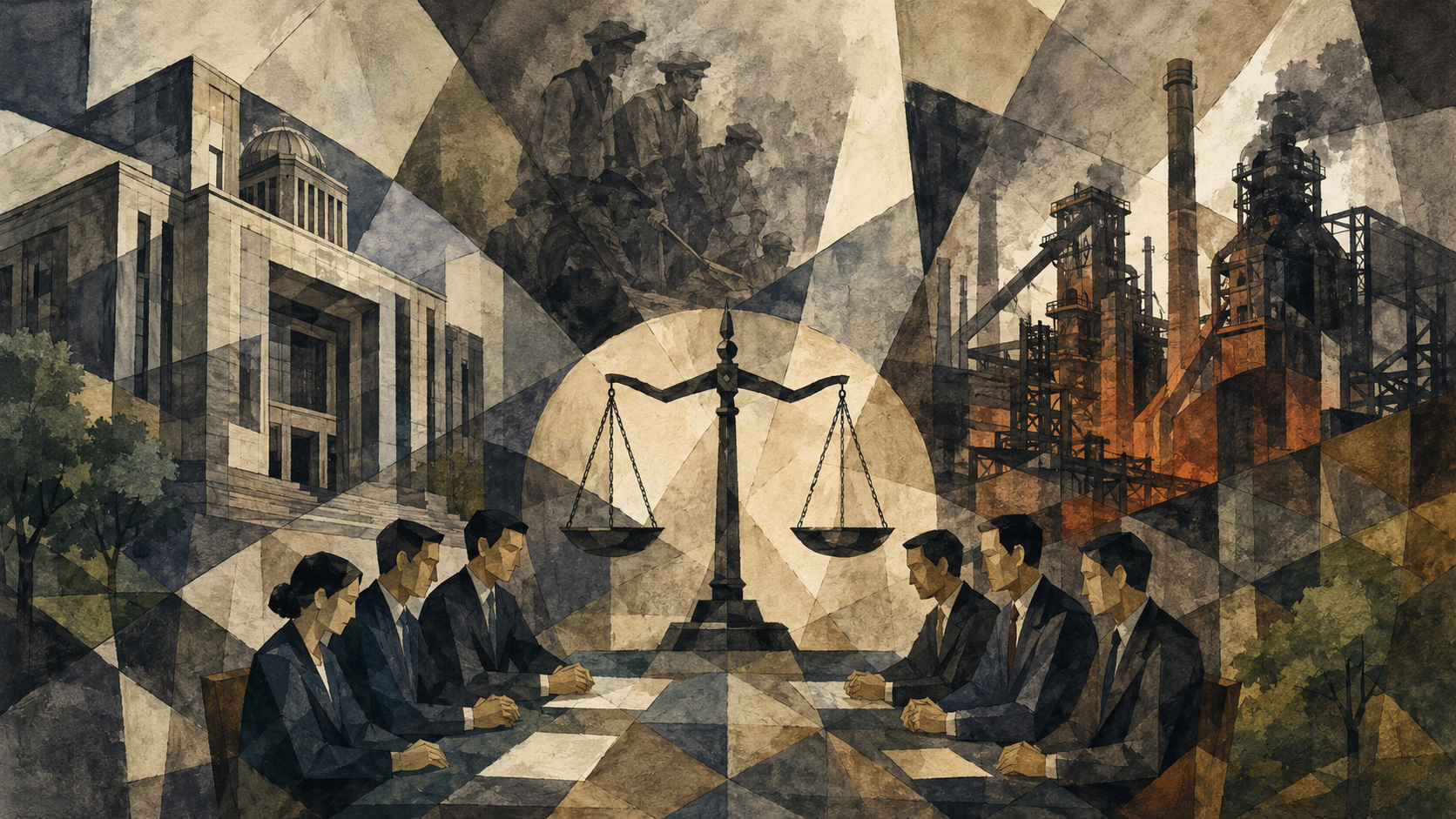
A courtroom can end an appeal. It cannot, by itself, end a disagreement between two states about what was settled sixty-one years ago.
On August 12, the Second Division of South Korea’s Supreme Court dismissed Nippon Steel Corporation’s appeal in case 2024Da288816. The ruling left intact a 2024 appellate judgment awarding a total of 80 million won—about ¥9 million at reporting-time conversions—to the family of the late Min Moon-sik. Five relatives brought the action; the result was recorded as a partial victory because the family had sought 100 million won.
The immediate legal issue was narrower than the great political dispute surrounding it. The Supreme Court did not take new testimony about a wartime steel mill. It did not renegotiate the 1965 claims agreement. It decided that the appellate court had correctly rejected Nippon Steel’s statute-of-limitations defense. That made the damages order final within South Korea’s judicial system.
Tokyo responded in the language of a different legal system. Masaaki Kanai, director-general of Japan’s Foreign Ministry’s Asian and Oceanian Affairs Bureau, made a formal representation to the deputy chief of mission at the South Korean embassy in Tokyo. He reiterated Japan’s position that claims of this kind were settled “completely and finally” by the 1965 agreement. The civil judgment and the diplomatic protest therefore arrived on the same day without answering the same question.
What the Supreme Court actually decided
The family filed its action on April 30, 2019. Ordinarily, Korean tort law places strict limits on a damages suit: a short period linked to knowledge of the injury and wrongdoer, and a longer outside period linked to the wrongful act. No ordinary calculation could simply begin in 1942 and arrive at a timely filing in 2019. The family’s case depended on a doctrine that prevents a defendant from invoking prescription when an objective obstacle made the practical exercise of the right impossible.
The trial court ruled against the family in February 2022. It accepted that such an obstacle had once existed, but treated May 24, 2012 as the point when it disappeared. On that date, the Supreme Court had reversed earlier lower-court losses in a separate Nippon Steel case and recognized a path for individual damages claims. If the three-year clock began then, the family’s 2019 filing was too late.
The appellate court reversed in 2024. The 2012 judgment, it reasoned, was a remand rather than the final resolution of the original plaintiffs’ rights. Years of further litigation followed. Only on October 30, 2018, when the Supreme Court sitting en banc finally affirmed damages against Nippon Steel, did the legal position become sufficiently settled to remove the practical obstacle. Min’s family sued six months later, within three years.
The August 12 panel found no error in that analysis. Its reasoning was consistent with a line of Supreme Court decisions issued in December 2023: until the 2018 full-bench judgment, victims could not realistically exercise these rights against Japanese corporations. The 2026 result therefore matters less as a new theory of treaty law than as another application of the court’s now-stable limitations rule.
| Question | Answer in the August 12 record | What it did not answer |
|---|---|---|
| Was the action out of time? | No. The operative obstacle lasted until the October 30, 2018 en-banc judgment; the family filed April 30, 2019. | Whether Japan accepts that doctrine or the underlying 2018 precedent. |
| What sum became final? | 80 million won in solatium, below the 100 million won requested. | When, from whom or by which mechanism cash will actually be received. |
| Who lost the appeal? | Nippon Steel; the Second Division dismissed its appeal. | Japan was not the corporate defendant, and no damages order was entered against the Japanese state. |
| Was the 1965 dispute settled? | The Korean precedent treats this category of tort claim as outside the agreement. | The two governments still have incompatible interstate interpretations. |
The life reduced to five months in a case file
Min Moon-sik was twenty-one when, according to the facts summarized by the Korean courts, he was taken to Japan and made to live as a laborer at the old Japan Iron & Steel Company’s Kamaishi works in Iwate Prefecture. The period recorded by legal reporting is unusually precise: February 9 to July 14, 1942. He escaped, moved among coal-mining areas and returned to Korea in 1945. He died in April 1989.
His relatives alleged that the old company’s conduct was bound to Japan’s unlawful colonial rule and war, that Min was separated from family protection and support, and that he performed dangerous work in harsh conditions. They sought solatium: damages for severe mental suffering and violation of dignity, not a calculation of five months of unpaid wages. The appellate court assessed 80 million won after considering the asserted illegality, Min’s age, the duration and intensity of work, the harm and Nippon Steel’s continuing denial of responsibility.
Those are the plaintiffs’ allegations and the findings on which the Korean judgment rests. They should not be carelessly enlarged. The public case summary does not supply a shift-by-shift account of Min’s job, wage ledger, dormitory, guards or route from Korea. Nor does it justify writing as though every Korean worker in Japan had the same recruitment history. Historical coercion can be real without every individual file being identical.
The date matters. Japan’s mobilization of Korean labor for work in Japan proceeded through changing administrative forms: company recruitment from 1939, more direct official placement beginning in 1942, and formal application of the National Requisition Ordinance from September 1944. Min’s transfer preceded the last category. Korean usage often places all three inside the broader system of forced mobilization because colonial authority, official pressure, deception, restricted movement and working conditions could make formally different routes coercive in practice. Japanese official usage stresses that “requisition” is technically inaccurate for pre-September 1944 cases.
- Forced mobilization / forced labor: the category used in the Korean litigation and by victims’ organizations to describe coercive colonial labor practices.
- Requisition or conscription: a narrower legal mechanism formally applied to Korean civilian labor from September 1944; Min’s 1942 dates precede it.
- Former civilian workers from the Korean Peninsula: Japan’s present official term, chosen to avoid accepting that every worker in the broader group was legally requisitioned or forcibly taken.
This vocabulary dispute is not cosmetic. If “conscripted” is used for everyone, a legal category is projected backward. If “worker” is used without the colonial structure or the family’s allegations, the coercion found by the Korean courts disappears. Precise chronology permits the two claims to be examined rather than smuggled into a noun.
Kamaishi: the furnace at the center of modern Japan
Kamaishi is an unusually charged setting for this case because the works occupies a foundational place in Japanese industrial memory. A western-style blast furnace was successfully operated in the Kamaishi area in 1857. The Meiji government began building a state steelworks there in the 1870s; the Tanaka enterprise achieved sustained private ironmaking in 1886. In 1934, Kamaishi was folded with Yawata and other operations into the state-sponsored Japan Iron & Steel Company.
Steel made railways, ships, factories and cities possible. In wartime it also made armor, weapons and the infrastructure of empire. By 1942, Japanese men had been pulled into military service and the total-war economy was reaching more deeply into Korea for labor. A twenty-one-year-old Korean and a famous northern mill met inside that machinery.
The corporate story did not stop in 1945. Occupation-era restructuring dissolved old Japan Iron & Steel in 1950 and divided major assets between Yawata Iron & Steel and Fuji Iron & Steel. Those companies merged in 1970 to form the modern Nippon Steel. It combined with Sumitomo Metal Industries in 2012 and adopted the current English and Japanese name in 2019.
That genealogy created a separate threshold dispute: could today’s Nippon Steel be liable for the old company? The Korean Supreme Court’s 2012 and 2018 decisions said yes, rejecting an argument that dissolution had severed responsibility. They viewed the successor as maintaining the old company’s economic identity despite changes imposed under postwar Japanese law. Japanese courts and the company had taken a different view in earlier proceedings. The 2026 panel inherited the Korean answer; it did not build that bridge anew.
The lawsuit before this lawsuit
Min’s family entered a path opened by four other men. In 1997, plaintiffs including Yeo Woon-taek and Shin Chun-su sued in Japan over labor at prewar Nippon Steel works. Japanese courts rejected their claims, and Japan’s Supreme Court ended that litigation in 2003. The plaintiffs sued again in Seoul in 2005.
Korean trial and appellate courts initially dismissed the case. On May 24, 2012, however, South Korea’s Supreme Court reversed. It said recognition of the Japanese judgment would conflict with the fundamental values of the Korean constitutional order; held that the modern company could be treated as the successor; and ruled that the relevant tort claims were not extinguished by the 1965 agreement. On remand, the Seoul High Court awarded 100 million won to each plaintiff in 2013.
Then the case waited more than five years at the Supreme Court. On October 30, 2018, an eleven-to-two full bench affirmed. Lee Chun-sik, by then the only surviving original plaintiff, was present to see a judgment that the others had not lived to receive. The wait later became legally consequential: it is why the current court treats 2018, rather than the provisional victory of 2012, as the moment an ordinary claimant could realistically sue.
1910–1945 Japan rules Korea as a colony.
February–July 1942 Min works at Kamaishi, escapes and later moves among mining areas.
June 22, 1965 Japan and South Korea sign the normalization treaty and claims agreement.
1997–2003 Separate Nippon Steel plaintiffs litigate and lose in Japan.
2005 They bring a new action in South Korea.
May 24, 2012 The Korean Supreme Court reverses their lower-court losses and remands.
October 30, 2018 The full bench affirms 100 million won for each of four original plaintiffs.
April 30, 2019 Min’s family files its action.
February 2022 The trial court dismisses it as time-barred.
2024 The appellate court reverses and awards 80 million won.
August 12, 2026 The Supreme Court dismisses Nippon Steel’s appeal.
The 1965 settlement: one text, two architectures
Japan and South Korea spent roughly fourteen years negotiating normalization after the Korean War and the end of Japanese colonial rule. On June 22, 1965, they signed a Treaty on Basic Relations and four associated agreements. The claims agreement entered into force on December 18.
Article I committed Japan to provide products and services worth $300 million as grants over ten years and to extend up to $200 million in long-term loans. Article II supplied the famous finality clause. The parties confirmed that problems concerning their property, rights and interests and those of their nationals, and claims between the parties and their nationals, were “settled completely and finally.” Subject to stated exceptions, it added that no contention could be made over claims arising from causes before signature.
The agreed minutes also linked that settlement to South Korea’s “Eight Items,” a negotiating list that included outstanding receivables, compensation and other claims of requisitioned Koreans. South Korea subsequently distributed a portion of the grant through domestic legislation, initially concentrating compensation on families of people who died during mobilization. Later Korean laws broadened support for survivors and families.
What the text did not contain was a jointly accepted verdict on the legality of colonial rule. The 1965 basic treaty declared earlier agreements between Japan and Korea “already null and void,” a phrase whose temporal meaning the two governments understood differently. The claims agreement called the $500 million economic cooperation, not reparations premised on an admission of unlawful colonization. That unresolved historical premise became decisive half a century later.
| Korean Supreme Court majority | Government of Japan |
|---|---|
| The plaintiffs seek solatium for torts directly connected to unlawful colonial rule and aggressive war, not merely unpaid wages or an ordinary financial claim. | The agreement covers claims between the states, their nationals and each other’s nationals, and uses categorical language: “completely and finally.” |
| The agreement was principally a political settlement of financial and civil debt-credit relations; it did not settle damages premised on colonial illegality that Japan did not accept in the negotiations. | The agreed minutes expressly include the Eight Items, which covered compensation and other claims of requisitioned Koreans; changing the label to solatium cannot remove such claims from Article II. |
| Therefore this particular right to claim damages falls outside the agreement, and a Korean court may enforce it against the corporate successor. | Therefore South Korea must prevent enforcement against Japanese companies and remedy what Tokyo regards as a breach of international law. |
The dissent inside the 2018 Korean court is important. Two justices concluded that the agreement did cover the claims. They read the text, negotiating history, Eight Items and South Korea’s later compensation statutes together. In their view, the agreement did not necessarily erase an individual claim as an abstract domestic-law right, but it prevented judicial enforcement against Japan or Japanese nationals. That distinction resembles an important nuance in Japan’s own historical statements: Japanese officials have at times said they were not asserting that every individual claim vanished metaphysically, while maintaining that the treaty removed any legal avenue for satisfaction.
Thus “the individual right survived” does not by itself settle the dispute. A right may conceptually exist while its enforceability is barred; alternatively, it may be a distinct human-rights tort never placed inside the bargain. The Korean majority chose the second architecture for these cases. Japan insists on the first. No jointly accepted international tribunal has decided between them.
Tokyo’s protest: precise, formal and limited
After the August 12 judgment, Kanai communicated Japan’s established position to the South Korean embassy’s deputy chief of mission in Tokyo. The démarche was directed to Seoul because international responsibility belongs to states even though Nippon Steel—not Japan—was the defendant in the civil suit.
Japan’s formal position, repeated since 2018, is that the rulings clearly violate Article II, inflict unjustifiable burdens on Japanese companies and overturn the legal foundation of bilateral relations built since normalization. In 2019 Japan invoked Article III of the agreement, first requesting diplomatic consultations and then an arbitral panel. The panel was never constituted because the two sides did not complete the appointment process. Japan also raised the possibility of international adjudication, but the dispute has not produced an International Court of Justice merits judgment.
That institutional gap matters. Calling the Korean judgment a violation of international law accurately states Japan’s official position; it is not the holding of a neutral international court. Calling the claims excluded from the agreement accurately states binding Korean precedent; it is not a treaty interpretation accepted by Japan. Responsible reporting attributes both.
It also matters that Tokyo’s protest was not an appeal. A foreign ministry cannot reverse a South Korean judgment. Seoul’s executive cannot simply instruct the Supreme Court how to decide a private case. Diplomacy instead operates on the consequences: who pays, whether seized assets are sold, whether a domestic foundation substitutes for the company, and whether the two governments prevent one ruling from destabilizing the wider relationship.
The 2023 bridge—and the weight placed upon it
In March 2023, President Yoon Suk Yeol’s administration announced a third-party payment plan. A South Korean government-affiliated foundation would pay the principal and delay interest in the 2018 judgments from private donations, without requiring the defendant Japanese companies to contribute. Seoul said the foundation would also cover pending cases, as of the announcement, if plaintiffs later obtained final victories.
Japan welcomed the measure as a way to return relations to a healthy footing and reaffirmed earlier cabinet statements on history, including the 1998 Japan–South Korea joint declaration. It did not change its 1965 legal position or accept corporate liability. Most eligible plaintiffs in the original group accepted foundation payments; some refused because they wanted payment and apology from the companies found liable.
The plan improved diplomatic room for security, trade and travel, but it did not erase the judgments. Its legal logic depends on a third party discharging the debt. Its moral legitimacy depends on the creditor accepting a remedy from someone other than the adjudged wrongdoer. Its practical life depends on donations. By December 2024 the foundation had paid 21 plaintiffs, according to Japan’s diplomatic record. Successive new judgments increased concern that its funds would not be enough.
President Lee Jae-myung’s government has indicated that it intends to maintain the framework even though Lee opposed it as an opposition leader. The 2026 award is precisely the kind of later final judgment the 2023 announcement contemplated. But inclusion is not the same as payment: the family’s choice, the foundation’s capacity and the legal treatment of the debt all still matter.
There is a second possible route. The family says it obtained a provisional order against Nippon Steel’s South Korean PNR shares after the appellate victory. Other plaintiffs have spent years pursuing seizure and liquidation of Japanese corporate assets. A sale could produce payment directly through enforcement, but it could also trigger an acute diplomatic crisis. Courts move by creditor application and procedure; governments move by warnings about the relationship. Neither clock is fast.
What money can—and cannot—finish
Eighty million won is the operative judicial remedy, but the family’s statement outside court was about more than money. Min’s son, Min Byeong-jo, said his father had tried in life to obtain relief and found no path. The son described the suit as an effort to restore his father’s honor and asked Nippon Steel to accept the judgment, apologize and compensate promptly.
A damages payment from the company, a foundation payment and a court-ordered asset sale can deliver the same numerical principal while carrying radically different meanings. Direct payment may signify acceptance of responsibility. Foundation payment prioritizes material relief and interstate stability while leaving liability denied. Compulsory execution vindicates judicial authority but may deepen diplomatic conflict. A claimant can reasonably care which road the money travels.
Japan’s concern is also larger than 80 million won. If the category is outside the 1965 settlement, an apparently final bargain cannot give Japanese companies closure against an expanding group of actions. Treaty reliability and protection from repeated liability are the center of Tokyo’s argument. For plaintiffs, the center is opposite: a state-to-state bargain that never addressed the wrong they allege should not silence the individual who suffered it.
These positions can be described without pretending they are symmetrical in every moral or historical respect. Korea was colonized; Japan was the colonial power. The workers did not negotiate the 1965 agreement. Yet a treaty between today’s sovereign states is also law, not merely public relations. The dispute persists because historical asymmetry and legal finality make different claims on the present.
A judgment final in one system, unfinished in another
Three things now deserve watching. First is satisfaction: whether Nippon Steel pays, the foundation offers payment, the family accepts it or enforcement against PNR proceeds. Second is accumulation: every later case tests the foundation’s resources and strengthens the Korean limitations precedent. Third is diplomacy: whether Tokyo and Seoul continue to contain these judgments while preserving cooperation that both governments regard as strategically important.
The August 12 decision has genuine legal force. In South Korea, Nippon Steel’s appeal is over and an 80 million won debt has been judicially confirmed. It is equally true that the cash has not necessarily moved, the Japanese government rejects the premise and the two states have not produced a shared treaty interpretation.
That is not a contradiction. Courts, companies, claimants and governments occupy related but different planes. A civil court assigns liability between private parties under its law. A family asks for memory and dignity. A corporation contests succession, scope and time. Two states defend rival accounts of a bargain made in 1965.
The steel at Kamaishi was made by forcing separate materials into one furnace. History does not fuse so easily. Min Moon-sik’s five months passed through colonial administration, wartime industry, corporate reconstruction, normalization diplomacy and sixty years of litigation before reaching a final judgment. On August 12, one legal clock stopped. The others kept running.
Reporting Notes and Principal Sources
This article distinguishes allegations, findings and official positions. Public information was cross-checked through August 13 at 9:52 AM Japan Standard Time. Currency equivalents in contemporary reports are approximate; the judgment itself is denominated in Korean won.
- Supreme Court of Korea: August 12 case notice and judgment, 2024Da288816
- Law Times: case facts and trial, appellate and Supreme Court holdings
- Yonhap: detailed ruling, family response, enforcement and third-party-payment context
- Jiji Press via Nippon.com: Japanese reporting on the final judgment
- Kyodo News via Livedoor: Japan’s August 12 diplomatic representation
- Supreme Court of Korea: English text of the October 30, 2018 en-banc decision, 2013Da61381
- American Journal of International Law: Yeo Woon Taek v. New Nippon Steel case note
- United Nations Treaty Series: 1965 Claims Agreement, protocols and agreed minutes
- Ministry of Foreign Affairs of Japan: October 30, 2018 statement on the Nippon Steel judgment
- Ministry of Foreign Affairs of Japan: background and official position on former civilian workers
- Ministry of Foreign Affairs of Japan: response to South Korea’s March 6, 2023 measures
- Japan Diplomatic Bluebook 2025: foundation payments and later judgments
- International Labour Organization Committee of Experts: wartime industrial forced labor observation
- Northeast Asian History Foundation: recruitment, official placement and 1944 requisition chronology
- Nippon Steel: official corporate chronology
- Nippon Steel: Kamaishi and corporate-history chronology