A day measured from shrine hill to harbor and back
The official day begins above the port. A departure rite is scheduled for 9:45 a.m. at the top of the main approach to Shiwahiko and Shiogama shrines. Shiogama City’s July 13 program lists the city procession from 10:58, with departure from West Wharf at 12:15 p.m., return to the same wharf at 5:25 and the final return toward the shrine from the foot of the approach at 7 p.m. Times can move as carriers, crews, tides, weather and street operations meet in one long ritual.
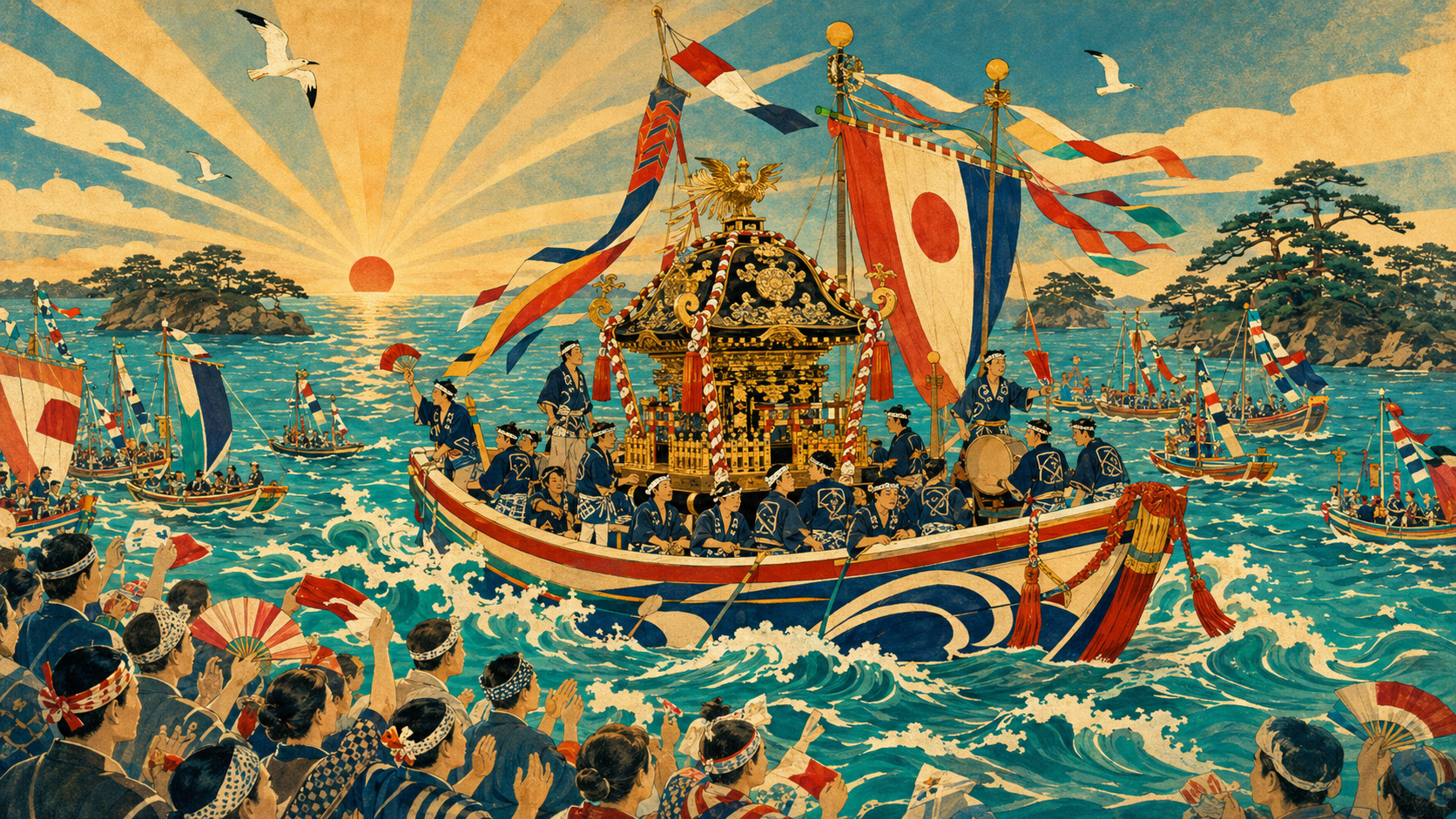
The city’s official 79th-festival page supplies the working clock. The festival committee’s more detailed festival notice explains the formation: Ryūhō Maru, carrying the Shiwahiko Shrine mikoshi, is scheduled to leave at 12:15; Hōō Maru, carrying the Shiogama Shrine mikoshi, follows at about 12:20. Around 70 escort boats turn the crossing into a moving field of streamers and tairyōbata, the multicolored flags of an abundant catch.
| Time | Official program for July 20 | Where and what to know |
|---|---|---|
| 9:45 a.m. | Departure rite | Top of the main approach at Shiwahiko and Shiogama shrines. |
| About 10:30–10:58 | Mikoshi descend and city procession begins | Program descriptions use slightly different markers; the city’s current timetable lists 10:58 for the city circuit. |
| 12:15 p.m. | Ceremonial vessels depart | West Wharf, east of Marine Gate Shiogama; departure performances precede sailing. |
| 1:00 p.m. | Land-parade opening | Honchō, Nishimachi and the streets below the shrine. |
| 2:00 / 3:10 p.m. | Student / general parade divisions | Dance and performance continue while the mikoshi are at sea. |
| 5:10 p.m. | Parade awards | Published times may shift with conditions. |
| 5:25 p.m. | Two vessels return side by side | West Wharf; first planned parallel return for the current pair, on their final voyage. |
| 7:00 p.m. | Final return begins from shrine foot | The mikoshi are carried back up toward the shrines. |
Two mikoshi, two vessels, two sea routes
The two mikoshi do not become decorative cargo. Each is formally installed aboard a vessel reserved for the rite. The Shiwahiko mikoshi boards Ryūhō Maru; the Shiogama mikoshi boards Hōō Maru. Five-color streamers rise above the vessels, while flags on the escort boats multiply the visual movement across the bay.
Current local program material assigns Ryūhō Maru the wider circuit toward Shichigahama, Matsushima and the Urato islands, while Hōō Maru performs the Shinhamacho-area sea visitation. Routes and timings remain operational matters, not promises to pass every viewing point at a fixed minute. The city decides whether the sea procession can proceed at 7 a.m.; cancellation is posted only if the answer is no.
Visitors cannot normally board with the mikoshi. The official FAQ says passage is principally limited to shrine personnel. The safest public vantage is the West Wharf and Marine Gate area for departure and return, while the moving fleet can also be encountered from parts of the bay route. Spectators must respect working-wharf restrictions rather than following the procession into controlled space.
The last run of Ryūhō Maru and Hōō Maru
The emotional center of the 79th festival is retirement. City project documents identify Ryūhō Maru as a 1964 vessel and the present Hōō Maru as a 1965 vessel. Both have been repaired repeatedly before festival season, but after more than six decades their aging structures need replacement.
Shiogama describes the pair as Japan’s only vessels dedicated to carrying mikoshi in a festival. That claim is narrower than saying no other Japanese festival places a shrine on a boat. What is distinctive is a matched pair of purpose-specific ceremonial vessels maintained for this annual sea crossing.
The city and festival committee are preparing replacements for the 80th festival in 2027. The official new-vessel project makes the sequence explicit: the old pair have passed sixty years; two new vessels are planned for unveiling next year. In 2026, the innovation belongs to the farewell. For the first time, the current vessels are scheduled to return to West Wharf in parallel rather than one behind the other.
A vessel can be rebuilt without making its tradition automatic. New hulls will still need maintenance, crews, shrine coordination, escort boats, route knowledge and public support. The fundraising project is therefore about more than replacement hardware. It transfers responsibility from one generation of port labor to the next.
A Coast Guard opening is listed—but details remain provisional
The national 38-page Marine Day and Sea Month program, dated June 23, lists a free public opening of a Japan Coast Guard patrol craft as part of the 79th Shiogama Port Festival. The entry does not name the craft or give public hours. More importantly, Shiogama City’s updated July 13 festival page does not include a separate Coast Guard timetable.
That difference must remain visible. It is reasonable to report a planned Coast Guard craft opening; it is not reasonable to invent a vessel name or boarding window. Visitors interested primarily in the opening should confirm directly with the organizer or Miyagi Coast Guard authorities before setting out. Operational ships can be withdrawn for missions, weather or security.
The program still fits the port. Shiogama’s planning documents describe four major faces: commercial port, fishing port, sightseeing port and disaster-response port. Marine Gate ferries represent passenger and island access; markets and processors represent fisheries; warehouses and tank facilities represent trade; and Coast Guard vessels give the disaster-response role a public form.
Sunday night: fireworks on Chiga-no-Ura
The festival opens on July 19 with a separate waterfront night. The published program schedules fireworks from 8 to 8:40 p.m. over Shiogama Port, including a water-level star mine and creative displays. The festival committee describes roughly 8,000 shots. Main viewing areas include Marine Gate Shiogama and Wandafuru Shiogama Seaside Park, also called Kitahama green space.
Because the fireworks were subject to a 2 p.m. same-day go/no-go announcement, this article—researched before that decision—does not treat their completion as verified. Sunday’s wider program was due to begin at 3 p.m. with exchange-city booths, a Chiga-no-Ura green-space stage at 4 and vendor areas through 9.
The separation matters. Fireworks make the port a viewing surface; the next day’s mikoshi makes it a route. One asks the public to look across the water, the other asks vessels to cross it. Together they turn a harbor into both stage and sacred geography.
The land parade keeps the city active while the gods are at sea
When the ceremonial fleet leaves, the city does not wait in silence. The land parade opens at 1 p.m. around Honchō, Nishimachi and the streets below the shrine. The student division begins at 2, the general division at 3:10 and awards are scheduled from 5:10. The city warns that both times and content can change with weather.
The principal dance is Yoshikono Shiogama, a postwar festival creation that became part of the city’s public identity. Shiogama-jinku and Hatto-se dancing add older port-song rhythms. Children, schools, neighborhood groups and adult teams turn the hours of the sea procession into a second, land-based circuit.
This division of movement is central to the festival’s design. The sea rite connects shrines, vessels and islands. The parade fills the temporary absence with civic performance. At day’s end, the two paths close: vessels return, parade awards are made, mikoshi re-enter the streets and carriers face the final ascent.
1948: industrial recovery and exhausted citizens
The first Shiogama Port Festival was held in 1948. The festival committee’s history gives two purposes with unusual directness: restore the port city’s industry and restore the spirits of citizens exhausted after the war. The first date, July 10, aligned with Shiogama Shrine’s annual festival while belonging to the wider observance of Marine Memorial Day.
That origin explains why shrine rite and citizen festival cannot be separated cleanly. The mikoshi provided sacred continuity; port organizations, businesses and residents supplied a modern reconstruction event. The sea crossing carried a deity, but it also demonstrated that boats, crews and a damaged city could once again act together.
Organizers call it the first mikoshi sea procession in Tohoku. It is also counted locally as one of Japan’s three major boat festivals, alongside the Kangen-sai of Itsukushima Shrine on Miyajima and the Kibune Festival in Manazuru. Such labels are cultural groupings rather than official national rankings, but here they express how Shiogama understands the scale and distinctiveness of its fleet.
Why the deity goes to sea
Shiogama Shrine’s principal sacred geography joins salt, navigation and settlement. Its separate sanctuary enshrines Shiotsuchi-Oji-no-Kami; the left and right sanctuaries enshrine Takemikazuchi-no-Kami and Futsunushi-no-Kami. The shrine identifies its traditions with saltmaking, fisheries, traffic safety and maritime safety as well as household and childbirth protection.
Festival history interprets Shiotsuchi-Oji-no-Kami as the guide who came by sea and remained in this place. Taking the deity out over the water once a year becomes an act of thanks and a prayer for safe navigation and plentiful catch. The movement is not a generic blessing transplanted to an attractive bay. It follows the character of the deity and the occupations of the town.
Shiwahiko Shrine has a different emphasis. Its deity is associated with agriculture, development of the land, industry and commerce. The shrine was transferred into the Shiogama precinct in the modern period because of an understood divine connection with the deities of Shiogama Shrine’s left and right sanctuaries. When the two mikoshi descend in one line, land development, production, salt, fisheries and navigation enter the port together.
From one vessel to the paired procession
At the first festivals, the Shiogama Shrine mikoshi traveled aboard a vessel named Hōō Maru. Historical photographs show an earlier vessel with a temporary ceremonial superstructure. The tradition did not arrive in 1948 already fixed in its present form.
In 1964, Ryūhō Maru was added and two-vessel sea processions began. The current Hōō Maru, built in 1965, is the second vessel of that name in the festival record. Their near-matched ages represent a moment when a reconstruction festival acquired purpose-built infrastructure and a dual-shrine formation.
Escort-fleet size has varied. Historical accounts often say about 100 boats or more; the current 2026 guidance says about 70. That is not a diminished ritual by definition. Every escort requires a seaworthy vessel, operator, fuel, decoration, coordination and safe spacing. The number makes visible the labor of sustaining a tradition on an actual bay rather than in a static costume display.
A port older than the festival—and older than the modern city
Shiogama’s name reaches into its maritime landscape. The city explains shiogama as a hearth or kiln used to boil seawater for salt. The place was also known as Kōzu, “the port of the provincial capital,” because it served inland Tagajō, the ancient administrative center of Mutsu Province.
Under the Date domain, the harbor functioned as a major port for Sendai. In 1689, Matsuo Bashō’s journey recorded travel by boat from Shiogama toward Matsushima. The bay was already sacred scenery, transport network, fishing ground and an inhabited archipelago long before a festival fleet formalized those meanings.
Modernization added rail and industrial port functions. The city identifies an 1886 freight line linking Shiogama harbor and Sendai as Tohoku’s first railway. Later the harbor became a base for coastal and distant-water fishing, fish processing, trade and passenger traffic. Marine Gate Shiogama, opened in 1996, now makes the older role of gateway to Matsushima and the Urato islands legible to visitors.
Four ports occupy one harbor
City planning describes Shiogama Port as four overlapping ports. The commercial face includes warehouses, international cargo activity and petroleum distribution. The fishing face joins the market, processing district and a reputation for fresh coastal tuna. The sightseeing face sends excursion and municipal boats toward Matsushima Bay and the inhabited Urato islands. The disaster-response face centers Coast Guard presence and resilient port infrastructure.
The festival activates all four without becoming identical to any one. Commercial and fishing vessels become escorts; the tourist waterfront becomes the public viewing edge; Coast Guard activity enters Marine Day education; and emergency planning determines whether the fleet can sail. The religious route succeeds only because a working port supplies crews, berths, repairs, radio discipline and weather judgment.
This is the deeper meaning of the current vessels’ age. Ryūhō Maru and Hōō Maru are ceremonial, but they have survived because a shipbuilding and repair culture remains close enough to inspect them. Ritual floats can be stored in a shed. A vessel that carries a mikoshi into Matsushima Bay must remain a vessel.
2011: the fleet carried mourning and recovery
The Great East Japan Earthquake and tsunami struck four months before the 64th festival. The tsunami lifted Ryūhō Maru onto a quay, though city history says it escaped major damage. The eve fireworks were canceled. The sea procession was shortened, but it went ahead with prayers for the dead and hopes for reconstruction.
The decision was continuous with 1948. The festival had begun to repair industry and public morale after war; in 2011 it again used collective maritime action to answer destruction. City history also notes reduced or partial programs after the 1960 Chilean-tsunami damage and the 1978 Miyagi offshore earthquake. Persistence did not mean pretending conditions were normal. It meant adapting the rite without abandoning its public function.
That record helped earn recognition. Fisheries authorities selected the festival in 2006 for a national collection of fishery and fishing-village historical cultural assets. In the 2014 fiscal-year Furusato Event Awards, it received the top Prime Minister’s Award, cited for citizen participation and local vitality. The award did not create the tradition; it recognized the social machinery that kept it moving.
Marine Day is the modern calendar, not the beginning
Today’s national holiday began in 1996 and moved to the third Monday of July in 2003. Shiogama’s festival is nearly half a century older. Its first edition referred to Marine Memorial Day, the non-holiday predecessor commemorating Emperor Meiji’s 1876 return aboard Meiji Maru, but it was held on July 10 with the shrine festival.
In 2026, the third Monday happens to fall on July 20, the historic date of the national maritime observance. The calendars briefly align: an old local festival, a postwar civic institution and the modern national holiday share one day without sharing one origin.
Planning the visit
JR Senseki Line’s Hon-Shiogama Station is the practical rail gateway. City guidance gives about ten minutes on foot to Marine Gate Shiogama and West Wharf. From JR Tohoku Main Line’s Shiogama Station, allow about 30 minutes to the waterfront and about 25 minutes to the land-parade area. There is no dedicated visitor parking.
The sea-procession decision is made at 7 a.m.; only cancellation is posted. The current city page says the land-parade decision will be made by 1 p.m. Times can change. ShioNavi city buses are scheduled to run normally, while New ShioNavi is suspended. Crowding, heat and controlled wharf access make rail the safer plan.
| Visitor question | Answer for July 20, 2026 |
|---|---|
| Where is the vessel departure? | West Wharf, east of Marine Gate Shiogama; scheduled for 12:15 p.m. |
| Best station? | Hon-Shiogama on the JR Senseki Line, about ten minutes on foot to the wharf. |
| Can visitors ride with the mikoshi? | No general boarding is announced; the official FAQ limits passage principally to shrine personnel. |
| When do the vessels return? | Scheduled for 5:25 p.m., side by side at West Wharf. |
| Where is the land parade? | Honchō, Nishimachi and the streets below Shiwahiko and Shiogama shrines. |
| Is the Coast Guard craft open? | Listed as a free planned opening in the June 23 national guide, but no vessel or hours appear on the city’s latest program. Reconfirm. |
| Parking? | No dedicated visitor parking. Use public transport. |
| What must be checked that morning? | Weather decisions, route and time changes, wharf restrictions and Coast Guard opening status. |
The final return is also a beginning
At West Wharf this afternoon, the most important sight may come after the outward spectacle. Two aging vessels are scheduled to appear together on the return leg, not because the ritual has always required it, but because this is their last chance. Parallel motion becomes a public farewell.
The mikoshi will leave the vessels and return to human shoulders. The harbor’s mechanical labor gives way to the physical labor of carriers climbing toward the shrine. That transfer—from shrine to street, street to hull, hull to bay, then back again—is the festival’s grammar.
In 2027, new vessels are planned to take the names. What returns will be visually new and institutionally continuous. The 79th festival stands at the seam: the last voyage of the hulls built when the paired procession was young, and a rehearsal for the responsibility of carrying it beyond eighty.
| Year | Festival, vessel or port milestone | Meaning in 2026 |
|---|---|---|
| Ancient era | Shiogama serves as Kōzu, port of the provincial capital at Tagajō. | Sacred and administrative sea routes predate the modern harbor. |
| 1689 | Bashō travels from Shiogama toward Matsushima by boat. | The bay is both transport route and celebrated landscape. |
| 1886 | Freight railway connects Shiogama harbor and Sendai. | Modern port infrastructure joins the older gateway. |
| 1948 | First port festival seeks industrial recovery and renewed civic spirit. | The event begins as postwar reconstruction, not as a tourist show. |
| 1964–65 | Ryūhō Maru and the present Hōō Maru enter the tradition. | The paired, purpose-built procession takes its lasting form. |
| 2011 | Tsunami damages the port; shortened sea procession proceeds with mourning and recovery prayers. | Adaptation becomes part of the festival’s historical meaning. |
| 2014 fiscal year | Prime Minister’s Award in the Furusato Event Awards. | National recognition follows citizen participation and resilience. |
| 2026 | Current vessels make their final run and first parallel return. | The 79th festival becomes a public handover. |
| 2027 planned | Replacement vessels debut at the 80th festival. | New hulls inherit old names and responsibilities. |
Principal sources and further reading
- Shiogama City, official 79th Port Festival page: July 19 fireworks, July 20 mikoshi and land-parade schedules, weather decisions, access and 2026 final-voyage return.
- Festival committee, 2026 program: roughly 8,000 fireworks, separate vessel departures, about 70 escort boats and parallel return.
- Shiogama Tourism and Products Association, current procession guide: five-color streamers, flags and the approximate escort-fleet size.
- Japan Maritime Public Relations Center, national 2026 Marine Day event list: planned free Coast Guard patrol-craft opening; the listing gives no craft name or hours.
- Shiogama City, ceremonial-vessel replacement project: vessel age, repair history and planned 2027 unveiling.
- Festival committee, history of the Shiogama Port Festival: 1948 reconstruction purposes, first sea procession, three-boat-festival grouping and the religious interpretation of the route.
- Shiogama City magazine, 70th-festival history: timeline, 2011 operation, vessel damage, 2006 cultural-asset selection and 2014-fiscal-year award.
- Shiwahiko and Shiogama shrines, official history: enshrined deities and traditions of salt, fisheries, development, industry and traffic safety.
- Shiogama City, the character 竈 and place-name history: saltmaking hearth and Kōzu, the port of the provincial capital.
- Shiogama City profile: ancient, Date-domain, modern fishing and sightseeing-port history, the 1886 railway and Urato islands.
- Shiogama urban planning document: commercial, fishing, sightseeing and disaster-response faces of the port.
- Festival committee FAQ: same-day decisions, departure location, boarding limits, buses and public transport.
Editor’s note: Research closed on July 18, 2026, Japan time. The July 19 fireworks still required a same-day decision and are described as scheduled, not verified as completed. The Coast Guard craft opening appears in the national June 23 program but lacks a vessel name and operating hours on the city’s updated page; visitors should reconfirm. Historical escort fleets are often described as about 100 boats, while the 2026 program says about 70. All sea and street times can change. The hero image is an editorial illustration, not a record photograph.