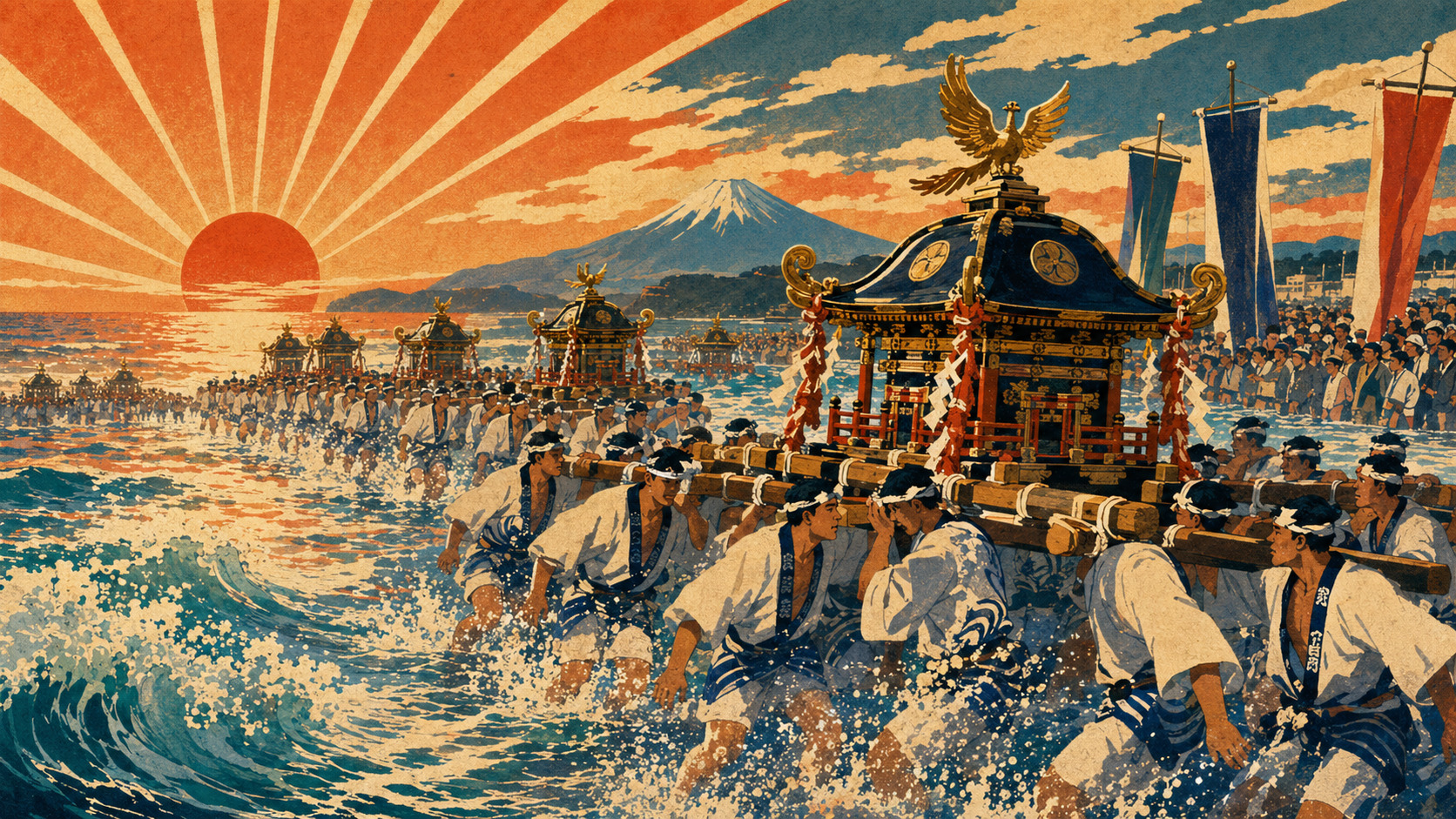
The festival begins while the city is asleep
Before Chigasaki becomes a beach city, it becomes a city of bells. Shrine doors open around midnight. Lanterns move through dark neighborhoods. Bearers settle two long poles onto their shoulders, and the first calls of “Dokkoi! Dokkoi!” strike walls and station arcades that will be ordinary commuter space again a few hours later.
The city’s 2026 program fixes the destination: Chigasaki Nishihama beach, west of Chigasaki Fishing Port and beyond Southern Beach Chigasaki. Thirty-four shrines in Chigasaki City and Samukawa Town are sending 38 mikoshi. The first is expected just after 4 a.m. The formal joint ceremony opens at 7. From 8, the lead mikoshi begin the journey home.
“Charge the sea” describes the emotional image, not a single synchronized maneuver. Mikoshi arrive over several hours. Their bearers wheel and surge on the sand, and some enter the surf during arrival or the departure called otachi. Chigasaki City specifically cautions that sea entry depends on conditions; wind, waves or judgment on the day can keep a mikoshi out of the water. The ritual’s power does not require visitors to mistake danger for authenticity.
Three places, one night-to-morning procession
The beach is the final convergence, not the only event. The city identifies three public vantage points that reveal different scales of the festival. Someone who watches from the station encounters separate neighborhood shrines becoming a procession; someone at Nango sees streams of mikoshi merge; someone on the beach sees the full ritual assembly.
| Approximate time | Place | What happens |
|---|---|---|
| Around midnight | Participating shrines | Miyadashi: the mikoshi leave their home shrines. Individual shrine times vary. |
| 2:00–3:00 a.m. | Chigasaki Station north rotary | Mikoshi from Honson Yassaka Shrine, Jukkenzaka Dairokuten Shrine and Shinmachi Itsukushima Shrine circle the illuminated station forecourt. |
| 4:00–5:00 a.m. | Nango Chuo intersection and Teppomichi | Processions from the Tsurumine, central Chigasaki and Nango districts meet as dawn reaches the city. |
| Just after 4:00 a.m. | Nishihama beach | The first mikoshi enters the festival ground; others arrive in succession. |
| 5:00–7:00 a.m. | Nishihama beach | Most arrivals, movement on the sand and possible entry into the surf. |
| 7:00 a.m. | Beach ceremonial ground | The Hamaori joint rite opens with prayers and offerings. |
| From 8:00 a.m. | Beach to home districts | Otachi: lead mikoshi depart, often the most likely period to see sea purification. |
| Around 9:00 a.m. | Nishihama | The beach program concludes as shrine processions continue home. |
For Samukawa Shrine, the day is longer still. Its 2026 shrine notice schedules a departure rite at 2:30 a.m., the beach rite at 7, an otabisho rite in front of the Samukawa Town Chamber of Commerce at 10:15 and the return ceremony at noon. A festival seen by spectators as four dramatic beach hours is, for each shrine community, an all-night circuit of departure, purification, return and neighborhood blessing.
What is being purified?
A mikoshi is not simply a decorated object or parade float. In Shinto festival practice it is a temporary vehicle for a shrine’s kami. The procession carries sacred presence from the shrine through its community. Kanagawa Prefecture’s cultural-property account explains Hamaori as a rite in which the sacred presence, mikoshi and people receive salt water: the water removes kegare—ritual impurity—and restores weakened spiritual vitality.
The festival ground makes that theology physical. Samukawa Shrine’s illustrated history describes a route through two torii gates, a turn toward the water for purification, then passage through a third gate to the waiting places. The sea is not a backdrop. The procession changes direction for it.
The prefecture also records an intimate preparation easily lost behind the mass scene. On the day before the festival, the Suzuki family of Nango—an old local household tied to the founding legend—prepares Samukawa Shrine’s sacred resting place. Sand is raised in a square, green bamboo stands at the corners, a shimenawa sacred rope is hung with seaweed, and branches of the coastal plant hamagou are laid beneath. A yellowtail fish is offered as sacred food, followed by tamagushi offerings.
The plants make the coast part of the rite. Samukawa Shrine’s historical pamphlet says hondawara seaweed and hamagou, once common on the Chigasaki shore, continue to be used. Because wild hamagou became scarce locally, the family cultivates it in its garden. Cultural continuity is sometimes carried not by a monument but by keeping one sand-loving shrub alive.
The 1838 story: a lost mikoshi and a fisherman
The festival’s best-known origin story begins after another great Sagami rite. In 1838, Samukawa Shrine’s mikoshi was returning from the annual Komachi festival at Oiso. At the Banyu crossing of the Sagami River, a quarrel broke out among shrine supporters. The mikoshi fell into the swollen river and disappeared toward Sagami Bay.
Days later, according to the tradition, a Nango fishing-net master named Suzuki Magoshichi found the mikoshi while fishing and reported it to Samukawa Shrine. In gratitude, the shrine began—or redirected—its purification journey to the Nango shore. The Suzuki household became keeper of the beach stopping place, and its heads inherited the name Magoshichi. Samukawa Shrine’s current history says the line has reached its tenth generation.
The shrine’s account preserves sharper details than the compressed legend. It says a reward of 300 koku was offered across the Shonan coast for the search—a striking figure beside the shrine’s 100-koku Edo-period estate. It also connects the quarrel to the surviving chonmage-zuka, a mound associated with the topknots cut from men who escaped execution through a magistrate’s mercy. These are elements of transmitted shrine history, not a modern court record reconstructed in full, and should be read with that distinction.
But the sea rite is older than the accident
The 1838 recovery story does not settle the beginning. Chigasaki City and the tourism association explicitly present multiple traditions. The late-Edo Shinpen Sagami no Kuni Fudokikō, a shogunate-sponsored geography, records Tsurumine Hachimangu’s procession to the shore for purification well before Samukawa Shrine’s thanksgiving visit.
Samukawa Shrine’s own pamphlet pushes the documentary horizon back as well. A 1780 festival register mentions an offering and sacred sake at the beach on the fifteenth day of the sixth lunar month. A 1804 Shinto authorization lists the shore rite beside the shrine’s principal observances. Those records indicate that a sea-related rite existed before the mikoshi-loss episode, even if its exact form and location cannot be assumed to match today’s assembly.
There is also a devotional tradition at Tsurumine Hachimangu that places a purification rite much earlier, in 1191 and in connection with prayers for Minamoto military victory. The city labels the festival’s origins as disputed rather than treating that date as proven. The responsible historical picture is layered: ancient coastal purification practices; separately held rites at Tsurumine and Samukawa; the powerful 1838 loss-and-recovery story; and later coordination into a regional gathering.
| Tradition or record | What it says | How to read it |
|---|---|---|
| Tsurumine purification tradition | A shoreward misogi procession predates the Samukawa recovery story; local tradition links it to 1191. | An old shrine tradition, with late-Edo written evidence for a pre-1838 rite. |
| Samukawa records, 1780 and 1804 | Beach offerings and the importance of a shore rite appear before the accident. | Documentary evidence of earlier practice, not proof that the modern festival already existed unchanged. |
| Lost mikoshi, 1838 | A mikoshi vanishes at the Sagami River crossing and Magoshichi recovers it near Nango. | The central explanatory legend for Samukawa Shrine’s journey and the Suzuki family’s role. |
| Modern joint festival | Multiple shrine traditions converge at one ceremonial shore. | A historical formation, not a single event invented on one date. |
1876 gave the rite its modern calendar and name
Chigasaki City dates a decisive reorganization to 1876. The old rite, previously held on the twenty-ninth day of the sixth lunar month in one account, was placed on July 15 under the new calendar, and “Hamaori Festival” became the established name. The year is a curious parallel with Marine Day history: 1876 was also the year Emperor Meiji returned to Yokohama aboard Meiji Maru, the voyage later commemorated by Marine Day. The two histories share a year but are not presented by local sources as causally connected.
Relationships between the principal shrines continued to change. Samukawa’s history says Tsurumine Hachimangu was temporarily treated as a subordinate shrine in the early Meiji era, later resumed an independent rite, and rejoined the shared Hamaori procession in 1923. Tsurumine now holds the customary role of sakigake, the lead shrine in the procession.
The festival date changed again in modern times. It moved to July 20 in 1997, after Marine Day had become a national holiday. When Japan’s “Happy Monday” reform made Marine Day the third Monday in July, Hamaori followed in 2004. In 2026 the movable holiday happens to fall on July 20, bringing the modern Monday schedule back onto the fixed date.
Continuity has never meant an unbroken performance. Shrine material records suspensions for epidemic risk, economic hardship and imperial mourning. The COVID-19 pandemic cancelled the beach festival in 2020, 2021 and 2022; the traditional form returned in 2023. The 2026 gathering is therefore both old and recently recovered.
| Date | Milestone | Significance |
|---|---|---|
| 1780 | Samukawa record notes beach offerings | Written evidence of a shore rite before the famous loss story. |
| 1838 | Lost-mikoshi and Magoshichi tradition | Explains the Nango destination and the Suzuki family’s ceremonial office. |
| 1876 | Calendar reform and Hamaori name | The ritual is reorganized on July 15 under the modern calendar. |
| 1923 | Tsurumine rejoins the joint rite | The lead-shrine relationship takes its modern form. |
| June 23, 1978 | Kanagawa cultural-property designation | Hamaori becomes a prefecturally designated Intangible Folk Cultural Property. |
| 1997 / 2004 | July 20, then third Monday | The festival aligns first with fixed Marine Day, then the movable holiday. |
| 2020–2022 | Beach festival cancelled | Pandemic interruption demonstrates that transmission can include pause and recovery. |
| 2026 | 34 shrines and 38 mikoshi | The city’s current count for the July 20 gathering. |
Why the mikoshi sound different here
Hamaori is also a moving exhibition of Soshu mikoshi culture. The call is not the Tokyo-style “Wasshoi,” but “Dokkoi! Dokkoi!” Between calls, bearers may sing Chigasaki Jinku, playful work-like verses that pace shoulders and wake the streets.
The hardware makes its own rhythm. Local tourism material points to metal rings called kan, nicknamed tansu because their pulls resemble chest handles. They are struck or worked to hold the beat. Bells ring only when the mikoshi is carried with sufficient movement. Two main poles run parallel, rather than the cross-braced arrangement familiar in many Edo-style mikoshi. Decorative cords, shrine-colored cloth nameplates and roof ornaments give each procession a distinct profile even in the mass formation.
The result is not noise added to ritual. Sound coordinates a heavy sacred vehicle across darkness, asphalt, sand and water. The tansu, bells, chant and song create a common clock where no marcher can see the whole body of bearers. At dawn, 38 such clocks overlap.
Thirty-eight, “about forty,” and what the count means
Chigasaki City’s July 1 press release gives the precise 2026 figure in this headline: 38 mikoshi from 34 shrines. Other official notices, including Samukawa Shrine’s July 17 announcement, use the traditional rounded phrase “about 40.” A shrine historical pamphlet counts 39 when a children’s mikoshi is included. These are not necessarily contradictions; they reflect whether the writer is giving a rounded public description, a particular year’s participating adult mikoshi, or an inclusive ceremonial inventory.
For the 2026 visitor, 38 is the operative count because it is the city’s current event figure. For cultural history, 34 shrines matter just as much. The festival is not a parade company assembling 38 interchangeable props. It is a federation of shrine communities, several of which maintain more than one mikoshi and all of which bring their own routes, bearers, colors and return rites.
Samukawa Shrine says roughly 95,000 people attended in 2025. Scale changes how the event must be watched. The cleanest photograph is not always the respectful position. Procession lanes, the ceremonial ground and the path between sand and sea must remain open for bearers who are carrying sacred structures under fatigue.
After the sea, the blessing goes home
The beach image dominates publicity, but the return completes the ritual. The Hamaori Festival Preservation Society describes the renewed mikoshi going back through their home districts, spreading prayers for household safety and freedom from illness. Samukawa Shrine continues to an intermediate stopping-place rite and a noon return ceremony. Other shrines conduct their own local rites and neighborhood processions.
This outward-and-home structure explains why Hamaori is simultaneously regional and intensely local. The beach creates one temporary sacred city of 34 shrines. The departure dissolves it. Each mikoshi then carries the sea’s renewal back into a particular set of streets and households.
How to watch in 2026 without getting in the way
There is no special temporary bus to the festival ground in 2026, according to Samukawa Shrine. Chigasaki City’s official traffic-control map shows closures and lane restrictions beginning as early as 2 a.m. and continuing in some places until 9 a.m.; times may be shortened or extended with conditions. Driving toward the shore is not a practical viewing strategy.
Arrive before the point you most want to see. The city suggests that mikoshi often enter the water around the 8 a.m. departure, but also warns that arriving at 8 will not secure a view. The earlier arrivals between 5 and 7 can also include sea entry. Nothing guarantees that every mikoshi will enter the water.
| Plan | Practical advice |
|---|---|
| Arrival | Use rail and walk; check the city’s restriction map before leaving. There is no festival-ground shuttle bus. |
| Footwear | Choose closed, secure shoes suitable for darkness, wet sand and crowded streets—not loose beach sandals. |
| Position | Stay outside procession and emergency lanes. Do not stand between moving bearers and the sea. |
| Conditions | Bring water and sun protection for after dawn; check rain, wind and any same-day organizer notice. |
| Photography | Avoid flashes into bearers’ faces, blocking low angles and stepping backward into a moving route. |
| Remote viewing | J:COM plans a live broadcast from 7 a.m.; Chigasaki FM broadcasts from 6 to 7:49 a.m., with a studio fallback if it rains. |
Above all, remember the category: this is a rite that visitors are allowed to witness, not a performance arranged around visitor sightlines. The most complete experience may begin at a neighborhood shrine before dawn, continue along a merging route and end not at the splash but with a mikoshi turning home.
Dawn makes the invisible visible
Hamaori’s force comes from compression. Night becomes day. Thirty-four separate sacred geographies become one beach. Asphalt becomes sand, then water. A story about a lost mikoshi meets documents showing that the sea rite was already old. Purification renews kami and community; the return distributes that renewal.
The 38 mikoshi are spectacular because they are not merely spectacular objects. Each has been carried out of a shrine, entrusted to a neighborhood and brought to the place where land can go no farther. At the water’s edge, the festival makes an old coastal idea visible: power can be restored by entering what cannot be possessed, then carrying its blessing home.
Sources and official links
- Chigasaki City: 2026 Hamaori Festival details: 34 shrines, 38 mikoshi, schedule, three viewing locations and traffic-control link.
- Chigasaki City press release, July 1, 2026: the current official count and city description.
- Chigasaki City: Hamaori Festival history: origin traditions, 1876 calendar reform, modern date changes and guidance on sea entry.
- Chigasaki City: 2026 traffic-control map: road closures and restrictions around the procession.
- Kanagawa Prefecture: Hamaori as an Intangible Folk Cultural Property: designation, purification meaning, beach altar and competing traditions.
- Hamaori Festival Preservation Society statement via Kanagawa Prefecture: spiritual renewal and the return of blessings to home districts.
- Samukawa Shrine: July 17, 2026 festival notice: shrine schedule, attendance context, broadcast, access and downloadable historical material.
- Samukawa Shrine’s illustrated Hamaori history: 1780 and 1804 records, the Magoshichi tradition, ritual plants, procession history, interruptions and post-pandemic return.
- Samukawa Shrine: participating-shrine map: the current ceremonial geography.
- Tsurumine Hachimangu: Hamaori Festival: the lead shrine and its purification tradition.
- Chigasaki Tourism Association: Hamaori guide: history, chants, song, carrying differences and visitor highlights.
- Association of Shinto Shrines: procession rites: the role of mikoshi and the broader category of shoreward shrine processions.
- Chigasaki FM: 2026 live broadcast: broadcast time and local coverage plan.
Editor’s note: The precise 2026 count of 38 mikoshi follows Chigasaki City’s July 1 release. Other official material uses “about 40,” and a shrine history counts 39 when a children’s mikoshi is included. Accounts of the festival’s beginning are traditions with different documentary foundations; this article preserves those distinctions. Sea entry and times can change with conditions. The hero artwork is an editorial illustration, not a documentary image.