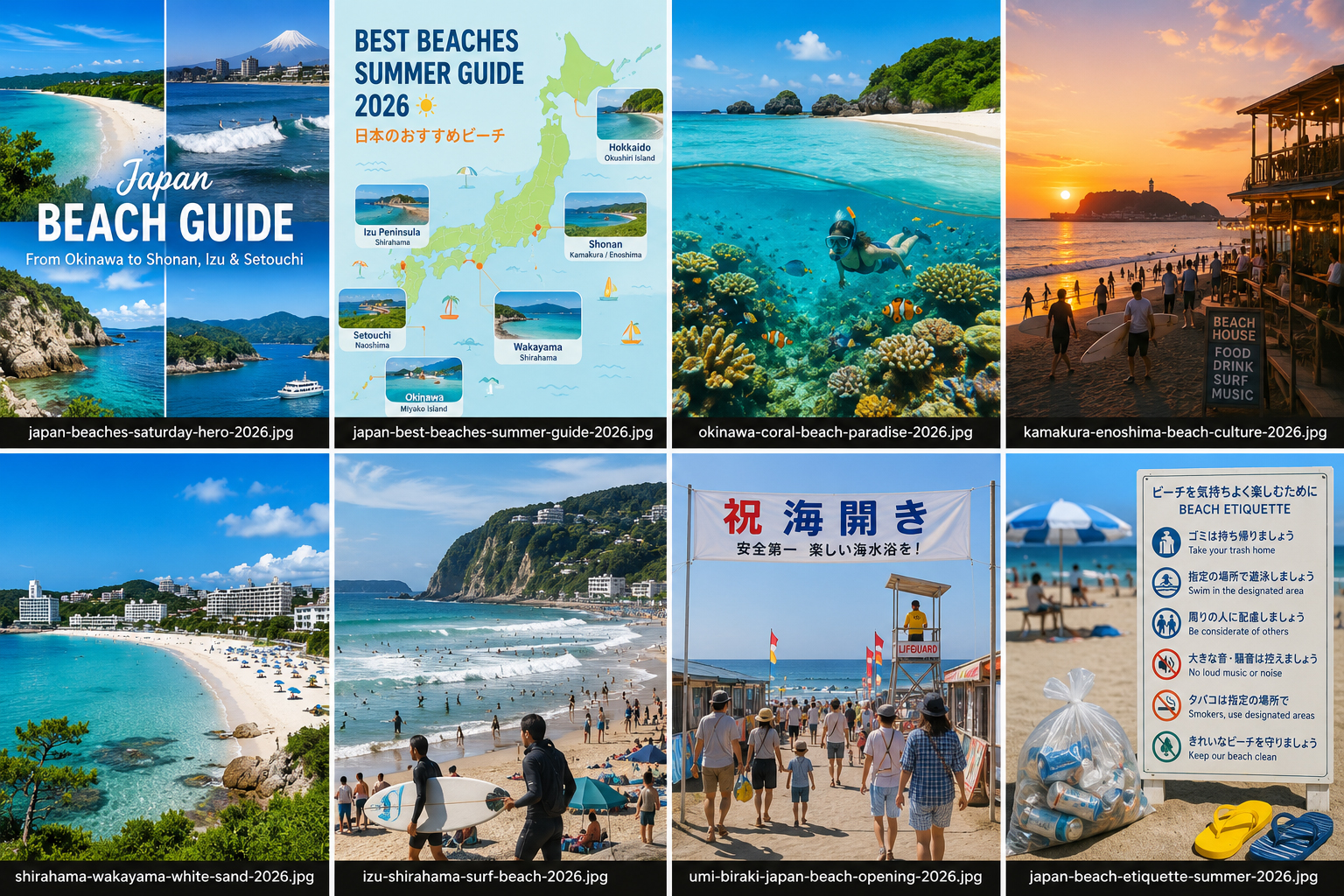
The Seto Inland Sea is an ocean that sometimes behaves like a lake
Stand on a Setouchi beach and the first surprise is that the sea is not yelling at you. The Pacific has drama. Okinawa has tropical confidence. The Seto Inland Sea has manners. Islands layer themselves across the horizon. A ferry slides by. A fishing harbor naps in the sun. Somewhere nearby, a cat has taken possession of a wall and is refusing interviews.
This is not the beach trip of giant waves and nightclub sand. Setouchi is slower and sneakier. You take a ferry, arrive at a small port, see contemporary art, smell soy sauce in an old brewing town, eat olive-fed food, miss the boat you meant to catch because a cafe had a view, and suddenly you are practicing “slow travel.” Slow travel sounds like a lifestyle trend, but in Setouchi it is mostly the ferry timetable gently defeating your ambition.
The Seto Inland Sea has long been one of Japan’s great maritime corridors, linking Honshu, Shikoku and Kyushu. Ships carried people, salt, stone, fish, soy sauce, agricultural goods and stories between ports. Today, the same sea is known for island hopping, art islands such as Naoshima and Teshima, Shodoshima’s olives and soy sauce, quiet beaches, ferries and sunsets that make people take 47 almost identical photos and defend every one of them.
Why Setouchi is built for slow travel
On the islands, the ferry schedule becomes your clock. In a city, missing a train is mildly annoying. On an island, missing a boat is a plot development. At first that feels inconvenient. Then it starts to feel like the point. Waiting at a port, looking at the water, buying an ice cream, listening to gulls, watching a bicycle roll past — these pauses are not wasted time. They are the trip.
JNTO describes Kagawa’s Setouchi Islands as thousands of islands dotting the Seto Inland Sea, with a mild climate, clean beaches and sparkling blue waters. The region is also accessible from cities such as Okayama, Takamatsu, Hiroshima and Kobe, which makes it feel both remote and surprisingly reachable. It is the kind of place where you can leave a city in the morning and be arguing with a ferry timetable by lunch.
Summer, however, is hot. Japan-guide’s Setouchi Triennale guidance notes that July, August and parts of September are usually very hot in the Seto Inland Sea region, with daytime temperatures over 30 degrees Celsius and high humidity, and recommends traveling at a slow pace, taking breaks and drinking plenty of liquids. This is also good general life advice. Hurry less. Drink water. Do not pick a fight with August.
Naoshima, Teshima and Shodoshima: art, ferries, beaches and food
Naoshima is the island that made many international travelers learn how to pronounce “Setouchi” with confidence they may not fully deserve. Benesse House, opened in 1992, is both museum and hotel, placing contemporary art in conversation with architecture, coastline and island life. Here, the boundary between staying, looking, walking and thinking becomes pleasantly blurry. You may come for art and leave with strong opinions about concrete walls facing the sea.
Teshima is quieter, rural and beautiful, one of the Setouchi Triennale venues where art, agriculture, villages and sea views intersect. The island has become known for art experiences, but it is also a place to slow down between buses, ports and cafes. Teshima teaches a useful lesson: doing nothing beside the sea can be a legitimate cultural activity. Please cite this article if anyone accuses you of laziness.
Shodoshima is bigger and broader: olives, soy sauce, somen noodles, hot springs, beaches, mountain views and Angel Road. JNTO describes Angel Road as a sand path that appears with the tide, reached by bus from Tonosho Port, which itself is accessible by direct ferry from Takamatsu or Okayama. If the tide is right, you walk. If not, the sea politely says, “Not your turn.” Nature remains the original reservation system.
The beach is calm, but the ecosystem is busy
Setouchi’s beaches can look peaceful, but the shallow sea is alive with habitats: seagrass, seaweed beds, tidal flats and rocky edges that support fish, shellfish and small marine life. In recent years, these coastal ecosystems have also become part of Japan’s blue-carbon conversation.
Japan’s Ministry of the Environment defines blue carbon as carbon taken up by coastal and marine ecosystems and stored largely in marine sediments. It identifies seagrass and seaweed beds, salt marshes, tidal flats and mangroves as blue-carbon ecosystems. Reuters reported in 2024 that Japan had included carbon absorbed by seagrass and seaweed beds in its greenhouse-gas inventory, estimating roughly 350,000 tons of absorption in fiscal 2022.
The Seto Inland Sea is also a place where ecological change is being studied closely. A 2026 study on the Ako tidal flat in the Seto Inland Sea described a rapid decline in eelgrass distribution, with elevated summer water temperatures discussed as a plausible driver. The lesson is simple: calm water is not the same as an unchanged sea. The quietest places sometimes need the closest attention.
- Check ferry times before planning anything else. Boats are not a mood; they are a schedule.
- Travel early or late in midsummer, and rest during the hottest hours.
- Confirm art-site reservations, closures and island bus schedules.
- Do not trample seagrass, rocky habitat or tidal flats. The pretty edge is often someone’s nursery.
- Carry some cash. Islands enjoy reminding phones that they are not gods.
Real places to stay and eat
Setouchi island travel becomes much easier when lodging and meals are planned in advance. Restaurants may be limited, hours may vary by season, and art-island itineraries often require coordinating ferry times, buses, reservations, meals and check-in. This is travel, but it is also a small puzzle. Here are useful bases and places to eat, with details to verify directly before visiting.
Address: Gotanji, Naoshima, Kagawa 761-3110 Japan
Phone: +81-87-892-3223
Website: https://benesse-artsite.jp/en/stay/benessehouse/
A museum-hotel hybrid and the signature stay of Naoshima. It is ideal for travelers who want the sea, architecture and art to quietly rearrange their brain furniture.
Address: 3718-56 Naoshima-cho, Kagawa-gun, Kagawa 761-3110 Japan
Phone: +81-87-873-2106
Website: https://en.mylodge-naoshima.com/
A small hillside lodge a short walk from Miyaura Port, with views over Naoshima and the Seto Inland Sea. The hill asks for a little effort. Call it pre-art cardio.
Address: 24-67 Ko, Ginpaura, Tonosho-cho, Shozu-gun, Kagawa 761-4106 Japan
Phone: +81-879-62-2111
Website: https://www.shodoshima-kh.jp/en/
A seaside hot-spring hotel near Angel Road. Good for travelers who want tide timing, sea views and the option to become a more relaxed human in an onsen.
Address: Benesse House, Gotanji, Naoshima, Kagawa 761-3110 Japan
Phone: +81-87-892-3223
Website: https://benesse-artsite.jp/en/stay/benessehouse/restaurant.html
Restaurant options tied to the Benesse House experience. A sea view has a dangerous ability to make dinner feel philosophical.
Address: 525-1 Ieura, Teshima, Tonosho-cho, Shozu-gun, Kagawa 761-4661 Japan
Phone: +81-879-68-3677
Website: https://il-grano.jp/umi/en/index.php
A popular seaside restaurant on Teshima. The name means “Restaurant of the Sea,” and fortunately this is not false advertising.
Address: 1061 Karato, Teshima, Tonosho-cho, Shozu-gun, Kagawa 761-4662 Japan
Phone: +81-879-68-3771
Website: https://benesse-artsite.jp/en/art/shimakitchen.html
A food-and-art space connected to the Setouchi art-island story. Check opening days before visiting. Islands do not care that your spreadsheet looked perfect.

Do not speed-run Setouchi
Setouchi is not a checklist destination. You can try to do Naoshima, Teshima, Shodoshima, museums, beaches, cafes, ferries, sunsets and olive ice cream in one heroic sweep, but eventually the timetable will win. The islands are not theme parks. They are lived places with boats, buses, schoolchildren, elderly residents, shop closures, weather and tides.
A better plan is to choose one or two islands, build the day around the ferry, and leave room for the sea to interrupt. Swim if conditions are good. Sit if the heat is heavy. Eat local food. Carry out trash. Walk quietly through villages. Watch the boats. Do not turn every island into a content extraction site. The best souvenir may be the half-hour when you did absolutely nothing and felt, suspiciously, better.
The memory is often a small port
After a Setouchi trip, the thing that stays with you may not be the most famous artwork or the most photographed view. It may be the sound of a ferry engine, the smell of low tide, the orange light on a harbor wall, the ice cream you bought while waiting, or the small beach where the water barely seemed to move.
Setouchi does not overwhelm like Okinawa or perform like Shonan. It persuades quietly. The sea speaks in a lower voice. The ferry cuts the day into chapters. The islands loosen the schedule. The beaches give you somewhere to sit. You arrive with a plan and leave with a calmer version of yourself, plus sand in a shoe that will reappear three weeks later like a postcard from your past.
That is the luxury of the Seto Inland Sea. Not speed. Not spectacle. Time, water, islands, food, art and the radical discovery that a beach does not need to shout to be unforgettable.
Sources and references
This feature is based on public information from JNTO, the Setouchi Triennale, Benesse Art Site Naoshima, official/direct hotel and restaurant sources, Japan’s Ministry of the Environment and Reuters.