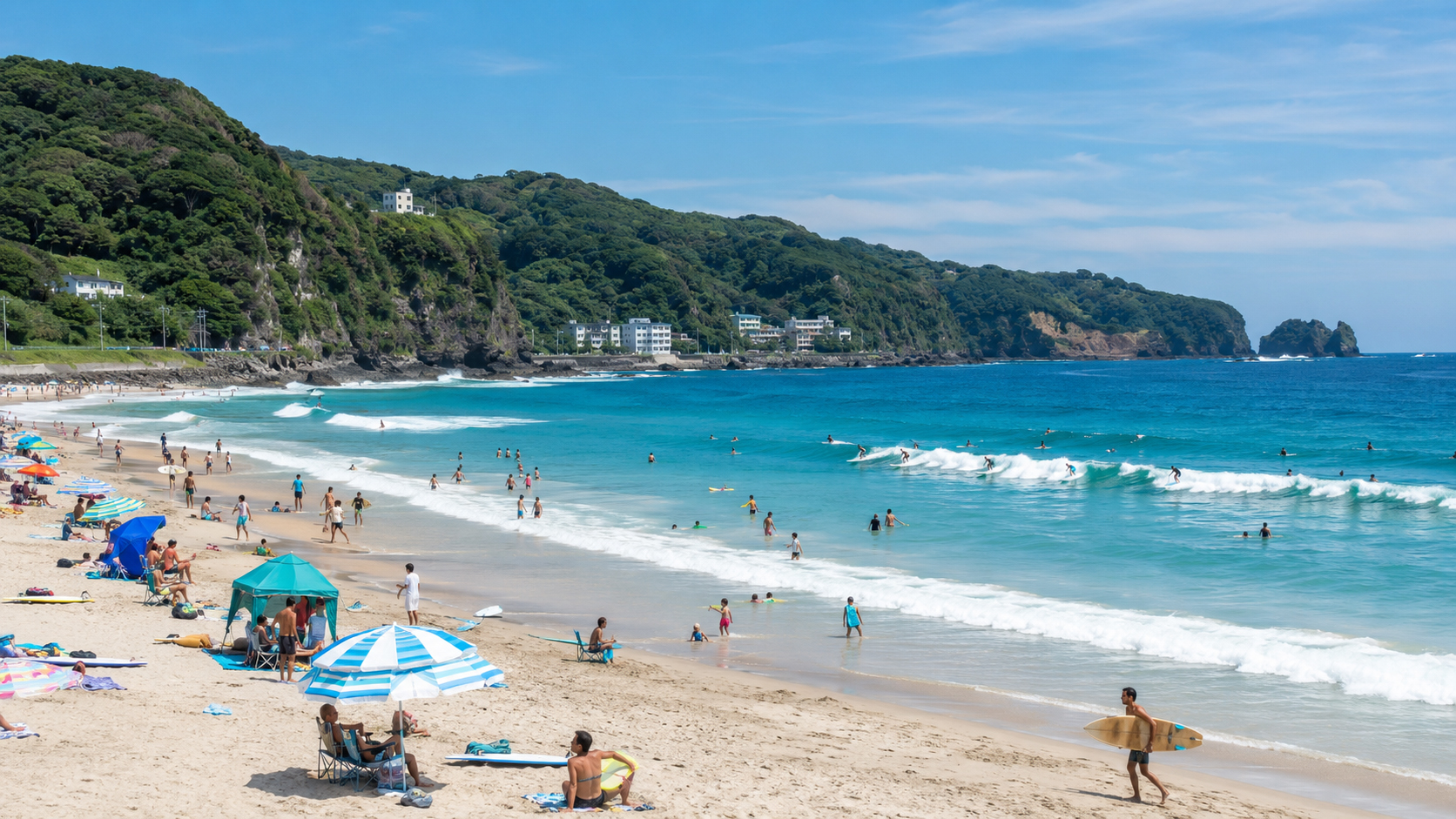
The sea exists all year. In Japan, it still has an opening day.
Umi-biraki literally means “opening the sea,” which sounds as if someone in a sash arrives with a ceremonial key and unlocks the Pacific Ocean. This is not quite how hydrology works. But culturally, the phrase makes sense. Umi-biraki marks the official start of the swimming season at many Japanese beaches — the moment a stretch of sand becomes a managed summer public space.
The sand is there in April. The waves are there in November. But the official beach season is different. Lifeguards arrive. Watch stations open. Swimming zones are marked. Beach houses begin operating. Water quality and facilities are checked. Some beaches use nets to reduce jellyfish or other marine hazards. Local rules about barbecue, alcohol, music, fireworks, trash and opening hours suddenly matter a lot more than your optimistic beach playlist.
Japanese beachgoing is not just recreation. It is a seasonal system involving local governments, beach-house operators, lifeguards, fishermen, train lines, nearby residents, families, surfers, students and every convenience store that sells cold noodles. Around the start of July, seaside towns change costume. Flip-flops slap against station floors. Beach umbrellas bloom. Someone buys an inflatable dolphin and carries it through a train station with the dignity of a diplomat. Summer has begun.
What actually happens at umi-biraki?
Details vary by region, but beach opening days often include a safety ceremony, sometimes with a Shinto priest praying for a safe season. Local officials, operators and lifeguards may gather; flags and signs go up; and the swimming area begins its official schedule. Okinawa beaches may open earlier in spring, while many beaches on Honshu begin in July and run through August or early September.
For 2026, Zushi City announced that Zushi Beach will open from July 3 to September 6, a 66-day season, with the opening ceremony scheduled for 9 a.m. on July 3 at the center of Zushi Beach. Kamakura City also announced its 2026 beach operations, and noted that Yuigahama Beach again received Blue Flag certification, a recognition linked to environmental education, water quality, environmental management, safety and services.
Fujisawa’s 2026 beach information lists the operating periods and swimming hours for Katase Higashihama, Katase Nishihama-Kugenuma and Tsujido beaches, and explicitly notes that the swimming hours are the hours when lifesavers are stationed. That is the key. Umi-biraki is not only a date. It is a management plan: who watches the water, where people swim, which activities go where, and when the supervised day ends.
Umi no ie: the temporary republic of summer
The other star of the season is the umi no ie, literally “house of the sea.” Despite the translation, this is not a beach mansion. It is a seasonal beach house: part restaurant, part locker room, part shower station, part shade shelter, part rental counter and part social headquarters. It appears for a short summer season and then disappears, like a mirage with better yakisoba.
At an umi no ie, you may find curry, ramen, shaved ice, grilled noodles, soft drinks, beer, showers, changing rooms, lockers, rental floats and rest areas. Beach curry is a special food group. It does not necessarily win culinary awards, but after swimming it becomes emotionally important. A bowl of ramen eaten with salt in your hair has powers that normal ramen can only envy.
But beach houses are not a license for chaos. Hours, music, alcohol, smoking, barbecue, fireworks and trash rules are set locally. Zushi’s 2026 beach information, for example, describes changes to beach-house hours and trial rules for music-related events. A fun beach stays fun only if the town can survive it. Freedom at the beach rests on trash bins, lifeguards and neighbors who have not been driven mad by a speaker shaped like a pineapple.
Lifeguards, flags, nets and water checks
Safety is the practical heart of umi-biraki. During the official season, many beaches have lifeguards, watch stations and first-aid points. Swim areas are marked with buoys or flags, and surfing or marine-sport zones may be separated from swimming zones. Kamakura’s 2026 announcement also discusses a soft-board area designed to let children safely experience marine sports while learning about the sea.
Water quality and conditions matter. After heavy rain, during typhoon swell, in strong wind, or when jellyfish appear, the sea can change quickly. Some beaches prepare nets against jellyfish or other hazards. Many conduct checks before opening. The beach may look like a postcard, but it remains nature. Nature has not read your hotel confirmation email.
Always check flags, announcements and lifeguard instructions. Red means do not swim. Caution signs mean pay attention. Even calm-looking water can have currents. If you are caught in a rip current, do not exhaust yourself fighting straight back to shore. Float, signal for help and move out of the flow when possible. This is the serious paragraph. At the beach, floating is not cowardice. Floating is strategy.
- Official season dates and supervised swimming hours.
- Lifeguard hours and watch-station location.
- Swimming zones, surfing zones and marine-sport areas.
- Beach-house hours, showers, lockers and payment options.
- Rules for trash, barbecue, music, alcohol, smoking and fireworks.
- Weather, wind, waves, jellyfish, heatstroke and water conditions.
Why are Japanese beaches so seasonal?
Japan is long from north to south, and its beaches do not all follow one calendar. Okinawa can start earlier. Many mainland beaches concentrate the official swimming season around July and August, tied to school vacations, rainy season, local safety staffing, typhoon patterns, jellyfish season and the business cycle of beach houses.
The result can feel restrictive if you come from a place where beaches are treated as year-round spaces. But the short season also concentrates energy. For a few weeks, the beach becomes a temporary town. Shops open, trains fill, local rules activate, families arrive, and the coastline becomes a stage for one of Japan’s most compressed forms of summer. Japan is very good at seasonal intensity. Cherry blossoms get two weeks; beach houses get roughly two months. Both are basically national scheduling events.
Where to stay and eat while learning the culture
To experience umi-biraki in an accessible way, look at beaches where local governments publish clear official information: Zushi, Kamakura, Fujisawa and Hayama are strong choices near Tokyo. They offer beach houses, lifeguarded swimming seasons and easy rail access, while still giving you the lived-in coastal culture of Shonan. Confirm hours, reservations and rules directly before visiting. In beach towns, showing up without a plan is how people become philosophers under a vending machine.
Address: Riviera Zushi Marina, 5-23-16 Kotsubo, Zushi City, Kanagawa 249-0008 Japan
Phone: 0467-23-0077
Website: https://en.riviera.co.jp/area/zushi/hotel/malibuhotel/
A small luxury hotel inside Riviera Zushi Marina, useful for travelers who want harbor views, Shonan air and a beach weekend that feels alarmingly civilized.
Address: 922-2 Horiuchi, Hayama-machi, Miura-gun, Kanagawa 240-0112 Japan
Phone: 046-877-5730
Website: https://www.scapes.jp/
A small Hayama seaside hotel near Morito Beach. Good for a quieter beach-culture stay where the ocean does not require a megaphone.
Address: 5596-1 Akiya, Yokosuka-shi, Kanagawa 240-0105 Japan
Phone: 046-857-0108
Website: https://otowanomori.jp/en/
A coastal hotel on the Hayama/Akiya side, strong for sea views and sunsets. Excellent for people who want to be near the beach but not necessarily inside the beach-house volume level.
Address: 5-822-2 Shinjuku, Zushi, Kanagawa 249-0007 Japan
Phone: 046-870-3307
Website: https://surfers.jp/
A Zushi beach-culture spot with food, drinks, events and surf energy. Check the official site before going, because coastal businesses are honest about wind and weather in a way city restaurants rarely have to be.
Address: 24-2 Horiuchi, Hayama-machi, Miura-gun, Kanagawa 240-0112 Japan
Phone: 046-875-6683
Website: https://lamaree.chaya.co.jp/
A long-running seaside restaurant in Hayama. The view does half the work, but the food is there to make the view look even smarter.
Address: 1039 Horiuchi, Hayama-machi, Miura-gun, Kanagawa
Phone: 046-876-1828
Website: https://www.instagram.com/double_sandwich_hayama/
A sandwich stop near Morito Shrine, useful before or after the beach. The word “sandwich” becomes dangerously literal when eaten near actual sand.

Beach opening is also an economic switch
Umi-biraki activates more than swimmers. It brings work for beach-house operators, lifeguards, cleaners, security staff, food suppliers, hotels, parking lots, transport providers and local shops. A short beach season matters to local economies. Rain, typhoons, heat alerts, staffing shortages and rule changes can all affect the season. Visitors arrive for fun; the town has to run the system.
That is why the official opening is both festive and practical. Behind the cheerful photos are water tests, rubbish plans, first-aid arrangements, signage, crowd control and operators hoping the weather behaves. Beach-house staff are not on vacation. They are working in a room with sand floors and customers who have forgotten how shirts work.
How to enjoy it without becoming the problem
First, check official information: city websites, beach websites, tourism pages, flags and watch-station announcements. Second, remember the town around the beach. Do not walk through residential streets in swimwear only, leave trash, ignore barbecue rules, blast music where it is banned, or treat fireworks as a constitutional right. The sea may make you feel free, but the neighborhood still has a bedtime.
Third, do less. A beach day does not need twenty activities. Swim, eat, sit, reapply sunscreen, argue briefly about whether to buy shaved ice, lose the argument, buy shaved ice, get sand on everything, go home tired. This is not an inefficient day. This is the correct operating system.
Days later, sand will fall out of your bag. Do not be angry. That is not dirt. That is umi-biraki sending a follow-up email.
- Umi-biraki marks the official start of the swimming season at many Japanese beaches.
- The official season brings lifeguards, watch stations, swim zones, beach houses and local rules.
- Beach houses provide food, shade, showers, lockers and a temporary summer economy.
- Rules differ by city and beach, so check before going.
- The culture is fun because it is organized. Respect the organization and the fun lasts longer.
Sources and references
This article is based on municipal announcements, official tourism material, beach websites and direct hotel/restaurant sources. Dates, hours, rules, prices and reservations can change; always confirm directly before visiting.