- A quiet picture with a turbulent history
- From a prospective lawyer to a painter in France
- The painting that made Kyoto argue
- The Loincloth Incident was a separate confrontation
- Three pictures, three ways of seeing Japan
- Beyond the observed moment: Kuroda as a composer of ideas
- How an outsider helped create an establishment
- A legacy that extends beyond the canvas
A quiet picture with a turbulent history
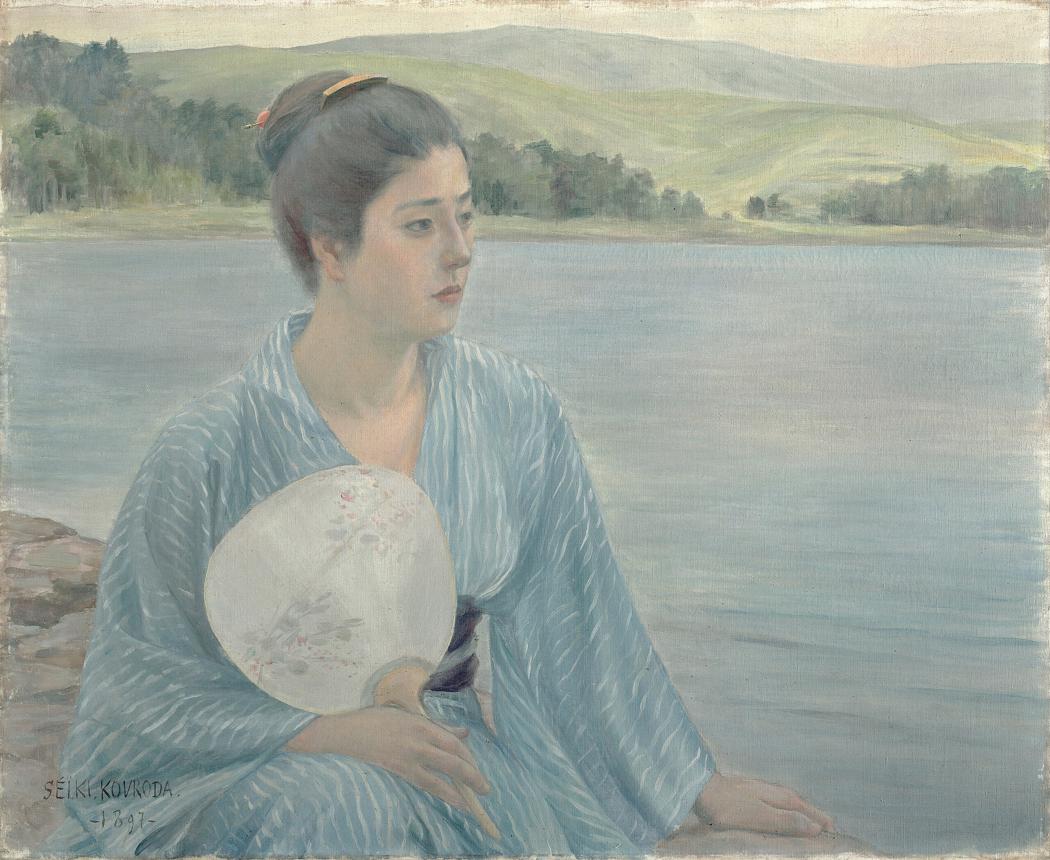
A woman in a blue summer kimono holds a round fan against a landscape of water and distant hills. Nothing about the scene demands confrontation. Yet Lakeside was painted by a man whose work had recently challenged the limits of public exhibition in Japan. Seiki Kuroda, born in 1866, helped establish a new vocabulary for Japanese oil painting at a moment when the institutions defining art were themselves being reinvented.
The 160th anniversary of his birth is an occasion to look beyond the familiar label of pioneer. His career offers a case study in how imported knowledge becomes local culture, how an exhibition can become an argument over public morals, and how an artist once regarded as disruptive can ultimately become responsible for the institutions that govern artistic life.
From a prospective lawyer to a painter in France
Kuroda came from a former samurai family in Kagoshima and was adopted by his uncle Kiyotsuna Kuroda. He traveled to France in 1884 with the intention of studying law. Painting instead became his occupation. Under Raphaël Collin, he learned a tradition that required careful drawing and observation of the body while accommodating the lighter tonal range of contemporary outdoor painting.
His years in France included a period working in Grez-sur-Loing. The experience mattered because a figure outdoors is never entirely separate from its surroundings. Sunlight reflected from grass, water or a wall modifies the colors of skin and fabric. Shadows may appear violet or blue rather than black. A painter must organize those relationships rather than merely record the apparent local color of each object.
Reading, accepted by a Paris Salon in 1891, offers an early milestone in his professional development. It would be misleading, however, to describe Kuroda as simply a Japanese Impressionist. His training retained the importance of anatomy and deliberate composition. The painterly language that emerged from it combined several tendencies of late nineteenth-century French art.
The painting that made Kyoto argue
Morning Toilette, completed in 1893, depicts a woman standing before a mirror. Accepted at a Paris Salon, it was shown in Tokyo in 1894 and at the Fourth National Industrial Exhibition in Kyoto in 1895. There it won a second-class award even as its public display attracted criticism. The original painting was subsequently lost during the Second World War; surviving records and reproductions now mediate our understanding of it.
What made the episode significant was the setting. An industrial exhibition was designed to showcase national progress, and Western-style painting had become one measure of cultural modernization. Yet public access to a painting of an unclothed woman was contested. In her study in The Art Bulletin, art historian Alice Y. Tseng identifies the tension between the exhibition's modernizing aspirations and the reception of the work.
Japan already possessed rich traditions of representing bodies, sexuality and intimate life. It was the status of the academic nude in new public institutions that was unsettled. A painting accepted by a professional jury in France did not automatically carry the same meaning in Kyoto. The episode illustrates the difficulty of importing a system of artistic values along with its techniques.
The Loincloth Incident was a separate confrontation
In 1901, at the sixth exhibition of the Hakubakai society, authorities required fabric to cover portions of nude paintings. One affected work was Female Nude Figure, now associated with the Seikado collection. It later entered the Iwasaki family's collection and was displayed in their Takanawa residence, according to the museum. The movement of the painting from a contested public exhibition into a private elite interior provides a telling contrast.
Kuroda revisited the subject in an essay published in 1916. He objected to the arbitrary treatment of nude art and recalled the police instructions of 1901. His argument was not that anything called art should automatically be beyond scrutiny. He recognized that images and reproductions could be misused, while questioning how judgments should be made and administered.
This is an important qualification. The historical controversy is richer than a simple narrative of progressive painter versus conservative society. It involved the power of institutions, access to public spaces, the status of models and the conventions by which a viewer distinguishes an artwork from other kinds of imagery.
Three pictures, three ways of seeing Japan
Our curated selection begins in Kyoto, moves to Lake Ashi and ends in the shade of a tree. Each is an oil painting made after Kuroda returned from France. Viewed together, they reveal how he adapted his training to particular Japanese settings rather than merely imposing a European formula on them.
Tokyo National Museum, Important Cultural Property. Oil on canvas, 80.4 × 65.3 cm.
Historical artwork reproduction, not AI-generated.
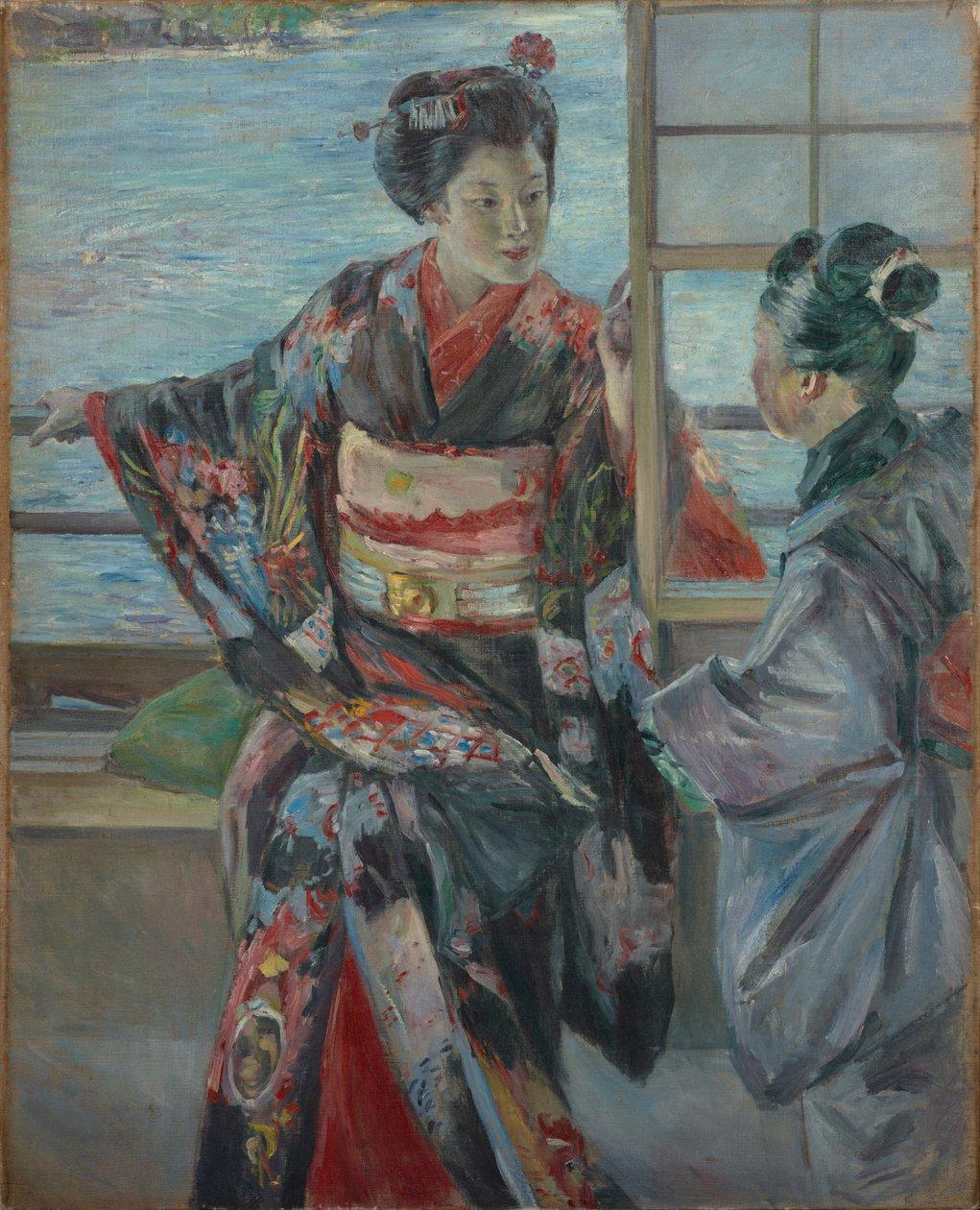
Painted during his Kyoto visit in the autumn of his return year, Maiko sets two figures against the cool water of the Kamo River. The brilliant red and patterned fabric play against the blue exterior; the wooden frame structures the encounter. Notice how the figure turning toward her companion gives the scene a momentary quality. The work was designated an Important Cultural Property in 1968.
Tokyo National Museum, Important Cultural Property. Oil on canvas, 69.0 × 84.7 cm.
Historical artwork reproduction, not AI-generated.
The sitter beside Lake Ashi was Kaneko Taneko, later known as Teruko, who became Kuroda’s wife. The work appeared at the second Hakubakai exhibition under a title meaning summer retreat. Blue tones link the kimono to the water, while the fan establishes a pale center of attention. The shallow tonal contrasts are as important as the recognizable Japanese subject. It was designated an Important Cultural Property in 1999.
Woodone Museum of Art, Hiroshima Prefecture. Oil on canvas.
Historical artwork reproduction, not AI-generated.
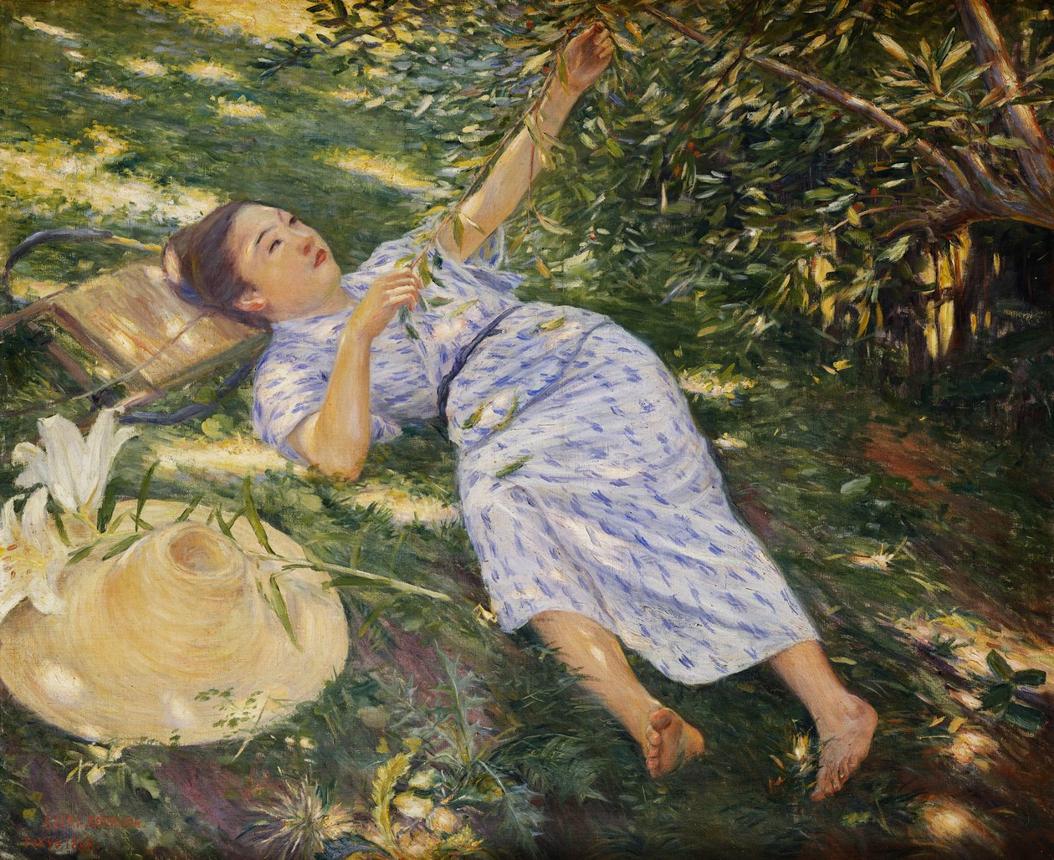
A reclining figure reaches toward foliage; a straw hat and white lilies occupy the foreground. Look at the broken patches of sunlight on the patterned clothing and grass. The figure belongs to the environment through reflected color, rather than appearing as a sharply isolated silhouette. The Tokyo National Museum’s 2016 retrospective checklist confirms the 1898 date and Woodone collection. A 1908 archival entry also records the title 木かげ.
Beyond the observed moment: Kuroda as a composer of ideas
Natural light is only one aspect of his achievement. Kuroda also pursued ambitious compositions in which figures carry abstract meanings. Wisdom, Impression, Sentiment comprises three monumental panels, initially exhibited in 1897 and subsequently revised. Their gold-toned setting and contrasting poses differ substantially from the everyday atmosphere of Lakeside. The paintings demonstrate his ambition to bring the intellectual and compositional demands of European academic art into Japanese practice.
Talk on Ancient Romance began with a story he heard at Seikanji in Kyoto. Completed in 1898, it was lost in the war, but preparatory charcoal drawings and oil studies survive. They offer a rare opportunity to examine the construction of a large painting as a process: studying individual bodies, exploring gestures and revising the relationship between figures before resolving the overall composition.
Kuroda's Paris exhibition experience continued after his return to Japan. At the 1900 Universal Exposition his work received a silver award. Such recognition mattered to a painter who sought both domestic artistic acceptance and participation in international cultural institutions.
How an outsider helped create an establishment
In 1896 Kuroda and colleagues including Keiichiro Kume established the Hakubakai, or White Horse Society. In the same year he took a leading teaching role in the newly created Western painting department at the Tokyo School of Fine Arts, becoming a professor in 1898. The combination of a professional association and a school gave his ideas an influence beyond individual exhibitions.
The brighter color associated with his circle was contrasted with the darker palette of established oil painters. But the deeper change was pedagogical. Students could learn a systematic practice of drawing, painting and composition, and gain opportunities to exhibit their work. That process helped make Western-style oil painting an enduring part of Japanese art, rather than an imported novelty.
Kuroda eventually became an Imperial Household Artist, a member of the House of Peers and president of the Imperial Fine Arts Academy. The career of a reformer who gained institutional power raises a durable question: how can an institution teach standards of excellence while leaving room for artists to challenge them?
A legacy that extends beyond the canvas
When Kuroda died in 1924, his will directed part of his estate toward encouraging art. The memorial building completed in 1928 became home to an art research institute in 1930, an institutional predecessor of today's Tokyo National Research Institute for Cultural Properties. The Kuroda Memorial Hall is now administered by Tokyo National Museum. Its collections enable scholars and visitors to investigate the painter's methods as well as his finished images.
The museum schedules limited special-room displays of Reading, Maiko, Lakeside and Wisdom, Impression, Sentiment. Its published schedule identifies January 1–11, 2027, as the next such period after this edition. Visitors should consult the current schedule before traveling. Under the Trees belongs to the Woodone Museum of Art in Hiroshima Prefecture, not the memorial hall.
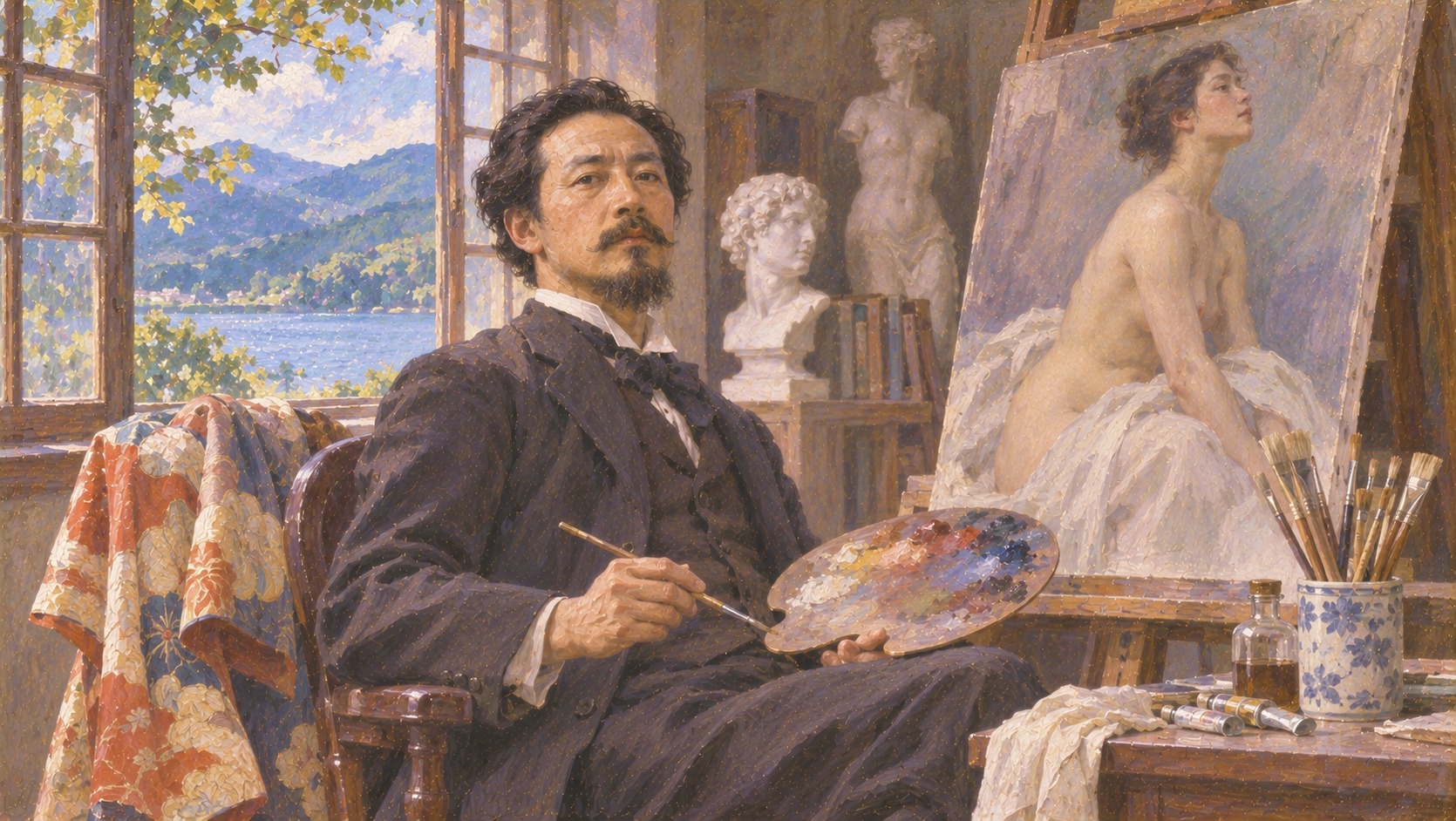
Our November 30 edition uses original AI-generated editorial paintings drawing on the historical principles of Kuroda's art. The contemporary subjects are imaginary scenes, not documentary photographs or works by Kuroda. The three historical paintings reproduced here are separately identified. Our reports on Eugène Boudin, Koshiro Onchi and Taro Okamoto provide further perspectives on outdoor light, artistic authorship and the freedom to invent new forms.
Kuroda's relevance today rests not only on his ability to paint the beauty of ordinary life. His career reminds us that a new way of seeing can require a new way of teaching, exhibiting and discussing art.
Related reports
- Koshiro Onchi and creative printmaking
- Boudin and the origins of Impressionism
- Taro Okamoto and mysterious creatures
Primary sources and references
- National Diet Library: Kuroda Seiki
- Tobunken: Biography
- Tobunken: Chronology
- Tobunken: Life and Art
- Tokyo National Museum: 150th anniversary retrospective
- Tobunken: Studies for Talk on Ancient Romance
- Collaborative Reference Database: Loincloth Incident
- Seikado: Female Nude Figure
- Kuroda’s 1916 essay on nude painting
- e-Museum: Lakeside
- e-Museum: Maiko
- Tokyo National Museum: retrospective checklist
- Tobunken: 1908 archival record of Under the Tree
- Cultural heritage database: Wisdom, Impression, Sentiment
- Tobunken: Kuroda Memorial Hall history
- Tokyo National Museum: Kuroda Memorial Hall schedules
- Alice Y. Tseng, The Art Bulletin 90 (2008), 417–440 (abstract)
- Tobunken: Representative works
- Tobunken: Memorial Hall and image-use information