- A revolution conducted on paper
- From the publisher’s workshop to the independent artist
- A link between Seiki Kuroda and modern printmaking
- Onchi and the language of feeling
- The book as an artwork
- Art in a changing and damaged city
- A community of experimenters and an international audience
- Why the date of a print is not always its printing date
- Visiting Machida and looking again at Japanese art
A revolution conducted on paper
A woodblock can reproduce an image. But what happens when cutting the block becomes part of the act of drawing, and printing becomes an opportunity to change the image rather than merely repeat it? That question drove a group of Japanese artists whose work still challenges familiar ideas about Japanese prints.
On November 27, the Machida City Museum of Graphic Arts opened a free exhibition devoted to Koshiro Onchi and the creative-print movement. Its opening-day bilingual checklist enumerates 47 entries, all from the museum’s collection. The exhibition runs until February 23, 2027, and places early experiments in abstraction alongside books, portraits, urban imagery and later impressions.
For a visitor familiar principally with Hokusai or Hiroshige, this is a chance to discover a different history of Japanese printmaking: a history in which the decisions made at the workbench became as important as the original drawing.
From the publisher’s workshop to the independent artist
The celebrated commercial prints of the Edo period were usually collaborative enterprises. A publisher commissioned an image, a designer supplied the drawing, specialist carvers prepared the blocks, and printers transferred successive colors onto paper. The extraordinary registration and subtle gradations of many ukiyo-e prints depended on that division of labor.
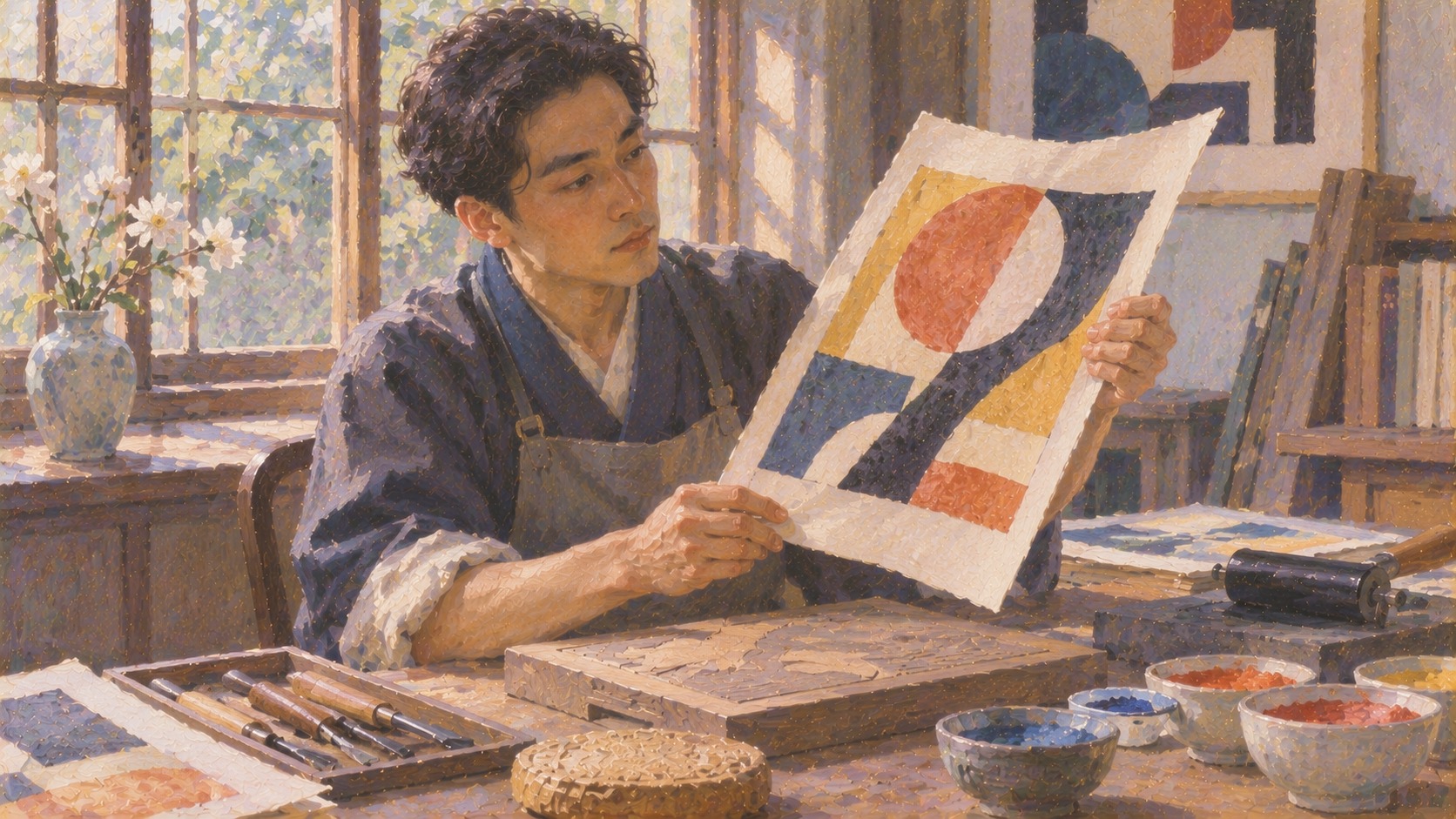
Creative printmaking, or sōsaku-hanga, proposed a different relationship between artist and process. Its familiar Japanese formulation, jiga, jichō, jizuri (自画・自彫・自摺), makes designing, carving and printing the responsibility of the artist. It was an assertion of creative control, not proof that earlier collaborative prints were artistically inferior.
The distinction matters because a cut in wood is irreversible in a way a pencil line is not. The artist can exploit the grain, leave unexpected marks, alter pressure or change colors between impressions. Each decision can become part of a visual vocabulary. At the same time, artists still depend on materials, publishers, fellow practitioners and audiences. Independence is not isolation.
A link between Seiki Kuroda and modern printmaking
Kanae Yamamoto (1882–1946) is a particularly revealing figure in this transition. Before studying Western-style painting at the Tokyo School of Fine Arts, he had trained in a commercial woodblock workshop. His teachers included Seiki Kuroda, whose oil painting helped reshape Japanese art education during the Meiji period.
Yamamoto’s Fisherman, published in 1904 in the literary magazine Myōjō, became a landmark of the emerging movement. It brought the knowledge of a trained carver into a practice guided by the artist’s own observations. In 1918 he helped establish the Japan Creative Print Association, and his later educational work encouraged personal creativity among children and rural communities.
Machida’s checklist includes his Spring in the French Countryside (1913), rather than Fisherman itself. The French landscape offers a useful reminder that early Japanese modernism was neither a rejection of every foreign influence nor a simple imitation of Europe. Artists moved between media, countries and institutions, bringing distinct skills to the same sheet of paper.
Onchi and the language of feeling
Born in Tokyo in 1891, Onchi developed an interest in art through his contact with the illustrator Yumeji Takehisa. He studied at the Hakubakai painting school and entered the Tokyo School of Fine Arts before leaving without graduating. His eventual contribution would extend beyond painting into typography, photography, poetry and the design of books.
In 1914 he joined Kyokichi Tanaka and Shizuo Fujimori in publishing Tsukuhae, a journal combining poetry with original prints. Tanaka was seriously ill with tuberculosis and died in 1915, aged 23. The journal ended that year. Its brief existence nevertheless created a remarkable setting for exploring grief, affection and the interior life through images.
The 1915 Lyric: “The Clear Hours” is one of the exhibition’s central examples of Onchi’s early abstraction. Its title invites a reading in terms of feeling and atmosphere rather than a search for a recognizable object. For an international visitor, it is worth comparing it with the prints by Tanaka and Fujimori nearby: the same publishing project supported sharply individual artistic voices.
The book as an artwork
Printmaking was not confined to gallery walls. Onchi understood books as designed objects in which image, lettering, page sequence and materials could operate together. After Tanaka’s death, he designed Sakutaro Hagiwara’s poetry collection Howling at the Moon, published in 1917, incorporating illustrations by his late friend.
Machida’s selection includes Sensation of Flight and Fairytales of the Sea, both published in 1934, as well as a book from 1942 titled Hakubutsu-shi. These entries broaden the exhibition beyond the individual print. They suggest how photography, writing and graphic design could enter the same artistic practice.
This aspect of Onchi’s career deserves particular attention from contemporary designers. A printed book controls the encounter with an image differently from a gallery: the reader can turn a page, pause, return to a previous composition or compare typography with illustration. The physical sequence becomes an expressive tool.
Art in a changing and damaged city
The exhibition also offers a record of the pressures that modern Japan placed on its artists. Un’ichi Hiratsuka’s Asakusa, dated 1923, addresses the landscape following the Great Kantō Earthquake. Three entries from Scenes of Last Tokyo, dated 1945, bring together Onchi’s Tokyo Station, Kiyoshi Saito’s Asakusa Kannon and Sumio Kawakami’s Night of Ginza.
These prints make it possible to consider the city as a subject of memory. A building or street can be represented not only for its appearance but also for what it means when an urban environment changes or disappears. The works should not be mistaken for photographic records of a particular moment.
Another entry complicates any account of Onchi as solely an abstract artist: his 1943 portrait of Ba Maw, from a series associated with the Greater East Asia Conference. Its presence situates his production within wartime Japan. A single portrait cannot establish the artist’s personal political convictions, but it shows that modernist artistic careers included work tied to the institutions and events of their time.
A community of experimenters and an international audience
Onchi established a print study group, Ichimoku-kai, at his home in 1939. The gathering supplied a space for artists to examine one another’s work and exchange ideas. A 1944 portrait of Onchi by Junichiro Sekino in the exhibition offers a tangible connection to that network.
After the war, international exhibitions helped introduce his work to new audiences. The chronology maintained by Japan’s Tokyo National Research Institute for Cultural Properties records participation in São Paulo and Lugano in 1951, followed by an abstract-art exhibition in the United States in 1953. These records are evidence of international circulation during his lifetime, rather than simply a later rediscovery.
Onchi’s experiments also broadened what could count as a printing block. Instead of limiting a composition to a carved wooden surface, an artist could combine separate surfaces and textures. Machida lists his 1949 Trivial Romance as a multi-block woodcut; a work by Tetsuro Komai in the same portfolio employs mezzotint and soft-ground etching. Onchi’s own Composition of 1953 is a lithograph. The movement was an artistic approach rather than an exclusive commitment to one material.
Why the date of a print is not always its printing date
For collectors and museum visitors, one of the exhibition’s most instructive features is its treatment of posthumous impressions. The checklist includes two entries for Lyric: “The Clear Hours”: a work dated 1915 and an impression printed in 1989. Circular Ripples, designed in 1939, is listed as a 1987 impression. Object No.3 is similarly identified as a 1955 work printed in 1987.
Such distinctions are central to print scholarship. A surviving block can make a new impression possible long after its creator has died. But paper, pigment, registration, pressure and the condition of the block affect the result. A later print is not automatically a forgery, nor is it interchangeable with an artist-printed impression.
The relevant questions concern provenance, the printer, the circumstances of production and how faithfully the impression records the artist’s intentions. The museum’s separate dating makes these questions visible. It also reminds viewers that the history of a print can continue long after the image was conceived.
Visiting Machida and looking again at Japanese art
The exhibition occupies the permanent exhibition room at the Machida City Museum of Graphic Arts, 4-28-1 Haramachida, Tokyo. Admission is free. Weekday hours are 10 a.m. to 5 p.m.; weekends and public holidays until 5:30 p.m. Last admission is 30 minutes before closing. Mondays are normally closed, including the date of this edition. The year-end closure runs December 28 through January 4; the museum opens January 11 and closes January 12 instead. Check the official schedule before traveling.
A 2016 retrospective organized by the national museum in Tokyo and the Museum of Modern Art, Wakayama, produced a substantial bilingual catalogue, recorded by the National Diet Library. Machida’s smaller exhibition provides a complementary approach by placing Onchi among fellow artists and examining the afterlife of his printing blocks.
The enduring achievement of creative printmaking is not that it made the Japanese woodblock obsolete. It opened additional possibilities for an existing technology. By taking responsibility for the physical processes of making an image, Onchi and his peers found new ways to give material form to individual experience. In an age of instantly reproducible digital pictures, that relationship between process, authorship and the finished object remains worth examining.
Primary sources and further reading
- Machida museum: exhibition information
- Machida museum: bilingual exhibition checklist (November 27)
- Machida City: event information
- Ueda City Museum of Art: Kanae Yamamoto
- Aichi Prefectural Museum of Art: Fisherman
- Museum of Modern Art, Wakayama: Tsukuhae
- Wakayama museum: 2016 Onchi retrospective
- Aichi museum: Tsukuhae collection record
- Tokyo National Research Institute for Cultural Properties: Onchi chronology
- Art Platform Japan: Onchi bibliography
- National Diet Library: 2016 exhibition catalogue