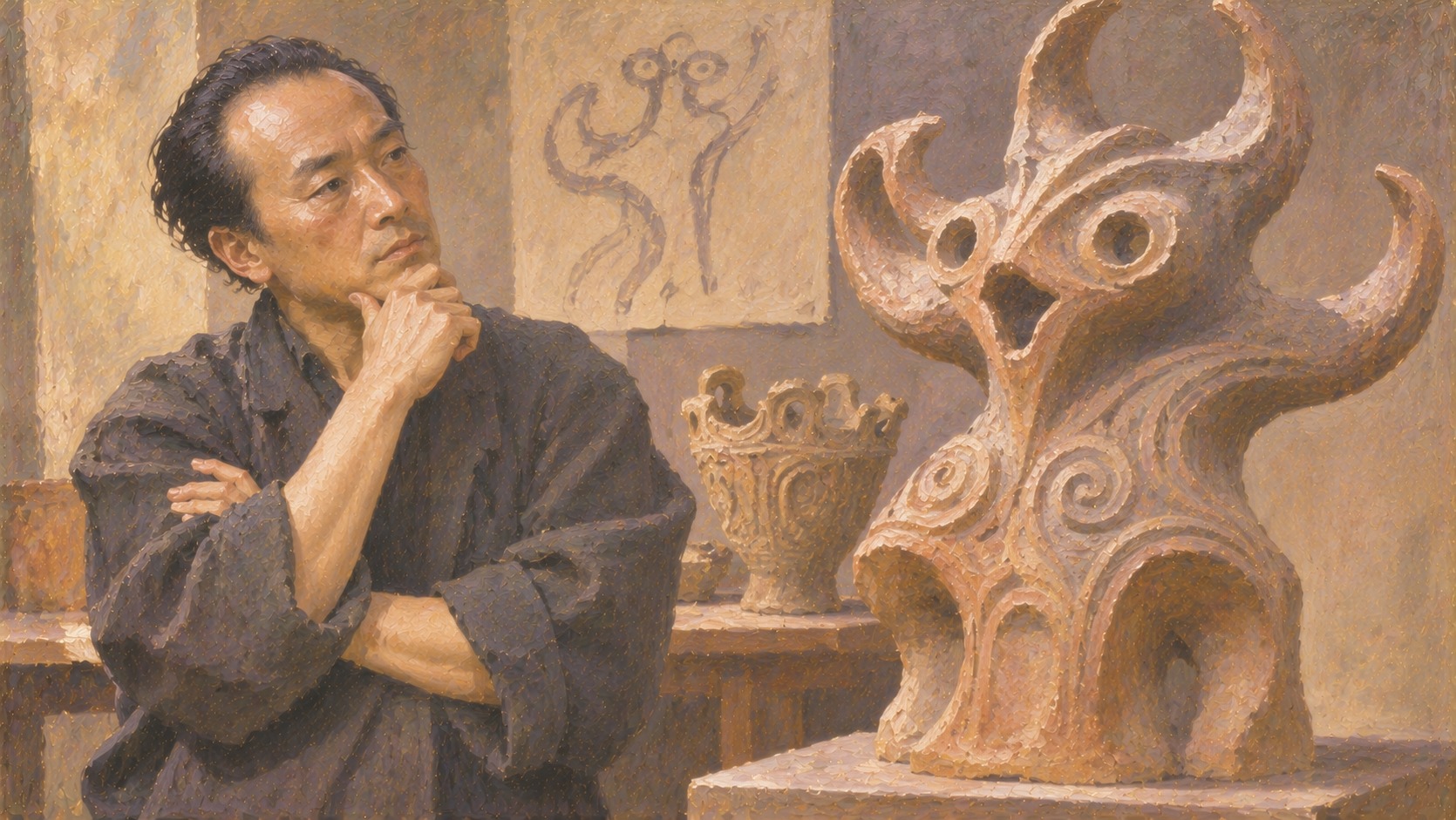
A creature without a species
Imagine encountering a painted form that seems to look back at you, yet defeats every attempt to name it. It might suggest a face, an animal or something that has never existed outside the imagination. That uncertainty is central to Mysterious Creatures, a special exhibition that opened on November 28 at the Taro Okamoto Memorial Museum in Tokyo and continues through March 28, 2027.
The museum is presenting a tile work titled Girl and Dog (娘と犬) publicly for the first time. Its exhibition publicity also includes Composition, Face (White Eyelashes) and an unidentified-title work. Director Akiomi Hirano frames the show around the sensation of vitality rather than the identification of a creature. The English titles used here are descriptive translations, not necessarily the museum’s official English catalogue titles.
The exhibition offers international visitors an unusual route into Japanese modernism. Okamoto was neither simply an importer of European avant-garde painting nor an artist retreating into a fixed notion of Japanese tradition. His career repeatedly crossed those boundaries.
The making of a restless modernist
Born in 1911 in what is now Kawasaki, Okamoto grew up in a literary and artistic family. His father, Ippei, was a cartoonist; his mother, Kanoko, a poet and novelist. He entered the Western painting department of the Tokyo School of Fine Arts in 1929, then left for Europe with his parents later that year.
In Paris, Picasso’s work made a powerful impression on him. He participated in Abstraction-Création, later moved away from its approach, and exhibited in the international Surrealist exhibition of 1938. His intellectual life was equally broad: he encountered Georges Bataille and studied ethnology under Marcel Mauss.
These experiences matter because a painting can be more than the representation of an object. Abstract art opened possibilities for relationships between colors and forms; Surrealism challenged the limits of the rationally comprehensible; ethnology offered ways to think about the place of objects, ceremonies and symbols within human societies. Okamoto’s later creatures can be read against this complex background without assigning them a single origin.
Starting again after war
Okamoto returned to Japan in 1940, served in the military and returned from wartime service in 1946 to find that the works stored at his family home had been destroyed. The reconstruction of his artistic practice coincided with a period when Japanese writers and artists were reconsidering the purpose of culture itself.
In 1948 he helped establish the Night Society with critic Kiyoteru Hanada. His artistic principle of polarism, or taikyoku shugi (対極主義), placed emphasis on the confrontation of incompatible forces rather than their easy reconciliation. For a viewer, that means a picture need not offer a tranquil or coherent world to be meaningful.
His 1950 painting Law of the Jungle (森の掟), discussed here as historical context rather than a confirmed exhibit, provides a useful entry into this approach. The tension of his imagery is part of its expressive power. It cannot be reduced to the cheerful public personality familiar to later television audiences.
Looking at prehistoric Japan through modern eyes
The Jōmon period, which preceded the spread of rice-farming societies across much of the Japanese archipelago, produced remarkable ceramic vessels and figurines. Their raised patterns, complex rims and sculpted surfaces do not fit neatly into modern divisions between functional objects and fine art.
Okamoto encountered Jōmon pottery at the Tokyo National Museum in November 1951 and published an essay on the subject in the art journal Mizue the following February. His response helped bring prehistoric objects into discussions of modern Japanese aesthetics. He did not discover Jōmon pottery in the archaeological sense; rather, he helped draw attention to its expressive possibilities as an artist.
There is an important archival caution. A Tokyo National Museum library reference record, available through the National Diet Library, notes that researchers could not confirm the inclusion of flame-shaped pottery in the catalogue of the exhibition he visited. It is tempting to identify a single dramatic vessel as the source of his inspiration, but the surviving evidence does not justify that certainty.
Nor can a modern artist’s interpretation reveal precisely what prehistoric makers believed. The ancient object and the modern response to it are separate historical phenomena, both worthy of attention.
Why a tile matters
Girl and Dog draws attention to a material that can easily be overlooked in an account of modern painting. A ceramic surface interacts with illumination differently from canvas, and an image made with tiles may have visible divisions or physical depth. The viewer’s relationship to the work also changes when it becomes part of an architectural environment.
Okamoto was already exploring mosaic tiles in the early 1950s, producing Myth of the Sun (太陽の神話) and the mural Creation (創生). This was part of a practice that reached beyond easel painting into objects and public space. His interest in expressive form was not confined to a single medium.
The museum’s announcement identifies Girl and Dog as a tile work receiving its first public showing. It does not establish the complete provenance, dimensions or date of manufacture. A first exhibition is not necessarily a recent discovery, and the work should not be described as newly created or newly authenticated on that evidence alone.
The creature that became a building
To appreciate the scale of Okamoto’s interest in life, travel intellectually from the intimate studio in Tokyo to the site of the 1970 Osaka Expo. There, the roughly 70-meter Tower of the Sun served as a part of the exposition’s thematic pavilion. Its three exterior faces represent the future, present and past. A fourth face, the Underground Sun, belonged to the interior exhibition experience.
The tower contains a roughly 41-meter Tree of Life, populated with models tracing the evolution of living organisms. Rather than simply presenting technological progress as a sequence of inventions, the structure situates humanity within a much longer history of life. The interior reopened to visitors in 2018 following restoration and seismic work.
The strange forms in the Tokyo exhibition and the tower in Osaka are not necessarily directly related through sketches or preparatory studies. But they invite a comparable question: what happens when an artwork is experienced as a presence, rather than merely an image of something familiar?
A studio preserved in the middle of Tokyo
The setting is an important part of the experience. The memorial museum occupies the site of Okamoto’s former home and studio, where he worked from 1954. Designed by architect Junzo Sakakura, the building brings the artist’s environment into the visitor’s encounter with the works.
Unlike a survey of masterpieces in a large gallery, a studio museum can suggest the material conditions of production. Artworks exist alongside spaces associated with the working life of an artist. That context helps explain why ceramics, painting, sculpture and architecture can all belong in the same account of a career.
The museum is not identical to the Taro Okamoto Museum of Art in Kawasaki. They are separate institutions; visitors seeking this particular exhibition should go to the Minami-Aoyama memorial museum.
An invitation to look without a rulebook
The contemporary appeal of Okamoto’s work is partly interpretive: it allows viewers to encounter forms that resist familiar standards of beauty. An unsettling image can be as memorable as a pleasing one, and the absence of a clear subject does not prevent a painting from communicating through rhythm, color or apparent movement.
The Taro Okamoto Award for Contemporary Art is one institutional example of how his legacy continues to engage with new creative work. It is not necessary, however, to claim that every unconventional Japanese artist is his successor. Artistic influence takes many forms, and shared motifs do not prove a direct line of descent.
This edition of JAPAN.co.jp also features Seiki Kuroda, a painter of an earlier generation whose engagement with European painting helped reshape Japanese art education. Putting the two careers in conversation illuminates the diversity of modern Japanese art, not a direct teacher-pupil relationship. Kuroda’s naturalistic attention to the visible world and Okamoto’s inventions present different ways to question established artistic conventions.
Planning a visit
The Taro Okamoto Memorial Museum is at 6-1-19 Minami-Aoyama, Minato-ku, Tokyo, approximately eight minutes on foot from Omotesando Station. Opening hours are 10 a.m. to 6 p.m., with last admission at 5:30 p.m. Admission is ¥900 for adults and ¥700 for high school and university students; younger visitors through junior high school enter free.
The museum normally closes on Tuesdays except public holidays, and from December 28 through January 4, as well as for maintenance. Visitors remove their shoes inside. The museum warns that it lacks comprehensive barrier-free facilities, does not accommodate strollers inside and has no luggage storage. Consult its official access information before traveling.
For a rewarding visit, try looking at a work before reading its caption. Notice the shape that first attracts your eye, the relationship between colors and the way the material catches light. The pleasure of Okamoto’s mysterious creatures is not necessarily in solving their mystery, but in discovering how much can be expressed without a familiar name.
Related reports
Primary sources and references
- Memorial Museum — Mysterious Creatures
- Museum press release, October 28, 2026
- Art Agenda — exhibition artworks
- Taro Okamoto Museum of Art, Kawasaki — chronology
- Memorial Museum — chronology
- National Diet Library — Tokyo National Museum library reference record
- Expo ’70 Commemorative Park — Tower of the Sun
- Official Tower of the Sun — exhibition history
- Memorial Museum — visitor information
- Taro Okamoto Award for Contemporary Art
- Agency for Cultural Affairs — Tower of the Sun
- Memorial Museum — Myth of Tomorrow