A retrospective in the year of Monet
On November 28, the Museum of Modern Art, Gunma, opened an exhibition devoted to Eugène Boudin, the French artist whose studies of the Normandy coast helped redirect European landscape painting. The show, running until January 31, 2027, brings together around 100 objects across several media. It follows a major Boudin exhibition at Tokyo’s SOMPO Museum earlier in 2026, a year in which Japan has also marked the centenary of Claude Monet’s death.
Boudin deserves attention on his own terms. His paintings register not only weather but the human activities that depend on it: boats preparing to depart, people gathering on beaches, cattle drinking and communities inhabiting a changing landscape. For an international visitor to Japan, the exhibition is also a window into a remarkable tradition of collecting and interpreting European art far from its place of origin.
The harbor as an education
Born in Honfleur in 1824, Boudin grew up in a maritime environment. As a young man in Le Havre he ran a shop associated with framing and art supplies. The business brought him into contact with established painters, including Jean-François Millet, who encouraged his ambitions. A municipal scholarship in 1851 helped him pursue studies in Paris.
He drew on Dutch painting and the example of artists associated with Barbizon. The latter treated ordinary countryside as a subject worthy of serious attention. Boudin retained a particular affinity for the coast, where tide, wind and cloud repeatedly transformed familiar places. By 1859 he was exhibiting at the Paris Salon; his career was not simply an outsider’s rebellion against every established institution.
How a teenager learned to look
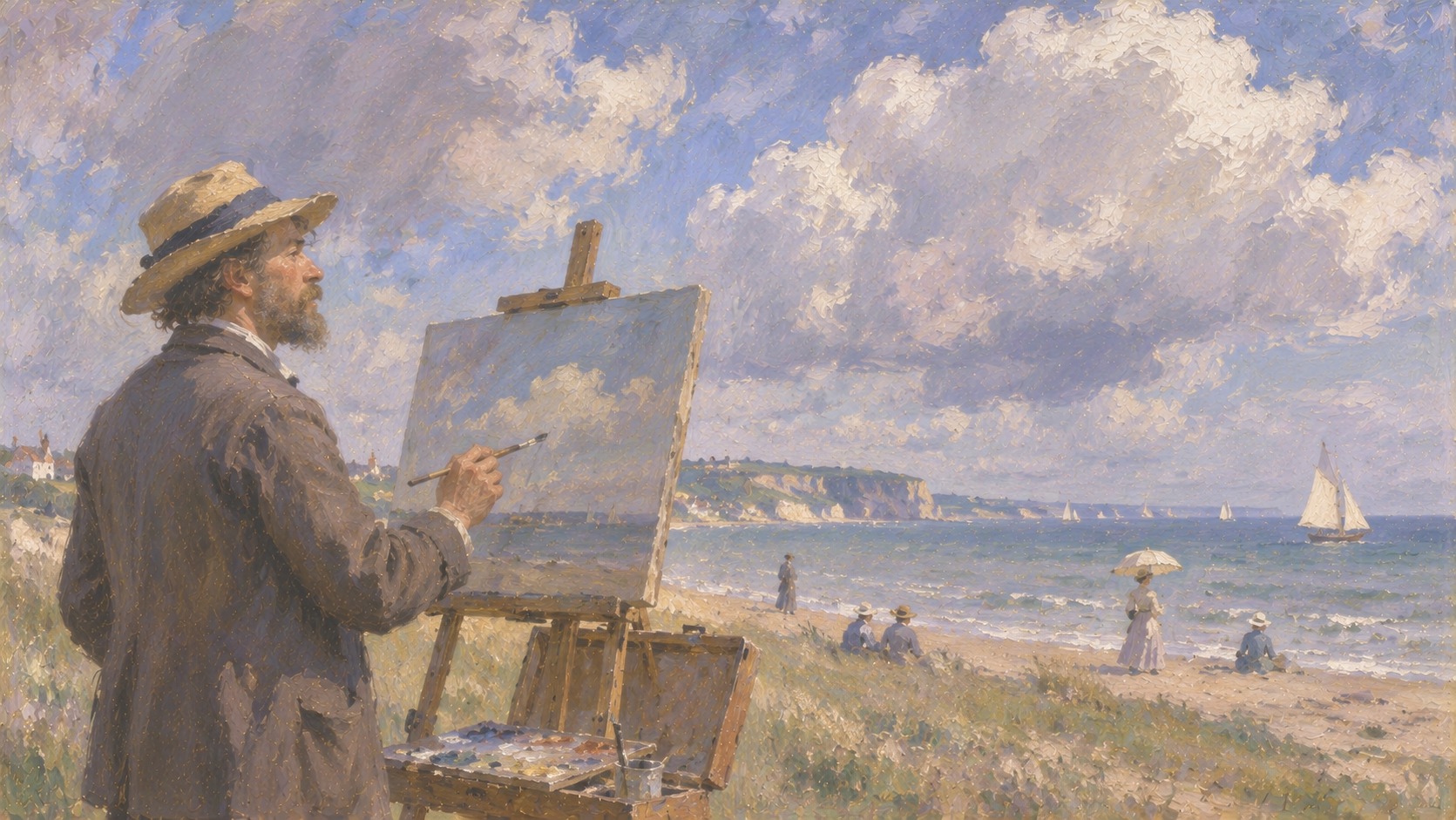
Claude Monet was known locally for caricatures before his encounter with Boudin in the latter half of the 1850s. The older painter encouraged him to work outside, confronting the landscape rather than relying solely on studio conventions. It was a lesson about attention as much as technique. A shadow observed at one moment might be gone before a painter had finished mixing its color.
Boudin joined the first Impressionist exhibition in 1874. Monet later became renowned for returning to the same motifs under changing conditions, but the two careers were distinct. Boudin’s long engagement with maritime life and the people inhabiting the coast makes his work more than a preface to Monet. The exact year of their first meeting varies in museum accounts; the late 1850s is the defensible common ground.
The beach becomes a modern subject
In the nineteenth century, French seaside resorts developed into destinations for leisure. Fashionable visitors brought a different rhythm to places long associated with fishing and transport. Boudin’s beach pictures record this coexistence of labor, recreation and new forms of consumption. A dark cluster of coats or a brightly colored parasol can carry as much social meaning as a detailed portrait.
The low horizon often leaves an unusually large share of the painting to the sky. This is not empty space: clouds organize the light across everything below. A sail can appear bright against a gray bank of cloud, then become a dark silhouette against illuminated water. Such relationships help explain why the paintings remain compelling even when individual figures are small.
From an outdoor observation to a finished picture
Plein-air painting means working in the presence of the subject. It does not require every painting to be completed outside in a single session. Portable materials help, but so do decisions about which details matter. A pastel can capture broad changes in hue rapidly; a drawing can preserve a composition; an oil painting can develop the relationship between these observations.
Look for differences between the edge of a boat, the softer outline of a cloud and the reflection beneath a building. These are distinct kinds of visual information. A painter who treats every contour with equal precision can lose the impression of distance. Boudin’s selective handling of edges allows the atmosphere to become part of the subject rather than a backdrop.
What Gunma is showing
The museum’s published highlights encompass a religious gathering in Brittany, a road near Trouville, members of the Boudin and Monet families, cattle, departing boats and Venetian architecture. These subjects span four decades of work. The selection below is drawn from the museum’s own exhibition page; it is not an exhaustive checklist.
Low Tide, dated 1884, is an oil on canvas measuring 117 by 161 centimeters. The late painting of the Sainte-Catherine bell tower in Honfleur is an oil on panel. The contrast in scale and support offers a useful starting point for understanding how the artist varied his practice. French lenders named by the museum include institutions in Honfleur, Le Havre, Reims and Saint-Lô.
| Work (descriptive English title) | Date | Collection |
|---|---|---|
| Pardon festival at Sainte-Anne-la-Palud, Douarnenez Bay | 1858 | MuMa, Le Havre |
| Road to Trouville, near Le Butin | 1860–63 | Musée Eugène-Boudin, Honfleur |
| Landscape with figures (Madame Boudin and the Monet family) | c. 1875–77 | Musée Eugène-Boudin, Honfleur |
| Herd of cows at a watering place | 1880 | Musée des Beaux-Arts, Reims |
| Low Tide | 1884 | Museum of Art and History, Saint-Lô |
| Berck, departure | 1890 | Musée des Beaux-Arts, Reims |
| Venice, San Giorgio Maggiore | c. 1895 | Musée des Beaux-Arts, Reims |
| Le Croisic | 1897 | MuMa, Le Havre |
| Honfleur, bell tower of Sainte-Catherine Church | c. 1897 | Musée Eugène-Boudin, Honfleur |
Why French Impressionism has a home in Japan
A history of Impressionism in Japan cannot be told solely through visiting exhibitions. The industrialist Kojiro Matsukata visited Monet at Giverny in 1921 and acquired paintings directly from him. The collection that bears Matsukata’s name became the foundation of the National Museum of Western Art, established in 1959. The museum’s summer 2026 centenary display gathered works by Monet from its collection and deposits.
Collectors, curators and public institutions have consequently shaped the ways successive generations encounter European painting. Gunma’s accompanying collection displays, which the prefecture says include Monet and Camille Pissarro, offer another opportunity to compare artists rather than treating Impressionism as a single uniform style.
A Japanese vocabulary for atmosphere
The Japanese painter Seiki Kuroda traveled to France in 1884 and studied with Raphaël Collin, whose approach combined academic painting with the treatment of outdoor light. Kuroda’s return helped reshape the teaching and practice of Western-style oil painting in Japan. This is a parallel history of artistic exchange, not evidence that Boudin directly taught Kuroda.
Long before that exchange, Japanese artists had developed other means of conveying atmospheric conditions. Hasegawa Tohaku’s sixteenth-century Pine Trees screens use the intensity of ink and the unpainted paper to make trees emerge from mist. Woodblock artists could use graduated printing and the juxtaposition of colors to suggest changing skies. Comparing these methods with Boudin’s oil painting reveals different solutions to a shared visual challenge without collapsing distinct traditions into one.
Planning a visit
The exhibition occupies Gallery 1 of the Museum of Modern Art, Gunma, at 992-1 Watanuki-machi, Takasaki. Hours are 9:30 a.m. to 5 p.m., with last admission at 4:30 p.m. Adult admission is ¥1,200; university and high school students pay ¥600; younger children enter free. The museum is closed on November 30. Regular Monday closures have exceptions on December 7, December 14 and January 11; the museum is also closed December 28–January 4 and January 12.
Gallery talks are scheduled for December 12, December 23 and January 11 at 2 p.m. Auditorium lectures are planned for January 9, 17 and 27, beginning at 2 p.m., with a capacity of 200 and an exhibition ticket required. Check the museum’s website for changes and access information.
A rewarding visit need not begin with a famous name. Choose a painting and look first at its horizon, then its clouds, then the people or boats beneath them. Step back and observe what changes. Boudin’s enduring achievement lies in making the most ordinary elements of a landscape worth sustained attention.
Primary sources and references
- Museum of Modern Art, Gunma: exhibition
- Gunma Prefecture: November 20 announcement
- SOMPO Museum: 2026 exhibition archive
- National Gallery, London: Boudin
- Thyssen-Bornemisza Museum: Boudin
- National Gallery of Art: Monet
- Museum Barberini: Boudin
- National Museum of Western Art: Monet centenary
- National Museum of Western Art: Matsukata collection
- National Diet Library: artists who studied in France
- Tokyo National Museum: Pine Trees screen
- National Art Center, Tokyo: exhibition listing