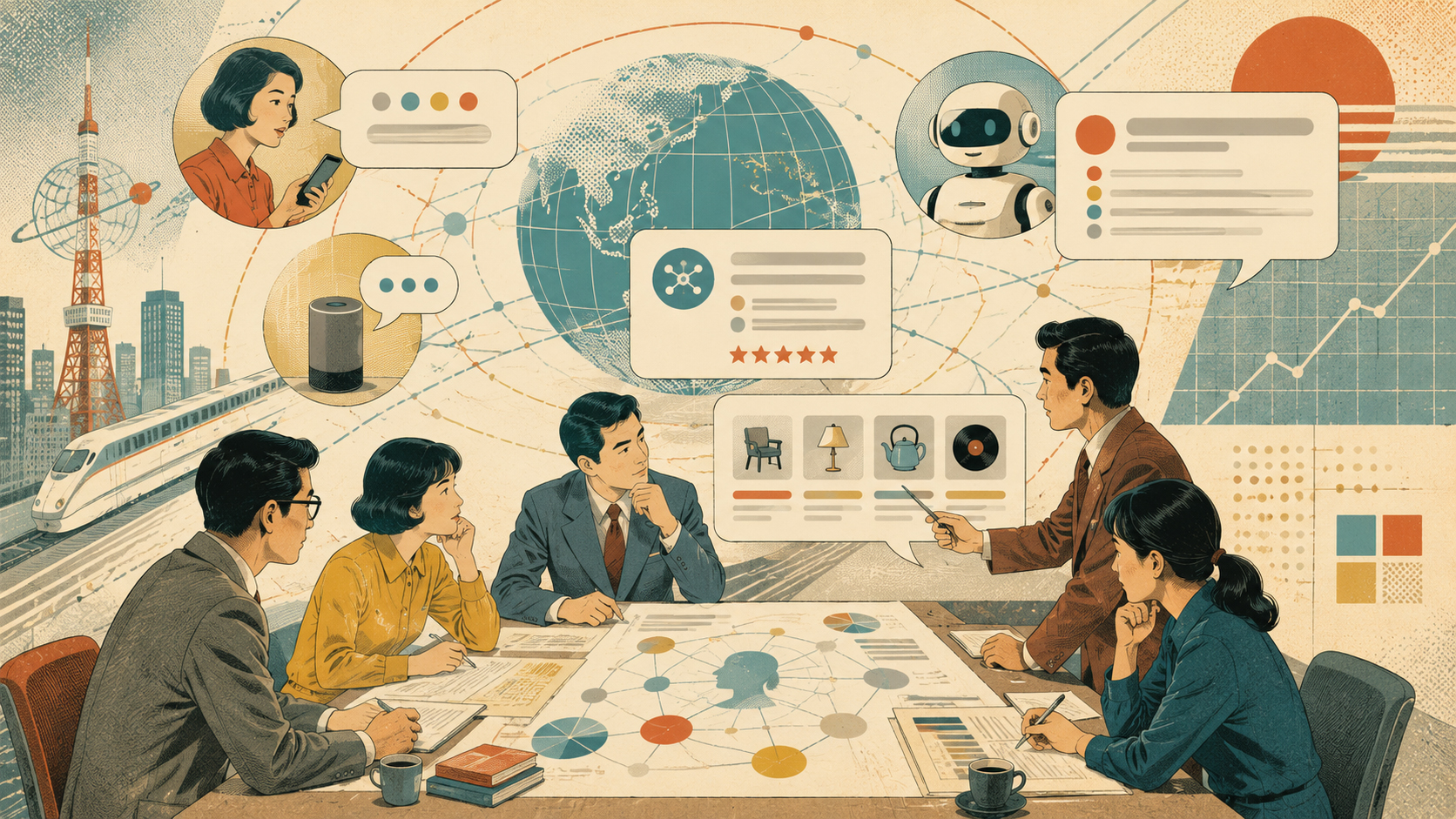
For years, companies chased the first page of search. Rank above the fold. Buy the ad slot. Collect reviews. Win the comparison page. Discovery generally happened somewhere between a blue link, a paid listing, a review site, and a sales landing page. In 2026, that entry point is changing. Users do not only type keywords into search boxes; they ask ChatGPT, Gemini, Google AI Mode, and Copilot for answers. The system may name a company, ignore it, describe it accurately, or pull an old impression from scattered public information. The new question is no longer simply, “Can people find us?” It is, “How does AI explain us?”
That is the territory where Yokohama-based secondz digital has moved early. AEO — answer engine optimization, AI search optimization, or the broader discipline of being visible and correctly described inside AI answers — turns brand discovery into a new kind of information-management problem. In March 2026, secondz digital announced that MarkeZine had published its explanation of AI search optimization: the idea that companies must now understand how their brands and services are described by generative AI environments, not only how they rank in conventional search.
What AEO means: not only rank, but representation
The terminology is still unstable. Some marketers say Answer Engine Optimization. Some say AI Engine Optimization. Others say Generative Engine Optimization or LLMO. Google itself acknowledges these terms but argues that, from Google Search’s perspective, optimizing for generative AI search is still part of optimizing for the search experience. The foundations remain: helpful information, clear technical structure, crawlability, credibility, originality, and human usefulness. Yet the surface experience has changed dramatically.
Classic SEO assumed a click. A user searched, saw a result, opened a page, and judged the source. AEO begins before the click. An answer system reads official pages, third-party articles, reviews, news, FAQs, videos, product pages, and comparison content, then synthesizes a response. Brands are no longer only competing to be ranked. They are competing to be cited, compared, trusted, and summarized correctly.
secondz Agentsense: measuring how AI sees a brand
The name at the center of secondz digital’s AEO push is secondz Agentsense. The company describes it as an agent for visualizing and optimizing how a brand or service is mentioned, evaluated, and cited in generative AI search environments such as ChatGPT, Google AI Mode, and Copilot. In another announcement, secondz digital said it had independently developed the platform in 2025 to analyze and improve brand visibility in the age of AI search.
The idea is important because it stretches marketing beyond “run the campaign.” Advertising can be bought. SEO can be engineered in part. But AI answers are formed from a larger mirror: corporate sites, product pages, press releases, reviews, old price pages, user complaints, job postings, media coverage, comparison articles, and forum discussions. AEO becomes the discipline of reading that mirror and repairing the public information environment around the brand.
The July 23 webinar: brand strategy becomes an AI-era management issue
On July 2, 2026, secondz digital announced an online webinar for July 23 titled around “brand strategy in the AI era” for large enterprises. The lineup includes Dentsu Consulting, Fun Marketing, Cross Marketing, Growth X, Keyword Marketing, Cloud Circus, Eltes, and Bilcom. The program spans AEO strategy for being selected by search AI, brand strategy for enterprise value, internal branding, AI-era insight discovery, AI talent development, misinformation and reputation risk, and integrated PR.
That lineup matters. AEO is not being framed merely as a search-marketing trick. It is being placed beside brand, PR, talent development, sales, reputation, and governance. In the AI answer era, a company’s fragments become visible at once: hiring promises, customer reviews, executive interviews, case studies, product FAQs, incident responses, and press releases. AI systems can cross those boundaries and compress them into a single impression.
From SEO history: links, content, zero-click, answers
In the late 1990s and early 2000s, search optimization was a game of titles, meta tags, directories, links, and keywords. As Google’s PageRank model made web links central to visibility, link quality became a battlefield. Then came the long cleanup: anti-spam systems, better content quality signals, mobile usability, page experience, structured data, and expertise-oriented content.
In the 2010s, the search results page itself became a destination. Featured snippets, knowledge panels, maps, product cards, video boxes, news boxes, and local packs gave users answers before they clicked. “Zero-click search” taught companies that discovery could happen on someone else’s surface. Brands had to manage official sites, Google Business Profiles, reviews, Wikipedia-style summaries, video presence, structured data, and FAQ content.
By the mid-2020s, generative search added a new layer. AI Overviews, AI Mode, ChatGPT, Perplexity, Gemini, and Copilot invite users to ask: “Which provider should I choose?” “Is this company trustworthy?” “Compare these products.” “What is the best Japanese vendor for this use case?” Search is moving from page retrieval toward delegated judgment.
Google’s position: no shortcut, but structure still matters
Google Search Central’s guidance on generative AI search is notably sober. It says the same SEO fundamentals still matter because generative AI features are grounded in Google’s core search systems and use retrieval techniques such as RAG and query fan-out. Google emphasizes unique, helpful, reliable, people-first content, clear technical structure, crawlability, good page experience, and high-quality images and video where relevant.
It also pushes back against supposed shortcuts. There is no need to create special AI-only files for Google Search, over-chunk content, rewrite pages only for AI systems, or chase inauthentic mentions. That warning is important for the AEO market. If the field becomes a collection of hacks, it will burn credibility quickly. The durable version of AEO will be closer to honest information architecture: accurate product pages, updated facts, genuine case studies, clear sources, and a web presence that reflects the business as it really is.
AI answers become editors
Recent research on AI Overviews shows why this is a structural shift, not a cosmetic change. One 2026 measurement study found that AI Overviews reach a vast audience and select sources in ways that are not simply identical to the traditional first page of search. It also reported that a meaningful share of atomic claims in AI Overview responses were not fully supported by the cited pages. Other research has found that generative search systems and traditional search can retrieve very different source sets and may respond inconsistently across similar queries.
For brands, the implication is uncomfortable. An AI answer does not merely list sources. It selects, condenses, paraphrases, compares, omits, and sometimes misframes. In practical terms, AI becomes an editor — one whose editorial logic is not fully visible. A company must monitor not only whether it appears, but what it is placed next to, which facts are chosen, whether old data persists, and whether the answer reflects the business’s current positioning.
Why this matters for Japanese enterprises
Japanese companies have traditionally invested heavily in formal accuracy: company profiles, product pages, IR pages, press releases, and carefully controlled public statements. But AI-answer visibility cannot be managed by the official site alone. Third-party media, hiring reviews, implementation stories, industry associations, event pages, customer blogs, YouTube explainers, comparison sites, and public controversy all become raw material.
That makes AEO a shared task across PR, marketing, sales, legal, HR, customer success, and product teams. Are sales materials and website claims consistent? Are old product names still floating around? Do FAQs answer actual customer questions? Are case studies concrete enough to be cited? Can the company explain limitations as well as strengths? In the AI era, brand management begins with information hygiene.
secondz digital’s position: from AI transformation to brand visibility
secondz digital was founded in November 2019 and is based in Yokohama. Its announcements describe a company that develops generative AI and LLM-based solutions and consulting, covering AI strategy, data infrastructure, product development, implementation, and adoption. CEO Ryuya Itai is described as having worked at GREE, en Japan, and PKSHA Technology before founding the company.
That background matters. secondz digital’s AEO move is not just an SEO agency rebranding a service line. It emerges from enterprise AI transformation work. The logic is symmetrical: companies need to use AI internally, and they also need to understand how external AI systems perceive them. Organizations with clean internal information and clear knowledge architecture will likely be better prepared for both sides of that equation.
The risk: AEO could become the next spam industry
There is a danger here. Every new search surface produces a new class of shortcuts. Keyword stuffing, link farms, thin content, fake reviews, low-value comparison pages, and synthetic authority all appeared because visibility had value. AI answers will create similar temptations: pages written only to be scraped, artificial mentions, fake third-party authority, shallow FAQs, and generative content designed to manipulate summaries.
If AEO goes down that path, it will become another spam war. The better path is harder and more valuable: publish primary evidence, update official data, explain limits, document customer outcomes, create useful product comparisons, and ensure that brand promises match lived experience. AI systems are imperfect, but low-quality public information almost guarantees low-quality answers.
Japan.co.jp’s view
AI-era brand strategy is a turning point for Japanese companies. Brands used to be formed through advertising, stores, salespeople, trade shows, newspaper coverage, and search results. Now they are also formed inside AI answers, before the user clicks anything at all.
secondz digital’s AEO work is interesting because it treats AI not merely as an efficiency tool, but as a new information environment. AI does not only help companies write faster or automate workflows. It summarizes reputation, compares vendors, and recommends candidates. In that environment, a brand is not just a logo or slogan. It is the sum of the evidence available across the web.
If AEO matures, it will not be the art of fooling machines. It will be the discipline of making companies accurately understandable. The winners will be firms that can be read honestly by people, search engines, and AI systems at the same time.
The Numbers
What Readers Should Watch
| Point | Meaning |
|---|---|
| What happened | secondz digital has put AEO at the center of its enterprise AI branding work: measuring and improving how companies and services are described by AI systems. |
| Why it matters | Discovery is shifting from rankings and clicks toward citation, description, comparison, and recommendation inside AI-generated answers. |
| Core tool | secondz Agentsense, a platform for analyzing brand mentions, evaluation, and citation across ChatGPT, Gemini, Google AI Mode, Copilot, and related AI-search environments. |
| Historical context | SEO, content marketing, zero-click search, and generative search have converged, making brand strategy and search strategy harder to separate. |
| Main risk | Brands may chase superficial AI hacks while neglecting the human proof, credibility, and experience that answer systems ultimately need to find. |
Sources and references
This article draws on secondz digital announcements, Google Search Central guidance on generative AI search, and recent research and reporting on AI Overviews and answer engines.
- PR TIMES / secondz digital: Announcement of the July 23, 2026 AI-era brand strategy webinar.
- PR TIMES / secondz digital: MarkeZine coverage of AEO and AI-search improvement; Agentsense and company background.
- PR TIMES / secondz digital: NexTech Week 2026 Spring exhibit and Agentsense description.
- Google Search Central: Official guidance on optimizing for generative AI features in Google Search.
- arXiv: Measurement study on Google AI Overviews, sources, fidelity, and publisher impact.