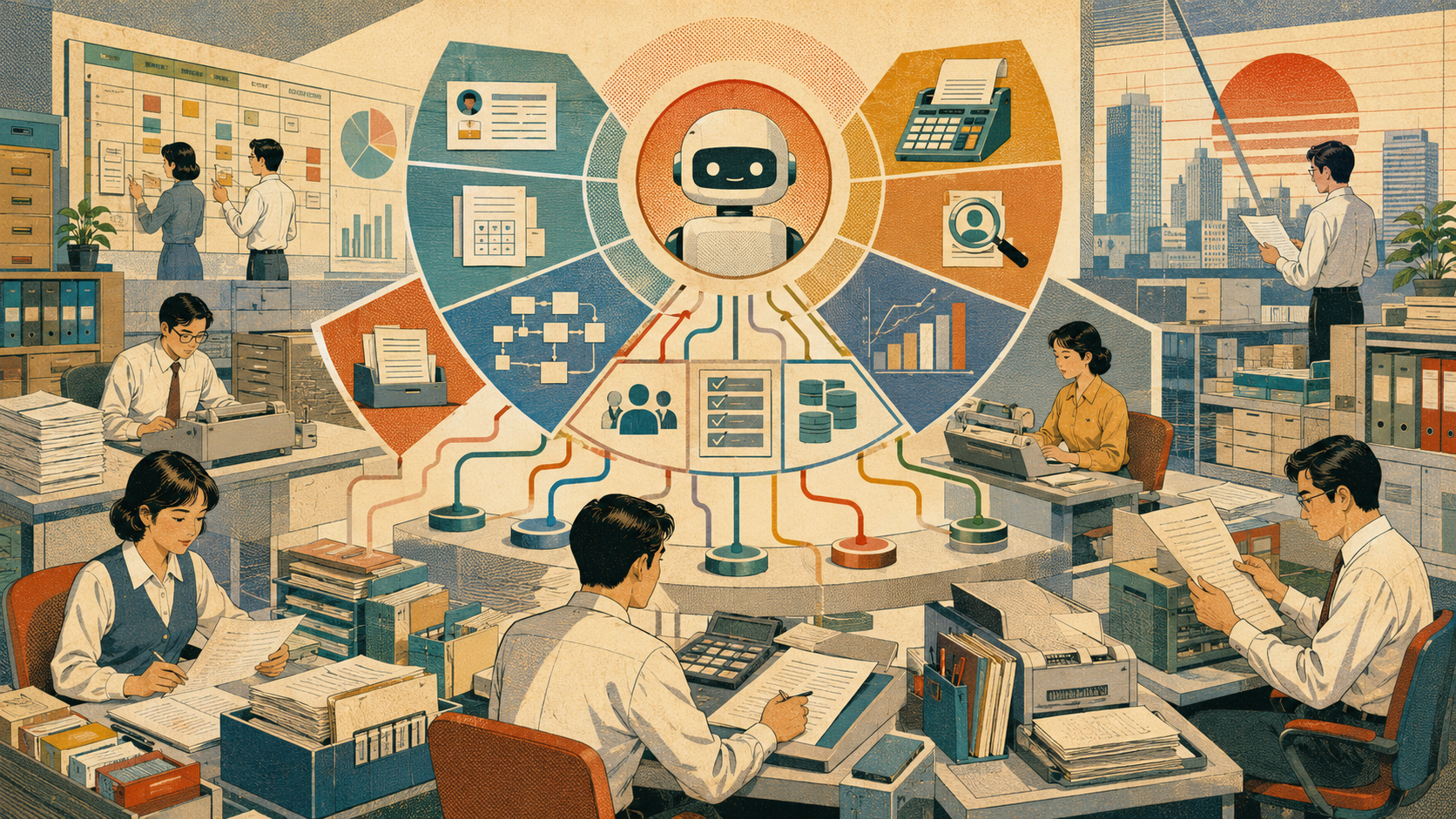
Japan’s AI adoption will not be decided only in data centers, research labs, or keynote speeches. Much of it will be decided in quieter places: invoice desks, HR teams, legal departments, internal help desks, meeting rooms, call centers, procurement teams, and the spreadsheet-heavy corners of corporate life.
That is why AIsmiley matters. The Tokyo-based company is not the loudest name in Japanese AI. It is not selling a sovereign model or a humanoid robot. Instead, it operates one of Japan’s major AI product portals, a comparison and lead-generation media business where companies can search, compare, and request materials for AI products and services. In a crowded market, AIsmiley is becoming a mapmaker.
In July 2026, AIsmiley announced that it would exhibit for three days from July 8 at Back Office World 2026 Summer Tokyo. The announcement matters because it places AIsmiley directly inside the enterprise adoption channel: not AI as theory, but AI as procurement, consultation, comparison, demo, governance, and budget approval.
AIsmiley is a mapmaker for the AI market
AIsmiley describes itself as one of Japan’s largest AI portal media platforms for corporate DX, allowing users to compare, search, and request materials for AI-equipped products and services. NTTPC’s Innovation LAB partner profile says AIsmiley has more than 3 million monthly page views and lets users compare and search more than 500 AI products.
Those numbers point to an important role. In the adoption phase of a technology wave, the bottleneck is often not invention. It is translation. A company may know that it wants to use AI, but still not know which department should start, which workflow should be automated, which vendor is credible, which security rule applies, or how to write the internal approval memo. AIsmiley sits at that translation layer.
What “back-office AI” really means
In March 2026, AIsmiley released a web magazine special issue on AI for the back office. The release framed back-office AI as a broad set of technologies that use image recognition and natural language processing to transform administrative productivity. It highlighted AI-OCR for eliminating data-entry work, generative AI for turning knowledge into an asset, and workflow automation for breaking down information silos and person-dependent processes.
In practice, that means invoice processing, expense checks, contract review, internal FAQ search, hiring support, meeting minutes, policy retrieval, training, customer-support knowledge bases, and system-help-desk automation. These may not sound glamorous, but they are exactly where Japanese companies feel the pressure of labor shortages, compliance burdens, and aging internal systems.
The numbers behind the signal
In May 2025, AIsmiley released a sales and back-office AI chaos map with 84 products, including AI agents and document-creation tools for business efficiency. In June 2026, it released a construction and real-estate AI services chaos map listing 122 products. It also published a department-based AI services chaos map that organized tools by sales and customer support, marketing and planning, HR, general affairs and legal, information systems, and development.
That shift is the story. AIsmiley is not merely grouping AI by technology type. It is grouping AI by work. Buyers do not wake up wanting “a large language model.” They wake up needing a contract reviewed, a help-desk backlog reduced, an invoice processed, or a compliance process made auditable.
Historical context: Japan’s back office before AI
Japan’s corporate back office has long carried the weight of paper forms, seals, Excel-based local rules, PDF attachments, manual approvals, and tacit knowledge passed from one employee to another. ERP, cloud accounting, e-contracts, and workflow systems have all improved parts of the picture, but many firms still live with fragmented systems and person-dependent procedures.
The RPA boom of the late 2010s automated some repetitive screen work. But RPA was strongest when rules were fixed and inputs were clean. It struggled with ambiguity, judgment, natural language, exceptions, and messy documents. Generative AI and AI agents promise a different layer: reading, classifying, drafting, summarizing, searching, and suggesting the next action.
Why chaos maps matter
A chaos map is valuable because the AI market is chaotic. Vendors overlap. Product categories change monthly. “AI agent,” “generative AI,” “OCR,” “RAG,” “workflow automation,” “knowledge management,” and “DX consulting” can all describe different pieces of the same adoption journey. Buyers need a way to compare the market without becoming AI specialists themselves.
AIsmiley’s chaos maps turn disorder into a procurement starting point. They also reveal where demand is thickening. When products are sorted by department and use case, the market becomes easier to understand: sales support here, HR automation there, legal review here, information-systems help desk there. That is how an AI market becomes an enterprise software market.
The exhibition signal
AIsmiley’s Back Office World 2026 Summer Tokyo appearance shows that AI adoption is moving from web search into face-to-face enterprise selling. Back-office buyers need more than a product page. They need to ask about security, integration, pricing, workflow fit, support, governance, and internal rollout. They need case studies and language they can use in internal approval documents.
That makes AIsmiley’s position interesting. It operates between the vendor’s ambition and the buyer’s confusion. It can educate the market, route leads, surface trends, and translate AI into the vocabulary of departments that have real budgets and real pain.
Japan.co.jp view
This is not the flashiest AI story in Japan. That is precisely why it is useful. The Japanese AI economy will not be built only by model labs and megacaps. It will also be built by market intermediaries that help ordinary companies find practical tools.
Back-office AI is a productivity story disguised as an administrative one. If internal questions are answered faster, invoices are processed with fewer errors, contracts are reviewed with better consistency, and departmental knowledge stops living only inside one veteran employee’s head, then AI has entered the company in the most important way: it has entered the operating system of work.
Reader’s guide
| Question | Answer |
|---|---|
| What happened? | AIsmiley announced its Back Office World 2026 Summer Tokyo exhibition and continues to map Japan’s AI product market through portals, special issues, and chaos maps. |
| Why it matters | Japan’s AI adoption is moving from experiments into department-specific administrative workflows. |
| AIsmiley’s role | It helps companies compare, search, and request materials for AI products and services. |
| Market signal | Chaos maps and special issues show AI demand fragmenting by department: HR, legal, general affairs, information systems, sales, customer support, and more. |
| Main risk | The product market can become so crowded that buyers need guidance as much as they need software. |
Sources and references
- PR TIMES: AIsmiley, Back Office World 2026 Summer Tokyo exhibition announcement.
- AIsmiley: AI product and service comparison portal.
- PR TIMES: Sales and back-office AI chaos map, 84 products.
- PR TIMES: Back-office AI special issue.
- AIsmiley: Department-based AI services chaos map.
- NTTPC Innovation LAB: AIsmiley partner profile.
- OECD: Artificial Intelligence and the Labour Market in Japan.