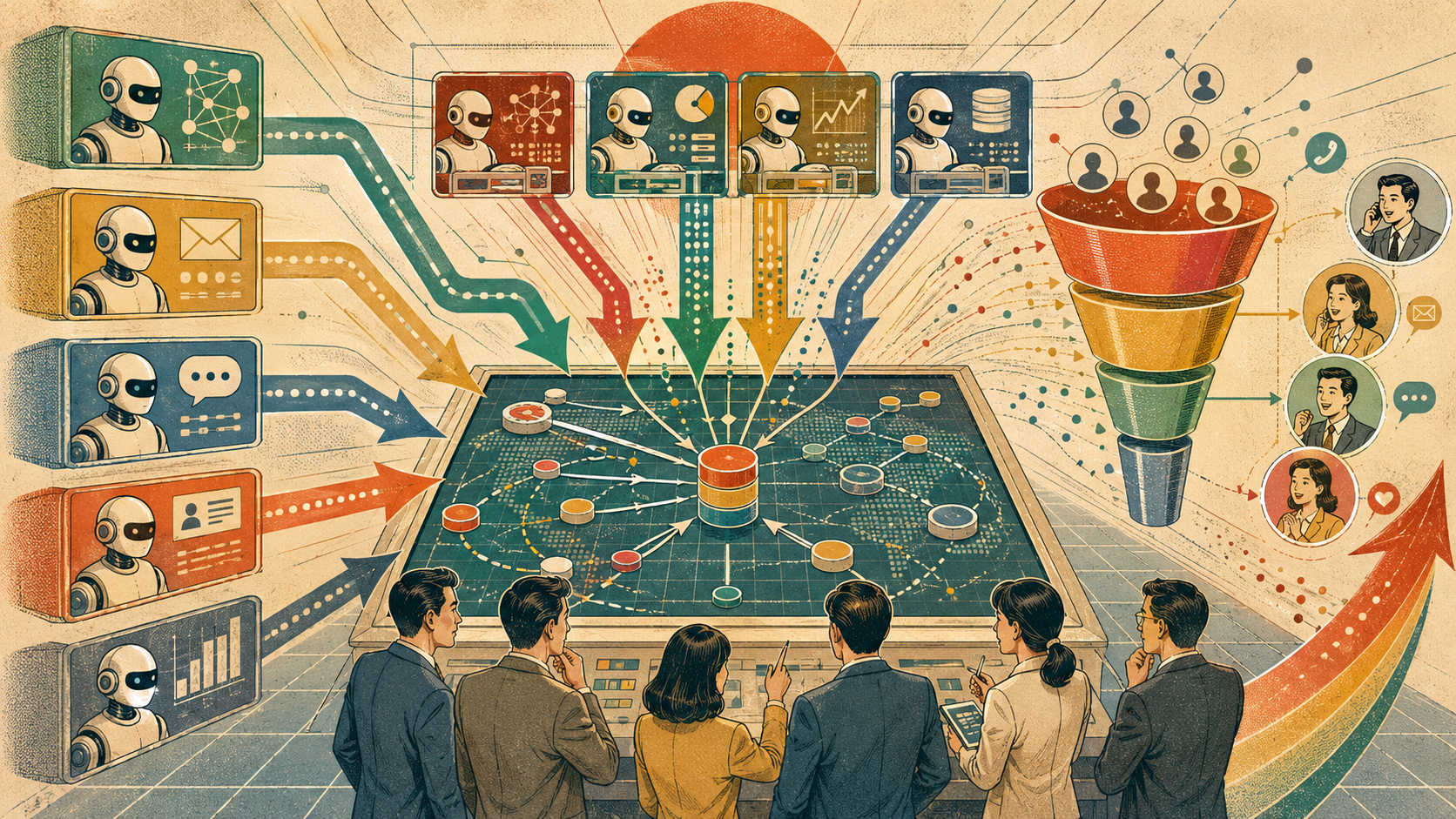
In every technology cycle there is a moment when the vocabulary changes. The old words are still useful, but they no longer describe the center of gravity. In sales technology, the old words were CRM, SFA, marketing automation, lead scoring, chatbot, and sales enablement. The new word is agent. That is why PIGNUS’s 2026 execution-type sales AI agent chaos map matters. It does not merely collect logos. It asks a sharper question: which systems only help a salesperson, and which systems are beginning to perform parts of the sales process themselves?
On February 17, 2026, PIGNUS released a map through its FitGap technology-selection engine that narrowed more than 100 domestic and overseas products down to 35 selected execution-type sales AI agents. The distinction is important. PIGNUS argues that many products calling themselves sales AI agents remain support tools. They summarize calls, draft messages, enrich lists, or remind humans what to do next. The new class is different. It plans, uses tools, iterates, and moves through a workflow: list creation, outreach, reply handling, scheduling, operations, administration, customer support, and, eventually, closing or vertical-specific sales execution.
Why a chaos map is actually useful
“Chaos map” sounds like a novelty term, but in Japan’s software market it has become a practical editorial form. When a field grows too quickly for buyers to understand, someone draws a map. Categories are grouped, logos are arranged, and the market gains temporary shape. It is not a final truth. It is a snapshot of confusion.
PIGNUS has been leaning into that role. In late 2025 it released a sequence of maps around CRM, BI, MA, and AI implementation levels. Its FitGap engine is positioned as a way for buyers to answer questions and narrow software choices. The sales AI agent map is therefore not only a media asset. It is a buyer-education device. It says: do not be dazzled by the word agent. Ask what process the product can actually execute, where it gets data, whether it connects to your systems, and how well it fits Japanese business practice.
That editorial discipline is valuable because 2026 is the year “agent washing” became a procurement problem. A button that drafts an email is not necessarily an agent. A chatbot that answers one question is not necessarily an agent. A real business agent needs a goal, tools, context, permission boundaries, memory or state, and a way to recover from error. In sales, that gap between language and operation is especially dangerous because the agent is not writing a private memo. It is speaking to prospects.
The old stack: CRM, SFA, MA
To understand the new map, rewind. Sales technology used to be a system of record problem. The CRM stored accounts, contacts, opportunities, pipeline stages, and notes. The SFA layer helped managers track activity and forecast revenue. Marketing automation scored leads and triggered nurture campaigns. Customer-support systems handled tickets and service workflows. Each tool had its lane.
The salesperson remained the operator. Software recorded, reminded, measured, and routed. Even when automation expanded, the human still owned the final interpretation. Which company should be approached? Which title matters? Is this a serious buyer or a student doing research? Should the email be formal, casual, seasonal, apologetic, deferential, or direct? In Japan, these questions are not cosmetic. They are the sales culture itself.
AI agents threaten to rearrange that division of labor. If an agent can find a target, draft the message, choose the channel, send the first approach, classify replies, update CRM fields, propose next actions, and schedule meetings, then the software is no longer a dashboard. It is a junior worker with tools. That is the shift from sales support to sales execution.
PIGNUS’s four-process frame
The PIGNUS map organizes the market across the sales process: outbound, inbound, operations and administration, and closing or vertical-specific execution. Outbound covers target-list creation, email or form sending, reply handling, and scheduling. Inbound covers website visitors, chat, and lead nurturing. Ops and admin covers order processing, invoices, CRM maintenance, and customer support. Closing and vertical products cover AI avatars, demos, negotiations, or industry-specific autonomous sales flows.
The most revealing part is not the four-box structure. It is the imbalance. According to PIGNUS, overseas outbound is dense and competitive. It confirmed 47 overseas execution-type outbound products, then highlighted top-tier names. Japan’s fully autonomous outbound field is much thinner. That is not because Japanese companies dislike technology. It is because the data and manners of Japanese sales are harder to mechanize.
| Area | What the map suggests |
|---|---|
| Outbound | Overseas products are concentrated here because LinkedIn, email-first SDR culture, and database-driven prospecting make autonomy easier. |
| Inbound | Japanese service culture can make inbound agents attractive: a visitor has arrived voluntarily, so the agent is receiving demand rather than interrupting strangers. |
| Ops & Admin | Japan’s remaining analog workflows — PDF invoices, order sheets, approvals, fax-like legacy flows — create demand for agents that process messy work. |
| Closing / Vertical | Still sparse, but potentially high-value: industry-specific agents and AI avatars must handle judgment, context, timing, and trust. |
Japan Market Fit: Structure, Source, Style
PIGNUS’s strongest editorial move is the 3S test for Japan Market Fit: Structure, Source, and Style. Structure asks whether a product has a Japanese entity, Japanese customer success, invoice payment support, and security alignment. Source asks whether it integrates with Japanese company databases, Japanese contact channels, and local business data. Style asks whether it can handle Japanese honorifics, nuance, approval processes, and business manners beyond basic machine translation.
This is where the sales-agent story becomes a Japan story. A model can write Japanese. That is not the same as understanding Japanese sales. It may know words of respect but miss the social distance. It may generate fluent outreach but choose the wrong level of humility. It may identify a company but not the true decision-maker. It may personalize from a public page but miss the fact that the company’s procurement path is relationship-driven and committee-based.
In the United States, an autonomous SDR can be judged partly by scale. Send many messages, learn from response rates, book meetings, optimize. In Japan, one badly tuned message can damage trust. The cost of embarrassment is high. That makes human-in-the-loop design more persistent and may slow fully autonomous outbound adoption.
The Japanese paradox: less autonomous outbound, more practical operations
PIGNUS’s map suggests that Japan may not follow the United States in a straight line. The American archetype is the AI SDR: a tireless outbound machine. Japan’s stronger near-term opportunity may be operational and administrative sales work. That sounds less glamorous, but it may be more valuable.
Japanese sales often includes paperwork and coordination that outsiders mistake for inefficiency. Order forms arrive in inconsistent formats. Invoices need checking. CRM data decays. Requests move through approval chains. Customer details live in email threads, PDFs, spreadsheets, and meeting notes. Human workers spend hours translating messy reality into systems of record. An AI agent that can safely handle this layer may produce more immediate ROI than a cold-email robot.
This also explains why domestic products may evolve differently. Instead of imitating overseas outbound stacks, Japanese AI vendors may build agents that sit between people, documents, and legacy systems. They may not look as glamorous in a demo. They may not promise to “replace your SDR team.” But they may solve the exact problems Japanese companies are willing to pay to remove.
From co-pilot to delegate
The agent transition has a psychological dimension. A co-pilot gives suggestions. A delegate takes action. In sales, delegation raises questions that procurement teams cannot ignore. Who approved the message? What data did the agent use? Did it hallucinate a fact about the prospect? Did it promise a discount? Did it reveal information from another customer? Did it update the CRM correctly? Did it stop when the customer objected?
These questions are not theoretical. 2026 research on autonomous agents has shown that tool-using systems can create security, privacy, identity, and accountability failures when they operate across email, files, persistent memory, and third-party communication systems. Sales agents live in exactly that environment. They touch emails, calendars, customer data, contracts, price lists, and sometimes confidential strategy.
That means the winning sales agent may not be the most aggressive. It may be the one with the clearest permission model. It may know when not to send. It may require approval before external contact, log every decision, separate drafting from execution, and show the source of its claims. In sales, safety is not a compliance ornament. It is brand protection.
The new sales organization
If execution-type agents become normal, the sales organization will change. A junior SDR may manage agent output rather than write every first-touch message. A sales-ops worker may design workflows rather than manually update CRM fields. Managers may audit agent behavior instead of checking individual activity reports. Marketing may optimize content not only for buyers but for the AI systems that summarize, retrieve, and personalize it.
This does not make the human salesperson obsolete. It may make human judgment more important. The agent can assemble the map, but someone still must decide what kind of relationship the company wants. Someone must understand timing, apology, urgency, trust, and discretion. In Japan, that final layer of judgment will remain difficult to automate.
But the work below that layer is changing fast. Prospect research, drafting, CRM hygiene, follow-up tracking, meeting preparation, and administrative handoffs are being pulled into agent workflows. The salesperson becomes less like a typist and more like an editor, supervisor, negotiator, and relationship owner.
The buyer’s problem in 2026
The practical buyer question is not “Should we use AI agents?” It is “Which tasks are safe enough to delegate?” PIGNUS’s map helps because it separates product claims by process. A company can decide that inbound chat is ready, outbound sending is not, CRM cleanup is acceptable, and closing remains human-only. That kind of staged adoption is more realistic than a single all-or-nothing AI policy.
The map also forces a second question: is the product localized for Japan, or merely translated? The difference will shape outcomes. A translated product may generate Japanese sentences. A localized product may understand Japanese workflows, data sources, support expectations, invoicing, security review, and business manners. That is why the 3S criteria are useful.
What PIGNUS is really mapping
At first glance, PIGNUS is mapping products. More deeply, it is mapping a labor transition. Sales software is moving from records to recommendations, from recommendations to actions, and from actions to autonomous chains of work. That transition will not happen evenly. It will proceed first where data is clean, risk is low, and workflows are repeatable. It will lag where trust, nuance, negotiation, and reputation matter most.
For Japan, that may be an advantage. The market’s caution can become a design discipline. Japanese companies may avoid the most reckless forms of AI outbound and instead build agents that respect approvals, context, and customer relationships. If that happens, Japan’s sales-agent market will not simply be a delayed version of Silicon Valley’s. It will be a different architecture of automation.
The name “chaos map” is modest. But the PIGNUS report points toward something larger: the redesign of white-collar sales work. The first wave put customer information into databases. The second wave measured activity. The third wave automated campaigns. The fourth wave is beginning to act. The question for 2026 is not whether AI will enter sales. It is whether companies can teach it restraint before they give it authority.
Sources and references
This article draws on PIGNUS / FitGap public releases and company information, plus wider materials on AI agents, CRM, SFA, marketing automation, and enterprise deployment risk.
- PR TIMES / PIGNUS: 2026 execution-type sales AI agent chaos map, February 17, 2026.
- PIGNUS: AI implementation-level four-layer chaos map and earlier CRM / BI / MA maps, December 16, 2025.
- FitGap: technology selection engine operated by PIGNUS.
- Salesforce: 2026 enterprise AI-agent trend framing.
- Agents of Chaos: 2026 red-team study on autonomy, tools, identity, and agent failure modes.