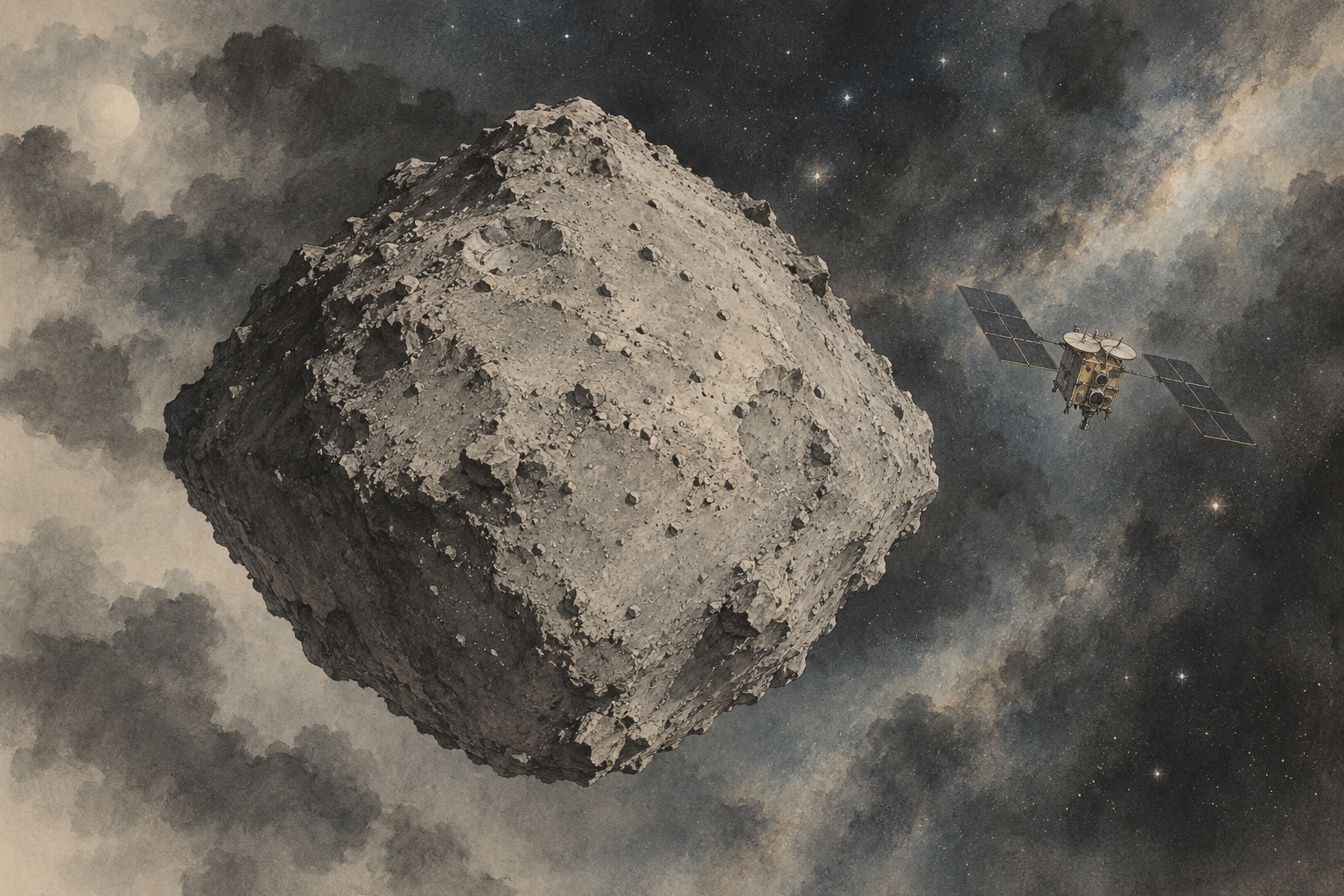
A grain returned from asteroid Ryugu has preserved a clock from the Solar System’s opening act. An international team led by researchers at Hokkaido University measured carbonate minerals in material collected by JAXA’s Hayabusa2 mission and found that one population of dolomite formed about 4.56530 billion years ago, from fluid at roughly 90°C. When that mineral age and temperature were combined with thermal models of the earlier body from which Ryugu came, the researchers inferred that the parent body itself must have assembled within roughly two million years of the start of Solar System formation. The work appeared online in Science on September 10.[1] [2] [3]
A mineral that remembers when water moved
The key mineral is dolomite, a carbonate composed mainly of calcium and magnesium, CaMg(CO3)2. In Ryugu’s history, such carbonates formed after ice inside the parent body melted and liquid water reacted with rock. That makes the mineral more than a component of the asteroid: it is a chemical record of when aqueous alteration was underway inside the body.[2] [4]
The team, led by Hokkaido University associate professor Noriyuki Kawasaki, used an isotope microscope to measure manganese and chromium isotopes in the dolomite. The clock is based on radioactive manganese-53, which decays to chromium-53 with a half-life of about 3.7 million years. That relatively short half-life makes the Mn–Cr system particularly useful for timing events during the Solar System’s first few million years.[2]
Earlier attempts to date Ryugu carbonates had produced substantially different ages. One suspected source of disagreement was how the measurements were calibrated. The new work adopted a calibration based on synthetic dolomite with a uniform manganese-to-chromium ratio, produced at Ibaraki University, to improve the chronology. The newly analyzed C0002 grain came from material associated with Hayabusa2’s second touchdown.[2]
The mineral age is not the parent body’s birthday
This distinction is the intellectual center of the study. A dolomite crystal that formed 4.56530 billion years ago tells researchers when a water-rock reaction occurred. It does not, by itself, say when the body containing that water and rock first assembled.
The researchers therefore added a second clock: temperature. Oxygen isotope differences between dolomite and magnetite act as a thermometer because the degree of isotopic fractionation depends on formation temperature. The result was about 90°C. Yet the newly assembled parent body would initially have been extremely cold — below roughly −200°C in the model. Heating by the decay of short-lived radioactive nuclides and other internal processes would have taken at least several hundred thousand years to raise parts of the body to the temperature at which the dolomite formed.[2]
That delay pushes the actual assembly of the parent body earlier than the carbonate age. The team therefore concludes not that the body formed at one precisely measured instant, but that it had to exist within about two million years of the beginning of Solar System formation.[1] [2]
Why two million years is extraordinarily early
Cosmochemists often define the opening of Solar System chronology using calcium-aluminum-rich inclusions, or CAIs, among the oldest known solids formed in the protoplanetary disk. A Hokkaido University study published this July dated one refractory inclusion in samples from asteroid Bennu to about 4.56730 billion years ago, effectively at that beginning point.[8]
Most carbonaceous chondrite meteorites — apart from the Ivuna-type, or CI, group — contain abundant chondrules, millimeter-scale spheres produced when rocky material was melted and rapidly cooled. The detailed Hokkaido release notes that many of those chondrules formed more than about 2.2 million years after Solar System formation began. If Ryugu’s parent body had already assembled within the first two million years, it predates the parent bodies that incorporated many of those later chondrules.[2]
The Science paper extends that argument beyond Ryugu. It also analyzes Ivuna-type material and concludes that the parent bodies of Ryugu and Ivuna formed before those of many other carbonaceous chondrites. The implication is a more layered early Solar System: carbon-rich planetesimals may have formed in multiple generations rather than in one synchronized wave.[3]
Ryugu is ancient material in a younger arrangement
Calling Ryugu an “early-generation” remnant can be misleading if it suggests that the asteroid has spent more than 4.5 billion years in exactly its present shape. JAXA’s returned-sample research instead supports a rubble-pile history. A larger parent body was altered internally, later disrupted, and its fragments subsequently reaccumulated. Material from different depths of that earlier body is now mixed within Ryugu.[4]
The history preserved in one sample can therefore contain several chapters: primordial solids accrete; internal ice melts; water reacts with rock; clays, carbonates and magnetite form; aqueous activity declines; the parent body is broken apart; fragments gather again; and, much later, a spacecraft touches the surface and carries a few grains back to Earth.
That is why sample-return science can seem to revise the age of the same asteroid again and again. Researchers are often dating different events in a complex history rather than a single act of formation.
What Hayabusa2’s five grams made possible
Hayabusa2 launched on December 3, 2014 and reached Ryugu on June 27, 2018. It completed its first touchdown on February 22, 2019. On April 5, the mission created an artificial crater with its Small Carry-on Impactor; a second touchdown followed on July 11. The spacecraft departed Ryugu in November 2019, and its return capsule was recovered in Australia on December 6, 2020.[5]
At JAXA’s Extraterrestrial Sample Curation Center, the returned material was measured at 5.424 ± 0.217 grams, vastly exceeding the mission’s 0.1-gram minimum requirement. That is a tiny mass by everyday standards. Scientifically, however, it has a major advantage over most meteorites: its extraterrestrial origin is certain, its collection context is known, and the material could be handled with extraordinary care to limit terrestrial contamination.[6] [10]
The C0002 grain used in the new chronology is especially valuable because it is associated with the second touchdown. Hayabusa2’s two sampling events were designed to capture material from different contexts, including material exposed by the mission’s artificial-impact experiment. That spatial history turns returned grains into more than anonymous pieces of space rock.
Why CI-like material matters
Ryugu is a C-type asteroid rich in water-bearing minerals and organic matter. JAXA’s analyses have shown a close relationship between its rock type and CI, or Ivuna-type, carbonaceous chondrites. CI meteorites are particularly important because, aside from volatile gases, their elemental abundances closely resemble the overall composition of the Solar System and they are often treated as a chemical reference material. JAXA describes Ryugu samples as being dominated by hydrated clay minerals and reports roughly 7% water and 5% carbon by mass in the analyzed material.[4] [7]
“Primitive,” however, does not mean chemically untouched. Ryugu’s parent body experienced extensive reactions between water and rock. Another study published in Nature Astronomy in August reported ammonium-bearing clays and multiple nitrogen species associated with late-stage brines in the parent body. Together, such studies are revealing a small world in which water circulated and chemistry evolved long before Earth existed in its present form.[9]
Bennu offers the next comparison
The research team points to asteroid Bennu as a critical next test. NASA’s OSIRIS-REx mission returned samples from Bennu, another carbon-rich asteroid with important chemical similarities to Ryugu. In July, Kawasaki and colleagues reported refractory inclusions in Bennu material, including one dated to about 4.56730 billion years ago. The inclusions resembled examples previously found in Ryugu, supporting the possibility that the two asteroids incorporated similar material in the outer Solar System.[8]
Dating alteration minerals in Bennu with comparable methods could answer a sharper question: did its parent body assemble in the same very early generation as Ryugu’s, or did similar raw materials come together at a different time? With two sample-return missions, researchers can begin to build a map not just of what early carbonaceous bodies contained, but when different populations of them formed.
The Solar System may have built planetesimals in generations
Planet formation is often summarized as a smooth progression: dust becomes pebbles, pebbles become planetesimals, and planetesimals become planets. The new Ryugu chronology points toward something less uniform. Carbonaceous planetesimals may have appeared in distinct generations during the first few million years, under changing conditions in the young Sun’s disk.
The evidence comes from a mineral far smaller than the asteroid itself. Its manganese and chromium isotopes carry a clock; its oxygen isotopes carry a thermometer. Put together with a thermal model, they say that before the water-rock reaction recorded by the dolomite could occur, an entire carbon-rich world had already assembled and begun heating from within.
Hayabusa2 returned only about five grams from Ryugu. Six years after those grains reached Earth, they are still opening new windows into time. This one reaches to within roughly two million years of the Solar System’s beginning — an interval so brief on a 4.6-billion-year scale that it is almost a geological instant. Yet by then, the raw architecture of water-rich planetesimals was already taking shape.
- University of Tokyo: English release on the age of Ryugu’s progenitor body, Sept. 11, 2026
- Hokkaido University and partners: detailed research release with methods, chronology and thermal modeling
- Kawasaki et al., Science: The parent bodies of Ryugu and Ivuna formed before those of other carbonaceous chondrites
- JAXA/ISAS: Hayabusa2 and Ryugu — scientific results from the returned samples
- JAXA: Hayabusa2 mission overview, touchdowns, artificial crater and sample return
- JAXA/ISAS: Ryugu sample curation and measured sample mass of 5.424 ± 0.217 g
- JAXA Hayabusa2 Project: Ryugu, C-type asteroids and mission science
- Hokkaido University: refractory inclusions in Bennu and links to Ryugu, July 23, 2026
- Nature Astronomy: ammonium-bearing clays and nitrogen species in late-stage brines of Ryugu’s parent body, Aug. 27, 2026
- JAXA: confirmation of returned Ryugu material, Dec. 14, 2020
Editorial note: 4.56530 billion years is the measured formation age of the newly analyzed dolomite, not a direct measurement of the present asteroid Ryugu’s assembly age. The inference that the parent body formed within roughly two million years of the start of Solar System formation combines mineral chronology, formation temperature and thermal-evolution modeling. Japanese names, readings and specialist terminology were checked against the Japanese Hokkaido University primary release.