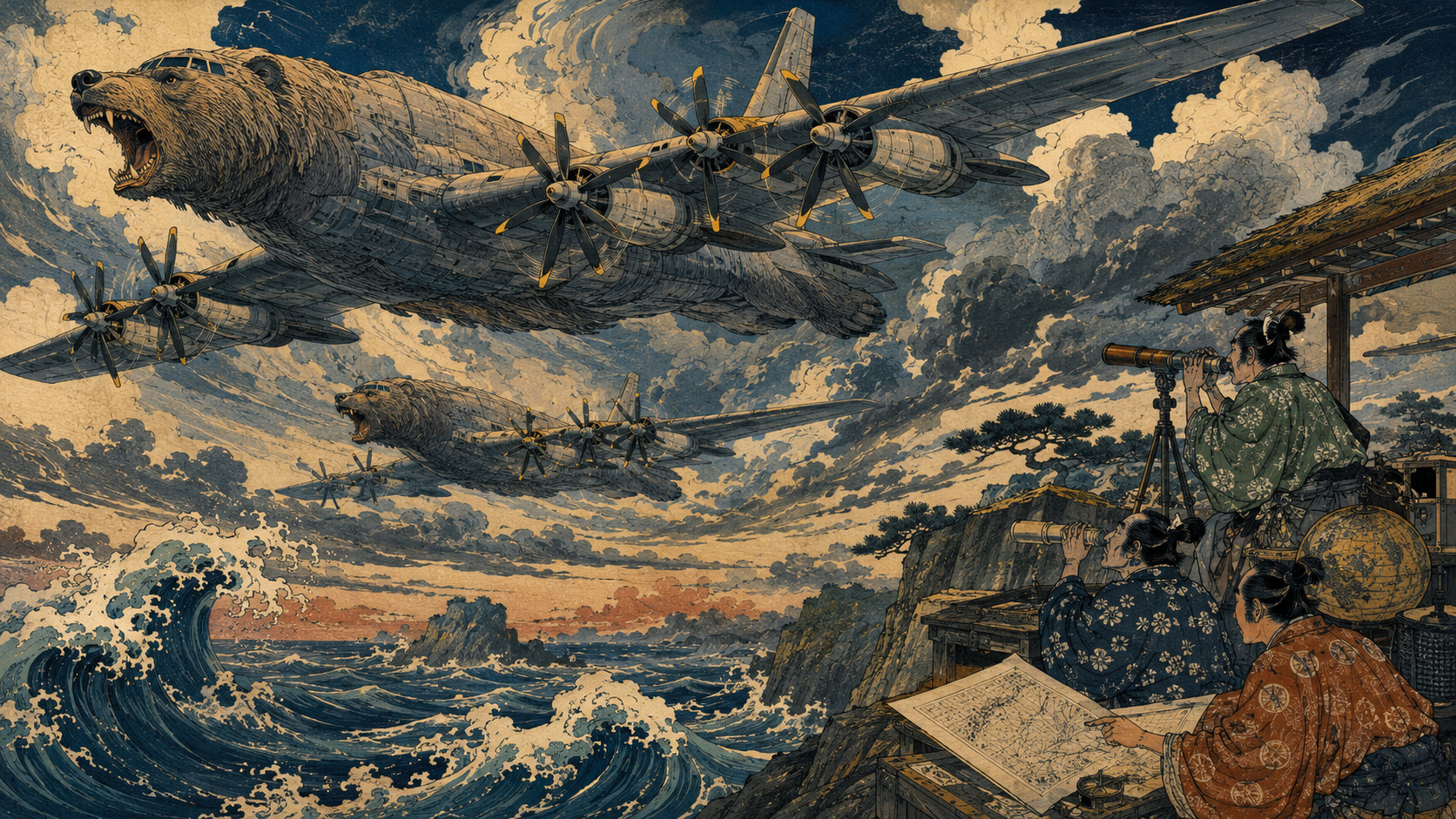
The aircraft approaching northern Japan on Tuesday afternoon belonged visually to another age. Four turboprop engines drove pairs of enormous counter-rotating propellers. A glazed nose and a long silver fuselage followed wings swept like those of an early jet. Its NATO reporting name, “Bear,” had been spoken in Cold War air-defence rooms before most of today’s fighter pilots were born.
But the Tupolev Tu-95 was not appearing as a museum piece. Japan’s Joint Staff said that on July 21 it observed one Tu-95 bomber, one Su-35 fighter and two additional aircraft assessed to be Russian. The group came from the direction of the continent, flew east over the Sea of Japan, changed course off Okushiri Island, headed north, turned again off Cape Kamui on Hokkaido’s Shakotan Peninsula and flew west toward the continent. Fighters from the Japan Air Self-Defense Force’s Northern Air Defense Force and other units scrambled in response.
Russia’s Ministry of Defense described the wider operation in different terms. It said Tu-95MS strategic missile carriers made a scheduled flight above neutral—international—waters of the Sea of Japan, with Su-35S and Su-30SM fighters providing escort. It gave the mission’s duration as more than 11 hours and said its long-range aviation flights complied strictly with international rules.
The accounts overlap but do not align one-for-one. Russia used the plural for the missile carriers; Japan publicly plotted one Tu-95 and did not assign types to two of the four tracked aircraft. That does not prove that either side was wrong. They may have described different portions of a larger sortie, used different identification thresholds or chosen different details for release. The disciplined conclusion is narrower: Japan directly documented one Bear and three accompanying aircraft on the northern Sea of Japan route, while Russia said its full Tu-95MS mission lasted more than 11 hours.
What is established—and what is not
- Established by Japan: four aircraft were tracked on July 21—one Tu-95, one Su-35 and two unidentified aircraft presumed Russian.
- Established by Japan: the formation flew over the Sea of Japan, turned near Okushiri Island and Cape Kamui, and prompted a JASDF scramble.
- Claimed by Russia: the planned Tu-95MS mission lasted more than 11 hours, used Su-35S and Su-30SM escorts, and remained over international waters.
- Not reported: Japan’s Joint Staff did not allege that the aircraft entered Japanese territorial airspace.
- Not established: no public evidence says that the Tu-95 carried nuclear weapons—or any missiles—on this flight.
- Not knowable from the route alone: training, readiness, signalling and intelligence collection can coexist; public evidence does not reveal the crew’s complete tasking.
Two phrases are especially easy to inflate. “Nuclear-capable” describes what a class of aircraft can be configured to carry; it does not describe the payload on a particular day. “More than 11 hours” describes the duration Moscow announced for the mission, not eleven uninterrupted hours circling Okushiri or Cape Kamui. The Japanese release places the formation near Hokkaido in the afternoon but does not state how long that local segment lasted.
A scramble is not proof of an incursion
Japan maintains ground radar, airborne sensors and command centres to build a continuous air picture. When an unidentified or potentially significant aircraft approaches, quick-reaction fighters can be launched to identify it visually, monitor its course, photograph its configuration and respond if it moves toward sovereign airspace. The English verb “intercept” can sound like an attempt to force down an aircraft. In routine air defence it often means meeting, identifying and escorting from a safe position.
Sovereign airspace and an air defence identification zone are not the same. Under the law of the sea, a coastal state’s sovereignty extends above its territory and territorial sea; the territorial sea may reach 12 nautical miles from the baseline. An ADIZ extends farther as an early-warning and identification buffer. It does not convert international airspace into national territory or by itself prohibit foreign military flight.
That is why two statements can both be true: Russian aircraft can fly legally in international airspace, and Japan can lawfully scramble fighters to determine what they are doing and guard against a turn toward its airspace. A real violation changes the response. Japan may issue radio warnings, direct an aircraft to leave and take graduated measures. In September 2024, when a Russian Il-38 patrol aircraft entered the airspace above Rebun Island three times, Japanese fighters used warning flares for the first publicly acknowledged time. The July 21, 2026 release reports no comparable breach or warning action.
The geography of a northern approach
The Sea of Japan is a semi-enclosed corridor between the Japanese archipelago, the Korean Peninsula and the Russian Far East. At its northern end, Hokkaido sits close to Sakhalin and the Kuril chain. Okushiri Island lies west of southern Hokkaido; Cape Kamui projects from the Shakotan Peninsula farther north. A flight that approaches from the continent, turns near Okushiri and then near Kamui traces the outside of a defended coast without needing to cross it.
That geometry offers several kinds of training. A bomber crew can practise navigation, long endurance, formation work and coordination with fighters. Escorts can rehearse protecting a high-value aircraft and managing encounters with foreign fighters. Ground controllers can exercise communications across a long route. The flight also makes a political fact visible: despite war, sanctions and pressure on its aircraft inventory, Russia can still send a strategic platform to the Pacific edge and support it with fighters.
For Japan, the same route tests the northern detection and command chain. The July response came from the Northern Air Defense Force, which guards Hokkaido and northern Honshu. Each launch consumes fuel, maintenance hours and crew attention, but declining to identify a strategic aircraft would create uncertainty. The operational answer is therefore repetitive by design: detect, launch, identify, record, accompany, recover, review.
Why a propeller bomber still matters
The Tu-95 looks technologically contradictory: a swept-wing intercontinental bomber powered by propellers. In the early 1950s that combination solved a hard problem. Piston engines lacked the power for the required size and speed. The turbojets then available burned too much fuel for the Soviet Union’s desired intercontinental reach. Turboprops offered much of a jet’s power with better cruise efficiency.
Each of the Tu-95’s four Kuznetsov NK-12 engines drives two four-bladed propellers in opposite directions. Counter-rotation absorbs power more efficiently and controls the twisting effects that a single giant propeller would produce. The wing is swept about 35 degrees to reduce drag at high subsonic speed. The propeller tips approach or cross the speed of sound, producing shock waves, vibration and the aircraft’s famous acoustic signature.
The Bear is neither stealthy nor difficult for a modern fighter to overtake. Its survival logic changed instead. An early bomber had to approach a target closely enough to release a gravity weapon. A modern Tu-95MS can serve as a standoff launch platform for long-range cruise missiles. The aircraft supplies range, payload, crew, communications and a launch point; the missile is intended to penetrate the defended distance. Efficiency and endurance matter more than dash speed.
| Visible feature | Engineering purpose | Operational trade-off |
|---|---|---|
| Four NK-12 turboprops | Efficient high-subsonic cruise over very long distances. | Enormous noise, vibration and maintenance demands. |
| Counter-rotating propellers | Convert great shaft power into thrust without one propeller absorbing it all. | Complex gearboxes and a highly distinctive signature. |
| Swept wing | Reduce drag as the propeller aircraft approaches jet-like speed. | Large radar return remains; the airframe is not stealthy. |
| Long-range missiles | Let the bomber launch outside the most dangerous air-defence zone. | Military effect depends on missile stocks, targeting and the survival of large bases. |
Born for a nuclear distance
The Tu-95 began with the strategic geography of the early Cold War. The Soviet Tu-4—a reverse-engineered Boeing B-29—could carry a nuclear bomb but could not offer a comfortable round trip to the continental United States. In 1951, the Soviet government approved Tupolev’s long-range turboprop concept. Test pilot Alexei Perelet took the first prototype into the air on November 12, 1952.
The programme immediately revealed the price of its ambition. On May 11, 1953, a gearbox and propeller-system failure led to fire and the loss of the prototype; Perelet and other crew members died. A second prototype used the definitive NK-12 engine arrangement. After further testing, series production began in 1956. The result was one of the few foundational strategic aircraft designs to outlive the state that created it.
Its most terrible historical load was experimental. On October 30, 1961, a specially modified Tu-95V dropped the AN602 device over Novaya Zemlya. The weapon, known as the Tsar Bomba, detonated at roughly 50 megatons—the largest human-made explosion in history. That aircraft and the July 2026 Tu-95MS are not the same variant, but the test fixed the Bear in the visual language of the nuclear age.
1951: The Soviet government approves the long-range Tupolev turboprop design.
November 1952: The first Tu-95 prototype flies.
May 1953: The prototype crashes after a propulsion-system failure, killing test pilot Alexei Perelet and others.
1956: Series production and operational introduction begin.
October 1961: A modified Tu-95V releases the 50-megaton Tsar Bomba test device.
1960s–80s: Missile-carrier, maritime reconnaissance and anti-submarine branches expand the family.
1981: Production opens for the Tu-95MS cruise-missile carrier lineage.
1991: Regular Soviet-era strategic patrols end amid the collapse of the USSR.
2007: President Vladimir Putin restores regular long-range strategic patrols.
2015: Tu-95s launch weapons in combat for the first time, against targets in Syria.
2022 onward: Russia uses Tu-95MS aircraft to launch cruise missiles in its war against Ukraine.
July 2026: Japan tracks a Tu-95-led formation near Hokkaido and scrambles fighters.
One airframe, many Cold War lives
The original Bear was only the trunk of a large family. Some versions carried the enormous Kh-20 missile. The Tu-95RTs performed maritime reconnaissance and supplied targeting information for Soviet naval forces. Its job was to find carrier groups across a vast ocean and help other platforms attack them. The Tu-142, developed from the same basic architecture, became a long-range maritime-patrol and anti-submarine aircraft. The Tu-114 airliner transformed the bomber’s engineering into a fast long-distance passenger machine.
The modern Tu-95MS is not merely an original 1950s bomber with new radios. It came from the Tu-142 branch and entered production in the 1980s as a carrier for the Kh-55 family of air-launched cruise missiles. Subsequent upgrades added navigation, communications, defensive systems and compatibility with the newer Kh-101 conventional and Kh-102 nuclear-capable missile family. The exact capability varies by airframe and upgrade standard.
This history explains the phrase “nuclear-capable.” The Tu-95MS belongs to Russia’s long-range aviation force and can carry missiles designed for nuclear delivery; it can also carry conventionally armed missiles. Dual capability creates deliberate ambiguity in a crisis. It also creates a journalistic obligation: capability must never be converted into a claim about an unobserved payload.
From patrol symbol to combat launcher
For most of its existence, the Bear’s public drama came from patrols and interceptions rather than combat. That changed in November 2015. Tu-95 and Tu-160 bombers launched Kh-101 cruise missiles during Russia’s intervention in Syria, giving the old aircraft its first documented combat use more than six decades after its first flight.
Since Russia’s full-scale invasion of Ukraine in 2022, Tu-95MS aircraft have repeatedly served as launch platforms for long-range conventional cruise-missile attacks. The bomber can remain far from Ukrainian fighters and surface-to-air missiles while its weapons fly onward. The same technical quality that makes it suited to an 11-hour patrol—efficient endurance—also makes it useful as an airborne missile truck.
That combat record changes how neighbouring countries read a training flight. It does not make every patrol an imminent attack. It does mean the aircraft is not only ceremonial, and the crew is operating a platform integrated into an active wartime strike system. Conversely, the losses and damage inflicted on Russian long-range aviation bases since 2022, including the deep Ukrainian drone operation of June 2025, show the Bear’s vulnerability on the ground. New Tu-95 airframes are no longer in production; every serviceable aircraft has disproportionate value.
Japan’s long record with the Bear
Russian and Soviet military aircraft have traced Japan’s margins for decades. During the Cold War, long-range bombers and reconnaissance aircraft flew along the Sea of Japan and Pacific sides, sometimes on routes linked to Soviet bases in the Far East. Japanese radar sites and fighters turned those approaches into a repeated ritual of observation: a crew launched, closed on the aircraft, photographed it and stayed nearby without letting a strategic signal become a surprise.
The record includes real violations, which is why precision matters. On June 20, 2019, Japan said Tu-95 aircraft entered its airspace near Minamidaito Island and Hachijo Island. On September 23, 2024, an Il-38 breached the airspace above Rebun Island three times, prompting the first announced use of warning flares by Japanese fighters. Those cases are categorically different from a track that remains beyond the territorial limit.
Frequency still carries a cost. In fiscal 2024, the JASDF scrambled 704 times in total: 464 responses to Chinese aircraft, 237 to Russian aircraft and three placed in other categories. The Russian total was up from 174 the previous year. A scramble count is not a count of violations or individual aircraft—one incident can involve several launches, and most targets remain outside sovereign airspace—but it measures the tempo imposed on Japan’s air-defence force.
A solo Russian mission in a season of coordination
The July 21 route came only twenty-four days after a much larger China–Russia flight. On June 27, Japan tracked two Russian Tu-95s, two Tu-142 patrol aircraft, two Chinese H-6 bombers and several Russian and Chinese fighters across the Sea of Japan, East China Sea and western Pacific. China called it the partners’ eleventh joint strategic air patrol; Japanese fighters scrambled.
China and Russia began announcing joint strategic bomber patrols in 2019. The formations have grown more varied, used longer routes and sometimes incorporated fighter escort and aerial refuelling. Japan’s 2025 defence white paper described the repeated joint bomber flights and naval movements as a serious security concern and evidence of expanding coordination. Beijing and Moscow say their cooperation is planned, defensive and not directed against third countries.
The July 21 formation was publicly presented by Russia as its own planned long-range aviation mission, not another joint patrol. Yet it appeared while Chinese and Russian ships were also conducting joint movements and live-fire training in the western Pacific. Strategic messages accumulate even when individual activities are legally and operationally separate. For Tokyo, the question is not only what one Bear did on Tuesday; it is how often Russian missions, Chinese missions and combined missions now overlap around the archipelago.
What strategic patrols communicate
A long-range bomber patrol can do several things simultaneously. It provides real flying hours for crews and maintainers. It exercises command networks, navigation and fighter coordination. It demonstrates that an aircraft and its supporting base can generate a mission. It creates imagery for domestic and foreign audiences. And when foreign defences respond, it can reveal radar coverage, reaction time, radio procedure and the aircraft assigned to intercept.
That last function should be described as a possibility, not a discovered secret plan. Cold War forces on both sides flew along each other’s edges to collect electronic information and measure responses. Modern militaries remain interested in the same data, but the public releases on the July mission do not disclose an intelligence task. A sortie can collect useful observations even when its declared purpose is training.
Bombers also possess a quality ballistic missiles do not: they are visible and recallable. A government can launch a patrol, redirect it, extend it, bring it home or release a photograph without firing a weapon. That makes the bomber a flexible signalling instrument. The same flexibility is a danger. Each side must infer whether an unfamiliar turn is navigation, provocation, malfunction or preparation. The closer aircraft operate, the less time remains to correct a mistaken inference.
The risks inside a routine encounter
Most patrol-and-intercept encounters end without incident because crews follow professional procedures: predictable approaches, safe separation, radio calls, visual signals and disciplined manoeuvres. Risk rises when an escort fighter moves aggressively, when aircraft cross at high closure speed, when weather hides relative position, when communications fail or when political leaders expect a tactical crew to perform strength for a camera.
The age of the Bear adds maintenance risk but not automatic recklessness. Military aircraft are maintained to airworthiness standards, and an old design can contain newer engines, avionics and overhauled structures. Still, an 11-hour mission across water leaves little tolerance for mechanical failure. Fighter escorts provide security, not a tow home. A propulsion problem, decompression, fire or navigation error can turn a strategic signal into a rescue and crisis-management problem.
There is also the risk of headline escalation. Calling a lawful international flight an “invasion” erases the legal boundary that air defenders exist to protect. Calling every scramble a panic misunderstands its preventive function. Saying “nuclear bomber” without the word “capable” suggests evidence that does not exist. Accuracy is not a softer description of the threat; it is the mechanism that keeps real warning signs distinguishable from routine ones.
What to watch after the engines fade
One sortie cannot establish a new pattern. The useful indicators are cumulative: how soon another Tu-95 flight occurs, whether its path lengthens toward the Pacific, whether tankers or early-warning aircraft appear, whether China joins, whether Russian escorts become more numerous, whether Japan reports unsafe conduct, and whether any route crosses the territorial limit. The balance between solo and joint missions will also show whether Moscow is emphasizing independent long-range reach or operational integration with Beijing.
Japan’s published maps and photographs are part of deterrence. They tell Moscow that the formation was seen, identified and met. Russia’s video and duration claim answer with a different message: the long-range force can still fly, sustain and return. Neither release reveals the full operational picture, but together they describe the encounter more honestly than either alone.
On July 21, the Bear came east, turned twice and went home. No weapon was reported, and no territorial airspace violation was alleged. That is the immediate fact. The reason the flight matters is the history carried inside it: a design born to cross a nuclear distance, converted into a cruise-missile carrier, revived as a patrol symbol, used in war and now sent past a country that has watched its silhouette for generations.
Primary sources and evidence notes
This article treats the Japanese and Russian statements as accounts with different observation and disclosure scopes. It does not infer a nuclear payload, equate an ADIZ flight with an airspace violation or convert Russia’s total mission time into time spent beside Hokkaido. Technical figures vary by Tu-95 variant and upgrade; broad design characteristics are used where exact configurations are not public.
- Japan Joint Staff: July 22, 2026 route, aircraft identifications, photographs and JASDF scramble
- Jiji Press via nippon.com: Russia’s 11-hour mission, escort and international-airspace statement
- Defense of Japan 2025: Russian bomber activity, the 2007 patrol restart and scramble history
- USNI News: fiscal 2024 Japanese scramble totals and regional commands
- Japan Joint Staff archive: June 2019 Tu-95 airspace violations and historical response data
- United Nations Convention on the Law of the Sea, Part II: territorial sea and overlying airspace
- U.S. Army ODIN: Tu-95 design, propulsion, prototype loss and mission data
- Air & Space Forces Magazine: Bear development, interception history and strategic-patrol functions
- Federation of American Scientists: Tu-95MS nuclear and conventional cruise-missile role
- CSIS Missile Threat: Kh-101/102 characteristics and Tu-95 combat use in Syria
- Atomic Archive: the 1961 Tu-95V delivery of the 50-megaton Tsar Bomba test device
- Reuters: Russia’s 2007 restoration of long-range bomber patrols
- USNI News: the June 27, 2026 China–Russia patrol near Japan
- Defense of Japan 2025: evolution of China–Russia joint bomber operations
- CSIS: 2025 Ukrainian attacks on Russia’s long-range aviation fleet