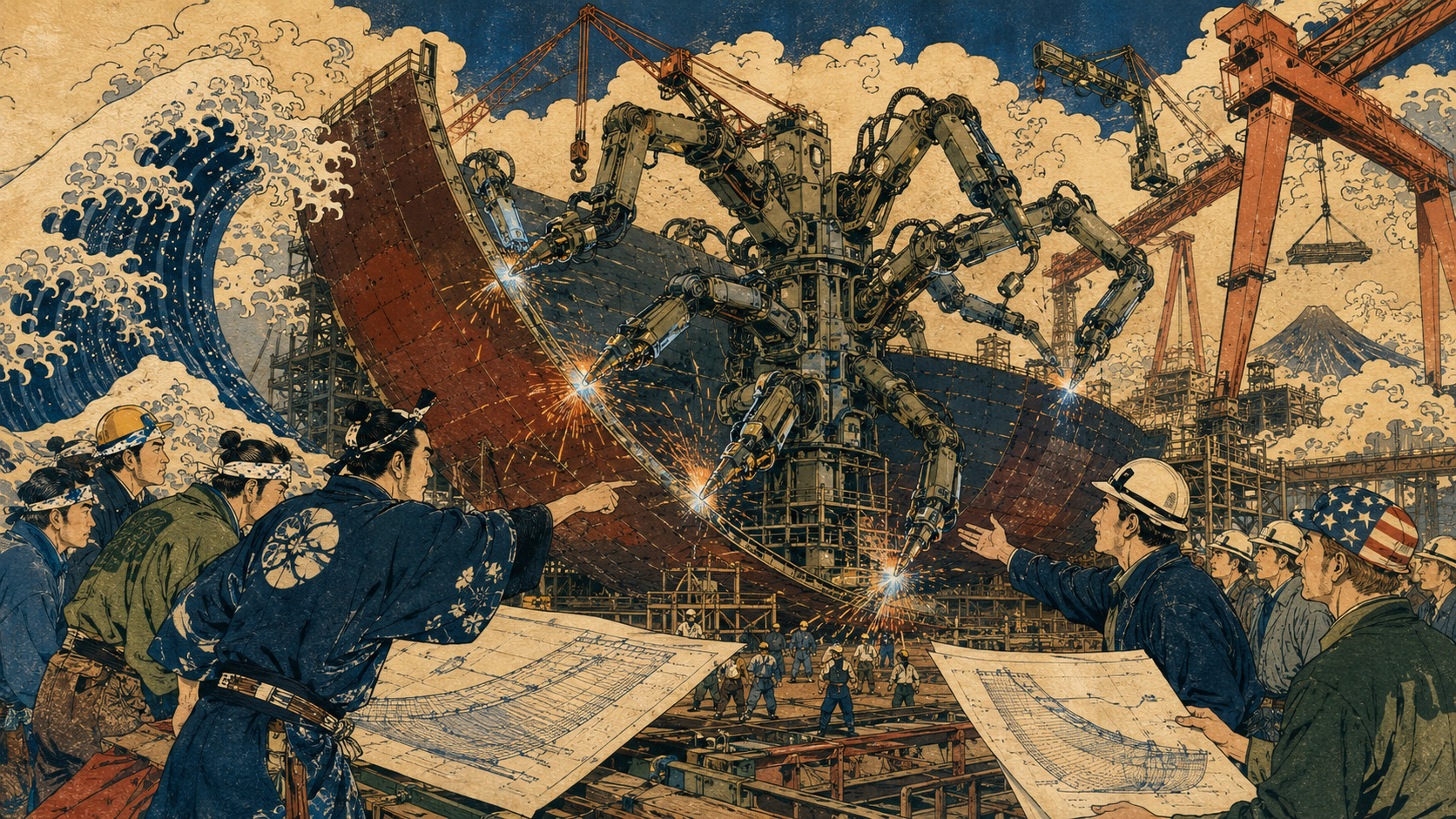
A ship under construction is a moving target made of steel. A design may specify where every pipe, cable tray, pump and electrical box belongs, but the object on the blocks changes hour by hour. Parts arrive late. Crews work out of sequence. A compartment closes. A pipe takes the shortest route—and leaves no passage for the cable that comes next. By the time a conflict is visible to everyone, the remedy may mean cutting out completed work.
The Japan–U.S. team that entered Fukuoka Shipbuilding and Japan Marine United this month is trying to give shipwrights earlier warning. From July 6 to 10, American and Japanese researchers inspected real yard conditions, divided responsibilities and set a goal: establish by the end of March 2027 an AI simulation platform able to ingest actual hull blocks and shipyard environments, then evaluate robot movements and production processes. They also began planning demonstrations in both countries.
Japan’s Ministry of Land, Infrastructure, Transport and Tourism formally announced the collaboration on July 17. The program joins two related efforts. Japanese teams are developing durable robots for plate bending, welding and other hull-construction work. The U.S. arm is building an autonomous “co-pilot” for outfitting—the crowded interior work in which hundreds of thousands of components turn an empty hull into an operating ship. A common simulation layer is meant to test paths, collisions, sensor sightlines and work sequences before a machine meets hot steel.
What has actually been launched
The project sits inside MLIT’s “Technology Development Project Contributing to the Realization of Next-Generation Shipyards through AI Utilization,” funded through the Cabinet Office BRIDGE program, which is intended to carry research toward social implementation. It follows a public solicitation opened in February for AI plate-bending and welding robots, reinforcement-learning methods and a virtual production simulator.
The U.S. simulation team consists of the University of Michigan, the Massachusetts Institute of Technology and the American Bureau of Shipping. The Japanese side includes Osaka University, Yokohama National University, Monohakobi Technology Institute—NYK Line’s R&D center—ClassNK, Namura Shipbuilding, Fukuoka Shipbuilding, MLIT, the National Maritime Research Institute and others. Fukuoka Shipbuilding and Japan Marine United hosted the July visits. Complementary Japanese projects are led by Yokohama National University, Osaka University, Osaka Metropolitan University and NMRI.
There are three numbers that should not be confused. First, the University of Michigan says MLIT awarded the U.S. arm $6.2 million through the first quarter of 2027. Second, official July launch material does not state a total value for the full bilateral portfolio. Third, the October 2025 cooperation memorandum is not a funding appropriation: its text expressly says that it creates no legally binding rights or obligations and commits neither participant to spend money. Earlier press reports describing a prospective $100 million initiative should therefore not be presented as the official cost of the launched project unless a government budget document confirms it.
| Workstream | Principal task | Status in July 2026 |
|---|---|---|
| Hull-construction robots | Use AI and reinforcement learning for plate bending, welding and related repetitive or hazardous work | Research and prototype development; MLIT seeks early practical deployment |
| Outfitting co-pilot | Roam the growing ship, map as-built pipes, cables and equipment, compare them with design and suggest recoveries | U.S.-led design and prototyping under a verified $6.2 million grant |
| Production simulator | Test robot paths, interference, sensor visibility, work order and time in virtual replicas of hull blocks and yards | Platform targeted by the end of March 2027 |
| Shipbuilding Test Block | Provide a reconfigurable physical ship section for training and evaluation across different build states | Planned research testbed, not a commercial vessel |
| Yard demonstrations | Evaluate the tools under Japanese and U.S. site conditions | Methods discussed; production results not yet published |
How the robot co-pilot is supposed to work
The American concept begins with perception. A mobile robot moves through passageways and compartments carrying cameras and LiDAR, which measures distance with pulses of light. Human measurements can be added where sensors cannot see. Software fuses those observations into an “as-built” model—a current digital representation of what has actually been installed—and compares it with the intended design twin.
That comparison is more difficult than finding a red pipe in the wrong location. The software must decide whether a visible difference is an error, an approved field change, incomplete work or bad sensor coverage. It must understand that a small deviation today can block a larger component next week. When it detects a likely conflict, the planned system will offer options and their trade-offs rather than silently changing the design. Workers verify the problem and decide what to do. If confidence is low or a surface is occluded, the system is supposed to say that the evidence is insufficient.
Training data are a bottleneck. Shipyards do not possess internet-scale collections of neatly labelled images showing every possible stage of every ship. The team will therefore simulate the build many times to create synthetic data. Researchers will interview tradespeople in Japan and the United States, translate their reasoning into useful decision structures and test the system on a reconfigurable Shipbuilding Test Block. Michigan is leading robot systems, algorithms, yard collaboration, worker interviews and the test block; MIT is developing multimodal AI and optimization methods.
- Sense: cameras, LiDAR and human measurements capture the changing worksite.
- Reconstruct: software builds a time-stamped as-built model.
- Compare: the model checks design, schedule and installation dependencies.
- Predict: simulation asks whether today’s choice creates tomorrow’s collision, delay or unsafe robot path.
- Advise: the system ranks workable options and exposes uncertainty.
- Decide: responsible workers and engineers approve, reject or modify the response.
Why a shipyard defeats factory-style automation
Automobile plants made industrial robots familiar by controlling the environment. Identical bodies arrive at fixed stations. Jigs hold parts in known positions. Barriers separate fast machines from people. Shipbuilding reverses many of those conditions. The product can be hundreds of metres long, production moves through it, and blocks fabricated in several workshops are joined outdoors or in vast docks. A robot’s workplace may contain heat, glare, welding smoke, dust, vibration, reflective steel, rain, steep ladders, temporary scaffolds and narrow openings.
Ships are built in small series compared with cars. A bulker, LNG carrier, ferry, destroyer and research vessel differ not just in scale but in structure, outfitting density, regulation and customer change. Even sister ships accumulate revisions. A welding arm that thrives on straight seams in a panel line may fail on curved or overhead joints with variable gaps. Plate bending still draws on skilled judgment about how heating, force and springback will change a unique three-dimensional surface.
This explains why the Japanese solicitation couples physical robots with simulation. A virtual environment can let a reinforcement-learning controller try thousands of actions without dropping a tool, striking a worker or damaging a multimillion-dollar block. Yet simulation is only useful when its assumptions match the yard. Friction, distortion, sensor noise and human movement refuse to remain ideal. The project’s July visits were not ceremonial tourism; they were an attempt to discover what a laboratory model leaves out.
Japan’s arc: from production revolution to capacity anxiety
Japan knows what a shipbuilding production revolution can do. Its postwar yards combined welded construction, large prefabricated blocks, improved cranes, flow production, design standardization and disciplined supplier networks. Government finance, export promotion, a strong steel industry and demand from Japanese shipping companies reinforced the system. In 1956 Japan passed Europe to become the world’s largest shipbuilder. MLIT records that it remained number one through 2001 and held more than half of global building volume at its peak.
The apparent permanence dissolved in cycles. The oil shocks collapsed tanker demand. Japan disposed of excess capacity twice, in 1980 and 1988. The yen’s appreciation after the 1985 Plaza Accord tightened margins. South Korea expanded modern, large-scale yards from the 1980s; China accelerated from the 1990s and especially after the 2003 shipping boom. Japanese builders kept improving output at existing facilities, but rivals added docks, labour and capital at a scale that productivity alone could not offset.
The legacy is not failure. Japan retains formidable ship design, marine-equipment, engine, steel, classification, owner and trading-company capabilities. Regional yards remain anchors of skilled employment. Japanese ships built reputations for fuel economy, reliability and delivery discipline. But the national arithmetic is now uncomfortable. Capacity in 2024 was 9.07 million gross tons, while Japanese owners have recently ordered roughly 12 million gross tons a year. Since 2022, MLIT says, China has won about 30–40% of Japanese owners’ orders, up from roughly 10–20% in the latter 2010s.
Japan’s December 2025 revival roadmap seeks 18 million gross tons of annual capacity by 2035—nearly twice the 2024 level—alongside next-generation zero-emission vessels and stronger allied cooperation. A ten-year Shipbuilding Revitalization Fund begins with ¥120 billion in the fiscal 2025 supplementary budget and aims, subject to three-year performance reviews, for roughly ¥350 billion of support over a decade. The roadmap calls for dock and crane investment, consolidation into one to three more integrated groups, workforce development, digital systems, AI and humanoid-robot research. Robotics is therefore one piece of an industrial expansion program, not a substitute for it.
1956 — Japan becomes the world’s largest shipbuilder.
1970s–80s — Its peak share exceeds 50%; oil shocks force capacity adjustment.
1980 and 1988 — Japan conducts two major rounds of excess-equipment disposal.
1985 — Plaza Accord and a stronger yen intensify price pressure.
1980s–2000s — South Korean and then Chinese capacity expands; Japan loses the top rank after 2001.
2016 — MLIT’s i-Shipping agenda promotes digital productivity from design through operation.
December 2025 — Japan adopts a roadmap targeting 18 million gross tons of capacity by 2035.
February–July 2026 — AI-robot solicitation, U.S. grant, yard visits and formal bilateral launch.
America’s arc: the arsenal without a commercial series
The United States carries a different memory. In World War II its yards turned standardized Liberty ships, tankers and warships into an immense logistical advantage. Prefabrication, welding, interchangeable sections, workforce mobilization and repetitive series production compressed schedules. The 2026 U.S. Maritime Action Plan says that more than 70% of oceangoing shipping was U.S.-flagged by 1946.
After the war, high domestic costs, changing subsidies, foreign industrial policy, the rise of containerization and Asian mass production pulled commercial orders abroad. The Jones Act preserved a domestic market for vessels moving cargo between U.S. points, while national-security procurement sustained specialized naval yards. Those markets kept capability alive, but they did not create the long export series that drive learning curves in Asian commercial yards. Today, the Maritime Action Plan says the United States constructs less than 1% of commercial ships globally.
Military output cannot simply be separated from this industrial condition. In April 2026 the U.S. Government Accountability Office reported that Navy and Coast Guard programs had collectively fallen billions of dollars over cost and years behind schedule across two decades. Both services’ builders struggle to recruit, train and retain welders, pipefitters and machinists. In 2025 GAO found none of the seven shipbuilders constructing Navy battle-force ships positioned to meet delivery goals, despite nearly $6 billion in Defense Department industrial-base investment through fiscal 2023.
That evidence is a warning against an AI morality play. The problem is not that American tradespeople forgot how to work or that Japanese yards rejected software. Shipbuilding performance emerges from mature designs, stable orders, supplier depth, facilities, finance, experienced supervision and production learning. A robot can reduce rework; it cannot make a late engine appear, expand a dry dock or stabilize requirements after construction starts.
Why the alliance now
On October 28, 2025, Japan’s transport minister Yasushi Kaneko and U.S. commerce secretary Howard Lutnick signed the memorandum that provides the project’s political frame. It created a working group around five priorities: capacity in both countries; investment in the U.S. maritime industrial base; clearer demand for public and private vessels important to economic security; workforce education; and technological innovation, including AI, robotics and advanced vessel design. It also asks the two countries to explore interoperable technical specifications.
The partnership matches different assets. Japanese yards contribute production knowledge, commercial-vessel experience, equipment makers and physical sites where an algorithm confronts the messiness of real construction. U.S. universities contribute robotics, multimodal learning, optimization and a naval-architecture research base. ABS and ClassNK bring the perspective of classification societies, whose rules and surveys help determine whether designs, materials, welding and systems satisfy safety requirements. Shipowners and shipbuilders contribute the operating and commercial test: whether the tool saves enough time, risk or rework to earn a place in the yard.
The geopolitical backdrop is impossible to miss. USTR says China’s share of global shipbuilding tonnage rose from under 5% in 1999 to more than 50% in 2023. Beijing’s scale reaches steel, cranes, containers, finance, shipowners and logistics—not merely final assembly. Washington’s February 2026 Maritime Action Plan calls for allied-yard cooperation, AI, additive manufacturing, robotics and modular production; Tokyo’s roadmap places U.S. cooperation beside capacity expansion and next-generation ships. Each government sees shipbuilding as both industry and resilience.
But the July research project should not be mislabelled a naval-weapons program. Its announced technical focus is shipyard productivity: hull fabrication, steel welding, outfitting, digital representation and robot planning. The broader memorandum covers economically important public and commercial vessels, and the industrial base has security consequences, but no official launch material says this team is designing a warship or autonomous weapon.
The labour question: extraction or apprenticeship?
“Labour-saving” can mean two very different systems. One strips tasks from workers, intensifies pace and leaves a thin workforce unable to recover when automation fails. The other makes scarce expertise more teachable, removes hazardous repetition and gives less-experienced people better information while preserving authority on the shop floor. Shipbuilding needs the second.
The project’s interviews with Japanese and American tradespeople are therefore central, not decorative. A veteran outfitter may glance at a drawing and know that an apparently valid route will be impossible to weld, inspect or maintain. That judgment is embodied knowledge. Turning it into training data raises questions: Who validates the rule? Does the worker know how it will be used? Can advice learned in one yard be transferred to a competitor? Will management mistake a probabilistic suggestion for a work instruction?
A trustworthy co-pilot should show evidence, alternatives and uncertainty; retain a record of who approved a deviation; and make escalation easier. Safety-critical changes must remain inside engineering control and classification processes. Productivity should be measured alongside injuries, near misses, rework, training time and worker acceptance. If only labour hours fall while error severity or turnover rises, the system has not succeeded.
Data, cyber risk and the problem of two yards
A digital shipyard concentrates sensitive information: complete three-dimensional models, production rates, supplier identities, machinery layouts, vulnerabilities, worker movements and inspection results. A shared Japan–U.S. platform must decide where that information is stored, who may train on it, how proprietary features are removed and whether models can run offline. The University of Michigan team anticipates several configurations—on the robot, on a connected local or remote server, or at an offline workstation—which makes architecture a policy choice as well as a computing choice.
Interoperability is equally difficult. A common platform must translate different computer-aided design formats, part numbers, work breakdown structures, units, safety rules and change-control practices. It must preserve lineage: which drawing revision, scan, algorithm and human decision produced a recommendation. If a model trained on one yard quietly assumes its crane reach, welding process or staging sequence, its confidence in another yard may be false.
For commercial adoption, teams will need clear boundaries around intellectual property and export control, role-based access, segmented networks, signed software updates, sensor calibration, incident response and an audit trail. They will also need a contractual answer to the oldest automation question: when an AI suggestion causes rework or injury, who is responsible—the vendor, integrator, shipyard, designer or approving engineer?
What success should look like by March—and after
The March 2027 milestone is a platform, not an automated national shipbuilding industry. A credible demonstration would load a real hull block and yard environment, navigate with limited human assistance, identify known deviations, flag uncertainty, simulate robot reach and collision, and offer options that experienced workers judge feasible. Results should report false alarms and missed defects as carefully as impressive detections.
| Measure | Useful question | Failure hidden by a showpiece demo |
|---|---|---|
| Perception | What fraction of installed objects is found, localized and classified under smoke, glare and occlusion? | A clean test block is much easier than a live ship |
| Prediction | How early does the system identify a downstream fit or sequence conflict? | Finding a visible error after rework is already necessary |
| Robot planning | Can it produce collision-free, reachable paths with valid sensor sightlines and safe human separation? | A virtual path may fail under real tolerances |
| Production value | Does it reduce rework hours, cycle time and schedule variance across repeated builds? | One successful task does not establish a learning curve |
| Human factors | Do workers understand, trust appropriately and override the system when needed? | High compliance can signal automation bias, not quality |
| Transfer | How much retraining and remodelling are required at a second yard and ship type? | A bespoke tool may never scale |
| Safety and security | Are near misses, access violations and model changes logged and investigated? | Productivity numbers can conceal new hazards |
Beyond the prototype, the hard sequence is integration, qualification and diffusion. Equipment must survive yard conditions. Work instructions and labour agreements must change. Classification and customer acceptance must be secured. Suppliers need service capacity. Smaller regional yards need a business case that does not require the computing budget of a university laboratory. The same tool must create value on the second, fifth and twentieth ship.
- A prototype works repeatedly outside the laboratory.
- It performs in a live yard without creating unacceptable safety risk.
- Workers can understand its confidence and take control.
- Design and classification change-control remain intact.
- Cybersecurity and proprietary data are governed.
- Benefits survive transfer to another yard or vessel class.
- Total savings exceed integration, maintenance, training and downtime costs.
A new production system, not a mechanical miracle
The most seductive image is a dark shipyard alive with tireless humanoids. The official project is more sober and more interesting. It treats perception, planning and human judgment as a connected production system. A rover maps what exists. A digital twin preserves the gap between drawing and reality. Simulation lets specialized robots rehearse. Skilled people decide whether the proposed recovery is safe and buildable.
If that loop works, it could reduce one of shipbuilding’s most punishing costs: discovering complexity too late. It could also make bending and welding less hazardous, carry scarce knowledge into training and help yards learn across projects. For Japan, that supports an attempt to double capacity without assuming the workforce can double. For the United States, it offers a way to rebuild production learning while docks, suppliers and training pipelines catch up.
Yet industrial history counsels humility. Japan won its postwar lead through an ecosystem of finance, steel, standardization, owners, suppliers and relentless shop-floor improvement. America’s wartime yards succeeded through scale, stable designs, vast orders and human mobilization. China’s present advantage is a system of systems. AI can strengthen such a system; it cannot conjure one from a grant.
The July launch matters because it moves alliance language into a yard and sets a near-term technical test. Its success will not be proved by a robot’s dramatic first weld. It will be proved when a second yard builds a second ship with less rework, safer labour and an honest record of what the machine did not know.
Reader guide
| Question | Answer |
|---|---|
| What was announced? | MLIT formally launched joint Japan–U.S. R&D for AI shipbuilding robots and a production-process simulation platform on July 17, after July 6–10 yard visits. |
| What will the U.S. team build? | A robot co-pilot and digital as-built model for outfitting, plus multimodal AI and optimization that detect deviations and propose options. |
| What will Japanese teams build? | Complementary robots for hull construction such as plate bending and welding, along with the shared simulation environment and yard demonstrations. |
| Is the total project worth $100 million? | Not on the public official evidence reviewed. A $6.2 million grant for the U.S. arm is verified; MLIT’s launch notice gives no aggregate total, and the 2025 memorandum commits no funds. |
| Will robots replace shipyard workers? | The announced design is assistive: it flags deviations and offers options for workers to verify and decide. The labour outcome will depend on implementation. |
| Does this build warships? | The announced R&D concerns production technology across shipyards. It has strategic relevance but is not described as a weapons or warship-design project. |
| When will it be operational? | The platform target is March 2027. That is a research milestone; broad commercial deployment has no published date. |
Sources and method
This article distinguishes the official launch, the non-binding 2025 cooperation memorandum, a funded research prototype and eventual commercial deployment. Capacity figures use the latest government documents available on July 22, 2026; “gross tons” measures enclosed volume, not mass. Technical benefits are presented as research objectives unless operating results have been published.
- Japan MLIT: Japan–U.S. Joint R&D on AI Shipbuilding Technologies Launches, July 17, 2026
- Japan MLIT: official English project brief and team list
- University of Michigan Engineering: robot co-pilot, digital twin and $6.2 million grant
- Japan MLIT: 2026 solicitation for AI bending, welding and simulation technology
- Japan–U.S. Memorandum of Cooperation Regarding Shipbuilding, October 28, 2025
- Japan MLIT: Shipbuilding Industry Revitalization Roadmap
- Japan MLIT: latest industry conditions, owner demand, capacity and revitalization fund
- Japan MLIT: i-Shipping strategy and history of Japan’s global shipbuilding position
- White House: America’s Maritime Action Plan, February 2026
- U.S. GAO: Navy and Coast Guard Shipbuilding, April 22, 2026
- USTR: Section 301 shipbuilding findings and global market-share figures
- White House: Executive Order 14269, April 9, 2025