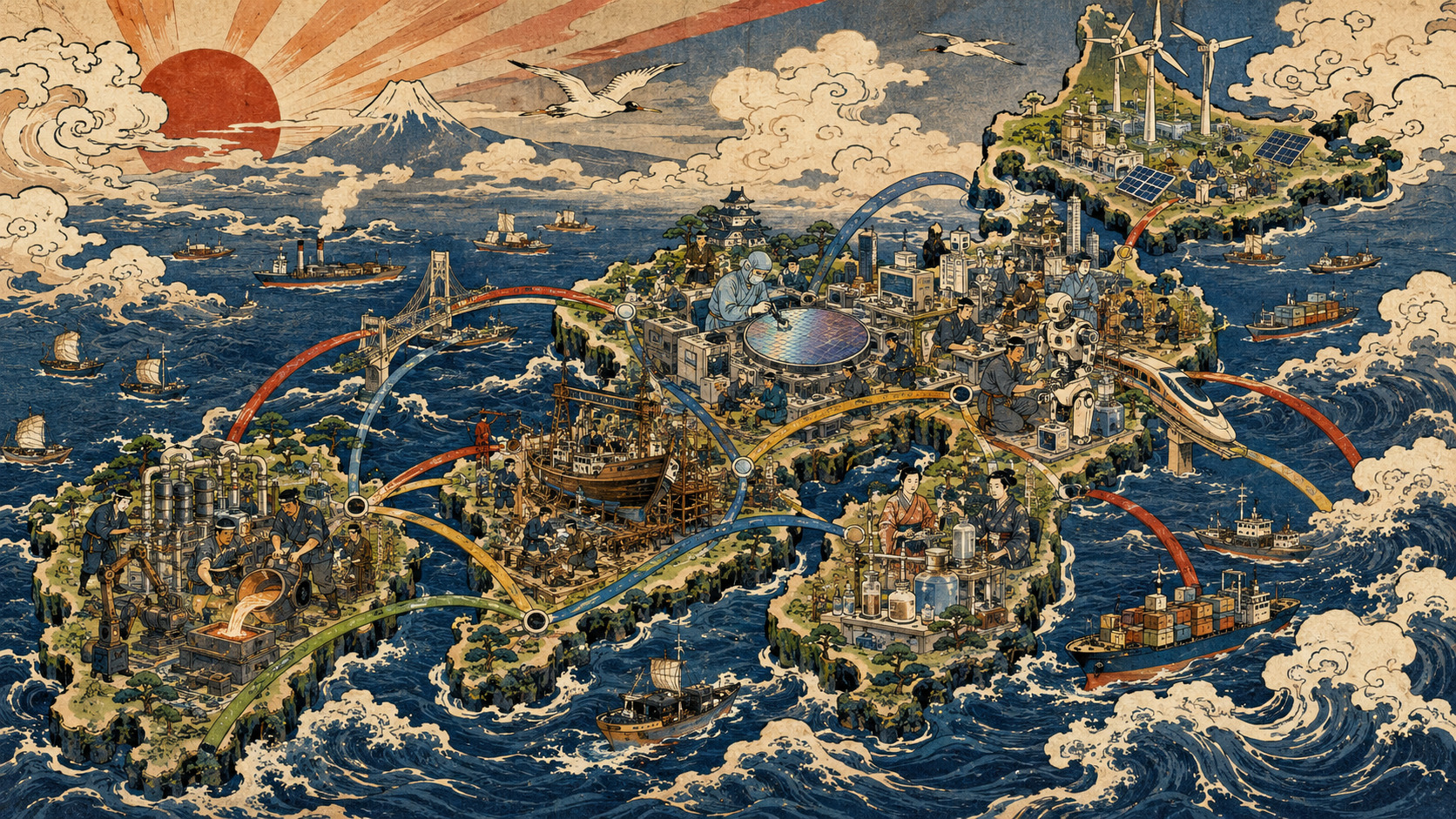
A semiconductor factory is never only a building. Before a single wafer is etched, electricity must arrive without interruption, ultra-clean water must flow in enormous volumes, chemicals must travel safely, engineers must find homes and schools, and hundreds of suppliers must decide that the neighborhood is worth joining. If those links deepen, one investment can alter a region. If they do not, the factory remains an expensive island.
That distinction sits at the center of Japan’s new Regional Future Strategy, adopted by the Cabinet on July 21. Running through fiscal 2030, it proposes regional industrial clusters tied to the 17 strategic fields in the government’s Japan Growth Strategy. The ambition is not merely to place plants outside Tokyo. It is to connect major investment with local suppliers, universities, startups, transport, industrial water, power, housing and trained workers—then convert that machinery into productivity and better pay.
The national growth strategy identifies 62 priority products and technologies across the 17 fields and envisions more than ¥370 trillion in cumulative public and private domestic investment through fiscal 2040. That is a planning ambition, not a ¥370 trillion government appropriation. The difficult questions—how much is genuinely additional, who bears which risk and what reaches local firms—remain to be answered project by project.
A three-storey architecture
The policy is easier to understand as three overlapping maps. At the top are Strategic Industry Cluster Plans, built around major corporate projects in the 17 national fields. They can cross prefectural boundaries and combine investment promotion with roads, rail, ports, industrial water, energy, specialized facilities and workforce programs. Government documents repeatedly point to the semiconductor ecosystems emerging around TSMC in Kumamoto and Rapidus in Hokkaido.
A second layer consists of prefecture-led Regional Industry Cluster Plans. A prefecture identifies sectors and companies with a credible local base, coordinates several municipalities and packages the public support needed to help suppliers expand. The third layer is prefecture- or municipality-led Local Industry Growth Plans, which can build higher value around agriculture and food, tourism, sport, traditional craft and other assets too place-specific to be dictated from Tokyo. The policy groups the latter two types under the broader Regional Industry Growth Plan framework.
| Layer | Typical geography | Purpose | Test of success |
|---|---|---|---|
| Strategic industry cluster | Regional bloc; often multiple prefectures | Build an ecosystem around large projects in the 17 national sectors | Domestic capacity, resilient supply chains and globally competitive output |
| Regional industry cluster | Mostly prefectural | Upgrade local suppliers and connect municipalities, firms and institutions | Productivity, contracts, investment, wages and skilled employment |
| Local industry growth | Municipal to prefectural | Raise value from distinctive food, tourism, culture, sport and craft | Durable local income, entrepreneurship and retained population |
This design acknowledges an old policy error: administrative borders are rarely economic borders. A chip supply chain may run from Hokkaido to Tohoku and Kanto; a shipyard relies on steel, engines, electronics, ports and training institutions spread around a sea. A real cluster is defined by repeated relationships, not by the color of a prefecture on a brochure.
The complete map: all 17 strategic fields
The breadth is deliberate. The government chose fields that can reduce supply-chain risk, win demand abroad or generate technological breakthroughs. Some categories overlap: AI depends on communications and cybersecurity; fusion belongs to energy but has a separate horizon; ports enable shipbuilding, food and critical-mineral supply chains. The overlap can encourage collaboration, but it can also multiply ministries, committees and competing claims on scarce engineers.
| # | Strategic field | What a functioning regional cluster would need |
|---|---|---|
| 1 | AI & semiconductors | Foundries, design, physical-AI robotics, materials and equipment, plus clean power, pure water, data and technicians. |
| 2 | Digital & cybersecurity | Secure cloud and data centers, domestic security services, government and business demand, software talent and trusted procurement. |
| 3 | Information & communications | All-photonics networks, subsea cables, 5G/Beyond 5G and non-terrestrial networks, joined to fiber, landing stations and resilient power. |
| 4 | Quantum | Computing, communications and sensing research, cryogenic equipment, testbeds, specialist education and patient capital. |
| 5 | Defense industry | Trusted suppliers, ships and small drones, dual-use innovation, security controls, testing, procurement visibility and skilled production. |
| 6 | Aviation & space | Aircraft, drones, advanced air mobility, rockets and satellite services supported by ranges, certification, component suppliers and launch infrastructure. |
| 7 | Ocean industries | Marine drones, maritime-domain awareness and seabed technology connected to ports, test waters, sensor networks and marine science. |
| 8 | Shipbuilding | Next-generation and LNG vessels, repair yards, docks, cranes, welding automation, naval architects and a deep component network. |
| 9 | Materials: critical minerals & components | Magnets, advanced metals, green steel, refining, recycling and AI-assisted materials discovery linked to energy and logistics. |
| 10 | Drug discovery & advanced medicine | Drug startups, hospitals and trials, biomanufacturing, regenerative medicine, devices, data and regulatory expertise. |
| 11 | Synthetic biology & biotechnology | Fermentation and biomanufacturing plants, pilot facilities, feedstocks, biological data, research institutions and scale-up finance. |
| 12 | Resources, energy security & GX | Perovskite solar, hydrogen and ammonia, storage, next-generation nuclear, CCS and green materials, all tied to grids, ports and pipelines. |
| 13 | Fusion energy | Plasma science, reactor components, high-performance materials, test facilities and long-horizon capital before commercial demand exists. |
| 14 | Disaster prevention & national resilience | Remote and automated construction, infrastructure inspection, risk data and real-world public procurement as a proving ground. |
| 15 | Port logistics | Automated cargo equipment and warehouses, Cyber Port data, efficient quays, cold chains, power and connections to road and rail. |
| 16 | Food technology | Plant factories, land-based aquaculture, food machinery and new foods backed by water, cold chains, certification and export channels. |
| 17 | Content | Games, anime, manga, music and screen production supported by studios, compute, rights expertise, creators and global distribution. |
No prefecture can—or should—pursue all 17. The economically serious choice is strategic specialization: identify a few fields where accumulated skill, institutions, infrastructure or geography create an advantage, then connect them to complementary regions. A catalog of 47 identical “AI hubs” would be the opposite of a cluster strategy.
From the Pacific Belt to technopolis
Japan has been drawing industrial maps for more than six decades. The first Comprehensive National Development Plan in 1962 used a “development pole” approach while the Pacific Belt of factories and cities drove high growth. The New Industrial Cities system and related laws attempted to distribute basic-material industries—steel, petrochemicals and heavy manufacturing—beyond the largest metropolitan centers.
As machinery and electronics displaced heavy materials as the growth engine, the policy instrument changed. The 1969 and 1977 national development plans stressed dispersal and regional settlement; the 1983 Technopolis Law sought cities where industry, research and good living conditions would coexist. By 1987, the fourth national plan promoted a multipolar country organized around stronger regional core cities.
These programs built roads, industrial parks and institutions. They also exposed a limit of place-based policy: cleared land does not create innovation. Branch plants could arrive without transferring research, purchasing power or decision-making to the region. When cost advantages shifted overseas, communities with thin local supplier and knowledge networks remained vulnerable.
2001: from locating factories to connecting firms
METI’s Industrial Cluster Project, launched in 2001, represented a conceptual turn. Inspired explicitly by Silicon Valley, it designated 19 projects and tried to connect local small and midsize companies with universities, public laboratories, financial institutions and new customers. MEXT’s Knowledge Cluster Initiative, begun in 2002, approached the same problem from research universities and scientific seeds.
By the mid-2000s, METI’s network encompassed roughly 5,800 small and midsize companies and 220 university researchers; the second program period reorganized the 19 projects into 17. Its workshops, coordinators and matching programs recognized that innovation often travels through trust, tacit knowledge and repeated contact rather than through an industrial estate alone.
The record was encouraging but untidy. A later RIETI study matched participant firms to transaction data and found that cluster participation expanded networks, sales and employment. Yet the significant network expansion was especially with firms concentrated in Tokyo, not with local firms in the same region. Earlier reviews also found many prototypes but fewer products generating sustained sales and profit.
That is not a verdict of failure. A local company winning a Tokyo customer can be a major gain. It is a warning about measurement: meetings, members, patents and prototypes are intermediate activity. The economic objective is a firm that sells, hires, raises productivity and can withstand the loss of any one customer.
Kumamoto and Hokkaido: anchors, not finished clusters
In Kyushu, semiconductor production never truly disappeared after the region acquired the nickname “Silicon Island” in the 1970s and 1980s. Image sensors, power chips, equipment, chemicals and engineering skill remained. TSMC’s Kumamoto investment, through Japan Advanced Semiconductor Manufacturing, landed on that base rather than on empty terrain.
The scale has been catalytic. A 2024 Kyushu METI tally counted 108 announced investment and site agreements across seven prefectures, worth more than ¥4.75 trillion; regional integrated-circuit output in 2023 exceeded ¥1 trillion for the first time in 16 years and represented more than half of the national total. Those dated figures should not be confused with completed output from every announced project, but they show why Kumamoto became the policy’s model.
Education is adjusting as well. Government progress reports show Kumamoto University expanding semiconductor-related undergraduate, master’s and doctoral capacity. Roads, industrial water, housing, schools and traffic are under pressure. Competition for technicians has contributed to higher advertised pay—good news for workers, but a shock for smaller employers, hospitals and services that recruit from the same limited labor pool.
Hokkaido begins from a different position. Rapidus chose Chitose in 2023 for its effort to manufacture leading-edge logic chips. The island offers abundant space, renewable-energy potential and research assets, but it lacks Kyushu’s depth of semiconductor suppliers. The regional draft therefore ties semiconductors and AI to green transformation, space, food and tourism while treating logistics, training and supplier formation as part of the industrial project itself.
Both cases demonstrate what an anchor can do: create a reason for suppliers and schools to move faster. They also reveal concentration risk. A region that reorganizes land, water and training around one champion acquires exposure to that company’s technology, schedule and customers. The public task is to use the anchor to create capabilities that remain valuable beyond the anchor.
The unglamorous infrastructure decides the outcome
The new policy is strongest where it admits that industrial policy and regional planning are inseparable. A fab needs power quality and water. A shipyard needs docks, steel logistics and welders. A biotech cluster needs hospitals, laboratories, waste handling and regulatory specialists. A content cluster may depend less on heavy infrastructure but more on affordable workspaces, high-capacity networks, intellectual-property expertise and a city where creators want to live.
Sequencing matters. Announcing a plant before roads, grid connections or housing are ready shifts costs onto residents and existing businesses. Building infrastructure years before credible private demand risks a white elephant. Good cluster governance must synchronize construction, workforce training and supplier commitments while publishing who pays and who receives priority access.
Land, water and electricity also carry political choices. Data centers, fabs and hydrogen projects can compete with households, farms and established industry. Defense and dual-use clusters require security without turning local planning into a black box. Large projects need credible environmental review and resident consent, not merely faster permitting.
- Local depth: suppliers win recurring contracts and upgrade technology, rather than providing only construction and catering.
- Knowledge circulation: engineers move among firms, universities and startups; research reaches production.
- Additionality: reported investment is new, not spending that would have happened elsewhere or a relocation between Japanese regions.
- Shared prosperity: productivity, wages and career paths rise without making housing and essential services inaccessible.
- Durability: capabilities, customers and entrepreneurs remain if an anchor company changes strategy.
The ¥370 trillion question
The headline investment figure gives the strategy scale, but it can obscure three different things: government budgets, private capital expenditure and forecast demand that may never be financed. The published total aggregates public and private investment contemplated for 62 products and technologies through fiscal 2040. It should not be read as money already committed.
The Regional Future Strategy has more immediate instruments. For fiscal 2026, ¥400 billion was placed in local allocation-tax calculations as a Regional Future Fund, and the government has indicated that it will consider further budgets, subsidies, tax and financing support. Yet success cannot be scored by the amount distributed. Subsidies can accelerate learning and compensate for national-security benefits that a single company cannot capture; they can also trigger bidding wars, overcapacity and dependency.
Transparent milestones and exit rules are therefore essential. Support should fall, change or stop when a project repeatedly misses investment, hiring or commercialization targets. Public reporting should separate signed announcements from money spent, temporary construction jobs from lasting employment, and national supply-chain gains from simple shifts between prefectures.
What should be measured by 2030
Japan has enough historical experience to choose better indicators. The useful dashboard is not hectares prepared, companies registered or committees convened. It is follow-on private investment; the share and value of purchases from regional suppliers; supplier productivity; median wages; new products reaching market; exports; startups formed and surviving; research licensed and commercialized; workers trained and retained; housing and commuting pressure; power and water reliability; and resilience when a foreign supplier fails.
Each measure needs a counterfactual. How much investment would have occurred without support? Did one region gain only because another lost the project? Did an anchor’s procurement remain in Tokyo or abroad? Did local graduates obtain durable careers, or were they trained for a single production ramp? Without such questions, a cluster becomes a story told by its beneficiaries.
Evaluation must also respect different clocks. Port automation can be deployed within years; a new medicine faces trials and approval; commercial fusion may take decades. The 17 fields include current earners, the next generation of export industries and speculative growth seeds. One uniform annual target would reward the easiest outputs and punish patient research.
A national strategy that must become local
Regional policy is often described as a remedy for population decline or Tokyo concentration. The 2026 strategy is more ambitious. It treats the regions as the physical sites of national economic security: the places where chips are fabricated, ships repaired, cables land, energy is stored, food is grown, medicines tested and stories created. Japan cannot diversify critical supply chains without also diversifying the geography of productive capacity.
But national urgency does not erase local agency. Prefectures and municipalities know which suppliers are credible, which river basin is stressed, which college can train technicians and which neighborhood cannot absorb another thousand cars. Their job is not to decorate a central wish list. It is to reject poor fits, specialize where advantages are real and negotiate a fair division of costs and gains.
The deepest lesson of Japan’s industrial geography is that infrastructure, institutions and networks must evolve together. The Pacific Belt proved the power of concentration. Technopolis tried to spread high technology. The 2001 project showed that connections matter and also that Tokyo can remain the strongest node inside a “regional” network. TSMC and Rapidus now test whether a large strategic investment can thicken the economy around it.
The colored lines on the new cluster map will mean little if they end at a factory gate. They will matter if they extend into a small supplier’s order book, a university laboratory, a train timetable, a worker’s wage and a startup that did not exist before. That is how a grant becomes an ecosystem—and how a national industrial strategy becomes a regional future.
Reader’s guide
| Question | Answer |
|---|---|
| What changed on July 21? | The Cabinet adopted the Regional Future Strategy through FY2030, including region-by-region industrial clusters linked to the national growth strategy. |
| Are there 17 geographic clusters? | No. There are 17 strategic industry fields. Individual regional plans can select and combine fields suited to their capabilities. |
| Is ¥370 trillion public spending? | No. It is a cumulative public-private domestic investment ambition through FY2040 across 62 priority products and technologies. |
| What are the model cases? | Government documents repeatedly cite the ecosystems forming around TSMC in Kumamoto and Rapidus in Hokkaido. |
| What is the central risk? | Confusing one subsidized facility or a list of participants with a durable network of suppliers, skills, research and customers. |
| What should readers watch? | Detailed regional plans, infrastructure sequencing, funding shares, local procurement, workforce and housing impacts, measurable milestones and exit rules. |
Sources and method
This article distinguishes Cabinet decisions and planning targets from completed investment. Historical outcomes are drawn from official policy reviews and empirical research; figures carry the dates of their underlying documents.
- Cabinet Secretariat: Regional Future Strategy portal
- Cabinet Secretariat: Regional Future Strategy, Cabinet decision of July 21, 2026
- Jiji Press via Nippon.com: adoption and FY2030 horizon
- Cabinet Secretariat: Japan Growth Strategy portal
- Cabinet Secretariat: public-private investment road maps for 17 strategic fields
- Japan Growth Strategy Council: 62 priority products and ¥370tn-plus investment framework
- Cabinet Office: growth and regional-policy package
- Cabinet Secretariat: FY2026 Regional Future Fund and support package
- Hokkaido METI: draft strategic industry cluster plan
- Kyushu METI: semiconductor investment and production data
- METI: semiconductor strategy progress and workforce education
- METI: Rapidus project and Hokkaido ecosystem
- MLIT: historical review of Japan’s regional industrial-development policy
- RIETI: evaluation of the 2000s Industrial Cluster Policy
- RIETI: Second Term Medium-range Industrial Cluster Program